Species · Flowering plants
Sideoats Grama Bouteloua curtipendula
The scientific name of the Sideoats Grama is Bouteloua curtipendula. It is a species of flowering plant in the family Poaceae (turf), order Poales.
- Scientific name
- Bouteloua curtipendula (Michx.) Torr.
- Common name
- Sideoats Grama
- Genus
- Bouteloua
- Family
- Poaceae (Turf)
- Order
- Poales
- Class
- Liliopsida
- Recorded in
- 20 countries
- Name status
- accepted in the Catalogue of Life

Overview
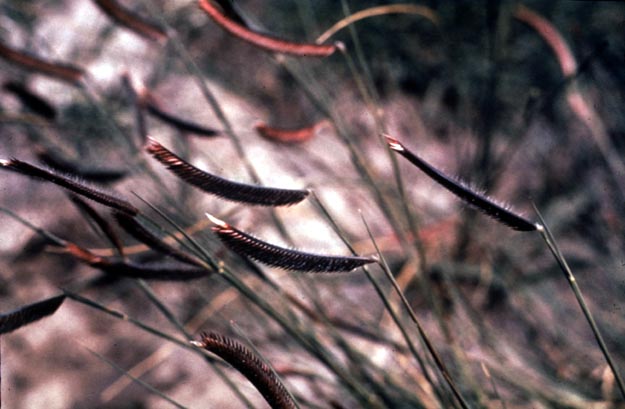
Sideoats grama is a perennial, short prairie grass in the family Poaceae. It is native across the temperate and tropical Western Hemisphere, from Canada to Argentina. Its compact flower spikes are arranged alternately along the upper portion of the flowering stem and often hang to one side.
Written 26 November 2026 from the sources listed below. Each statement was checked against the passage it cites; statements that could not be supported were removed.
Appearance
Sideoats grama has flowering stems 30–100 cm tall. Its alternate leaves are concentrated near the bottom of the stems and are light green to blue-green, reaching up to 6 mm in width.[1][2][3]
Its flowers form compact spikes arranged alternately in a raceme along the upper 15–25 cm of the flowering stem. Each stem bears 10–50 spikes, which often hang to one side.[4][5][6]
Each spike usually contains three to six spikelets, occasionally as many as ten. The spikelets measure 4.5–10 mm in length and consist of two glumes and two florets, one of which is fertile.[7][8][9][10]
During flowering, the fertile florets have orange to brownish-red anthers and feathery white stigmas. The flower spikes can be pale green, pale red, greenish-red, or purple, becoming straw-colored after flowering.[11][12][13]
Habitat
Sideoats grama grows on mountainous plateaus, rocky slopes, and sandy plains. It generally occurs in dry woods in the eastern United States and in dry prairies and sandhills in western states.[14][15][16][17][18]
It is a major component of Great Plains tallgrass prairie and also occurs in mixed-grass prairie, shortgrass steppe, and desert grasslands of the Southwest.[19][20][21]
Its habitats also include ponderosa pine forests, eastern hardwood savannas, southwestern oak and pinyon-juniper woodlands and savannas, and desert and semidesert shrublands.[22][23][24][25]
Behaviour
Sideoats grama is a warm-season grass that tolerates drought and cold conditions.[26][27]
Reproduction and life cycle
Sideoats grama flowers during summer and autumn. Its fertile florets produce seeds, and mature flower spikes fall to the ground when the seeds are ripe.[28][29][30]
Conservation
Sideoats grama is listed as threatened in Michigan and considered endangered in Connecticut.[31][32]
Uses
Sideoats grama is considered suitable forage for livestock and is planted for erosion control.[33][34]
It is cultivated as an ornamental in native-plant and drought-tolerant gardens. It is designated as the state grass of Texas.[35][36]
Classification of the Sideoats Grama
| Kingdom | Plantae |
|---|---|
| Subkingdom | Pteridobiotina |
| Phylum | Tracheophyta |
| Class | Liliopsida |
| Order | Poales |
| Family | Poaceae (Turf) |
| Genus | Bouteloua (Grama) |
| Species | Bouteloua curtipendula (Michx.) Torr. |
Where the Sideoats Grama is found
Checklists and occurrence records place Bouteloua curtipendula in 20 countries across Asia, North America and South America. GBIF holds 27,426 georeferenced records of it.
Countries where it is native or its origin is not stated
- Argentina 448
- Bolivia 73
- Brazil 4
- Canada 444
- Colombia 38
- Costa Rica 28
- Ecuador 97
- El Salvador 3
- Guatemala 9
- Honduras 4
- Mexico 3,886
- Nicaragua 5
- Paraguay 5
- Peru 111
- Uruguay 2
- Venezuela 4
Countries where it has been introduced
Regions and cities with the most records
- Texas, United States 6,816
- New Mexico, United States 1,412
- Arizona, United States 1,410
- Illinois, United States 954
- Minnesota, United States 947
- Colorado, United States 915
- Wisconsin, United States 829
- Kansas, United States 740
- Addison, United States 533
- Iowa, United States 517
- Plano, United States 484
- Fort Worth, United States 481
- White Settlement, United States 450
- Frisco, United States 437
- Benbrook, United States 430
- The Colony, United States 428
- South Dakota, United States 427
- Allen, United States 419
- Richardson, United States 409
- Carrollton, United States 404
- Coahuila, Mexico 398
- Farmers Branch, United States 382
- Haltom City, United States 377
- Austin, United States 356
- The Trails of Frisco, United States 353
- Highland Village, United States 350
- Brushy Creek, United States 342
- Oklahoma, United States 341
- Nebraska, United States 340
- Saginaw, United States 333
- Little Elm, United States 328
- North Richland Hills, United States 328
- Garland, United States 324
- Round Rock, United States 324
- Lewisville, United States 319
- Cedar Park, United States 316
5 more countries have a few records outside this range
These countries hold a few records of Bouteloua curtipendula but lie outside the range the checklists give for it. Such records are often zoo or garden specimens, museum material or vagrants, so the species is not counted as occurring there.
A number beside a place is its count of GBIF occurrence records. A place without a number comes from a checklist alone. Records show where a species has been observed or collected, which can include escapes and vagrants.
Common names
English
- Sideoats Grama
- Side Oats
- Side-oats Grama
- Tall Grama
- Tall Grama Grass
Names in 9 other languages
- Chinese
- 垂穗草
- Finnish
- nuokkugammaheinä
- French
- boutelou élevé, grand boutelou
- Japanese
- アゼガヤモドキ
- Polish
- Butelua groniasta
- Portuguese
- grama-azul
- Spanish
- Banderilla, navajita banderilla
- Swedish
- stort moskitgräs
- nav
- Tł’ohłichi’í
Synonyms
8 other scientific names have been used for this species and are now treated as synonyms of Bouteloua curtipendula.
- Andropogon curtipendulus (Michx.) Spreng.
- Andropogon curtipendulus (Michx.) Steud.
- Atheropogon curtipendulus (Michx.) E.Fourn.
- Bouteloua melicaeformis Hornem. ex Roem. & Schult.
- Chloris curtipendula Michx.
- Cynodon curtipendulus (Michx.) Raspail
- Dinebra curtipendula (Michx.) P.Beauv.
- Eutriana curtipendula (Michx.) Trin.
Subspecies and varieties
- Bouteloua curtipendula var. caespitosa variety
- Bouteloua curtipendula var. curtipendula (Tall Grama) variety
- Bouteloua curtipendula var. tenuis variety
Related species
-
 Blue GramaBouteloua gracilis
-
 Black GramaBouteloua eriopoda
-
 Hairy GramaBouteloua hirsuta
-
 Needle GramaBouteloua aristidoides
-
 Sixweeks GramaBouteloua barbata
-
 Slender GramaBouteloua repens
-
 Red GramaBouteloua trifida
- Gypsum GramaBouteloua breviseta
Compare
Questions and answers
What is the scientific name of the Sideoats Grama?
The scientific name of the Sideoats Grama is Bouteloua curtipendula. Written with its author, the full name is Bouteloua curtipendula (Michx.) Torr..
Which family does the Sideoats Grama belong to?
Bouteloua curtipendula belongs to the family Poaceae, in the order Poales and the class Liliopsida.
Where is the Sideoats Grama found?
Checklists and occurrence records place Bouteloua curtipendula in 20 countries, including Mexico, Argentina, Canada, Peru, Ecuador and Bolivia.
What other names does the Sideoats Grama have?
Bouteloua curtipendula is also known in English as Side Oats, Side-oats Grama, Tall Grama and Tall Grama Grass.
Does sideoats grama spread?
Its roots may spread laterally 1–1.5 feet within the upper 2–4 inches of soil.[37]
What is the native range of Bouteloua curtipendula?
It is native across the temperate and tropical Western Hemisphere, from Canada to Argentina.[38]
Is bouteloua a warm season grass?
Sideoats grama is a warm-season grass.[26]
Sources
Passages the profile rests on
- Its flowering stems are 30–100 cm tall. Source passage: “The culms (flowering stems) are 30–100 cm (12–39 in) tall” — English Wikipedia
- Its alternate leaves are concentrated near the bottom of the flowering stems. Source passage: “have alternate leaves that are concentrated at the bottom of the culm.” — English Wikipedia
- Its leaves are light green to blue-green and reach up to 6 mm in width. Source passage: “The leaves are light green to blue-green in color, and up to 6 mm (1⁄4 in) across.” — English Wikipedia
- Its flowers form compact spikes arranged alternately in a raceme along the upper 15–25 cm of the flowering stem. Source passage: “They consist of compact spikes that hang alternately in a raceme along the top 15 to 25 cm (6 to 10 in) of the culm.” — English Wikipedia
- Its flower spikes often hang to one side of the stem. Source passage: “The spikes often fall to one side of the stem, which gives the plant its name.” — English Wikipedia
- Each flowering stem bears 10–50 spikes. Source passage: “There are 10–50 spikes per culm” — English Wikipedia
- Each spike usually contains three to six spikelets, although it can occasionally contain as many as ten. Source passage: “in each spike there are three to six spikelets, or rarely as many as 10.” — English Wikipedia
- Its spikelets measure 4.5–10 mm in length. Source passage: “Each spikelet is 4.5 to 10 mm (3⁄16 to 13⁄32 in) long” — English Wikipedia
- Each spikelet consists of two glumes and two florets. Source passage: “and consists of two glumes and two florets.” — English Wikipedia
- One floret in each spikelet is fertile. Source passage: “One of the florets is fertile” — English Wikipedia
- The fertile florets have orange to brownish-red anthers and feathery white stigmas during flowering. Source passage: “has colorful orange to brownish red anthers and feathery white stigmas during the blooming period” — English Wikipedia
- Its flower spikes can be pale green, pale red, greenish-red, or purple. Source passage: “the pale green, pale red, greenish-red, or purple color of the spikes themselves.” — English Wikipedia
- Its spikes become straw-colored after flowering. Source passage: “After blooming, the spikes become straw-colored.” — English Wikipedia
- The species grows on mountainous plateaus. Source passage: “Sideoats grama grows well on mountainous plateaus, rocky slopes, and sandy plains.” — English Wikipedia
- The species grows on rocky slopes. Source passage: “Sideoats grama grows well on mountainous plateaus, rocky slopes, and sandy plains.” — English Wikipedia
- The species grows on sandy plains. Source passage: “Sideoats grama grows well on mountainous plateaus, rocky slopes, and sandy plains.” — English Wikipedia
- The species generally occurs in dry woods in the eastern United States. Source passage: “Sideoats grama generally occurs in dry woods in the eastern United States” — fs.usda.gov
- The species generally occurs in dry prairies and sandhills in western states. Source passage: “in dry prairies and sandhills in the western states” — fs.usda.gov
- The species is a major component of Great Plains tallgrass prairie. Source passage: “It is a major species in grasslands of the Great Plains, including tallgrass prairie” — fs.usda.gov
- The species occurs in mixed-grass prairie and shortgrass steppe. Source passage: “mixed-grass prairie and shortgrass steppe” — fs.usda.gov
- The species occurs in desert grasslands of the Southwest. Source passage: “and in desert grasslands of the Southwest” — fs.usda.gov
- The species also occurs in ponderosa pine forests. Source passage: “Sideoats grama is also found in ponderosa pine (Pinus ponderosa) forests” — fs.usda.gov
- The species occurs in eastern hardwood savannas. Source passage: “eastern hardwood savannas” — fs.usda.gov
- The species occurs in southwestern oak and pinyon-juniper woodlands and savannas. Source passage: “southwestern oak (Quercus spp.) and pinyon-juniper (Pinus-Juniperus spp.) woodlands and savannas” — fs.usda.gov
- The species also occurs in desert and semidesert shrublands. Source passage: “and desert and semidesert shrublands” — fs.usda.gov
- The species is a warm-season grass. Source passage: “Sideoats grama is a warm-season grass.” — English Wikipedia
- The species tolerates drought and cold conditions. Source passage: “It is drought- and cold-tolerant” — English Wikipedia
- The species flowers during summer and autumn. Source passage: “The flowers bloom in summer and autumn.” — English Wikipedia
- Its fertile florets produce seeds. Source passage: “The fertile florets produce seeds” — English Wikipedia
- Its mature flower spikes fall to the ground when the seeds are ripe. Source passage: “and when they are ripe, the spikes fall to the ground.” — English Wikipedia
- The species is listed as threatened in Michigan. Source passage: “It is currently listed as a threatened species in the U.S. state of Michigan.” — English Wikipedia
- The species is considered endangered in Connecticut. Source passage: “It is considered as an endangered species in Connecticut.” — English Wikipedia
- The species is considered suitable forage for livestock. Source passage: “Sideoats grama is considered a good foraging grass for livestock.” — English Wikipedia
- The species is planted for erosion control. Source passage: “It is planted for erosion control.” — English Wikipedia
- The species is cultivated as an ornamental in native-plant and drought-tolerant gardens. Source passage: “It is cultivated as an ornamental plant for native plant and drought-tolerant gardens.” — English Wikipedia
- The species is designated as the state grass of Texas. Source passage: “Sideoats grama is the state grass of Texas.” — English Wikipedia
- Its roots may spread laterally 1–1.5 feet within the upper 2–4 inches of soil. Source passage: “spread laterally 1 to 1.5 feet (0.3-0.5 m) in the top 2 to 4 inches (5-10 cm) of soil” — fs.usda.gov
- The species is native across the temperate and tropical Western Hemisphere, from Canada to Argentina. Source passage: “is native throughout the temperate and tropical Western Hemisphere, from Canada south to Argentina.” — English Wikipedia
Data
- Catalogue of Life, 2026-10-16 XR cc by
- Global Biodiversity Information Facility CC BY 4.0
- Wikidata CC0
- GeoNames CC BY 4.0
- Wikimedia Commons per image; credit shown with each image
- Within the Catalogue of Life, this name comes from The World Checklist of Vascular Plants (WCVP) cc by
References
- R.B.Marcy, Explor. Red River Louisiana: 300 (1853) where the name was published
This species in other databases
Page built on 27 November 2026. See how the catalog is made and all sources and licences.
Cite this page
ScientificNames.org. (2026). Bouteloua curtipendula (Sideoats Grama). Retrieved November 27, 2026, from https://scientificnames.org/species/bouteloua-curtipendula
“Bouteloua curtipendula (Sideoats Grama).” ScientificNames.org, 2026, scientificnames.org/species/bouteloua-curtipendula. Accessed 27 Nov. 2026.
ScientificNames.org. “Bouteloua curtipendula (Sideoats Grama).” Accessed November 27, 2026. https://scientificnames.org/species/bouteloua-curtipendula.
@misc{scientificnames_bouteloua_curtipendula_sideoats_grama,
  author = {{ScientificNames.org}},
  title = {Bouteloua curtipendula (Sideoats Grama)},
  year = {2026},
  url = {https://scientificnames.org/species/bouteloua-curtipendula},
  note = {Accessed 2026-11-27}
}