Species · Insects
Brachagenius lugubris
Brachagenius lugubris has no English name on record in the checklists used here. It is a species of insect in the family Scarabaeidae (dung beetles), order Coleoptera. The name dates from 1888.
- Scientific name
- Brachagenius lugubris (Péringuey, 1888)
- Genus
- Brachagenius
- Family
- Scarabaeidae (Dung Beetles)
- Order
- Coleoptera
- Class
- Insecta
- Recorded in
- 1 country
- Name status
- accepted in the Catalogue of Life
Overview
The species occurs in South Africa's Western Cape. Males have black bodies with rufescent-brown wing covers, while females are entirely black and have conspicuous sub-velvety markings on the elytra.
Written 28 November 2026 from the sources listed below. Each statement was checked against the passage it cites; statements that could not be supported were removed.
Appearance
Adult males have black bodies and rufescent-brown wing covers, each bearing a black, sub-velvety discoidal patch. Their heads and clypei are deeply punctured and covered with moderately dense, long, yellowish hairs.[1][2]
The male pronotum has a shagreened surface with partly appressed, long, relatively sparse yellowish hairs. The scutellum is roughly punctured and lacks hairs.[3][4]
The male elytra bear a row of short, evenly spaced, upright black bristles. The propygidium is only partly concealed by the elytra.[5][6]
The pygidium is triangular, vertical, and slightly convex, with its upper portion overhung by the elytra.[7]
Females are entirely black and have a conspicuous sub-velvety discoidal band on each side of the elytra. Their pronotum resembles that of males but has long, bristly hairs along its sides.[8][9]
Adults measure approximately 9–11 mm in length.[10]
Classification of Brachagenius lugubris
| Kingdom | Animalia |
|---|---|
| Phylum | Arthropoda |
| Subphylum | Hexapoda |
| Class | Insecta (Insect) |
| Order | Coleoptera (Beetle) |
| Suborder | Polyphaga |
| Series | Staphyliniformia |
| Superfamily | Scarabaeoidea |
| Family | Scarabaeidae (Dung Beetles) |
| Subfamily | Cetoniinae |
| Tribe | Trichiini |
| Genus | Brachagenius |
| Species | Brachagenius lugubris (Péringuey, 1888) |
Where Brachagenius lugubris is found
Checklists and occurrence records place Brachagenius lugubris in 1 country. GBIF holds 7 georeferenced records of it.
Countries
Range as the checklists state it
Afrotropical(Republic South Africa:Western Cape)
A number beside a place is its count of GBIF occurrence records. A place without a number comes from a checklist alone. Records show where a species has been observed or collected, which can include escapes and vagrants.
Synonyms
One other scientific name has been used for this species and is now treated as a synonym of Brachagenius lugubris.
- Stegopterus lugubris Péringuey, 1888
Related species
- Brachagenius oculatus
- Brachagenius pictipennis
-
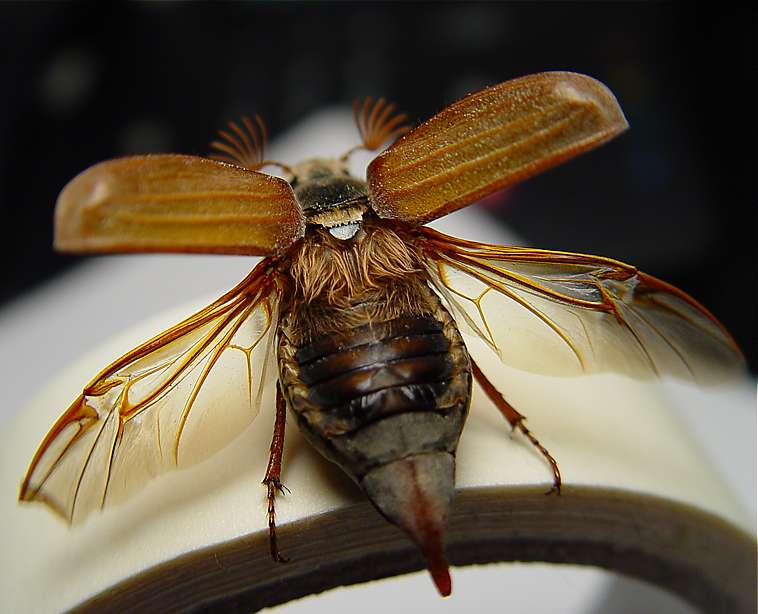 CockchaferMelolontha melolontha
-
 Hercules BeetleDynastes (Dynastes) hercules
-
 Japanese BeetlePopillia japonica
-
 Japanese Rhinoceros BeetleTrypoxylus dichotomus
-
 Sacred ScarabScarabaeus sacer
-
 Figeater BeetleCotinis (Cotinis) mutabilis
Compare
Sources
Passages the profile rests on
- Adult males have black bodies with rufescent-brown wing covers bearing a black, sub-velvety discoidal patch on each side. Source passage: “Males are black, with the elytra rufescent-brown, and on each side a discoidal, black, sub-velvety patch.” — English Wikipedia
- The head and clypeus of males are deeply punctured and covered with moderately dense, long, yellowish hairs. Source passage: “The head and clypeus are deeply punctured and clothed with moderately dense, long, flavescent hairs.” — English Wikipedia
- The male pronotum has a shagreened surface and partly appressed, long, relatively sparse yellowish hairs. Source passage: “The pronotum is shagreened and clothed with partly appressed, long, but not very dense, flavescent hairs.” — English Wikipedia
- The male scutellum is roughly punctured and lacks hairs. Source passage: “The scutellum is scabrosely punctate and glabrous” — English Wikipedia
- The male elytra bear a row of short, evenly spaced, upright black bristles. Source passage: “the elytra have a series of short, equidistant, erect, black setae.” — English Wikipedia
- The male propygidium is only partly concealed by the elytra. Source passage: “The propygidium is only partly covered by the elytra” — English Wikipedia
- The pygidium is triangular, vertical, and slightly convex, with its upper portion overhung by the elytra. Source passage: “their apical edge overhangs the triangular, vertical, but slightly convex pygidium.” — English Wikipedia
- Females are entirely black and have a conspicuous sub-velvety discoidal band on each side of the elytra. Source passage: “Females are completely black, and have the sub-velvety discoidal band on each side of the elytra always conspicuous.” — English Wikipedia
- The female pronotum resembles the male pronotum but has long, bristly hairs along its sides. Source passage: “The pronotum is like that of the males, but with long, bristly hairs laterally.” — English Wikipedia
- Adults measure approximately 9–11 mm in length. Source passage: “Adults reach a length of about 9–11 mm (0.35–0.43 in).” — English Wikipedia
Data
- Catalogue of Life, 2026-10-16 XR cc by
- Global Biodiversity Information Facility CC BY 4.0
- Wikidata CC0
- GeoNames CC BY 4.0
- Within the Catalogue of Life, this name comes from World Scarabaeidae Database cc by
References
- Evans, A. (1987). A new species of the genus Brachagenius Kraatz (=Xiphoscelidus Péringuey syn.nov.) with notes on the synonymy of Elpidus Hopei (Burmeister) (Coleoptera: Scarabaeidae: Trichiinae). Journal of the Entomological Society of Southern Africa 50(2):351-356. https://archive.org/download/cb22328f4fde34160ebeca910320241b20cea483/cb22328f4fde34160ebeca910320241b20cea483.pdf Link where the name was published
This species in other databases
Page built on 29 November 2026. See how the catalog is made and all sources and licences.
Cite this page
ScientificNames.org. (2026). Brachagenius lugubris. Retrieved November 29, 2026, from https://scientificnames.org/species/brachagenius-lugubris
“Brachagenius lugubris.” ScientificNames.org, 2026, scientificnames.org/species/brachagenius-lugubris. Accessed 29 Nov. 2026.
ScientificNames.org. “Brachagenius lugubris.” Accessed November 29, 2026. https://scientificnames.org/species/brachagenius-lugubris.
@misc{scientificnames_brachagenius_lugubris,
  author = {{ScientificNames.org}},
  title = {Brachagenius lugubris},
  year = {2026},
  url = {https://scientificnames.org/species/brachagenius-lugubris},
  note = {Accessed 2026-11-29}
}