Species · Reptiles
Central Fijian Banded Iguana Brachylophus bulabula
The scientific name of the Central Fijian Banded Iguana is Brachylophus bulabula. It is a species of reptile in the family Iguanidae (iguanas), order Squamata. The name dates from 2008.
- Scientific name
- Brachylophus bulabula Fisher, Harlow, Edwards & Keogh, 2008
- Common name
- Central Fijian Banded Iguana
- Genus
- Brachylophus
- Family
- Iguanidae (Iguanas)
- Order
- Squamata
- Class
- Reptilia
- Red List category
- EN Endangered
- Recorded in
- 2 countries
- Name status
- accepted in the Catalogue of Life

Overview
Brachylophus bulabula is endemic to the Fijian islands of Ovalau, Kadavu, and Viti Levu. It has green coloration, sex-specific stripe patterns, and short spiny crests along its back.
Written 26 November 2026 from the sources listed below. Each statement was checked against the passage it cites; statements that could not be supported were removed.
Appearance
Males are green with blue stripes, whereas females are green with white stripes. The species has short spiny crests along its back.[1][2]
The species can reach a total length of 2 feet.[3]
Habitat
The species occurs in Fijian wet forest. It is typically found on tropical wet islands at elevations of 650–1,700 feet above sea level.[4][5]
The species basks at temperatures between 75 and 95 °F (24–35 °C).[6]
Diet
The species is primarily herbivorous and eats leaves, fruit, and flowers from trees and shrubs. It particularly feeds on hibiscus flowers from the Vau tree (Hibiscus tiliaceus).[7][8][9]
Bananas and papayas are among the fruits consumed by the species. When preferred fruits are scarce, individuals may forage for leaves and other native plant species.[10][11]
Hatchlings may consume insects, although adults usually do not.[12]
Behaviour
Males attract potential mates by repeatedly extending and flicking their tongues. They also perform rhythmic head-bobbing movements to attract mates.[13][14]
Reproduction and life cycle
Individuals reach reproductive maturity at approximately three to four years of age. Females typically lay clutches containing five to seven eggs.[15][16]
The eggs undergo an incubation period of seven to nine months.[17]
Classification of the Central Fijian Banded Iguana
| Kingdom | Animalia |
|---|---|
| Phylum | Chordata |
| Subphylum | Vertebrata |
| Infraphylum | Gnathostomata |
| Parvphylum | Osteichthyes |
| Megaclass | Tetrapoda |
| Class | Reptilia (Reptile) |
| Order | Squamata (Snakes) |
| Suborder | Iguania (Iguanas) |
| Family | Iguanidae (Iguanas) |
| Genus | Brachylophus (Melanesian Iguanas) |
| Species | Brachylophus bulabula Fisher, Harlow, Edwards & Keogh, 2008 |
Where the Central Fijian Banded Iguana is found
Checklists and occurrence records place Brachylophus bulabula in 2 countries across Oceania. GBIF holds 48 georeferenced records of it.
Countries
Regions and cities with the most records
- Eastern, Fiji 8
- Port-Vila, Vanuatu 5
- Shefa, Vanuatu 4
- Central, Fiji 3
- Lami, Fiji 3
- Nasinu, Fiji 3
- Suva, Fiji 3
Range as the checklists state it
Larger NW islands Fiji (Viti group, including Ovalau,Gau,Kadavu and Viti Levu), Vanuatu
A number beside a place is its count of GBIF occurrence records. A place without a number comes from a checklist alone. Records show where a species has been observed or collected, which can include escapes and vagrants.
Common names
English
- Central Fijian Banded Iguana
- Fiji Banded Iguana
- Fiji Iguana
- Fijian Banded Iguana
Names in 4 other languages
- Arabic
- إغوانة وسط فيجي المخططة
- German
- Kurzkamm-Fidschileguan
- Japanese
- フィジーイグアナ
- Spanish
- Iguana Fijiana
Related species
-
 Fiji Crested IguanaBrachylophus vitiensis
-
 Lau Banded IguanaBrachylophus fasciatus
-
 Gau IguanaBrachylophus gau
-
 Green IguanaIguana iguana
-
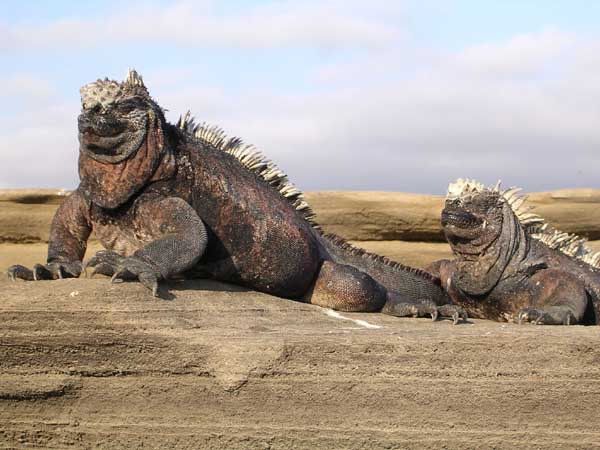 Marine IguanaAmblyrhynchus cristatus
-
 Black Spiny-tailed IguanaCtenosaura similis
-
 Blue IguanaCyclura lewisi
-
 Rhinoceros IguanaCyclura cornuta
Compare
Questions and answers
What is the scientific name of the Central Fijian Banded Iguana?
The scientific name of the Central Fijian Banded Iguana is Brachylophus bulabula. Written with its author, the full name is Brachylophus bulabula Fisher, Harlow, Edwards & Keogh, 2008.
Which family does the Central Fijian Banded Iguana belong to?
Brachylophus bulabula belongs to the family Iguanidae, in the order Squamata and the class Reptilia.
Where is the Central Fijian Banded Iguana found?
Checklists and occurrence records place Brachylophus bulabula in 2 countries: Fiji and Vanuatu.
What is the conservation status of the Central Fijian Banded Iguana?
The IUCN Red List category recorded for Brachylophus bulabula is Endangered (EN).
What other names does the Central Fijian Banded Iguana have?
Brachylophus bulabula is also known in English as Fiji Banded Iguana, Fiji Iguana and Fijian Banded Iguana.
What do Fiji banded iguanas eat?
They are primarily herbivorous and eat leaves, fruit, and flowers from trees and shrubs. Their diet includes hibiscus flowers, bananas, and papayas.[7][8][10][9]
Sources
Passages the profile rests on
- Males are green with blue stripes, whereas females are green with white stripes. Source passage: “Males are typically green with blue stripes and the females are green with white stripes.” — English Wikipedia
- The species has short spiny crests along its back. Source passage: “denoting the short spiny crests along the back of this species.” — English Wikipedia
- The species can reach a total length of 2 feet. Source passage: “They can grow up to 2 feet long” — English Wikipedia
- The species occurs in Fijian wet forest. Source passage: “where it occurs in Fijian wet forest.” — English Wikipedia
- The species is typically found on tropical wet islands at elevations of 650–1,700 feet above sea level. Source passage: “Fijian banded iguana typically are found in tropical wet islands that are typically 650-1700 feet above sea level.” — English Wikipedia
- The species basks at temperatures between 75 and 95 °F (24–35 °C). Source passage: “They also like to bask in temperatures ranging from 75–95 °F (24–35 °C).” — English Wikipedia
- The species is herbivorous and eats leaves, fruit, and flowers from trees and shrubs. Source passage: “Fiji iguanas are herbivorous; they feed on the leaves, fruit, and flowers of trees and shrubs” — English Wikipedia
- The species particularly feeds on hibiscus flowers from the Vau tree (Hibiscus tiliaceus). Source passage: “particularly hibiscus flowers of the Vau tree (Hibiscus tiliaceus)” — English Wikipedia
- The species is primarily herbivorous. Source passage: “These lizards are primarily herbivorous and forage for ...” — nationalzoo.si.edu
- Bananas and papayas are among the fruits consumed by the species. Source passage: “and fruit such as banana and papaya.” — English Wikipedia
- When preferred fruits are scarce, individuals may forage for leaves and other native plant species. Source passage: “When certain fruits are not as abundant, Fiji banded iguanas may also forage for leaves and other native plant species.” — English Wikipedia
- Hatchlings may consume insects, although adults usually do not. Source passage: “Hatchlings may feed on insects; however, adults usually will not.” — English Wikipedia
- Males attract potential mates by repeatedly extending and flicking their tongues. Source passage: “male Fiji banded iguanas will often times stick out their tongues and flick them repeatedly.” — English Wikipedia
- Males perform rhythmic head-bobbing movements to attract mates. Source passage: “They also will bob their heads in a rhythmic way to attract mates.” — English Wikipedia
- Individuals reach reproductive maturity at approximately three to four years of age. Source passage: “Fiji banded Iguanas reach reproductive maturity around 3 or 4 years old.” — English Wikipedia
- Females typically lay clutches containing five to seven eggs. Source passage: “Females will typically lay a clutch of 5–7 eggs” — English Wikipedia
- The eggs undergo an incubation period of seven to nine months. Source passage: “those eggs incubate for 7–9 months.” — English Wikipedia
Data
- Catalogue of Life, 2026-10-16 XR cc by
- Global Biodiversity Information Facility CC BY 4.0
- Wikidata CC0
- GeoNames CC BY 4.0
- Wikimedia Commons per image; credit shown with each image
- Within the Catalogue of Life, this name comes from The Reptile Database cc by
References
- Keogh, Edwards, Fisher and Harlow, 2008 where the name was published
- Keogh JS, Edwards DL, Fisher RN, Harlow PS. (2008). Molecular and morphological analysis of the critically endangered Fijian iguanas reveals cryptic diversity and a complex biogeographic history. Philos Trans R Soc Lond B Biol Sci. 363(1508): 3413-26.
- Kwet, A. (2009). Brachylophus bulabula “Hallo Hallo”, neuer Fidschi-Leguan. Terraria (15) 4 (1): 74.
- Ineich, I. (2009). The terrestrial herpetofauna of Torres and Banks Groups (northern Vanuatu), with report of a new species for Vanuatu. Zootaxa 2198: 1-15.
- Ineich, I. (2011). Amphibians and reptiles. In: Bouchet P., Le Guyader H. & PascaL O. (eds), The Natural History of Santo. pp. 187-236. MNhN, Paris; Ird, Marseille; PNI, Paris. 572 Pp. (Patrimoines Naturels; 70).
- ZUG, G. R. (2013). Reptiles and Amphibians of the Pacific Islands. University of California Press, Berkeley, 306 Pp.
- Buckley, Larry J.; Kevin de Queiroz, Tandora D. Grant, Bradford D. Hollingsworth, John B. Iverson (Chair, Stesha A. Pasachnik, and Catherine L. Stephen (Iguana Taxonomy Working Group, ITWG. (2016). A Checklist of the Iguanas of the World (Iguanidae; Iguaninae). Herp. Cons. Biol. 11 (Monograph 6).
- Cunningham, O. K., & Allain, S. J. R. (2018). A Description of the Successful Hatching of the Fijian Banded Iguana (Brachylophus bulabula) and Observations on Vermiculite Moisture. Captive & Field Herpetology 2 (1): 12-15.
- Scarpetta, Simon G.; Robert N. Fisher, Benjamin R. Karin, Jone B. Niukula, Ammon Corl, Todd R. Jackman, Jimmy A. McGuire. (2025). Iguanas rafted more than 8,000 km from North America to Fiji. Proceedings of the National Academy of Sciences, 122, 12.
- Ali, J. R., & Fritz, U. (2025). New twist to a fantastical distribution: Fiji–Tonga iguanas. Trends in Ecology & Evolution.
This species in other databases
Page built on 29 November 2026. See how the catalog is made and all sources and licences.
Cite this page
ScientificNames.org. (2026). Brachylophus bulabula (Central Fijian Banded Iguana). Retrieved November 29, 2026, from https://scientificnames.org/species/brachylophus-bulabula
“Brachylophus bulabula (Central Fijian Banded Iguana).” ScientificNames.org, 2026, scientificnames.org/species/brachylophus-bulabula. Accessed 29 Nov. 2026.
ScientificNames.org. “Brachylophus bulabula (Central Fijian Banded Iguana).” Accessed November 29, 2026. https://scientificnames.org/species/brachylophus-bulabula.
@misc{scientificnames_brachylophus_bulabula_central_fijian_banded_iguana,
  author = {{ScientificNames.org}},
  title = {Brachylophus bulabula (Central Fijian Banded Iguana)},
  year = {2026},
  url = {https://scientificnames.org/species/brachylophus-bulabula},
  note = {Accessed 2026-11-29}
}