Species · Fishes
Lenok Brachymystax lenok
The scientific name of the Lenok is Brachymystax lenok. It is a species of fish in the family Salmonidae (trouts), order Salmoniformes. The name dates from 1773.
- Scientific name
- Brachymystax lenok (Pallas, 1773)
- Common name
- Lenok
- Genus
- Brachymystax
- Family
- Salmonidae (Trouts)
- Order
- Salmoniformes
- Class
- Teleostei
- Red List category
- LC Least Concern
- Environment
- freshwater
- Recorded in
- 5 countries
- Name status
- accepted in the Catalogue of Life

Overview
Brachymystax lenok (Pallas, 1773), known as Lenok, is a fish in the genus Brachymystax, family Salmonidae, and order Salmoniformes. It occurs across central and eastern Russia, northern Mongolia, northeastern Kazakhstan, northeastern China, and Korea. The sharp-snouted lenok differs from the blunt-snouted lenok through morphological and genetic characteristics and can reach a total length of 70 cm.
Written 26 November 2026 from the sources listed below. Each statement was checked against the passage it cites; statements that could not be supported were removed.
Appearance
The sharp-snouted lenok is distinguished from the blunt-snouted lenok by morphological and genetic differences. It can reach a total length of 70 cm.[1][2]
Habitat
Lenok inhabits clean, fast-flowing mountain streams with low water temperatures. It also occurs in rivers and lakes of the Selenga River and Lake Baikal drainage.[3][4]
The species occurs across central and eastern Russia and is widely distributed in northern Mongolia. It also occurs locally in northeastern Kazakhstan in the Irtysh Basin and in northeastern China in the Amur Basin.[5][6][7][8]
Its Siberian distribution extends from the Ertis–Ob river basin eastward to the Kolyma River and Primorsky Krai in Russia. In China, it inhabits the Heilongjiang River in the northeast and the Ertis River basin in the northwest, while Korea represents the southernmost limit of its distribution.[9][10][11]
Diet
Lenok primarily feeds on benthic invertebrates. Fish prey makes a substantial contribution to its assimilated diet.[12][13]
Behaviour
The species shows high sensitivity to environmental changes.[14]
Reproduction and life cycle
Artificial propagation under controlled conditions is used as a conservation measure for remaining populations in China. Reintroductions of hatchery-bred individuals into natural habitats have achieved limited success.[15][16]
Conservation
Wild populations of Lenok have declined because of habitat loss and overfishing. Some populations, particularly those in China, have declined because of overexploitation and pollution.[17][18]
Wild germplasm resources of the species in China have declined sharply because of climate warming, environmental pollution, and overfishing. The species has been listed as a National Class II Key Protected Wild Animal in China since 2021.[19][20]
Protected areas for the species in South Korea include 2.36 km² in Jeongseon and 24.23 km² in Bonghwa.[21]
Classification of the Lenok
| Kingdom | Animalia |
|---|---|
| Phylum | Chordata |
| Subphylum | Vertebrata |
| Infraphylum | Gnathostomata |
| Parvphylum | Osteichthyes |
| Gigaclass | Actinopterygii |
| Superclass | Actinopteri |
| Class | Teleostei (Teleost) |
| Order | Salmoniformes |
| Family | Salmonidae (Trouts) |
| Subfamily | Salmoninae |
| Genus | Brachymystax (Lenok) |
| Species | Brachymystax lenok (Pallas, 1773) |
Where the Lenok is found
Checklists and occurrence records place Brachymystax lenok in 5 countries. GBIF holds 473 georeferenced records of it.
Countries
Regions and cities with the most records
- Sakha, Russia 198
- Primorye, Russia 100
- Irkutsk Oblast, Russia 11
- Shaanxi, China 11
- Gangwon-do, South Korea 10
- Khabarovsk, Russia 10
- Krasnoyarsk Krai, Russia 7
- Selenge Province, Mongolia 5
- Amur Oblast, Russia 4
- Irkutsk, Russia 4
- Markova, Russia 4
- Shelekhov, Russia 4
- South Hamgyong, North Korea 4
A number beside a place is its count of GBIF occurrence records. A place without a number comes from a checklist alone. Records show where a species has been observed or collected, which can include escapes and vagrants.
Common names
English
- Lenok
- Sharp-snouted Lenok
- Tsinling Lenok
- Tsinling Lenok Trout
Names in 6 other languages
- Chinese
- 秦岭细鳞鲑, 秦嶺細鱗鮭, 細鱗鮭, 细鳞鲑
- Czech
- lenok sibiřský
- German
- Spitznasen-Lenok
- Korean
- 시베리아열목어, 열목어
- Russian
- Ленок, цинлиньский ленок
- Spanish
- Lenok de hocico afilado
Synonyms
7 other scientific names have been used for this species and are now treated as synonyms of Brachymystax lenok.
- Brachymystax coregonoides (Pallas, 1814)
- Brachymystax lenok tsinlingensis Li, 1966
- Brachymystax lenox Pallas, 1773
- Brachymystax tsinlingensis Li, 1966
- Brachymystax tumensis Shedko, 2001
- Salmo coregonoides Pallas, 1814
- Salmo lenok Pallas, 1773
Subspecies and varieties
- Brachymystax lenox swetowidowi subspecies
Related species
-
Brachymystax tumensis
- Large Blue LenokBrachymystax savinovi
-
 Arctic CharSalvelinus alpinus
-
 Sockeye SalmonOncorhynchus nerka
-
 Rainbow TroutOncorhynchus mykiss
-
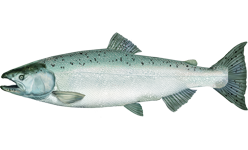 Chinook SalmonOncorhynchus tshawytscha
-
 Atlantic SalmonSalmo salar
-
 Coho SalmonOncorhynchus kisutch
Compare
Questions and answers
What is the scientific name of the Lenok?
The scientific name of the Lenok is Brachymystax lenok. Written with its author, the full name is Brachymystax lenok (Pallas, 1773).
Which family does the Lenok belong to?
Brachymystax lenok belongs to the family Salmonidae, in the order Salmoniformes and the class Teleostei.
Where is the Lenok found?
Checklists and occurrence records place Brachymystax lenok in 5 countries: Russia, South Korea, Mongolia, China and North Korea.
What is the conservation status of the Lenok?
The IUCN Red List category recorded for Brachymystax lenok is Least Concern (LC).
What other names does the Lenok have?
Brachymystax lenok is also known in English as Sharp-snouted Lenok, Tsinling Lenok and Tsinling Lenok Trout.
Sources
Passages the profile rests on
- The sharp-snouted lenok is distinguished from the blunt-snouted lenok by morphological and genetic differences. Source passage: “based on differences in morphology and genetics.” — English Wikipedia
- The sharp-snouted lenok can reach a total length of 70 cm. Source passage: “This species grows to a total length of 70 cm (28 in).” — English Wikipedia
- The species inhabits clean, fast-flowing mountain streams with low water temperatures. Source passage: “B. lenok typically resides in clean, fast-flowing mountain streams with low water temperatures” — pmc.ncbi.nlm.nih.gov
- The species occurs in rivers and lakes of the Selenga River and Lake Baikal drainage. Source passage: “lenok (Brachymystax lenok) are two salmonids which co-occur in lakes and rivers of the Selenga River and Lake Baikal drainage” — hero.epa.gov
- The species occurs across central and eastern Russia. Source passage: “the sharp-snouted lenok is widespread in central and eastern Russia” — English Wikipedia
- The species is widely distributed in northern Mongolia. Source passage: “and also found widely in northern Mongolia” — English Wikipedia
- The species occurs locally in northeastern Kazakhstan in the Irtysh Basin. Source passage: “locally in northeastern Kazakhstan (Irtysh Basin)” — English Wikipedia
- The species occurs in northeastern China in the Amur Basin. Source passage: “and northeastern China (Amur Basin).” — English Wikipedia
- Its Siberian distribution extends from the Ertis–Ob river basin eastward to the Kolyma River and Primorsky Krai in Russia. Source passage: “from the Ertis–Ob river basin eastward to the Kolyma River and Primorsky Krai in Russia” — pmc.ncbi.nlm.nih.gov
- In China, the species inhabits the Heilongjiang River in the northeast and the Ertis River basin in the northwest. Source passage: “In China, B. lenok primarily inhabits the Heilongjiang River in the northeast and the Ertis River basin in the northwest.” — pmc.ncbi.nlm.nih.gov
- Korea represents the southernmost limit of the species' distribution. Source passage: “Korea is considered to be the southernmost limit of this fish” — English Wikipedia
- Lenok primarily feeds on benthic invertebrates. Source passage: “Stomach content analysis indicated that lenok were benthic specialists” — hero.epa.gov
- Fish prey makes a substantial contribution to the assimilated diet of lenok. Source passage: “but also revealed a greater importance of fish prey to lenok diets.” — hero.epa.gov
- The species shows high sensitivity to environmental changes. Source passage: “showing high sensitivity to environmental changes.” — pmc.ncbi.nlm.nih.gov
- Artificial propagation under controlled conditions is used as a conservation measure for remaining populations in China. Source passage: “artificial propagation under controlled conditions has become a crucial measure for conserving the remaining populations.” — pmc.ncbi.nlm.nih.gov
- Reintroductions of hatchery-bred individuals into natural habitats have achieved limited success. Source passage: “multiple attempts to reintroduce hatchery-bred individuals into natural habitats have achieved limited success” — pmc.ncbi.nlm.nih.gov
- Some populations, particularly those in China, have declined because of overexploitation and pollution. Source passage: “some populations, especially in China, have declined due to overexploitation and pollution.” — English Wikipedia
- Wild populations of the species have declined because of habitat loss and overfishing. Source passage: “Populations of both species have declined due to habitat loss and overfishing.” — hero.epa.gov
- Wild germplasm resources of the species in China have declined sharply because of climate warming, environmental pollution, and overfishing. Source passage: “the wild germplasm resources of B. lenok have declined sharply due to climate warming, environmental pollution, and overfishing” — pmc.ncbi.nlm.nih.gov
- The species has been listed as a National Class II Key Protected Wild Animal in China since 2021. Source passage: “It has been listed as a National Class II Key Protected Wild Animal in China since 2021.” — pmc.ncbi.nlm.nih.gov
- Protected areas for the species in South Korea include 2.36 km² in Jeongseon and 24.23 km² in Bonghwa. Source passage: “2.36 km2 in Jeongseon, 24.23 km2 in Bonghwa” — English Wikipedia
Data
- Catalogue of Life, 2026-10-16 XR cc by
- Global Biodiversity Information Facility CC BY 4.0
- Wikidata CC0
- GeoNames CC BY 4.0
- Wikimedia Commons per image; credit shown with each image
- Within the Catalogue of Life, this name comes from World Register of Marine Species cc by
References
- Pallas, Peter S. 1773. [Untitled volume]. [Unspecified Publisher] Vol. 2, No. Parts 1-2: [1-4], 1-744. where the name was published
This species in other databases
- Catalogue of Life MXRW
- Wikidata Q498911
- iNaturalist 620189
- WoRMS urn:lsid:marinespecies.org:taxname:1026966
- ITIS 623479
Page built on 29 November 2026. See how the catalog is made and all sources and licences.
Cite this page
ScientificNames.org. (2026). Brachymystax lenok (Lenok). Retrieved November 29, 2026, from https://scientificnames.org/species/brachymystax-lenok
“Brachymystax lenok (Lenok).” ScientificNames.org, 2026, scientificnames.org/species/brachymystax-lenok. Accessed 29 Nov. 2026.
ScientificNames.org. “Brachymystax lenok (Lenok).” Accessed November 29, 2026. https://scientificnames.org/species/brachymystax-lenok.
@misc{scientificnames_brachymystax_lenok_lenok,
  author = {{ScientificNames.org}},
  title = {Brachymystax lenok (Lenok)},
  year = {2026},
  url = {https://scientificnames.org/species/brachymystax-lenok},
  note = {Accessed 2026-11-29}
}