Species · Mammals
Cuban Fruit-eating Bat Brachyphylla nana
The scientific name of the Cuban Fruit-eating Bat is Brachyphylla nana. It is a species of mammal in the family Phyllostomidae (new world leaf-nosed bats), order Chiroptera. The name dates from 1902.
- Scientific name
- Brachyphylla nana Miller, 1902
- Common name
- Cuban Fruit-eating Bat
- Genus
- Brachyphylla
- Family
- Phyllostomidae (New World Leaf-nosed Bats)
- Order
- Chiroptera
- Class
- Mammalia
- Red List category
- LC Least Concern
- Recorded in
- 7 countries
- Name status
- accepted in the Catalogue of Life

Overview
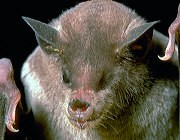
The Cuban Fruit-eating Bat occurs in the Cayman Islands, Cuba, and Hispaniola, including the Dominican Republic and Haiti. It is distinguished by a very small vestigial nose leaf, a V-shaped groove on the lower lip, and coloration ranging from light brown to ivory.
Written 26 November 2026 from the sources listed below. Each statement was checked against the passage it cites; statements that could not be supported were removed.
Habitat
The Cuban Fruit-eating Bat is a cave-dwelling species. In Cuba, it prefers deep caves that are often hot and humid.[1][2]
In Middle Caicos, the species occupies cooler and less humid caves because deep caves are absent there. Cuban colonies have been estimated to contain between 2,000 and 10,000 individuals.[3][4]
Appearance
The Cuban Fruit-eating Bat has a very small vestigial nose leaf. Its lower lip has a V-shaped groove bordered by tubercles, and tubercles also occur on both sides of the upper lip.[5][6][7]
The ears are medium-sized and have a slightly rounded V-shaped upper outline. The species has a well-developed uropatagium and a concealed, vestigial tail.[8][9]
Its coloration typically ranges from light brown to ivory, sometimes with reddish or yellowish tones. The neck, shoulders, and sides are usually grayish-white and paler than the rest of the body, while the underside is brown.[10][11][12]
Diet
The Cuban Fruit-eating Bat is an opportunistic feeder. Its diet includes pollen, seeds, fruit nectar, and insects.[13][14]
Behaviour
Individuals rest in caves during the daytime. They leave their roosts very late in the evening to search for food and return to their cave refuges well before dawn.[15][16][17]
Reproduction and life cycle
The species has separate male and female sexes. Mating begins in October, after which females form maternity colonies.[18][19][20]
During the mating period, colonies may occupy cave sections that are usually uninhabited at other times of the year. Females usually give birth to one infant between December and May.[21][22]
Uses
The Cuban Fruit-eating Bat may contribute to pollination because of its highly variable diet. It may also help control insect populations in some areas.[23][24]
No negative economic impact on humans was reported for this species.[25]
Conservation
The species has been extirpated from the Bahamas and Jamaica. The Animal Diversity Web account reports no special conservation status for the species.[26][27]
Classification of the Cuban Fruit-eating Bat
| Kingdom | Animalia |
|---|---|
| Phylum | Chordata |
| Subphylum | Vertebrata |
| Infraphylum | Gnathostomata |
| Parvphylum | Osteichthyes |
| Megaclass | Tetrapoda |
| Class | Mammalia (Mammal) |
| Subclass | Theria |
| Infraclass | Eutheria |
| Order | Chiroptera (Bat) |
| Suborder | Yangochiroptera |
| Superfamily | Noctilionoidea |
| Family | Phyllostomidae (New World Leaf-nosed Bats) |
| Subfamily | Glossophaginae |
| Tribe | Brachyphyllini (Flower Bats) |
| Subtribe | Brachyphyllina |
| Genus | Brachyphylla (Antillean Fruit-eating Bats) |
| Species | Brachyphylla nana Miller, 1902 |
Where the Cuban Fruit-eating Bat is found
Checklists and occurrence records place Brachyphylla nana in 7 countries across North America. GBIF holds 759 georeferenced records of it.
Countries
- Cayman Islands 29
- Cuba 375
- Dominican Republic 310
- Haiti 14
- Jamaica 7
- Turks and Caicos Islands 19
- U.S. Virgin Islands 5
Regions and cities with the most records
- Barahona Province, Dominican Republic 175
- Sancti Spíritus Province, Cuba 94
- Trinidad, Cuba 67
- Mayabeque, Cuba 48
- San José de las Lajas, Cuba 48
- Jaruco, Cuba 39
- Santiago de Cuba Province, Cuba 38
- Santiago de Cuba, Cuba 34
- Bayaguana, Dominican Republic 33
- Monte Plata Province, Dominican Republic 33
- Yaguajay, Cuba 25
- Ciego de Ávila Province, Cuba 21
- Isla de la Juventud, Cuba 21
- George Town, Cayman Islands 17
- West Bay, Cayman Islands 17
- Cienfuegos, Cuba 15
- Cienfuegos Province, Cuba 15
- Cruces, Cuba 15
- Palmira, Cuba 15
- Baraguá, Cuba 12
- Ciego de Ávila, Cuba 12
- Nueva Gerona, Cuba 12
- Venezuela, Cuba 12
- Alquízar, Cuba 11
- Cumanayagua, Cuba 11
- Guanajay, Cuba 11
- Güira de Melena, Cuba 11
- La Salud, Cuba 11
- San Antonio de los Baños, Cuba 11
- Artemisa, Cuba 10
- Bauta, Cuba 10
- Camagüey, Cuba 10
- Güines, Cuba 10
- Pedernales Province, Dominican Republic 10
- Holguín Province, Cuba 9
- Morón, Cuba 9
Range as the checklists state it
Caribbean
A number beside a place is its count of GBIF occurrence records. A place without a number comes from a checklist alone. Records show where a species has been observed or collected, which can include escapes and vagrants.
Common names
English
- Cuban Fruit-eating Bat
- Cuban Fruit-eating Bat.
- Western Antillean Fruit-eating Bat
Names in 8 other languages
- Czech
- listonos žlutý
- Finnish
- kuubanhedelmäleikko
- French
- Brachyphylle de Cuba
- German
- Kleiner Antillen-Fruchtvampir, Kubanischer Fruchtvampir
- Japanese
- キューバフルーツヘラコウモリ
- Polish
- Rękoliść kubański
- Russian
- Эль-гуамский листонос
- Spanish
- Bracofilo de Cuba
Synonyms
One other scientific name has been used for this species and is now treated as a synonym of Brachyphylla nana.
- Brachyphylla pumilia Miller, 1918
Related species
-
 Antillean Fruit-eating BatBrachyphylla cavernarum
-
 Common Vampire BatDesmodus rotundus
-
 Honduran White BatEctophylla alba
-
 Spectral BatVampyrum spectrum
-
 Hairy-legged Vampire BatDiphylla ecaudata
-
 Big-eared Woolly BatChrotopterus auritus
-
 Seba's Short-tailed BatCarollia perspicillata
-
 Lesser Long-nosed BatLeptonycteris yerbabuenae
Compare
Questions and answers
What is the scientific name of the Cuban Fruit-eating Bat?
The scientific name of the Cuban Fruit-eating Bat is Brachyphylla nana. Written with its author, the full name is Brachyphylla nana Miller, 1902.
Which family does the Cuban Fruit-eating Bat belong to?
Brachyphylla nana belongs to the family Phyllostomidae, in the order Chiroptera and the class Mammalia.
Where is the Cuban Fruit-eating Bat found?
Checklists and occurrence records place Brachyphylla nana in 7 countries, including Cuba, Dominican Republic, Cayman Islands, Turks and Caicos Islands, Haiti and Jamaica.
What is the conservation status of the Cuban Fruit-eating Bat?
The IUCN Red List category recorded for Brachyphylla nana is Least Concern (LC).
What other names does the Cuban Fruit-eating Bat have?
Brachyphylla nana is also known in English as Cuban Fruit-eating Bat. and Western Antillean Fruit-eating Bat.
What is the diet of a fruit bat?
The Cuban Fruit-eating Bat is an opportunistic feeder. Its diet includes pollen, seeds, fruit nectar, and insects.[13][14]
Sources
Passages the profile rests on
- The Cuban fruit-eating bat is a cave-dwelling species. Source passage: “Brachyphylla nana is a cave dwelling species.” — animaldiversity.org
- In Cuba, this species prefers deep caves that are often hot and humid. Source passage: “In Cuba, they prefer deep caves that are often hot and humid.” — animaldiversity.org
- In Middle Caicos, the species occupies cooler and less humid caves because deep caves are absent there. Source passage: “In Middle Caicos, where there are no deep caves, they seem to be more opportunistic in their selection of habitat, and will live in cooler, less humid caves.” — animaldiversity.org
- Cuban colonies have been estimated to contain between 2,000 and 10,000 individuals. Source passage: “Colonies of Brachyphylla nana in Cuba have been estimated to contain between 2,000 and 10,000 individuals.” — animaldiversity.org
- The species has a very small vestigial nose leaf. Source passage: “Brachyphylla nana has a very small vestigial nose leaf.” — animaldiversity.org
- The lower lip has a V-shaped groove bordered by tubercles. Source passage: “a V-shaped groove margined by tubercles” — animaldiversity.org
- Tubercles also occur on the upper lip on both sides of the muzzle. Source passage: “The tubercles also line the portions of the upper lip on either side of the muzzle.” — animaldiversity.org
- The ears are medium-sized and have a slightly rounded V-shaped upper outline. Source passage: “The ears are medium sized, and form a slightly rounded V-shape at the top.” — animaldiversity.org
- The species has a well-developed uropatagium and a concealed, vestigial tail. Source passage: “Brachyphylla nana has a well-developed uropatagium with a concealed, vestigial tail.” — animaldiversity.org
- Its coloration typically ranges from light brown to ivory, sometimes with reddish or yellowish tones. Source passage: “The species is typically light brown to ivory in color with reddish or yellowish tones.” — animaldiversity.org
- The neck, shoulders, and sides are usually grayish-white and paler than the rest of the body. Source passage: “The neck, shoulders and sides are usually paler in color (grayish-white) than the rest of the body” — animaldiversity.org
- The underside of the body is brown. Source passage: “the underside is brown.” — animaldiversity.org
- The Cuban fruit-eating bat is an opportunistic feeder. Source passage: “Brachyphylla nana are known to be opportunistic feeders.” — animaldiversity.org
- Its diet includes pollen, seeds, fruit nectar, and insects. Source passage: “Their diet consists of pollen, seeds, fruit nectar and insects.” — animaldiversity.org
- Individuals rest in caves during the daytime. Source passage: “During the day, Brachyphylla nana rest in caves.” — animaldiversity.org
- Individuals leave their roosts very late in the evening to search for food. Source passage: “They leave their roosts very late in the evening in search of food” — animaldiversity.org
- Individuals return to their cave refuges well before dawn. Source passage: “but return to their refuge well before dawn.” — animaldiversity.org
- The species has separate male and female sexes. Source passage: “gonochoric/gonochoristic/dioecious (sexes separate)” — animaldiversity.org
- Mating in this species begins in October. Source passage: “Mating begins in October.” — animaldiversity.org
- Females form maternity colonies after mating. Source passage: “Females form maternity colonies after mating.” — animaldiversity.org
- During the mating period, colonies may occupy cave sections that are usually uninhabited at other times of the year. Source passage: “During this period, the colony may occupy parts of the cave which typically remain uninhabited during the rest of the year.” — animaldiversity.org
- Females usually give birth to one infant between December and May. Source passage: “Females usually give birth to a single infant between December and May.” — animaldiversity.org
- The species may contribute to pollination because of its highly variable diet. Source passage: “Because of the highly variable diet in this species, they may be good pollinators” — animaldiversity.org
- The species may help control insect populations in some areas. Source passage: “they may help control insect populations in some areas.” — animaldiversity.org
- No negative economic impact on humans was reported for this species. Source passage: “No negative impact on humans was reported.” — animaldiversity.org
- The species has been extirpated from the Bahamas and Jamaica. Source passage: “It has been extirpated from the Bahamas and Jamaica.” — English Wikipedia
- The Animal Diversity Web account reports no special conservation status for the species. Source passage: “No special status was reported for Brachyphylla nana .” — animaldiversity.org
Data
- Catalogue of Life, 2026-10-16 XR cc by
- Global Biodiversity Information Facility CC BY 4.0
- Wikidata CC0
- GeoNames CC BY 4.0
- Wikimedia Commons per image; credit shown with each image
- Within the Catalogue of Life, this name comes from The Integrated Taxonomic Information System cc0
References
- Proc. Acad. Nat. Sci. Phil. vol.54 p.409 where the name was published
- Hall, & Raymond, E. (1981). The Mammals of North America, Vols. I and II, 2nd Ed.
- Wilson, Don E., and DeeAnn M. Reeder, eds. (1993). Mammal Species of the World: A Taxonomic and Geographic Reference, 2nd Ed., 3rd Printing.
- Wilson, Don E., and F. Russell Cole. (2000). Common Names of Mammals of the World.
- Simmons, Nancy B. / Wilson, Don E., and DeeAnn M. Reeder, eds. (2005). Order Chiroptera. Mammal Species of the World: A Taxonomic and Geographic Reference, 3rd Ed., Vols. 1 & 2.
- Wilson, D. E., and R. A. Mittermeier, eds. (2019). Handbook of the Mammals of the World. Vol. 9: Bats.
This species in other databases
Page built on 28 November 2026. See how the catalog is made and all sources and licences.
Cite this page
ScientificNames.org. (2026). Brachyphylla nana (Cuban Fruit-eating Bat). Retrieved November 28, 2026, from https://scientificnames.org/species/brachyphylla-nana
“Brachyphylla nana (Cuban Fruit-eating Bat).” ScientificNames.org, 2026, scientificnames.org/species/brachyphylla-nana. Accessed 28 Nov. 2026.
ScientificNames.org. “Brachyphylla nana (Cuban Fruit-eating Bat).” Accessed November 28, 2026. https://scientificnames.org/species/brachyphylla-nana.
@misc{scientificnames_brachyphylla_nana_cuban_fruit_eating_bat,
  author = {{ScientificNames.org}},
  title = {Brachyphylla nana (Cuban Fruit-eating Bat)},
  year = {2026},
  url = {https://scientificnames.org/species/brachyphylla-nana},
  note = {Accessed 2026-11-28}
}