Species · Birds
Chestnut-collared Longspur Calcarius ornatus
The scientific name of the Chestnut-collared Longspur is Calcarius ornatus. It is a species of bird in the family Calcariidae (longspurs), order Passeriformes. The name dates from 1837.
- Scientific name
- Calcarius ornatus (J. K. Townsend, 1837)
- Common name
- Chestnut-collared Longspur
- Genus
- Calcarius
- Family
- Calcariidae (Longspurs)
- Order
- Passeriformes
- Class
- Aves
- Red List category
- VU Vulnerable
- Environment
- terrestrial
- Recorded in
- 3 countries
- Name status
- accepted in the Catalogue of Life

Overview
Calcarius ornatus breeds in central Canada and the north-central United States and migrates to the southern United States and Mexico during winter. Breeding males have black underparts, a chestnut nape, a yellow throat, and a black crown.
Written 26 November 2026 from the sources listed below. Each statement was checked against the passage it cites; statements that could not be supported were removed.
Appearance
The Chestnut-collared Longspur has a short conical bill, a streaked back, and a white tail with a dark tip. Breeding males have black underparts, a chestnut nape, a yellow throat, and a black crown.[1][2]
Females and non-breeding adults have light brown underparts, a dark crown, brown wings, and a subtle buff-colored facial pattern.[3]
Habitat
The species breeds in shortgrass and mixed-grass prairie habitats, preferring areas where grass height is below one foot. It frequently inhabits land maintained through grazing or controlled burning.[4][5][6]
Livestock pastures and mowed airstrips also provide habitat. Winter habitats include shortgrass prairies and desert grasslands with little or no shrub cover.[7][8]
Diet
The Chestnut-collared Longspur primarily eats seeds. Its summer diet also includes grasshoppers, beetles, and ants.[9][10]
Young birds are fed mainly insects.[11]
Behaviour
The species forages on the ground. Wintering individuals gather in flocks that can contain 50–100 birds.[12][13]
Breeding pairs actively defend their territories against other pairs. Males sing while flying upward during territorial defense.[14][15]
During territorial flight displays, males produce a complex, melodious, descending warbling song. The species also has a distinctive two-syllable call.[16][17]
Reproduction and life cycle
Females lay four or five eggs per clutch. The nest is a grass cup constructed in a shallow scrape on the ground.[18][19]
Both parents feed the young.[20]
Conservation
The Chestnut-collared Longspur is listed as Vulnerable on the IUCN Red List. Its population has experienced a long-term decline of more than 73% to 87% since the 1960s.[21][22]
Conversion of native shortgrass and mixed-grass prairies into agricultural land and towns is the primary driver of population decline. Nest predation and prolonged rainstorms or severe weather events also affect population productivity.[23][24]
Controlled burning may benefit the species by making low-growing food plants easier to spot.[25]
Classification of the Chestnut-collared Longspur
| Kingdom | Animalia |
|---|---|
| Phylum | Chordata |
| Subphylum | Vertebrata |
| Infraphylum | Gnathostomata |
| Parvphylum | Osteichthyes |
| Megaclass | Tetrapoda |
| Class | Aves (Bird) |
| Order | Passeriformes (Passerine) |
| Family | Calcariidae (Longspurs) |
| Genus | Calcarius (Longspur) |
| Species | Calcarius ornatus (J. K. Townsend, 1837) |
Where the Chestnut-collared Longspur is found
Checklists and occurrence records place Calcarius ornatus in 3 countries across North America. GBIF holds 56,222 georeferenced records of it.
Countries
Regions and cities with the most records
- Montana, United States 7,897
- North Dakota, United States 5,894
- Alberta, Canada 4,739
- Arizona, United States 4,674
- Colorado, United States 4,647
- Saskatchewan, Canada 4,499
- New Mexico, United States 3,914
- Texas, United States 3,646
- California, United States 1,991
- South Dakota, United States 1,670
- Manitoba, Canada 1,519
- Wyoming, United States 982
- Oklahoma, United States 979
- Kansas, United States 955
- Nebraska, United States 661
- Chihuahua, Mexico 605
- Great Falls, United States 556
- Coronado, United States 485
- National City, United States 485
- Chula Vista, United States 477
- San Diego, United States 477
- Lemon Grove, United States 471
- Minnesota, United States 331
- La Mesa, United States 301
- Massachusetts, United States 283
- Fitchburg, United States 272
- Leominster, United States 272
- Oregon, United States 255
- Brushy Creek, United States 249
- Cedar Park, United States 223
- Leander, United States 220
- Benbrook, United States 198
- Fremont, United States 197
- Newark, United States 197
- East Palo Alto, United States 195
- San Carlos, United States 192
Range as the checklists state it
Middle America
North America
A number beside a place is its count of GBIF occurrence records. A place without a number comes from a checklist alone. Records show where a species has been observed or collected, which can include escapes and vagrants.
Common names
English
- Chestnut-collared Longspur
- Chestnut-coloured Finch
Names in 30 other languages
- Arabic
- طويل المهماز كستنائي الطوق
- Catalan
- repicatalons pitnegre
- Chinese
- 栗領鐵爪鵐, 栗领铁爪鹀
- Croatian
- crnoprsa strnadica
- Czech
- strnad límcový
- Danish
- Rødnakket Sporeværling
- Dutch
- Amerikaanse IJsgors, Roodhalsgors
- Esperanto
- Brunnuka emberizo, nigraventra kalkario
- Estonian
- mustkõht-tsiitsitaja
- Finnish
- kirjopreeriasirkku
- French
- Bruant à col roux, Plectrophane à ventre noir, bruant à ventre noir
- German
- Gelbkehl-Spornammer, Gelbkehlspornammer, Schmuckammer
- Hungarian
- feketebegyű sarkantyússármány
- Italian
- Zigolo collocastano, Zigolo ornato
- Japanese
- アカエリツメナガホオジロ
- Latvian
- bērkakla stērste
- Lithuanian
- spalvingoji pentinuotoji starta
- Norwegian
- præriespurv
- Persian
- پنجهبلند طوقبلوطی
- Polish
- poświerka czarnobrzucha
- Portuguese
- escrevedeira-de-nuca-ruiva, escrevedeira-de-peito-preto
- Russian
- Украшенный подорожник
- Serbian
- Smeđovrata strnadica ostrugašica
- Slovak
- ostrohárka ozdobená
- Spanish
- Escribano collar castaño, Escribano collarejo
- Swedish
- praktlappsparv
- Turkish
- Kestane Boğazlı Çinte
- Ukrainian
- подорожник чорногрудий
- Welsh
- bras bronddu’r Gogledd
- nav
- Tsídiiłbáhí késhgaaní bitsiiyah halchíʼígíí
Synonyms
One other scientific name has been used for this species and is now treated as a synonym of Calcarius ornatus.
- Plectrophanes ornata Townsend, JK, 1837
Related species
-
 Lapland LongspurCalcarius lapponicus
-
 Smith's LongspurCalcarius pictus
-
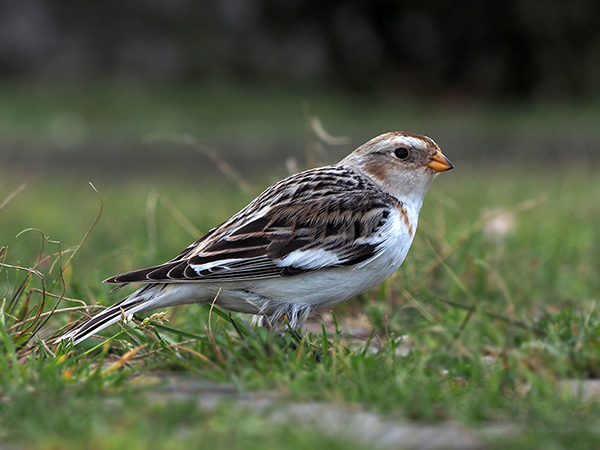 Snow BuntingPlectrophenax nivalis
-
 McKay's BuntingPlectrophenax hyperboreus
-
 Thick-billed LongspurRhynchophanes mccownii
Compare
Questions and answers
What is the scientific name of the Chestnut-collared Longspur?
The scientific name of the Chestnut-collared Longspur is Calcarius ornatus. Written with its author, the full name is Calcarius ornatus (J. K. Townsend, 1837).
Which family does the Chestnut-collared Longspur belong to?
Calcarius ornatus belongs to the family Calcariidae, in the order Passeriformes and the class Aves.
Where is the Chestnut-collared Longspur found?
Checklists and occurrence records place Calcarius ornatus in 3 countries: United States, Canada and Mexico.
What is the conservation status of the Chestnut-collared Longspur?
The IUCN Red List category recorded for Calcarius ornatus is Vulnerable (VU).
What other names does the Chestnut-collared Longspur have?
Calcarius ornatus is also known in English as Chestnut-coloured Finch.
Sources
Passages the profile rests on
- The species has a short conical bill, a streaked back, and a white tail with a dark tip. Source passage: “These birds have a short conical bill, a streaked back and a white tail with a dark tip.” — English Wikipedia
- Breeding males have black underparts, a chestnut nape, a yellow throat, and a black crown. Source passage: “In breeding plumage, the male has black underparts, a chestnut nape, a yellow throat and a black crown.” — English Wikipedia
- Females and non-breeding adults have light brown underparts, a dark crown, brown wings, and a subtle buff-colored facial pattern. Source passage: “Meanwhile, females and non-breeding adult birds have light brown underparts, a dark crown, brown wings and a more subtle, “buff-colored face pattern.”” — English Wikipedia
- The species breeds in shortgrass and mixed-grass prairie habitats. Source passage: “This bird breeds in short and mixed grass prairies in central Canada and the north central United States.” — English Wikipedia
- Breeding habitats are preferred when grass height is below one foot. Source passage: “They prefer areas where grass height is under 1 foot” — English Wikipedia
- The species frequently inhabits land maintained through grazing or controlled burning. Source passage: “frequently inhabit land shaped by grazing or controlled burns.” — English Wikipedia
- Livestock pastures and mowed airstrips provide habitat for the species. Source passage: “today longspurs also rely on livestock pastures and mowed airstrips.” — English Wikipedia
- Winter habitats include shortgrass prairies and desert grasslands with little or no shrub cover. Source passage: “inhabiting shortgrass prairies and desert grasslands with little to no shrub stock or cover.” — English Wikipedia
- The species primarily eats seeds. Source passage: “Their diet consists primarily of seeds” — English Wikipedia
- Its summer diet also includes grasshoppers, beetles, and ants. Source passage: “also eating insects (such as grasshoppers, beetles, and ants) in summer.” — English Wikipedia
- Young birds are fed mainly insects. Source passage: “Young birds are mainly fed insects.” — English Wikipedia
- The species forages on the ground. Source passage: “These birds forage on the ground” — English Wikipedia
- Wintering individuals gather in flocks that can contain 50–100 birds. Source passage: “While wintering flocks are gregarious and can number between 50 and 100 individuals” — English Wikipedia
- Breeding pairs actively defend their territories against other pairs. Source passage: “breeding pairs actively defend their territories from other pairs.” — English Wikipedia
- Males sing while flying upward during territorial defense. Source passage: “The male sings and flies up to defend his territory.” — English Wikipedia
- Males produce a complex, melodious, descending warbling song during territorial flight displays. Source passage: “males deliver a complex, melodious, descending warbling song during their territorial flight displays.” — English Wikipedia
- The species has a distinctive two-syllable call. Source passage: “The call of the chestnut-collared longspur is a distinctive two-syllabled note” — English Wikipedia
- Females lay four or five eggs per clutch. Source passage: “The female lays 4 or 5 eggs” — English Wikipedia
- The nest is a grass cup constructed in a shallow scrape on the ground. Source passage: “in a grass cup nest in a shallow scrape on the ground.” — English Wikipedia
- Both parents feed the young. Source passage: “Both parents feed the young birds.” — English Wikipedia
- The species is listed as Vulnerable on the IUCN Red List. Source passage: “is listed as Vulnerable on the IUCN Red List.” — English Wikipedia
- The species has experienced a long-term population decline of more than 73% to 87% since the 1960s. Source passage: “the species has suffered a steep long-term population decline of over 73% to 87% since the 1960s.” — English Wikipedia
- Conversion of native shortgrass and mixed-grass prairies into agricultural land and towns is the primary driver of population decline. Source passage: “The primary driver of their decline is the conversion of native shortgrass and mixed-grass prairies into agricultural croplands and towns.” — English Wikipedia
- Nest predation and prolonged rainstorms or severe weather events also affect population productivity. Source passage: “Additionally, natural high rates of nest predation and prolonged rainstorms or severe weather events also impact population productivity.” — English Wikipedia
- Controlled burning may benefit the species by making low-growing food plants easier to spot. Source passage: “Controlled burns may benefit this species as they feed on low-growing plants that are more easily spotted after a fire.” — English Wikipedia
Data
- Catalogue of Life, 2026-10-16 XR cc by
- Global Biodiversity Information Facility CC BY 4.0
- Wikidata CC0
- GeoNames CC BY 4.0
- Wikimedia Commons per image; credit shown with each image
- Within the Catalogue of Life, this name comes from The Integrated Taxonomic Information System cc0
References
- J. Acad. Nat. Sci. Philadelphia, 7: 189. 1837 where the name was published
- Banks, R. C., R. W. McDiarmid, and A. L. Gardner. (1987). Checklist of Vertebrates of the United States, the U.S. Territories, and Canada. Resource Publication, No. 166.
- Gill, Frank, & and Minturn Wright. (2006). Birds of the World: Recommended English Names.
This species in other databases
Page built on 29 November 2026. See how the catalog is made and all sources and licences.
Cite this page
ScientificNames.org. (2026). Calcarius ornatus (Chestnut-collared Longspur). Retrieved November 29, 2026, from https://scientificnames.org/species/calcarius-ornatus
“Calcarius ornatus (Chestnut-collared Longspur).” ScientificNames.org, 2026, scientificnames.org/species/calcarius-ornatus. Accessed 29 Nov. 2026.
ScientificNames.org. “Calcarius ornatus (Chestnut-collared Longspur).” Accessed November 29, 2026. https://scientificnames.org/species/calcarius-ornatus.
@misc{scientificnames_calcarius_ornatus_chestnut_collared_longspur,
  author = {{ScientificNames.org}},
  title = {Calcarius ornatus (Chestnut-collared Longspur)},
  year = {2026},
  url = {https://scientificnames.org/species/calcarius-ornatus},
  note = {Accessed 2026-11-29}
}