Species · Birds
Smith's Longspur Calcarius pictus
The scientific name of the Smith's Longspur is Calcarius pictus. It is a species of bird in the family Calcariidae (longspurs), order Passeriformes. The name dates from 1832.
- Scientific name
- Calcarius pictus (Swainson, 1832)
- Common name
- Smith's Longspur
- Genus
- Calcarius
- Family
- Calcariidae (Longspurs)
- Order
- Passeriformes
- Class
- Aves
- Red List category
- LC Least Concern
- Recorded in
- 2 countries
- Name status
- accepted in the Catalogue of Life

Overview
Calcarius pictus breeds in northern Canada and Alaska, winters in the southern United States, and migrates through central and southern Illinois. Breeding males have pumpkin-orange underparts and a black-and-white facial pattern, while all age groups have two white outer tail feathers on each side.
Written 26 November 2026 from the sources listed below. Each statement was checked against the passage it cites; statements that could not be supported were removed.
Appearance
Smith's Longspur has a short, cone-shaped bill, a streaked back, and a dark tail with white outer feathers. The two outer tail feathers on each side are white, and this tail pattern is consistent across all age groups.[1][2][3]
Breeding males have pumpkin-orange throats, napes, and underparts that contrast with a black-and-white facial pattern. They also have a white spot surrounded by black below each eye and conspicuous white lesser wing coverts during spring and early summer.[4][5][6]
Females and immature birds have lightly streaked buff-colored underparts, dark crowns, brown wings, and light-colored faces. Females and nonbreeding males have a few faint breast streaks.[7][8]
The lower side of the bird is light red-brown. Some males have a white patch along the edge of the wing.[9][10]
The species measures 15–17 cm in length and weighs 20–31 g. Its wingspan is approximately 25 cm.[11][12][13]
Habitat
During the breeding season, Smith's Longspur inhabits open grassy areas near the tree line. Its habitats include fields, meadows, grasslands, tundra, and boreal habitats.[14][15]
During winter, the species gathers in open fields, including airports, in the south-central United States. It winters mainly in the southeastern part of the Midwest.[16][17]
During migration through Illinois, the species is commonly found in patches of grasses and weeds within crop fields.[18]
The species breeds in northern Canada and Alaska and winters in the southern United States. It migrates through central and southern Illinois and rarely winters in the southern part of the state.[19][20][21]
Diet
Smith's Longspur primarily feeds on seeds while foraging on the ground. Its diet also includes insects.[22][23]
During summer, the species preferentially consumes insects and spiders when these prey are more available. Young birds are mainly fed invertebrates, including spiders, insects, and snails.[24][25]
Nestlings may also swallow plant material that becomes stuck to their mouths.[26]
Behaviour
Smith's Longspur forages on the ground and gathers in flocks outside the nesting season. It nests in small colonies, and males do not defend territories.[27][28]
The species has a sweet warbling song with an inflected ending. Its call is a dry rattle that is noticeably drier than the call of the Lapland longspur.[29][30]
The species follows an elliptical migration pattern, with spring migrants staging in Illinois and fall migrants crossing the Great Plains. Spring migrants begin appearing in Illinois in early March, while fall migration through Illinois begins in late October.[31][32][33]
Reproduction and life cycle
Females lay three to five eggs in grass cup nests built on the ground. The species exhibits polygynandry, with both males and females potentially having multiple mates.[34][35]
The young are fed by one female and potentially more than one male parent.[36]
Conservation
Smith's Longspur is classified as common and native in Illinois.[37]
Classification of the Smith's Longspur
| Kingdom | Animalia |
|---|---|
| Phylum | Chordata |
| Subphylum | Vertebrata |
| Infraphylum | Gnathostomata |
| Parvphylum | Osteichthyes |
| Megaclass | Tetrapoda |
| Class | Aves (Bird) |
| Order | Passeriformes (Passerine) |
| Family | Calcariidae (Longspurs) |
| Genus | Calcarius (Longspur) |
| Species | Calcarius pictus (Swainson, 1832) |
Where the Smith's Longspur is found
Checklists and occurrence records place Calcarius pictus in 2 countries across North America. GBIF holds 15,814 georeferenced records of it.
Countries
Regions and cities with the most records
- Illinois, United States 1,604
- Oklahoma, United States 1,234
- Alaska, United States 1,222
- Manitoba, Canada 1,193
- Indiana, United States 1,178
- Ontario, Canada 1,150
- Kansas, United States 1,017
- Texas, United States 814
- Missouri, United States 584
- Crawfordsville, United States 555
- Arkansas, United States 549
- Iowa, United States 546
- Massachusetts, United States 407
- Oak Lawn, United States 366
- Alsip, United States 357
- Blue Island, United States 357
- Country Club Hills, United States 356
- Harvey, United States 356
- Homewood, United States 355
- Oak Forest, United States 355
- Tinley Park, United States 353
- Minnesota, United States 349
- Orland Park, United States 349
- Palos Hills, United States 349
- Emporia, United States 338
- Goodings Grove, United States 338
- Homer Glen, United States 338
- Mokena, United States 337
- Park Forest, United States 320
- Matteson, United States 314
- Amherst, United States 304
- Amherst Center, United States 304
- Easthampton, United States 304
- Holyoke, United States 304
- North Chicopee, United States 304
- Northampton, United States 304
Range as the checklists state it
North America
A number beside a place is its count of GBIF occurrence records. A place without a number comes from a checklist alone. Records show where a species has been observed or collected, which can include escapes and vagrants.
Common names
English
- Smith's Longspur
- Buff-breasted Finch
Names in 28 other languages
- Arabic
- طويل المهماز السميثي
- Catalan
- repicatalons de Smith
- Chinese
- 黃腹鐵爪鵐, 黄腹铁爪鹀
- Croatian
- dugonokta strnadica
- Czech
- strnad pestrý
- Danish
- Rustbuget Sporeværling
- Dutch
- Bonte IJsgors
- Esperanto
- tundra kalkario
- Estonian
- tarnatsiitsitaja
- Finnish
- tundrasirkku
- French
- Plectrophane de Smith, bruant de Smith
- German
- Bunt-Spornammer, Goldbauch-Spornammer, Goldbauchspornammer, Smithspornammer
- Hungarian
- fehérszárnyú sarkantyússármány
- Italian
- Zigolo di Smith
- Japanese
- ヒバリツメナガホオジロ
- Latvian
- losā stērste
- Lithuanian
- raštuotoji pentinuotoji starta
- Norwegian
- tundraspurv
- Polish
- poświerka płowa
- Portuguese
- escrevedeira-de-smith, escrevedeira-ocrácea
- Russian
- Расписной подорожник
- Serbian
- Smitova strnadica ostrugašica
- Slovak
- ostrohárka maľovaná
- Spanish
- Escribano de Smith
- Swedish
- tundralappsparv
- Turkish
- Smith Çintesi
- Ukrainian
- подорожник вохристий
- Welsh
- bras Smith
Synonyms
3 other scientific names have been used for this species and are now treated as synonyms of Calcarius pictus.
- Calcarius pictus mersi Kemsies, E, 1961
- Calcarius pictus roweorum Kemsies, E, 1961
- Emberiza picta Swainson, WJ, 1832
Related species
-
 Lapland LongspurCalcarius lapponicus
-
 Chestnut-collared LongspurCalcarius ornatus
-
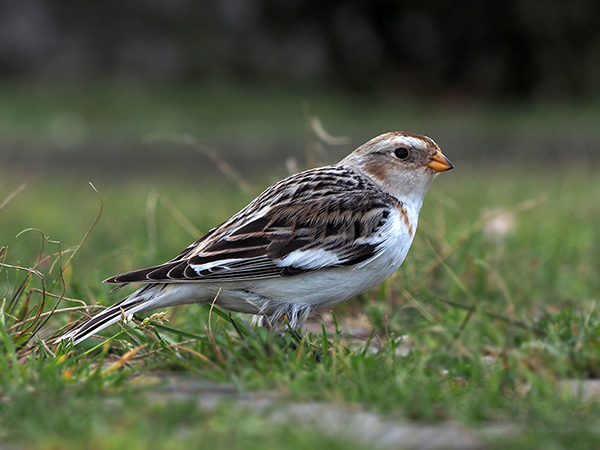 Snow BuntingPlectrophenax nivalis
-
 McKay's BuntingPlectrophenax hyperboreus
-
 Thick-billed LongspurRhynchophanes mccownii
Compare
Questions and answers
What is the scientific name of the Smith's Longspur?
The scientific name of the Smith's Longspur is Calcarius pictus. Written with its author, the full name is Calcarius pictus (Swainson, 1832).
Which family does the Smith's Longspur belong to?
Calcarius pictus belongs to the family Calcariidae, in the order Passeriformes and the class Aves.
Where is the Smith's Longspur found?
Checklists and occurrence records place Calcarius pictus in 2 countries: United States and Canada.
What is the conservation status of the Smith's Longspur?
The IUCN Red List category recorded for Calcarius pictus is Least Concern (LC).
What other names does the Smith's Longspur have?
Calcarius pictus is also known in English as Buff-breasted Finch.
Sources
Passages the profile rests on
- The species has short, cone-shaped bills, streaked backs, and dark tails with white outer tail feathers. Source passage: “These birds have short cone-shaped bills, streaked backs, and dark tails with white outer rectrices.” — English Wikipedia
- The tail pattern is the same across all age groups. Source passage: “The tail is identical at all ages.” — English Wikipedia
- The two outer tail feathers on each side are white. Source passage: “The two outside feathers on each side of the tail are white.” — dnr.illinois.gov
- Breeding males have pumpkin-orange throats, napes, and underparts contrasting with a black-and-white facial pattern. Source passage: “the male has a pumpkin-orange throat, nape, and underparts contrasting with an intricate black-and-white face pattern.” — English Wikipedia
- Male Smith's longspurs have conspicuous white lesser wing coverts during spring and early summer. Source passage: “The white lesser coverts are quite pronounced on a male in spring and early summer.” — English Wikipedia
- Breeding males have a white spot surrounded by black below each eye. Source passage: “The breeding male has a white spot surrounded with black below each eye.” — dnr.illinois.gov
- Females and immature birds have lightly streaked buff-colored underparts, dark crowns, brown wings, and light-colored faces. Source passage: “Females and immatures have lightly streaked buffy underparts, dark crowns, brown wings with less obvious white lesser coverts, and a light-colored face.” — English Wikipedia
- Females and nonbreeding males have a few faint breast streaks. Source passage: “The female and nonbreeding male have a few faint streaks on the breast.” — dnr.illinois.gov
- The lower side of the bird is light red-brown. Source passage: “The lower side of the bird is a light red-brown color.” — dnr.illinois.gov
- Some males have a white patch along the edge of the wing. Source passage: “Some males have a white patch on the edge of the wing.” — dnr.illinois.gov
- The species measures 15–17 cm in length. Source passage: “Length: 15–17 cm (5.9–6.7 in)” — English Wikipedia
- The species weighs 20–31 g. Source passage: “Weight: 20–31 g (0.7–1.1 oz)” — English Wikipedia
- The wingspan is approximately 25 cm. Source passage: “Wingspan: 25 cm (9.8 in)” — English Wikipedia
- The species inhabits open grassy areas near the tree line during its breeding season. Source passage: “This bird breeds in open grassy areas near the tree line in northern Canada and Alaska.” — English Wikipedia
- The species uses fields, meadows, grasslands, tundra, and boreal habitats. Source passage: “Fields, Meadows, and Grasslands, Tundra and Boreal Habitats.” — audubon.org
- During winter, the species gathers in open fields, including airports, in the south-central United States. Source passage: “In winter, they congregate in open fields, including airports, in the south-central United States.” — English Wikipedia
- The species winters mainly in the southeastern part of the Midwest. Source passage: “Most of these birds winter in the southeastern part of the Midwest.” — dnr.illinois.gov
- During migration through Illinois, the species is commonly found in patches of grasses and weeds within crop fields. Source passage: “This species is most often found in patches of grasses and weeds within crop fields during migration.” — dnr.illinois.gov
- The species breeds in northern Canada and Alaska. Source passage: “it breeds in northern Canada and Alaska” — English Wikipedia
- The species winters in the southern United States. Source passage: “and winters in the southern United States.” — English Wikipedia
- The species migrates through central and southern Illinois and rarely winters in the southern part of the state. Source passage: “Smith's longspur migrates through central and southern Illinois and rarely winters in the southern part of the state.” — dnr.illinois.gov
- The species primarily feeds on seeds while foraging on the ground. Source passage: “Primarily a ground-feeding seed-eater, it supplements its diet with insects in the summer.” — English Wikipedia
- Seeds and insects make up the species' diet. Source passage: “Seeds and insects compose the diet.” — dnr.illinois.gov
- The species preferentially consumes insects and spiders during summer when these prey are more available. Source passage: “They mainly eat seeds, but preferentially eat insects and spiders in the summer, when these prey become more available.” — English Wikipedia
- Young birds are mainly fed invertebrates, including spiders, insects, and snails. Source passage: “Young birds are mainly fed invertebrates (spiders, insects, snails)” — English Wikipedia
- Nestlings may also swallow plant material that becomes stuck to their mouths. Source passage: “nestlings may also swallow plant material which becomes stuck to their mouths.” — English Wikipedia
- The species forages on the ground and gathers in flocks outside the nesting season. Source passage: “These birds forage on the ground, gathering in flocks outside of the nesting season.” — English Wikipedia
- The species nests in small colonies, and males do not defend territories. Source passage: “These birds nest in small colonies; males do not defend territory.” — English Wikipedia
- The species has a sweet warbling song with an inflected ending. Source passage: “The song is a sweet warble that is inflected at the end” — English Wikipedia
- Its call is a dry rattle that is noticeably drier than the call of the Lapland longspur. Source passage: “The call is a dry rattle, like a shortened version of the call of a female brown-headed cowbird, noticeably drier than that of Lapland longspur.” — English Wikipedia
- The species follows an elliptical migration pattern, with spring migrants staging in Illinois and fall migrants crossing the Great Plains. Source passage: “Migration is elliptical, with northbound birds staging in Illinois in the spring and southbound birds flying over the Great Plains in the fall.” — English Wikipedia
- Spring migrants begin appearing in Illinois in early March. Source passage: “Spring migrants begin appearing in Illinois in early March.” — dnr.illinois.gov
- Fall migration through Illinois begins in late October. Source passage: “Fall migration commences through the state in late October.” — dnr.illinois.gov
- Females lay three to five eggs in grass cup nests built on the ground. Source passage: “The female lays three to five eggs in a grass cup nest on the ground.” — English Wikipedia
- The species exhibits polygynandry, with both males and females potentially having multiple mates. Source passage: “Both males and females may have more than one mate (polygynandry).” — English Wikipedia
- The young are fed by one female and potentially more than one male parent. Source passage: “The parents, one female and possibly more than one male, feed the young birds.” — English Wikipedia
- The species is classified as common and native in Illinois. Source passage: “Illinois Status: common, native” — dnr.illinois.gov
Data
- Catalogue of Life, 2026-10-16 XR cc by
- Global Biodiversity Information Facility CC BY 4.0
- Wikidata CC0
- GeoNames CC BY 4.0
- Wikimedia Commons per image; credit shown with each image
- Within the Catalogue of Life, this name comes from The Integrated Taxonomic Information System cc0
References
- Banks, R. C., R. W. McDiarmid, and A. L. Gardner. (1987). Checklist of Vertebrates of the United States, the U.S. Territories, and Canada. Resource Publication, No. 166.
- Gill, Frank, & and Minturn Wright. (2006). Birds of the World: Recommended English Names.
This species in other databases
Page built on 28 November 2026. See how the catalog is made and all sources and licences.
Cite this page
ScientificNames.org. (2026). Calcarius pictus (Smith's Longspur). Retrieved November 28, 2026, from https://scientificnames.org/species/calcarius-pictus
“Calcarius pictus (Smith's Longspur).” ScientificNames.org, 2026, scientificnames.org/species/calcarius-pictus. Accessed 28 Nov. 2026.
ScientificNames.org. “Calcarius pictus (Smith's Longspur).” Accessed November 28, 2026. https://scientificnames.org/species/calcarius-pictus.
@misc{scientificnames_calcarius_pictus_smiths_longspur,
  author = {{ScientificNames.org}},
  title = {Calcarius pictus (Smith's Longspur)},
  year = {2026},
  url = {https://scientificnames.org/species/calcarius-pictus},
  note = {Accessed 2026-11-28}
}