Species · Flowering plants
Field Marigold Calendula arvensis
The scientific name of the Field Marigold is Calendula arvensis. It is a species of flowering plant in the family Asteraceae (composite), order Asterales.
- Scientific name
- Calendula arvensis L.
- Common name
- Field Marigold
- Genus
- Calendula
- Family
- Asteraceae (Composite)
- Order
- Asterales
- Class
- Magnoliopsida
- Recorded in
- 81 countries
- Name status
- accepted in the Catalogue of Life

Overview
Calendula arvensis grows in cultivated fields, along roadsides, and in disturbed sites. It is distinguished by yellow to yellow-orange flower heads and fruits occurring in three shapes: rostrate, cymbiform, and annular.
Written 26 November 2026 from the sources listed below. Each statement was checked against the passage it cites; statements that could not be supported were removed.
Appearance
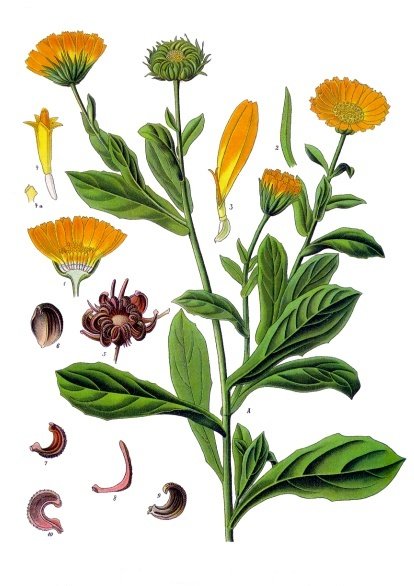
Field marigold has lance-shaped leaves borne on petioles and slender, hairy stems. Its leaves bear secretory trichomes.[1][2]
Its flower heads contain yellow ligulate ray florets surrounding tubular central florets. The ray florets range from bright yellow to yellow-orange.[3][4]
The plant grows between 10 and 50 cm tall. Its flower heads measure approximately 2–3 cm across and can reach four centimeters in width.[5][6][7]
Its fruits occur in three shapes: rostrate, cymbiform, and annular.[8]
Habitat
Field marigold grows in cultivated fields, along roadsides, and in disturbed sites. It can grow on different soil types.[9][10]
The species is native to central and southern Europe, North Africa, and the Middle East. It is widely distributed in Europe, northern Africa, southwestern Asia, and the Macaronesian region.[11][12]
It has become naturalized in other temperate regions and occurs globally as an introduced species.[13][14]
Reproduction and life cycle
Field marigold is monoecious and self-compatible. It can produce fruits without pollinators and flowers from November through May.[15][16][17]
The species produces three different types of achenes: rostrate, cymbiform, and annular. Rostrate and cymbiform achenes are larger and heavier than annular achenes.[8][18][19]
Rostrate and cymbiform achenes are adapted to long-distance dispersal, whereas annular achenes are adapted to short-distance dispersal.[20]
Its achenes can germinate across a wide range of temperatures in both light and darkness. Rostrate and cymbiform achenes produce seedlings that can emerge from deeper burial depths than seedlings from annular achenes.[21][22]
Seedlings originating from rostrate and cymbiform achenes can flower earlier than seedlings originating from annular achenes. The species produces abundant seeds and forms a persistent seed bank.[23][24]
Behaviour
The species' reproductive characteristics favor its establishment and expansion in unpredictable and disturbed habitats.[25]
Uses
The flowers and leaves are commonly used as ingredients in local food dishes. The flowers are consumed as a boiled vegetable, and the leaves are used as ingredients in a traditional soup.[26][27][28]
Field marigold is traditionally used as an edible plant in different Italian regions.[29]
Decoctions made from the species are traditionally used to treat wounds, contusions, and burns. Tea made from the species is traditionally associated with antiseptic and astringent properties.[30][31]
Flower-based preparations are suggested for external use to maintain skin firmness, counteract skin inflammation, and regenerate damaged tissues.[32][33]
Classification of the Field Marigold
| Kingdom | Plantae |
|---|---|
| Subkingdom | Pteridobiotina |
| Phylum | Tracheophyta |
| Class | Magnoliopsida |
| Order | Asterales |
| Family | Asteraceae (Composite) |
| Subfamily | Asteroideae |
| Tribe | Calenduleae |
| Genus | Calendula (Marigold) |
| Species | Calendula arvensis L. |
Where the Field Marigold is found
Checklists and occurrence records place Calendula arvensis in 81 countries across Africa, Asia, Europe, North America, Oceania and South America. GBIF holds 59,471 georeferenced records of it.
Countries where it is native or its origin is not stated
- Afghanistan 8
- Albania 6
- Algeria 326
- Armenia 11
- Austria 28
- Azerbaijan 144
- Bahrain 18
- Belgium 202
- Bulgaria 5
- Cabo Verde 1
- Chad 1
- China 12
- Croatia 185
- Cyprus 278
- Czechia 10
- Denmark 14
- Egypt 187
- Finland 5
- France 14,873
- Georgia 2
- Gibraltar 7
- Greece 1,375
- Hungary 6
- India 16
- Iran 112
- Iraq 255
- Isle of Man 4
- Israel 4,348
- Italy 2,999
- Japan 77
- Jordan 85
- Kosovo
- Kuwait 28
- Lebanon 57
- Libya 45
- Luxembourg 38
- Malta 61
- Moldova
- Monaco 2
- Montenegro 3
- Morocco 343
- North Macedonia
- Norway 7
- Oman 4
- Pakistan 43
- Palestinian Territory 245
- Poland 41
- Portugal 5,446
- Qatar 3
- Romania 3
- Russia 6
- San Marino 1
- Saudi Arabia 68
- Serbia 1
- Slovakia
- Slovenia 1
- Spain 21,724
- Sweden 79
- Switzerland 1,501
- Syria 103
- Tajikistan
- The Netherlands 245
- Tunisia 118
- Turkey 297
- Turkmenistan 34
- Ukraine 11
- United Arab Emirates
- Yemen 14
Countries where it has been introduced
- Argentina 7
- Australia 449
- Chile 45
- Estonia 2
- Germany 679
- Guernsey 7
- Jersey
- New Zealand 5
- South Africa 3
- South Korea 16
- United Kingdom 374
- United States 1,709
- Uruguay 3
Regions and cities with the most records
- Valencia, Spain 6,626
- Occitanie, France 5,390
- Catalonia, Spain 4,350
- Provence-Alpes-Côte d'Azur, France 2,407
- Southern District, Israel 1,906
- California, United States 1,568
- Canary Islands, Spain 1,517
- Madrid, Spain 1,403
- Beja, Portugal 1,171
- Balearic Islands, Spain 1,120
- Vaud, Switzerland 1,105
- Centre-Val de Loire, France 1,047
- L'Eliana, Spain 974
- Ribarroja del Turia, Spain 940
- Bétera, Spain 915
- El Goloso, Spain 907
- Manises, Spain 896
- La Pobla de Vallbona, Spain 884
- Tuscany, Italy 882
- Aldaia, Spain 877
- Paterna, Spain 865
- Alaquàs, Spain 860
- Quart de Poblet, Spain 858
- Alcobendas, Spain 854
- Auvergne-Rhône-Alpes, France 854
- Torrent, Spain 849
- Rubí, Spain 842
- San Sebastián de los Reyes, Spain 841
- Extremadura, Spain 835
- Montpellier, France 832
- Sant Andreu de la Barca, Spain 823
- Burjassot, Spain 819
- Castelnau-le-Lez, France 819
- Sant Cugat del Vallès, Spain 813
- West Bank, Palestinian Territory 813
- Xirivella, Spain 812
2 more countries have a few records outside this range
These countries hold a few records of Calendula arvensis but lie outside the range the checklists give for it. Such records are often zoo or garden specimens, museum material or vagrants, so the species is not counted as occurring there.
Range as the checklists state it
England [I] (England [I], Wales [I], Scotland [I], Isles of Scilly [I]); Sweden; Netherlands; Luxembourg; Germany (Brandenburg [I], Berlin [I], Baden-Württemberg, Bayern, +Hessen, Hessen [I], Nordrhein-Westfalen [I], Rheinland-Pfalz, Schleswig-Holstein [I], +Saarland, +Sachsen, +Sachsen-Anhalt, +Thüringen); Switzerland; Austria; Poland; Slovakia; Hungary; Portugal; Spain; Gibraltar; Baleares (Ibiza & Formentera, Mallorca, Menorca); France; Monaco; Channel Isl. [I] (Alderney [I], Guernsey [I], Jersey [I]); Corsica; Sardinia; Italy; Sicily; Pantelleria; Isole Pelagie (Lampedusa); Malta; San Marino; Slovenia; Croatia; Bosnia & Hercegovina; Montenegro; Serbia; Kosovo; North Macedonia; Albania; Romania; Bulgaria; European Turkey; Greece (very widespread); Crete (widespread, incl. Gavdos); Estonia [I]; Moldova; Ukraine; Crimea; Morocco; Algeria; Tunisia; Libya; Egypt (Desert Oases, Eastern Desert, Great Southwestern Desert, NE-Egypt, Nile Delta, Nile Valley, NW-coastal Egypt, SE-Egypt); Azores (Santa Maria Isl., Sao Miguel Isl., Terceira, Graciosa, Sao Jorge, Pico, Faial, Flores Isl.); Madeira (Madeira Isl., Ilhas Desertas, Porto Santo Isl.); Canary Isl. (Lanzarote, Fuerteventura, Gran Canaria, Tenerife, La Gomera, Hierro, La Palma); Cape Verde Isl. (Santo Antao Isl., Sao Vicente Isl.); Chad; South Africa [I] (KwaZulu-Natal [I]); Turkmenistan; Tajikistan; Georgia [Caucasus]; Armenia; Azerbaijan (incl. Nachichevan); East Aegaean Isl. (widespread, incl. Rhodos); Turkey (Inner Anatolia, N-Anatolia, NW-Anatolia: Bithynia, S-Anatolia, SE-Anatolia, SSW-Anatolia, SW-Anatolia, W-Anatolia, WN-Anatolia); Iraq (NW-Iraq, SE-Iraq: Mesopotamia, S-Iraq, W-Iraq: Desert); Iran (NE-Iran: Mts., N-Iran, Iranian Aserbaijan, S-Iran, W-Iran); Afghanistan (Laghman, Kunar / Nuristan, Nangarhar); Cyprus (C-Mountains, E-Cyprus, N-Cyprus, S-Cyprus, W-Cyprus); Lebanon (C-Lebanon, coastal W-Lebanon); Syria (C-Syrian Desert, Jazira, NW-Syria, Jbel Druze, W-Syrian Mountains); Israel (coastal W-Israel, Rift Valley, N-Israel, N-Negev Desert, Judean Desert, S-Negev Desert, Negev Desert); Sinai peninsula (C-Sinai, N-Sinai, S-Sinai); Jordania (S-Jordania, W-Jordania); Saudi Arabia (C-Saudi Arabia, Dahana, NE-Saudi Arabia, N-Saudi Arabia, Nafud Desert, Hejaz, S-Saudi Arabia: Rub to Khali, Asir, Nejd Desert); Kuwait; Bahrain; Qatar; United Arab Emirates; Oman (Mascat & Oman); Yemen (Aden Desert, N-Inner Yemen, W-Yemen); South Korea [I]; Pakistan (Baluchistan, N. W. Frontier Prov., Swat, Hazara, Pakistani Punjab, Baltistan); NW-India (Ladakh, Poonch, Jammu & Kashmir); Australia [I] (South Australia [I], Queensland [I], New South Wales [I], Victoria [I], Tasmania [I]); New Zealand [I]; USA [I] (California [I]); Uruguay [I]; Argentina [I]; Chile [I] (Coquimbo [I], Valparaíso [I], Metropolitana de Santiago [I], Biobío [I])
A number beside a place is its count of GBIF occurrence records. A place without a number comes from a checklist alone. Records show where a species has been observed or collected, which can include escapes and vagrants.
Common names
English
- Field Marigold
- Field-marigold
- Wild Marigold
Names in 8 other languages
- Arabic
- 'ayn al-baqar, hanwa
- Dutch
- Akkergoudsbloem
- Finnish
- peltokehäkukka
- French
- souci des champs, souci sauvage
- German
- Acker-Ringelblume
- Norwegian Bokmål
- åkerringblom
- Swedish
- åkerringblomma
- Welsh
- Melyn Mair yr Âr, Melyn-Mair yr Ŷd
Synonyms
75 other scientific names have been used for this species and are now treated as synonyms of Calendula arvensis.
- Calendula aegyptiaca Desf.
- Calendula aegyptiaca Pers.
- Calendula aegyptiaca subsp. aegyptiaca
- Calendula aegyptiaca var. aegyptiaca
- Calendula aegyptiaca var. crista-galli (Viv.) Lanza
- Calendula aegyptiaca var. crista-galli (Viv.) Bég. & Vacc.
- Calendula aegyptiaca var. exalata-longirostris Lanza
- Calendula aegyptiaca var. hymenocarpa (DC.) Pamp.
- Calendula aegyptiaca var. intermedia (Coss. & Kralik) Pamp.
- Calendula aegyptiaca var. microcephala (Boiss.) Rawi
- Calendula aegyptiaca var. microcephala (Kral ex Rchb.) Boiss.
- Calendula aegyptiaca var. suberostris Boiss.
- Calendula alata Rech.fil.
- Calendula algeriensis Boiss. & Reut.
- Calendula amplexifolia Rchb.
- Calendula arvensis Batt.
- Calendula arvensis f. alata Heyn et al.
- Calendula arvensis subsp. aegyptiaca (Pers.) Hayek
- Calendula arvensis subsp. arvensis
- Calendula arvensis subsp. bicolor (Raf.) Nyman
- Calendula arvensis subsp. communis Emb. & Maire
- Calendula arvensis subsp. macroptera Rouy
- Calendula arvensis subsp. malacitana (Boiss. & Reut.) Cout.
- Calendula arvensis subsp. micrantha (Tineo & Guss.) Holmboe
- Calendula arvensis subsp. micrantha (Tineo & Guss.) Arcangeli
- Calendula arvensis subsp. sublanata (Rchb.fil.) Nyman
- Calendula arvensis subsp. sublanata P.Fourn.
- Calendula arvensis var. arvensis
- Calendula arvensis var. bicolor (Raf.) DC.
- Calendula arvensis var. echinata Ball
- Calendula arvensis var. macroptera (Rouy) O.Bolòs & Vigo
- Calendula arvensis var. micrantha Ball
- Calendula arvensis var. parviflora Willk.
- Calendula arvensis var. parviflora (Raf.) Batt.
- Calendula bicolor Raf.
- Calendula bicolor var. bicolor
- Calendula bicolor var. cossoni Quézel & Santa
- Calendula bicolor var. faureli Quézel & Santa
- Calendula bicolor var. odettei Quézel & Santa
- Calendula brachyglossa Rupr.
Showing 40 of 75.
Related species
-
 Pot MarigoldCalendula officinalis
-
 Sea MarigoldCalendula suffruticosa
- Calendula tripterocarpa
- Calendula stellata
- Calendula palaestina
- Calendula pachysperma
- Calendula maroccana
- Calendula davisii
Compare
Questions and answers
What is the scientific name of the Field Marigold?
The scientific name of the Field Marigold is Calendula arvensis. Written with its author, the full name is Calendula arvensis L..
Which family does the Field Marigold belong to?
Calendula arvensis belongs to the family Asteraceae, in the order Asterales and the class Magnoliopsida.
Where is the Field Marigold found?
Checklists and occurrence records place Calendula arvensis in 81 countries, including Spain, France, Portugal, Israel, Italy and Switzerland.
What other names does the Field Marigold have?
Calendula arvensis is also known in English as Field-marigold and Wild Marigold.
What are the three types of marigolds?
Field marigold produces three types of achenes: rostrate, cymbiform, and annular.[8][18]
What is the habitat of marigolds?
Field marigold grows in cultivated fields, along roadsides, and in disturbed sites. It can grow on different soil types.[9][10]
Where does calendula grow naturally?
Field marigold is native to central and southern Europe, North Africa, and the Middle East.[11]
Sources
Passages the profile rests on
- The species has lance-shaped leaves borne on petioles and slender, hairy stems. Source passage: “The leaves are lance-shaped and borne on petioles from the slender, hairy stem.” — English Wikipedia
- Its leaves bear secretory trichomes. Source passage: “It has lance-shaped leaves with secretory trichomes” — pmc.ncbi.nlm.nih.gov
- Its flower heads contain bright yellow to yellow-orange ray florets surrounding yellow disc florets. Source passage: “with bright yellow to yellow-orange ray florets around a center of yellow disc florets.” — English Wikipedia
- Its flower heads have yellow ligulate ray florets and tubular central florets. Source passage: “small capitula (2–3 cm) with yellow ligulate ray florets, and tubulous central florets” — pmc.ncbi.nlm.nih.gov
- The plant grows between 10 and 50 cm tall. Source passage: “Calendula arvensis is an annual or biennial herb 10 to 50 cm (3.9 to 19.7 in) tall.” — English Wikipedia
- Its flower heads measure approximately 2–3 cm across. Source passage: “small capitula (2–3 cm)” — pmc.ncbi.nlm.nih.gov
- Its flower heads can reach four centimeters in width. Source passage: “a single flower head up to four centimeters wide” — English Wikipedia
- Its fruits occur in three shapes: rostrate, cymbiform, and annular. Source passage: “they are rostrate, cymbiform and annular.” — English Wikipedia
- The species grows in cultivated fields, along roadsides, and in disturbed sites. Source passage: “It can be found everywhere, being able to grow in cultivated fields, along roadsides, and in disturbed sites on different soil types” — pmc.ncbi.nlm.nih.gov
- The species can grow on different soil types. Source passage: “in disturbed sites on different soil types” — pmc.ncbi.nlm.nih.gov
- The species is native to central and southern Europe, North Africa, and the Middle East. Source passage: “It is native to central and southern Europe, North Africa and the Middle East” — English Wikipedia
- The species is widely distributed in Europe, northern Africa, southwestern Asia, and the Macaronesian region. Source passage: “widely distributed in Europe, northern Africa, SW Asia, and the Macaronesian region” — pmc.ncbi.nlm.nih.gov
- The species has become naturalized in other temperate regions. Source passage: “and also naturalized in other temperate regions.” — pmc.ncbi.nlm.nih.gov
- The species occurs globally as an introduced species. Source passage: “it is known across the globe as an introduced species.” — English Wikipedia
- The species is monoecious and self-compatible. Source passage: “C. arvensis is a monoecious, self-compatible, and polymorphic annual weed.” — pmc.ncbi.nlm.nih.gov
- The species can produce fruits without pollinators. Source passage: “fruiting also takes place without pollinators.” — pmc.ncbi.nlm.nih.gov
- The species flowers from November through May. Source passage: “The flowering period ranges from November to May” — pmc.ncbi.nlm.nih.gov
- The species produces three different types of achenes. Source passage: “the fruits are achenes of three different shapes” — pmc.ncbi.nlm.nih.gov
- Rostrate and cymbiform achenes are larger and heavier than annular achenes. Source passage: “Rostrate and cymbiform are suitable for long-distance diffusion, because they have larger size and weight than annular” — English Wikipedia
- Rostrate and cymbiform achenes are adapted to long-distance dispersal, whereas annular achenes are adapted to short-distance dispersal. Source passage: “while annular is suitable for short-distance diffusion.” — English Wikipedia
- The species' achenes can germinate across a wide range of temperatures in both light and darkness. Source passage: “achenes germinate across a wide temperature range (in light and in darkness).” — pmc.ncbi.nlm.nih.gov
- Rostrate and cymbiform achenes produce seedlings that can emerge from deeper burial depths than seedlings from annular achenes. Source passage: “Rostrate and cymbiform achenes produce seedlings best able to emerge from deeper burial depths” — pmc.ncbi.nlm.nih.gov
- Seedlings originating from rostrate and cymbiform achenes can flower earlier than seedlings originating from annular achenes. Source passage: “and are able to exhibit earlier flowering than seedlings from annular achenes” — pmc.ncbi.nlm.nih.gov
- The species produces abundant seeds and forms a persistent seed bank. Source passage: “It is a prolific seed producer, forming a persistent seed bank.” — pmc.ncbi.nlm.nih.gov
- The species' reproductive characteristics favor its establishment and expansion in unpredictable and disturbed habitats. Source passage: “All these features favor the species establishment and expansion in unpredictable and disturbed habitats” — pmc.ncbi.nlm.nih.gov
- The flowers and leaves are commonly used as ingredients in local food dishes. Source passage: “whose flowers and leaves are a common part of local food dishes.” — pmc.ncbi.nlm.nih.gov
- The flowers are consumed as a boiled vegetable. Source passage: “Literature reports the use of field marigold flower as a boiling vegetable” — pmc.ncbi.nlm.nih.gov
- The leaves are used as ingredients in a traditional soup. Source passage: “whereas the leaves are key ingredients in cooking a typical soup” — pmc.ncbi.nlm.nih.gov
- The species is traditionally used as an edible plant in different Italian regions. Source passage: “C. arvensis has a long tradition of uses in different Italian regions, where it is utilized as an edible alimurgic plant.” — pmc.ncbi.nlm.nih.gov
- Decoctions made from the species are used traditionally to treat wounds, contusions, and burns. Source passage: “C. arvensis-based decoction are used for treating wounds, contusion, and burns” — pmc.ncbi.nlm.nih.gov
- Tea made from the species is traditionally associated with antiseptic and astringent properties. Source passage: “field marigold tea is known for its antiseptic and astringent properties.” — pmc.ncbi.nlm.nih.gov
- Flower-based preparations are suggested for external use to maintain skin firmness. Source passage: “Flower-based preparations are suggested for external use to preserve skin firmness” — pmc.ncbi.nlm.nih.gov
- Flower-based preparations are suggested for counteracting skin inflammation and regenerating damaged tissues. Source passage: “or to counteract skin inflammation, and to regenerate damaged tissues” — pmc.ncbi.nlm.nih.gov
Data
- Catalogue of Life, 2026-10-16 XR cc by
- Global Biodiversity Information Facility CC BY 4.0
- Wikidata CC0
- GeoNames CC BY 4.0
- Wikimedia Commons per image; credit shown with each image
- Within the Catalogue of Life, this name comes from Synonymic Checklists of the Vascular Plants of the World cc by
References
- L. (1763). Sp. Pl. [Linnaeus], ed. 2: 1303 (1763). where the name was published
This species in other databases
Page built on 26 November 2026. See how the catalog is made and all sources and licences.
Cite this page
ScientificNames.org. (2026). Calendula arvensis (Field Marigold). Retrieved November 26, 2026, from https://scientificnames.org/species/calendula-arvensis
“Calendula arvensis (Field Marigold).” ScientificNames.org, 2026, scientificnames.org/species/calendula-arvensis. Accessed 26 Nov. 2026.
ScientificNames.org. “Calendula arvensis (Field Marigold).” Accessed November 26, 2026. https://scientificnames.org/species/calendula-arvensis.
@misc{scientificnames_calendula_arvensis_field_marigold,
  author = {{ScientificNames.org}},
  title = {Calendula arvensis (Field Marigold)},
  year = {2026},
  url = {https://scientificnames.org/species/calendula-arvensis},
  note = {Accessed 2026-11-26}
}