Species · Flowering plants
Sea Marigold Calendula suffruticosa
The scientific name of the Sea Marigold is Calendula suffruticosa. It is a species of flowering plant in the family Asteraceae (composite), order Asterales.
- Scientific name
- Calendula suffruticosa Vahl
- Common name
- Sea Marigold
- Genus
- Calendula
- Family
- Asteraceae (Composite)
- Order
- Asterales
- Class
- Magnoliopsida
- Recorded in
- 16 countries
- Name status
- accepted in the Catalogue of Life

Overview
Calendula suffruticosa has a self-supporting growth form, broad leaves and usually yellow or orange multipellated flowers.
Written 26 November 2026 from the sources listed below. Each statement was checked against the passage it cites; statements that could not be supported were removed.
Appearance
Sea Marigold has a self-supporting growth form and broad leaves. Its flowers are multipellated and usually yellow or orange.[1][2][3][4]
Individual plants can reach a height of 40 cm.[5]
Similar species
Sea Marigold is a highly variable species across its geographical range, and multiple subspecies are recognised within it.[6][7]
Classification of the Sea Marigold
| Kingdom | Plantae |
|---|---|
| Subkingdom | Pteridobiotina |
| Phylum | Tracheophyta |
| Class | Magnoliopsida |
| Order | Asterales |
| Family | Asteraceae (Composite) |
| Subfamily | Asteroideae |
| Tribe | Calenduleae |
| Genus | Calendula (Marigold) |
| Species | Calendula suffruticosa Vahl |
Where the Sea Marigold is found
Checklists and occurrence records place Calendula suffruticosa in 16 countries across Africa, Asia and Europe. GBIF holds 3,234 georeferenced records of it.
Countries
- Algeria 246
- Denmark 15
- France 13
- Germany 9
- Gibraltar 40
- India 5
- Italy 271
- Libya 1
- Malta 13
- Morocco 142
- Portugal 1,795
- Spain 600
- Sweden 3
- Tunisia 54
- Turkey 22
- United Kingdom 5
Regions and cities with the most records
- Faro, Portugal 280
- Setúbal, Portugal 220
- Lisbon, Portugal 219
- Quinta Do Conde, Portugal 205
- Azeitão, Portugal 199
- Sesimbra, Portugal 196
- Leiria, Portugal 150
- Madeira, Portugal 135
- Algueirão, Portugal 125
- Cacém, Portugal 125
- Rio de Mouro, Portugal 123
- Caniço, Portugal 117
- Setúbal, Portugal 117
- Parede, Portugal 112
- São Domingos de Rana, Portugal 112
- Palmela, Portugal 111
- Estoril, Portugal 110
- Massamá, Portugal 110
- Peniche, Portugal 109
- Coimbra, Portugal 107
- Sintra, Portugal 106
- Alcabideche, Portugal 103
- Carcavelos, Portugal 103
- Charneca de Caparica, Portugal 103
- Oeiras, Portugal 103
- Monte Estoril, Portugal 97
- Algeciras, Spain 96
- Cascais, Portugal 94
- Belas, Portugal 91
- Figueira da Foz, Portugal 82
- Torres Vedras, Portugal 81
- Los Barrios, Spain 78
- Sicily, Italy 78
- Queluz, Portugal 77
- Tarifa, Spain 76
- Olival, Portugal 74
1 more country has a few records outside this range
These countries hold a few records of Calendula suffruticosa but lie outside the range the checklists give for it. Such records are often zoo or garden specimens, museum material or vagrants, so the species is not counted as occurring there.
A number beside a place is its count of GBIF occurrence records. A place without a number comes from a checklist alone. Records show where a species has been observed or collected, which can include escapes and vagrants.
Common names
English
- Sea Marigold
Names in 8 other languages
- Arabic
- أذريون شجيري, بكورية شجيرية
- Finnish
- varpukehäkukka
- German
- Halbstrauchige Ringelblume
- Italian
- Fiorrancio fulgido, Fiorrancio suffruticoso
- Portuguese
- erva-vaqueira-das-arribas
- Slovak
- nechtík polokrovitý
- Spanish
- Maravilla de mar
- Turkish
- Öküzgözü
Synonyms
5 other scientific names have been used for this species and are now treated as synonyms of Calendula suffruticosa.
- Calendula fulgida var. melitensis Sommier
- Calendula suffruticosa f. suffruticosa
- Calendula suffruticosa var. dichroa Batt.
- Calendula suffruticosa var. obtusifolia Maire
- Calendula suffruticosa var. suffruticosa
Subspecies and varieties
- Calendula suffruticosa subsp. algarbiensis subspecies
- Calendula suffruticosa subsp. balansae subspecies
- Calendula suffruticosa subsp. boccoyana subspecies
- Calendula suffruticosa subsp. boissieri subspecies
- Calendula suffruticosa subsp. carbonellii subspecies
- Calendula suffruticosa subsp. cinerea subspecies
- Calendula suffruticosa subsp. dersana subspecies
- Calendula suffruticosa subsp. djurdjurensis subspecies
- Calendula suffruticosa subsp. foliosa subspecies
- Calendula suffruticosa subsp. fulgida subspecies
- Calendula suffruticosa subsp. greuteri subspecies
- Calendula suffruticosa subsp. guruguensis subspecies
- Calendula suffruticosa subsp. hosmarensis subspecies
- Calendula suffruticosa subsp. lusitanica subspecies
- Calendula suffruticosa subsp. maderensis subspecies
- Calendula suffruticosa subsp. marginata subspecies
- Calendula suffruticosa subsp. maritima (Sea Marigold) subspecies
- Calendula suffruticosa subsp. marsaensis subspecies
- Calendula suffruticosa subsp. monardii subspecies
- Calendula suffruticosa subsp. riffensis subspecies
- Calendula suffruticosa subsp. suffruticosa subspecies
- Calendula suffruticosa subsp. tazaensis subspecies
- Calendula suffruticosa subsp. tlemcensis subspecies
- Calendula suffruticosa subsp. tomentosa subspecies
- Calendula suffruticosa subsp. trialata subspecies
- Calendula suffruticosa subsp. tunetana subspecies
- Calendula suffruticosa subsp. vejerensis subspecies
Related species
-
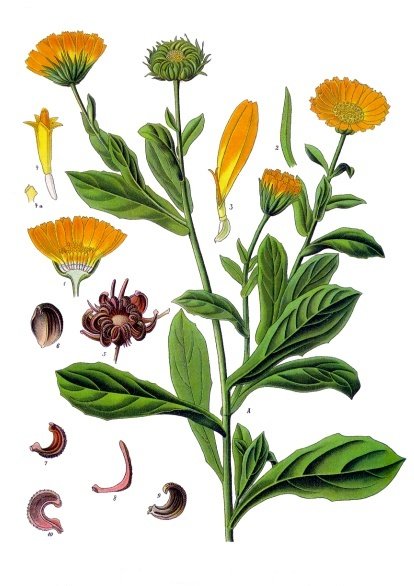 Pot MarigoldCalendula officinalis
-
 Field MarigoldCalendula arvensis
- Calendula tripterocarpa
- Calendula stellata
- Calendula palaestina
- Calendula pachysperma
- Calendula maroccana
- Calendula davisii
Compare
Questions and answers
What is the scientific name of the Sea Marigold?
The scientific name of the Sea Marigold is Calendula suffruticosa. Written with its author, the full name is Calendula suffruticosa Vahl.
Which family does the Sea Marigold belong to?
Calendula suffruticosa belongs to the family Asteraceae, in the order Asterales and the class Magnoliopsida.
Where is the Sea Marigold found?
Checklists and occurrence records place Calendula suffruticosa in 16 countries, including Portugal, Spain, Italy, Algeria, Morocco and Tunisia.
Sources
Passages the profile rests on
- Calendula suffruticosa has a self-supporting growth form. Source passage: “It has a self-supporting growth form and broad leaves.” — English Wikipedia
- Calendula suffruticosa has broad leaves. Source passage: “It has a self-supporting growth form and broad leaves.” — English Wikipedia
- The flowers of Calendula suffruticosa are multipellated. Source passage: “Flowers are multipellated, and are usually yellow or orange in colour.” — English Wikipedia
- The flowers of Calendula suffruticosa are usually yellow or orange. Source passage: “Flowers are multipellated, and are usually yellow or orange in colour.” — English Wikipedia
- Individual Calendula suffruticosa plants can reach a height of 40 cm. Source passage: “Individuals can grow up to 40 cm (16 in).” — English Wikipedia
- Calendula suffruticosa is a highly variable species across its geographical range. Source passage: “The species is highly variable throughout its range” — English Wikipedia
- Multiple subspecies are recognised within Calendula suffruticosa. Source passage: “multiple subspecies are recognised:” — English Wikipedia
- Calendula suffruticosa subsp. lusitanica grows in inland rocky areas of central Portugal. Source passage: “inland rocky areas in central Portugal” — English Wikipedia
- Calendula suffruticosa subsp. tomentosa grows in low-elevation sandy loams in southern Spain. Source passage: “southern Spain, in low elevation sandy loams” — English Wikipedia
- Calendula suffruticosa subsp. vejerensis is endemic to calcareous sandstones in Vejer de la Frontera, southern Spain. Source passage: “endemic to calcereous sandstones in Vejer de la Frontera, in southern Spain.” — English Wikipedia
Data
- Catalogue of Life, 2026-10-16 XR cc by
- Global Biodiversity Information Facility CC BY 4.0
- Wikidata CC0
- GeoNames CC BY 4.0
- Wikimedia Commons per image; credit shown with each image
- Within the Catalogue of Life, this name comes from Synonymic Checklists of the Vascular Plants of the World cc by
References
- Vahl. where the name was published
This species in other databases
- Catalogue of Life 695Y8
- Wikidata Q3650646
- iNaturalist 82653
- World Flora Online wfo-0000080753
- GRIN 313532
Page built on 27 November 2026. See how the catalog is made and all sources and licences.
Cite this page
ScientificNames.org. (2026). Calendula suffruticosa (Sea Marigold). Retrieved November 27, 2026, from https://scientificnames.org/species/calendula-suffruticosa
“Calendula suffruticosa (Sea Marigold).” ScientificNames.org, 2026, scientificnames.org/species/calendula-suffruticosa. Accessed 27 Nov. 2026.
ScientificNames.org. “Calendula suffruticosa (Sea Marigold).” Accessed November 27, 2026. https://scientificnames.org/species/calendula-suffruticosa.
@misc{scientificnames_calendula_suffruticosa_sea_marigold,
  author = {{ScientificNames.org}},
  title = {Calendula suffruticosa (Sea Marigold)},
  year = {2026},
  url = {https://scientificnames.org/species/calendula-suffruticosa},
  note = {Accessed 2026-11-27}
}