Species · Flowering plants
Pot Marigold Calendula officinalis
The scientific name of the Pot Marigold is Calendula officinalis. It is a species of flowering plant in the family Asteraceae (composite), order Asterales.
- Scientific name
- Calendula officinalis L.
- Common name
- Pot Marigold
- Genus
- Calendula
- Family
- Asteraceae (Composite)
- Order
- Asterales
- Class
- Magnoliopsida
- Recorded in
- 92 countries
- Name status
- accepted in the Catalogue of Life
Overview
Calendula officinalis is probably native to southern Europe and is widely naturalised in northern Europe, reaching southern England, and in other warm temperate regions. It is distinguished by yellow or orange flowerheads, edible florets and thorny, curved achenes.
Written 26 November 2026 from the sources listed below. Each statement was checked against the passage it cites; statements that could not be supported were removed.
Appearance
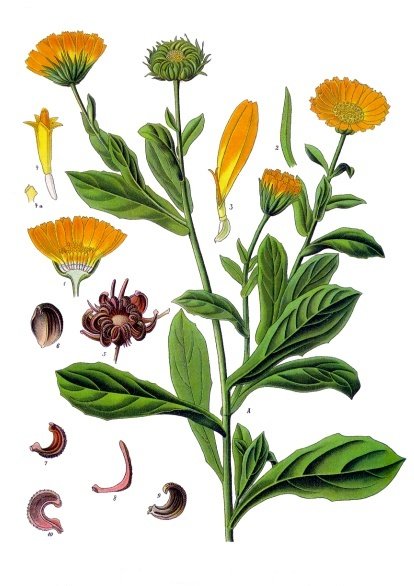
Pot marigold is an aromatic herbaceous perennial with sparsely branched, lax or upright stems. It can grow to a height of 80 cm.[1][2]
Its oblong-lanceolate leaves measure 5–17 cm in length and are hairy on both surfaces. Its yellow or orange flowerheads measure 4–7 cm in diameter and are surrounded by two rows of hairy bracts.[3][4][5]
Wild plants have a single ring of ray florets surrounding central disc florets. The disc florets are tubular and hermaphroditic.[6][7]
Its fruit is a thorny, curved achene.[8]
Habitat
Pot marigold can grow in most soil types in sunny locations. It performs best in sunny locations with rich, well-drained soil.[9][10]
Diet
The florets of pot marigold are edible and are commonly added to salads for colour or used as a saffron substitute in garnishes. Its leaves are also edible but are generally considered unpalatable.[11][12][13]
The leaves have historically been incorporated into potherbs and salads.[14]
Behaviour
The flowers can appear throughout the year when environmental conditions are suitable.[15]
Pot marigold serves as a food plant for larvae of several moth species. Cabbage moth larvae use its plants as food.[16][17]
Reproduction and life cycle
Pot marigold can germinate readily in sunny or partially sunny locations. Plants typically flower in less than two months after germinating from seed.[18][19]
In temperate climates, seeds are sown in spring to produce flowers through summer and into autumn. In regions with limited winter freezing, seeds are sown in autumn for winter flowering.[20][21]
Uses
Pot marigold is used to prepare tea. Its flowers have been used as medicinal herbs in ancient Greek, Roman, Middle Eastern, and Indian cultures.[22][23]
The flowers have historically been used as dyes for fabrics, foods, and cosmetics. The plant is also used to produce oil for skin-care products, and its extracts are widely incorporated into cosmetic products.[24][25][26]
Its leaves can be prepared as a poultice traditionally believed to help scratches and shallow cuts heal faster and prevent infection.[27]
The flowers contain 29.8 mg of lutein per 100 g. The petals and pollen contain triterpenoid esters and the carotenoids flavoxanthin and auroxanthin.[28][29]
The leaves and stems contain lutein, zeaxanthin, and beta-carotene, with lutein accounting for 80% of the listed carotenoids. The flowers contain flavonol glycosides, triterpene oligoglycosides, oleanane-type triterpene glycosides, saponins, and a sesquiterpene glucoside.[30][31]
Classification of the Pot Marigold
| Kingdom | Plantae |
|---|---|
| Subkingdom | Pteridobiotina |
| Phylum | Tracheophyta |
| Class | Magnoliopsida |
| Order | Asterales |
| Family | Asteraceae (Composite) |
| Subfamily | Asteroideae |
| Tribe | Calenduleae |
| Genus | Calendula (Marigold) |
| Species | Calendula officinalis L. |
Where the Pot Marigold is found
Checklists and occurrence records place Calendula officinalis in 92 countries across Africa, Asia, Europe, North America, Oceania and South America. GBIF holds 52,112 georeferenced records of it.
Countries where it is native or its origin is not stated
- Aland Islands 7
- Albania 5
- Algeria 7
- Andorra 8
- Armenia 3
- Austria 901
- Azerbaijan 4
- Belgium 5,348
- Bulgaria 7
- Croatia 38
- Cyprus 6
- Czechia 273
- Denmark 895
- Egypt 13
- Finland 316
- France 3,339
- Georgia 10
- Hungary 52
- Iceland 3
- India 86
- Iraq 9
- Isle of Man 124
- Italy 408
- Japan 50
- Kosovo 2
- Latvia 47
- Libya 1
- Lithuania 14
- Luxembourg 63
- Malta 1
- Moldova 3
- Montenegro 2
- Nepal 9
- North Macedonia 4
- Poland 360
- Portugal 718
- Reunion 8
- Romania 217
- Russia 1,514
- Serbia 8
- Slovakia 67
- Slovenia 12
- South Africa 8
- South Korea 7
- Spain 2,582
- Switzerland 908
- Tajikistan
- Tanzania 3
- The Netherlands 3,653
- Turkmenistan 3
- Ukraine 279
Countries where it has been introduced
- Afghanistan
- Argentina 81
- Australia 179
- Bangladesh 1
- Belarus 97
- Bhutan 14
- Bolivia 39
- Chile 123
- China 195
- Colombia 146
- Ecuador 66
- Estonia 135
- Fiji 1
- Germany 5,865
- Greece 35
- Guatemala 4
- Guernsey 8
- Honduras
- Iran 17
- Ireland 135
- Jersey 8
- Kazakhstan 49
- Lebanon 3
- Liechtenstein
- Mauritius
- Mexico 377
- Morocco 21
- Myanmar
- New Zealand 499
- Norway 324
- Pakistan 16
- San Marino
- Sweden 4,198
- Syria 18
- Taiwan 1
- Trinidad and Tobago
- Turkey 54
- United Kingdom 15,732
- United States 1,263
- Uzbekistan 2
- Vietnam 1
Regions and cities with the most records
- England, United Kingdom 13,220
- Bavaria, Germany 2,276
- Shepherds Bush, United Kingdom 1,125
- Acton, United Kingdom 1,120
- Barnes, United Kingdom 1,115
- Harlesden, United Kingdom 1,115
- Willesden, United Kingdom 1,113
- Fulham, United Kingdom 1,107
- London, United Kingdom 1,100
- City of Westminster, United Kingdom 1,096
- Cricklewood, United Kingdom 1,093
- West Ealing, United Kingdom 1,093
- Catalonia, Spain 1,090
- Camden Town, United Kingdom 1,087
- Chalk Farm, United Kingdom 1,087
- Wembley, United Kingdom 1,083
- Richmond, United Kingdom 1,081
- Earlsfield, United Kingdom 1,072
- Islington, United Kingdom 1,067
- Shadwell, United Kingdom 1,065
- Golders Green, United Kingdom 1,059
- Streatham, United Kingdom 1,055
- Isleworth, United Kingdom 1,053
- Greenford, United Kingdom 1,044
- Southall, United Kingdom 1,043
- Stepney, United Kingdom 1,043
- Hounslow, United Kingdom 1,042
- Archway, United Kingdom 1,038
- Hanworth, United Kingdom 1,033
- Heston, United Kingdom 1,033
- Highbury, United Kingdom 1,033
- Feltham, United Kingdom 1,031
- Finchley, United Kingdom 1,021
- Stratford, United Kingdom 1,014
- Harringay, United Kingdom 1,011
- Muswell Hill, United Kingdom 1,007
8 more countries have a few records outside this range
These countries hold a few records of Calendula officinalis but lie outside the range the checklists give for it. Such records are often zoo or garden specimens, museum material or vagrants, so the species is not counted as occurring there.
Range as the checklists state it
England [I] (England [I], Wales [I], Isle of Man [I], Scotland [I], Shetland Isl. [I], Isles of Scilly [I]); Ireland [I] (Ireland [I], Northern Ireland [I]); Norway [I]; Sweden [I]; Netherlands; Belgium; Germany [I]; Switzerland; Liechtenstein [I]; Austria; Poland; Slovakia; Hungary; Portugal; Spain; Baleares (Mallorca); France; Channel Isl. [I] (Alderney [I], Guernsey [I], Jersey [I], Sark [I]); Corsica; Sardinia; Italy; Sicily; Malta; San Marino [I]; Slovenia; Croatia; Bosnia & Hercegovina; Montenegro; Serbia; Kosovo; Albania [c]; Romania; Bulgaria; Greece [I]; Crete [I]; S-European Russia; Estonia [I]; Belarus [I]; C-European Russia; E-European Russia; N-European Russia; NW-European Russia (incl. Kaliningrad region); Moldova; Ukraine; Crimea; Morocco [I]; Libya [c]; Azores (Corvo, Faial, Flores Isl., Graciosa, Pico, Sao Jorge, Sao Miguel, Sta. Maria, Terceira); Madeira (Porto Santo Isl., Madeira Isl.); Canary Isl. (El Hierro, La Palma, Tenerife); Mauritius [I]; Russian Far East [I] (Primorye [I]); Kazakhstan [I]; Turkmenistan; Uzbekistan [I]; Tajikistan; Northern Caucasus; East Aegaean Isl. [I]; Turkey [I]; Iran [I]; Afghanistan [I]; Lebanon [I] (coastal W-Lebanon [I]); Syria [I] (C-Syrian Desert [I], NW-Syria [I]); China [I]; Taiwan [I]; Pakistan [I]; Bhutan [I]; India [c]; Bangladesh [I]; Myanmar [I]; Vietnam [I]; Sulawesi [I]; Jawa [I]; Lesser Sunda Isl. [I]; Australia [I] (South Australia [I], Victoria [I], Tasmania [I], New South Wales [I]); New Zealand [I]; Chatham Isl. [I]; Rotuma Isl. [I]; USA [I] (California [I], Connecticut [I], Maine [I], Massachusetts [I], Michigan [I], New Hampshire [I], Ohio [I], Pennsylvania [I]); Mexico [I]; Guatemala [I]; Honduras [I]; Trinidad & Tobago [I]; Colombia [I]; Ecuador [I]; Bolivia [I]; Argentina [I]; Chile [I] (Coquimbo [I], Valparaíso [I], Metropolitana de Santiago [I], Biobío [I]); Juan Fdz. Isl. [I]
A number beside a place is its count of GBIF occurrence records. A place without a number comes from a checklist alone. Records show where a species has been observed or collected, which can include escapes and vagrants.
Common names
English
- Pot Marigold
- Scotch Marigold
- Scotch-marigold
- Scottish-marigold
- Calendula
- Garden Marigold
- Garden-marigold
- Marigold
- Pot-marigold
- Ruddles
Names in 32 other languages
- Arabic
- أذريون الطبي, بكورية طبية
- Catalan
- Boixac de jardí
- Chinese
- jin zhan ju, 金盞花
- Croatian
- Ljekoviti neven, Neven
- Czech
- měsíček lékařský
- Danish
- Have-morgenfrue, Havemorgenfrue, Morgenfrue
- Dutch
- Goudsbloem, Tuingoudsbloem
- Estonian
- harilik saialill
- Finnish
- tarhakehäkukka
- French
- souci, souci des jardins, souci officinal
- German
- Garten-Ringelblume, Ringelblume
- Hungarian
- körömvirág, orvosi körömvirág
- Italian
- Calendola o fiorrancio
- Japanese
- tō-kin-sen-ka, キンセンカ, トウキンセンカ
- Korean
- geumjanhwa
- Latvian
- kliņģerītes
- Lithuanian
- Vaistinė medetka
- Macedonian
- Невен
- Northern Sami
- gierdolieđđi
- Norwegian Bokmål
- ringblom, ringblomst
- Polish
- Nagietek lekarski
- Portuguese
- calêndula
- Romanian
- Gălbenele
- Russian
- kalendula, nogot'ki lekarstvennye, Календула лекарственная, ноготки лекарственные
- Serbian
- Невен/Neven
- Slovak
- nechtík lekársky
- Slovenian
- vrtni ognjič
- Spanish
- Caléndula, Caléndula del Mediterráneo, maravilla
- Swedish
- ringblomma
- Turkish
- aynısafa
- Ukrainian
- Календула лікарська, Нагідки лікарські
- Welsh
- Gold Mair, Melyn Mair, Rhuddos, Senseg, Swynesgras, Synseg
Synonyms
24 other scientific names have been used for this species and are now treated as synonyms of Calendula officinalis.
- Calendula arvensis subsp. hydruntina (Fiori) Lanza
- Calendula aurantiaca Kotschy ex Boiss.
- Calendula eriocarpa DC.
- Calendula hydruntina (Fiori) Lanza
- Calendula officinalis f. isabellina Hegi
- Calendula officinalis f. ligulata Hegi
- Calendula officinalis f. lingulata Nordh.
- Calendula officinalis f. pallida Hegi
- Calendula officinalis f. pleniflora Moldenke
- Calendula officinalis f. ranunculodes Hegi
- Calendula officinalis f. regalis Hegi
- Calendula officinalis f. sulphurea Hegi
- Calendula officinalis f. superba Hegi
- Calendula officinalis var. hydruntina Fiori
- Calendula officinalis var. officinalis
- Calendula officinalis var. parviflora Kuntze
- Calendula officinalis var. prolifera Gaudin
- Calendula officinalis var. prolifera Hort.
- Calendula prolifera Steud.
- Calendula ranunculodes Voss
- Calendula santamariae Font Quer
- Calendula sinuata Boiss. & Gaill.
- Calendula sinuata var. aurantiaca (Kotschy) Boiss.
- Caltha officinalis (L.) Moench
Related species
-
 Field MarigoldCalendula arvensis
-
 Sea MarigoldCalendula suffruticosa
- Calendula tripterocarpa
- Calendula stellata
- Calendula palaestina
- Calendula pachysperma
- Calendula maroccana
- Calendula davisii
Compare
Questions and answers
What is the scientific name of the Pot Marigold?
The scientific name of the Pot Marigold is Calendula officinalis. Written with its author, the full name is Calendula officinalis L..
Which family does the Pot Marigold belong to?
Calendula officinalis belongs to the family Asteraceae, in the order Asterales and the class Magnoliopsida.
Where is the Pot Marigold found?
Checklists and occurrence records place Calendula officinalis in 92 countries, including Belgium, The Netherlands, France, Spain, Russia and Switzerland.
What other names does the Pot Marigold have?
Calendula officinalis is also known in English as Scotch Marigold, Scotch-marigold, Scottish-marigold, Calendula, Garden Marigold and Garden-marigold.
Where does calendula grow naturally?
Pot marigold is probably native to southern Europe, although its precise native origin is uncertain because of its long cultivation history. It is widely naturalised in northern Europe, reaching southern England, and in other warm temperate regions.[32][33][34]
Sources
Passages the profile rests on
- Calendula officinalis is an aromatic herbaceous perennial with sparsely branched, lax or upright stems. Source passage: “a short-lived aromatic herbaceous perennial, growing to 80 cm (31 in) tall, with sparsely branched lax or upright stems.” — English Wikipedia
- Calendula officinalis can grow to a height of 80 cm. Source passage: “growing to 80 cm (31 in) tall” — English Wikipedia
- Its oblong-lanceolate leaves measure 5–17 cm in length and are hairy on both surfaces. Source passage: “The leaves are oblong-lanceolate, 5–17 cm (2–7 in) long, hairy on both sides” — English Wikipedia
- Its flowerheads are yellow or orange and measure 4–7 cm in diameter. Source passage: “The inflorescences are yellow or orange, comprising a thick capitulum or flowerhead 4–7 cm (1+1⁄2–3 in) diameter” — English Wikipedia
- Its flowerheads are surrounded by two rows of hairy bracts. Source passage: “surrounded by two rows of hairy bracts.” — English Wikipedia
- Wild plants have a single ring of ray florets surrounding central disc florets. Source passage: “In the wild plant they have a single ring of ray florets surrounding the central disc florets.” — English Wikipedia
- Its disc florets are tubular and hermaphroditic. Source passage: “The disc florets are tubular and hermaphroditic” — English Wikipedia
- Its fruit is a thorny, curved achene. Source passage: “The fruit is a thorny curved achene.” — English Wikipedia
- Calendula officinalis can grow in most soil types in sunny locations. Source passage: “can be grown easily in sunny locations in most kinds of soils.” — English Wikipedia
- The plant performs best in sunny locations with rich, well-drained soil. Source passage: “plants do best if planted in sunny locations with rich, well-drained soil.” — English Wikipedia
- The florets of Calendula officinalis are edible. Source passage: “The florets are edible.” — English Wikipedia
- Its florets are commonly added to salads for colour or used as a saffron substitute in garnishes. Source passage: “They are often included in salads for their color or added to dishes as a garnish in lieu of saffron.” — English Wikipedia
- Its leaves are edible but are generally considered unpalatable. Source passage: “While the leaves are also edible, they are generally not considered palatable” — English Wikipedia
- The leaves have historically been incorporated into potherbs and salads. Source passage: “historically they have been incorporated into potherb and salads.” — English Wikipedia
- The flowers can appear throughout the year when environmental conditions are suitable. Source passage: “The flowers may appear all year long where conditions are suitable.” — English Wikipedia
- Calendula officinalis serves as a food plant for larvae of several moth species. Source passage: “Calendulas are used as food plants by the larvae of some Lepidoptera species” — English Wikipedia
- Cabbage moth larvae use Calendula plants as food. Source passage: “including cabbage moth, gothic moth, large yellow underwing, and setaceous Hebrew character.” — English Wikipedia
- The species can germinate readily in sunny or partially sunny locations. Source passage: “Seeds will germinate freely in sunny or half-sunny locations” — English Wikipedia
- Pot marigold plants typically flower in less than two months after germinating from seed. Source passage: “Pot marigolds typically bloom quickly from seed (in under two months)” — English Wikipedia
- In temperate climates, seeds are sown in spring to produce flowers through summer and into autumn. Source passage: “In temperate climates, seeds are sown in spring for blooms that last throughout the summer and well into the fall.” — English Wikipedia
- In regions with limited winter freezing, seeds are sown in autumn for winter flowering. Source passage: “In areas of limited winter freezing, seeds are sown in autumn for winter color.” — English Wikipedia
- The plant is used to prepare tea. Source passage: “Additionally, the plant is utilized for making tea.” — English Wikipedia
- Calendula flowers have been used as medicinal herbs in ancient Greek, Roman, Middle Eastern, and Indian cultures. Source passage: “Flowers were used in ancient Greek, Roman, Middle Eastern, and Indian cultures as a medicinal herb” — English Wikipedia
- The flowers have historically been used as dyes for fabrics, foods, and cosmetics. Source passage: “as well as a dye for fabrics, foods, and cosmetics.” — English Wikipedia
- The plant is used to produce oil for skin-care products. Source passage: “They are also used to make an oil that is widely used in skin products.” — English Wikipedia
- Plant extracts are widely incorporated into cosmetic products. Source passage: “Plant extracts are also widely used in cosmetics” — English Wikipedia
- Its leaves can be prepared as a poultice traditionally believed to help scratches and shallow cuts heal faster and prevent infection. Source passage: “Marigold leaves can also be made into a poultice that is believed to help scratches and shallow cuts to heal faster and to prevent infection.” — English Wikipedia
- The flowers contain 29.8 mg of lutein per 100 g. Source passage: “The flowers are a rich source of lutein, containing 29.8 mg/100g.” — English Wikipedia
- The petals and pollen contain triterpenoid esters and the carotenoids flavoxanthin and auroxanthin. Source passage: “The petals and pollen contain triterpenoid esters, as well as carotenoids flavoxanthin and auroxanthin” — English Wikipedia
- The leaves and stems contain lutein, zeaxanthin, and beta-carotene, with lutein accounting for 80% of the listed carotenoids. Source passage: “mostly lutein (80%), zeaxanthin (5%), and beta-carotene.” — English Wikipedia
- The flowers contain flavonol glycosides, triterpene oligoglycosides, oleanane-type triterpene glycosides, saponins, and a sesquiterpene glucoside. Source passage: “The flowers contain flavonol glycosides, triterpene oligoglycosides, oleanane-type triterpene glycosides, saponins, and a sesquiterpene glucoside.” — English Wikipedia
- Calendula officinalis is probably native to southern Europe. Source passage: “It is probably native to southern Europe” — English Wikipedia
- Its precise native origin is uncertain because of its long cultivation history. Source passage: “its long history of cultivation makes its precise origin unknown” — English Wikipedia
- The species is widely naturalised in northern Europe, reaching southern England, and in other warm temperate regions. Source passage: “widely naturalised further north in Europe (as far north as southern England) and elsewhere in warm temperate regions of the world.” — English Wikipedia
Data
- Catalogue of Life, 2026-10-16 XR cc by
- Global Biodiversity Information Facility CC BY 4.0
- Wikidata CC0
- GeoNames CC BY 4.0
- Wikimedia Commons per image; credit shown with each image
- Within the Catalogue of Life, this name comes from Synonymic Checklists of the Vascular Plants of the World cc by
References
- L. (1753). Sp. Pl. [Linnaeus] 2: 921 (1753). where the name was published
This species in other databases
Page built on 27 November 2026. See how the catalog is made and all sources and licences.
Cite this page
ScientificNames.org. (2026). Calendula officinalis (Pot Marigold). Retrieved November 27, 2026, from https://scientificnames.org/species/calendula-officinalis
“Calendula officinalis (Pot Marigold).” ScientificNames.org, 2026, scientificnames.org/species/calendula-officinalis. Accessed 27 Nov. 2026.
ScientificNames.org. “Calendula officinalis (Pot Marigold).” Accessed November 27, 2026. https://scientificnames.org/species/calendula-officinalis.
@misc{scientificnames_calendula_officinalis_pot_marigold,
  author = {{ScientificNames.org}},
  title = {Calendula officinalis (Pot Marigold)},
  year = {2026},
  url = {https://scientificnames.org/species/calendula-officinalis},
  note = {Accessed 2026-11-27}
}