Species · Flowering plants
Plumeless Thistle Carduus acanthoides
The scientific name of the Plumeless Thistle is Carduus acanthoides. It is a species of flowering plant in the family Asteraceae (composite), order Asterales.
- Scientific name
- Carduus acanthoides L.
- Common name
- Plumeless Thistle
- Genus
- Carduus
- Family
- Asteraceae (Composite)
- Order
- Asterales
- Class
- Magnoliopsida
- Recorded in
- 59 countries
- Name status
- accepted in the Catalogue of Life

Overview
Plumeless thistle (Carduus acanthoides L.) is a biennial flowering plant in the family Asteraceae, order Asterales, and class Magnoliopsida. It is native to Europe and Asia and has been introduced across much of North America. It has spiny stems and foliage, rounded flower heads with purple or pink florets, and can grow to more than 2 metres tall.
Written 26 November 2026 from the sources listed below. Each statement was checked against the passage it cites; statements that could not be supported were removed.
Appearance
Plumeless thistle initially grows as a flat basal rosette before producing an erect stem. Its stems bear spiny wings, and its stems and foliage are spiny; the foliage may sometimes be woolly.[1][2][3]
Its leaves are approximately 10–20 cm long, with lobed or pinnately divided margins. They are occasionally toothed, wrinkled, and spiny, and their undersides are somewhat hairy.[4][5][6][7]
Each stem branch terminates in an inflorescence containing one or several rounded flower heads covered with spiny phyllaries. The heads contain numerous threadlike purple or pink disc florets and measure approximately 13–25 mm across.[8][9][10][11]
The plant produces four-angled achenes with faint longitudinal stripes. The achenes measure approximately 2–3 mm in length, and the pappus bristles measure approximately 11–13 mm.[12][13][14]
Habitat
Within its native range, plumeless thistle occurs in open grasslands and disturbed areas.[15]
In non-native regions, it occurs in annual grasslands, roadsides, fields, pastures, and disturbed areas. In Michigan and Wisconsin, it occurs in disturbed locations such as railroad rights-of-way, roadsides, and farm fields rather than remnant native habitats.[16][17]
The species is native to Europe and Asia. Its stated native range extends from France, Italy, and western Turkey through Russia and Kazakhstan to China, and it has been introduced across much of North America.[18][19][20]
Behaviour
Plumeless thistle can form dense, weedy stands consisting of a single species. It flowers throughout summer and early autumn.[21][22]
Reproduction and life cycle
Plumeless thistle spreads through its seeds, which it produces in the form of achenes. Each plant produces approximately 1,000 seeds.[23][24][25]
Conservation
Plumeless thistle is considered an invasive species in some introduced regions and is sometimes classified as a noxious weed in North America. California has an active program to control known populations of the species.[26][27][28]
Uses
Plumeless thistle has beneficial effects on native bees in North America.[29]
Classification of the Plumeless Thistle
| Kingdom | Plantae |
|---|---|
| Subkingdom | Pteridobiotina |
| Phylum | Tracheophyta |
| Class | Magnoliopsida |
| Order | Asterales |
| Family | Asteraceae (Composite) |
| Subfamily | Carduoideae |
| Tribe | Cardueae |
| Subtribe | Carduinae |
| Genus | Carduus (Thistle) |
| Species | Carduus acanthoides L. |
Where the Plumeless Thistle is found
Checklists and occurrence records place Carduus acanthoides in 59 countries across Africa, Asia, Europe, North America, Oceania and South America. GBIF holds 52,793 georeferenced records of it.
Countries where it is native or its origin is not stated
- Albania 9
- Armenia 11
- Austria 1,887
- Azerbaijan 4
- Belarus 43
- Belgium 1,827
- Bosnia and Herzegovina 15
- Bulgaria 22
- China 539
- Croatia 33
- Czechia 2,382
- Denmark 602
- Egypt
- Estonia 29
- Finland 37
- France 1,191
- Georgia 4
- Greece 93
- Hungary 403
- India 4
- Ireland 3
- Italy 94
- Japan 2
- Kazakhstan 35
- Kosovo 3
- Kyrgyzstan 4
- Latvia 22
- Libya 1
- Lithuania 5
- Luxembourg 30
- Moldova 27
- Montenegro 11
- Nepal 6
- North Korea
- North Macedonia 3
- Norway 185
- Pakistan 4
- Poland 2,586
- Romania 129
- Russia 9,432
- Serbia 59
- Slovakia 5,340
- Slovenia 8
- South Korea
- Spain 20
- Sweden 2,707
- Switzerland 56
- The Netherlands 518
- Turkey 17
- Ukraine 1,913
Countries where it has been introduced
- Argentina 441
- Australia 4
- Brazil 1
- Canada 564
- Germany 15,964
- New Zealand 31
- United Kingdom 167
- United States 3,185
- Uruguay 81
Regions and cities with the most records
- Bavaria, Germany 8,868
- Skåne, Sweden 1,518
- Zwijndrecht, Belgium 1,472
- Beveren, Belgium 1,468
- Antwerp, Belgium 1,457
- Hoboken, Belgium 1,457
- Borgerhout, Belgium 1,455
- Deurne, Belgium 1,455
- Merksem, Belgium 1,452
- Brasschaat, Belgium 1,449
- Ekeren, Belgium 1,448
- Kapellen, Belgium 1,448
- Stabroek, Belgium 1,440
- Berchem, Belgium 1,438
- Schoten, Belgium 1,435
- Wilrijk, Belgium 1,423
- Banská Bystrica Region, Slovakia 1,379
- Kalmthout, Belgium 1,368
- Mortsel, Belgium 1,367
- Edegem, Belgium 1,362
- Saxony-Anhalt, Germany 1,280
- Schilde, Belgium 1,169
- Sint-Gillis-Waas, Belgium 1,167
- Kontich, Belgium 1,045
- Ranst, Belgium 1,026
- Bad Neustadt an der Saale, Germany 950
- Bad Kissingen, Germany 918
- Schweinfurt, Germany 898
- Thuringia, Germany 894
- Trenčín Region, Slovakia 888
- Malmö, Sweden 875
- Baden-Wurttemberg, Germany 857
- Limhamn, Sweden 855
- Staffanstorp, Sweden 828
- Nitra Region, Slovakia 798
- Donauwörth, Germany 777
A number beside a place is its count of GBIF occurrence records. A place without a number comes from a checklist alone. Records show where a species has been observed or collected, which can include escapes and vagrants.
Common names
English
- Plumeless Thistle
- Plumeless-thistle
- Spiny Plumeless-thistle
- Welted Thistle
Names in 7 other languages
- Danish
- Tornet tidsel
- Dutch
- Langstekelige distel
- Finnish
- piikkikarhiainen
- French
- chardon faux-acanthe, chardon épineux
- German
- Weg-Distel
- Portuguese
- cardo-chileno, cardo-espinhoso, cardo-pratense
- Swedish
- piggtistel
Synonyms
5 other scientific names have been used for this species and are now treated as synonyms of Carduus acanthoides.
- Carduus acanthoides f. acanthoides
- Carduus crispus Huds.
- Carduus polyacanthus Schreb.
- Carduus velebiticus Borbás
- Cirsium acanthoides L.
Subspecies and varieties
- Carduus acanthoides subsp. acanthoides (Welted Thistle) subspecies
- Carduus acanthoides subsp. pakistanicus subspecies
- Carduus acanthoides subsp. sintenisii subspecies
Related species
-
 Musk ThistleCarduus nutans
-
 Italian ThistleCarduus pycnocephalus
-
 Curly Plumeless-thistleCarduus crispus
-
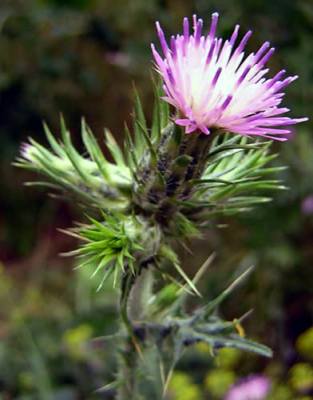 Slender ThistleCarduus tenuiflorus
-
 Great Marsh ThistleCarduus personata
-
 Alpine ThistleCarduus defloratus
- Carduus carlinifolius
- Carduus nigrescens
Compare
Questions and answers
What is the scientific name of the Plumeless Thistle?
The scientific name of the Plumeless Thistle is Carduus acanthoides. Written with its author, the full name is Carduus acanthoides L..
Which family does the Plumeless Thistle belong to?
Carduus acanthoides belongs to the family Asteraceae, in the order Asterales and the class Magnoliopsida.
Where is the Plumeless Thistle found?
Checklists and occurrence records place Carduus acanthoides in 59 countries, including Russia, Slovakia, Sweden, Poland, Czechia and Ukraine.
What other names does the Plumeless Thistle have?
Carduus acanthoides is also known in English as Plumeless-thistle, Spiny Plumeless-thistle and Welted Thistle.
Sources
Passages the profile rests on
- Carduus acanthoides has spiny stems and foliage that may sometimes be woolly. Source passage: “The stem and foliage are spiny and sometimes woolly.” — English Wikipedia
- The plant initially grows as a flat basal rosette before producing an erect stem. Source passage: “The plant starts from a flat, basal rosette and then bolts an erect stem” — English Wikipedia
- Plumeless thistle stems bear spiny wings. Source passage: “Plumeless thistle stems also bear spiny wings.” — rex.libraries.wsu.edu
- Its leaves are occasionally toothed, wrinkled, and spiny. Source passage: “with occasional toothed, wrinkled, spiny leaves.” — English Wikipedia
- The leaves measure approximately 10–20 cm in length. Source passage: “The leaves are 4–8 in (10–20 cm) long” — English Wikipedia
- The leaf margins are lobed or pinnately divided. Source passage: “with lobed or pinnately-divided edges.” — English Wikipedia
- The undersides of the leaves are somewhat hairy. Source passage: “The abaxial surface (underside) of the leaf is somewhat hairy.” — English Wikipedia
- Each stem branch terminates in an inflorescence containing one or several flower heads. Source passage: “At the top of each branch of the stem is an inflorescence of one to several flower heads” — English Wikipedia
- The flower heads are rounded and covered with spiny phyllaries. Source passage: “each rounded, covered in spiny phyllaries” — English Wikipedia
- The flower heads contain numerous threadlike purple or pink disc florets. Source passage: “bearing many threadlike, purple or pink disc florets.” — English Wikipedia
- The flower heads measure approximately 13–25 mm across. Source passage: “Each flowerhead is around 0.5–1 in (13–25 mm) across.” — English Wikipedia
- The plant produces four-angled achenes with faint longitudinal stripes. Source passage: “The achenes are 2–3 mm long, four-angled, with faint lengthwise stripes.” — English Wikipedia
- The achenes measure approximately 2–3 mm in length. Source passage: “The achenes are 2–3 mm long” — English Wikipedia
- The pappus bristles measure approximately 11–13 mm in length. Source passage: “The fluffy pappus bristles are 11–13 mm long.” — English Wikipedia
- Within its native range, the species occurs in open grasslands and disturbed areas. Source passage: “In its native range the plant is found in open grasslands and disturbed areas” — English Wikipedia
- In non-native regions, the species occurs in annual grasslands, roadsides, fields, pastures, and disturbed areas. Source passage: “in non-native ranges it is a weed of annual grasslands, roadsides, fields and pastures, and disturbed areas.” — English Wikipedia
- In Michigan and Wisconsin, the species occurs in disturbed locations such as railroad rights-of-way, roadsides, and farm fields rather than remnant native habitats. Source passage: “In Michigan and Wisconsin, it does not occur in remnant, native habitats, but rather those with a history of disturbance, such as railroad right-of-ways, roadsides, and farm fields.” — English Wikipedia
- The species is native to Europe and Asia. Source passage: “The plant is native to Europe and Asia” — English Wikipedia
- Its stated native range extends from France, Italy, and western Turkey through Russia and Kazakhstan to China. Source passage: “Carduus acanthoides is native from France, Italy, and western Turkey; through Russia and Kazakhstan; to China.” — English Wikipedia
- The species has been introduced across much of North America. Source passage: “The plant has introduced broadly across much of North America” — English Wikipedia
- The species can form dense, weedy stands consisting of a single species. Source passage: “can form weedy monotypic stands.” — English Wikipedia
- The plant flowers throughout summer and early autumn. Source passage: “It flowers throughout the summer and early fall.” — English Wikipedia
- The species spreads through its seeds. Source passage: “It spreads through its seeds.” — English Wikipedia
- Each plant produces approximately 1,000 seeds. Source passage: “Each plant creates around 1,000 seeds.” — English Wikipedia
- The species produces seeds in the form of achenes. Source passage: “After flowering and setting seed, it dies.” — English Wikipedia
- The species is considered an invasive species in some introduced regions. Source passage: “where it is sometimes considered an invasive species.” — English Wikipedia
- The species is sometimes classified as a noxious weed in North America. Source passage: “where it is sometimes considered a noxious weed or invasive species.” — English Wikipedia
- California has an active program to control known populations of the species. Source passage: “The California Department of Food and Agriculture has an active program to control known populations.” — English Wikipedia
- The species has beneficial effects on native bees in North America. Source passage: “However, the plant has beneficial impacts on the native bees in North America.” — English Wikipedia
Data
- Catalogue of Life, 2026-10-16 XR cc by
- Global Biodiversity Information Facility CC BY 4.0
- Wikidata CC0
- GeoNames CC BY 4.0
- Wikimedia Commons per image; credit shown with each image
- Within the Catalogue of Life, this name comes from Synonymic Checklists of the Vascular Plants of the World cc by
References
- L. where the name was published
This species in other databases
Page built on 27 November 2026. See how the catalog is made and all sources and licences.
Cite this page
ScientificNames.org. (2026). Carduus acanthoides (Plumeless Thistle). Retrieved November 27, 2026, from https://scientificnames.org/species/carduus-acanthoides
“Carduus acanthoides (Plumeless Thistle).” ScientificNames.org, 2026, scientificnames.org/species/carduus-acanthoides. Accessed 27 Nov. 2026.
ScientificNames.org. “Carduus acanthoides (Plumeless Thistle).” Accessed November 27, 2026. https://scientificnames.org/species/carduus-acanthoides.
@misc{scientificnames_carduus_acanthoides_plumeless_thistle,
  author = {{ScientificNames.org}},
  title = {Carduus acanthoides (Plumeless Thistle)},
  year = {2026},
  url = {https://scientificnames.org/species/carduus-acanthoides},
  note = {Accessed 2026-11-27}
}