Species · Flowering plants
Curly Plumeless-thistle Carduus crispus
The scientific name of the Curly Plumeless-thistle is Carduus crispus. It is a species of flowering plant in the family Asteraceae (composite), order Asterales.
- Scientific name
- Carduus crispus L.
- Common name
- Curly Plumeless-thistle
- Genus
- Carduus
- Family
- Asteraceae (Composite)
- Order
- Asterales
- Class
- Magnoliopsida
- Recorded in
- 53 countries
- Name status
- accepted in the Catalogue of Life

Overview
Carduus crispus is native to Europe and Asia, including Armenia and China, and has become naturalized in Greenland, parts of the United States and Canada, and India. It has an upright growth habit, leaves with white-haired undersides, and purple, pink, or white flowers.
Written 26 November 2026 from the sources listed below. Each statement was checked against the passage it cites; statements that could not be supported were removed.
Appearance
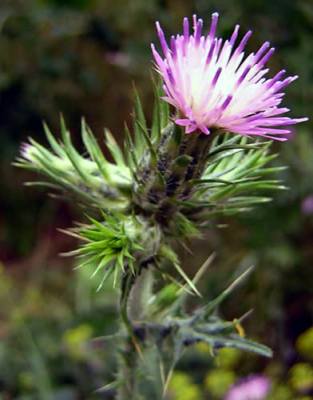
The curly plumeless-thistle has an upright growth habit. Its simple, alternate leaves begin at the plant's base and may be lobed or unlobed, with toothed or lobed margins.[1][2][3][4]
The upper leaf surfaces have relatively little hair, while the undersides have white hairs. The leaf petioles are winged at their bases.[5][6]
Typical plants range from 50 to 180 centimetres in height, with a maximum height of 3 metres. The leaf blades measure 10–20 centimetres in length.[7][8][9]
Its flower heads measure 15–18 millimetres across and contain disk-shaped flowers but no ray-shaped flowers. The flowers range from purple to pink and white and are hermaphroditic, containing both male and female reproductive parts.[10][11][12][13]
Its fruits are yellow or slightly grey-brown achenes. These flattened, round-shaped fruits have long, unbranched hairs attached at one end.[14][15]
Habitat
The curly plumeless-thistle grows in pastures and along roadsides. It requires wet soil and substantial sunlight and is not shade tolerant.[16][17][18]
Reproduction and life cycle
The species begins flowering in May. Insects, including bees, pollinate its flowers.[19][20]
Wind is the principal means of seed dispersal. The long, unbranched hairs on its achenes assist wind dispersal.[21][22]
Diet
Caterpillars of the painted lady butterfly (Vanessa cardui) feed on the curly plumeless-thistle.[23]
Conservation
Carduus crispus is considered a noxious weed in several United States states, including West Virginia.[24]
Uses
Bees use the plant for honey production.[25]
The plant has been reported to possess anti-tumour properties associated with the alkaloid Crispine B. Crispine B is described as a cytotoxic alkaloid that can prevent cancer cells from replicating.[26][27]
The roots are reported to have pain-relieving properties.[28]
Classification of the Curly Plumeless-thistle
| Kingdom | Plantae |
|---|---|
| Subkingdom | Pteridobiotina |
| Phylum | Tracheophyta |
| Class | Magnoliopsida |
| Order | Asterales |
| Family | Asteraceae (Composite) |
| Subfamily | Carduoideae |
| Tribe | Cardueae |
| Subtribe | Carduinae |
| Genus | Carduus (Thistle) |
| Species | Carduus crispus L. |
Where the Curly Plumeless-thistle is found
Checklists and occurrence records place Carduus crispus in 53 countries across Asia, Europe and North America. GBIF holds 211,318 georeferenced records of it.
Countries where it is native or its origin is not stated
- Aland Islands 165
- Armenia 11
- Austria 1,148
- Azerbaijan 4
- Belarus 262
- Belgium 8,990
- Bulgaria 5
- China 688
- Croatia 2
- Czechia 1,178
- Denmark 5,842
- Estonia 1,674
- Finland 8,114
- France 28,468
- Georgia 11
- Greece 4
- Guernsey
- Hungary 68
- India 4
- Ireland 5
- Isle of Man 6
- Italy 27
- Japan 470
- Jersey
- Kazakhstan 64
- Kosovo
- Kyrgyzstan 3
- Latvia 32
- Liechtenstein 18
- Lithuania 167
- Luxembourg 477
- Moldova 4
- Mongolia 54
- Montenegro
- North Korea 24
- North Macedonia
- Norway 4,060
- Poland 2,260
- Romania 25
- Russia 11,088
- Serbia
- Slovakia 808
- Slovenia 3
- South Korea 2,140
- Spain 259
- Sweden 17,296
- Switzerland 1,228
- The Netherlands 37,437
- Ukraine 1,100
- United Kingdom 58,765
Countries where it has been introduced
Regions and cities with the most records
- England, United Kingdom 53,307
- Gelderland, The Netherlands 8,237
- Grand Est, France 7,661
- Hauts-de-France, France 6,207
- Bavaria, Germany 5,469
- Beuningen, The Netherlands 5,244
- Elst, The Netherlands 5,132
- Île-de-France, France 5,122
- Maastricht, The Netherlands 5,107
- Nijmegen, The Netherlands 5,102
- Lanaken, Belgium 4,580
- Wijchen, The Netherlands 4,463
- Limburg, The Netherlands 4,462
- Hoensbroek, The Netherlands 4,440
- Geleen, The Netherlands 4,420
- Maasmechelen, Belgium 4,417
- Mechelen-aan-de-Maas, Belgium 4,382
- Berkel en Rodenrijs, The Netherlands 4,317
- Huissen, The Netherlands 4,297
- Pijnacker, The Netherlands 4,200
- Bergschenhoek, The Netherlands 4,194
- Riemst, Belgium 4,023
- Arnhem, The Netherlands 3,954
- Nootdorp, The Netherlands 3,954
- Visé, Belgium 3,862
- Capelle aan den IJssel, The Netherlands 3,854
- Wageningen, The Netherlands 3,837
- Benthuizen, The Netherlands 3,800
- Rotterdam, The Netherlands 3,790
- Bilzen, Belgium 3,758
- Ypenburg, The Netherlands 3,752
- Sittard, The Netherlands 3,723
- Groesbeek, The Netherlands 3,717
- Velp, The Netherlands 3,701
- Delft, The Netherlands 3,644
- Zoetermeer, The Netherlands 3,637
A number beside a place is its count of GBIF occurrence records. A place without a number comes from a checklist alone. Records show where a species has been observed or collected, which can include escapes and vagrants.
Common names
English
- Curly Plumeless-thistle
- Curled Thistle
- Welted Thistle
Names in 8 other languages
- Danish
- Kruset tidsel
- Dutch
- Kruldistel
- Finnish
- kyläkarhiainen
- French
- chardon crépu, chardon frisé
- German
- krause Distel
- Norwegian Nynorsk
- krusetistel
- Swedish
- krustistel
- Welsh
- Ysgall Crych, Ysgall Crychion, Ysgallen Grech, Ysgallen Grych
Synonyms
3 other scientific names have been used for this species and are now treated as synonyms of Carduus crispus.
- Carduus crispus var. albus Makino
- Carduus crispus var. crispus
- Carduus crispus var. microcephalus Domin
Subspecies and varieties
- Carduus crispus subsp. crispus (Curly Plumeless Thistle) subspecies
- Carduus crispus subsp. multiflorus subspecies
Related species
-
 Musk ThistleCarduus nutans
-
 Plumeless ThistleCarduus acanthoides
-
 Italian ThistleCarduus pycnocephalus
-
 Slender ThistleCarduus tenuiflorus
-
 Great Marsh ThistleCarduus personata
-
 Alpine ThistleCarduus defloratus
- Carduus carlinifolius
- Carduus nigrescens
Compare
Questions and answers
What is the scientific name of the Curly Plumeless-thistle?
The scientific name of the Curly Plumeless-thistle is Carduus crispus. Written with its author, the full name is Carduus crispus L..
Which family does the Curly Plumeless-thistle belong to?
Carduus crispus belongs to the family Asteraceae, in the order Asterales and the class Magnoliopsida.
Where is the Curly Plumeless-thistle found?
Checklists and occurrence records place Carduus crispus in 53 countries, including United Kingdom, The Netherlands, France, Sweden, Russia and Belgium.
What other names does the Curly Plumeless-thistle have?
Carduus crispus is also known in English as Curled Thistle and Welted Thistle.
Which thistles are invasive?
The curly plumeless-thistle has become naturalized in Greenland, parts of the United States and Canada, and India. It is considered a noxious weed in several United States states, including West Virginia.[29][24]
Where do thistles thrive?
The curly plumeless-thistle grows in pastures and along roadsides. It requires wet soil and substantial sunlight and is not shade tolerant.[16][17][18]
Do thistles have any medicinal properties?
The curly plumeless-thistle has been reported to possess anti-tumour properties associated with the alkaloid Crispine B, which is described as cytotoxic and able to prevent cancer cells from replicating. Its roots are also reported to have pain-relieving properties.[26][27][28]
Sources
Passages the profile rests on
- Carduus crispus has an upright growth habit. Source passage: “Carduus crispus has upright growth” — English Wikipedia
- Its leaves are simple and alternate, beginning at the plant's base. Source passage: “The leaves of this plant are simple, alternate and they start at the base of the pant.” — English Wikipedia
- Its leaves may be either lobed or unlobed. Source passage: “The leaves cannot be in leaflets, but they can vary between being lobed and unlobed.” — English Wikipedia
- Its leaf margins may be toothed, lobed, or both. Source passage: “The blade edges of the leaves can either be toothed, have lobes, or have both.” — English Wikipedia
- The upper leaf surfaces have relatively little hair, whereas the undersides have white hairs. Source passage: “The top of the leaves does not have a lot of hair, while the underside of the leaves has white hair.” — English Wikipedia
- The leaf petioles are winged at their bases. Source passage: “the petioles are winged at the base of the leaves.” — English Wikipedia
- Individual plants can reach a maximum height of 3 metres. Source passage: “individuals can grow up to 3 metres (10 ft) tall” — English Wikipedia
- The typical plant height ranges from 50 to 180 centimetres. Source passage: “the typical height being 50–180 centimetres (19+1⁄2–71 in).” — English Wikipedia
- Its leaf blades measure 10–20 centimetres in length. Source passage: “The size of the leaf blades varies from 10–20 centimetres (4–8 in) in length” — English Wikipedia
- Its flower heads measure 15–18 millimetres across. Source passage: “with the head width reaching 15 to 18 millimetres (5⁄8 to 3⁄4 in).” — English Wikipedia
- Its flower heads contain disk-shaped flowers but no ray-shaped flowers. Source passage: “this plant does not have any ray-shaped flowers, only disk-shaped flowers” — English Wikipedia
- Its flowers range in colour from purple to pink and white. Source passage: “The colours of the flowers can range from purple to pink and white.” — English Wikipedia
- Its flowers are hermaphroditic, containing both male and female reproductive parts. Source passage: “The flowers are hermaphrodite, as they have both male and female parts.” — English Wikipedia
- Its fruits are achenes that are yellow or slightly grey-brown. Source passage: “The type of fruit this species produces is called achenes, and they are yellow or slightly gray and brown in colour.” — English Wikipedia
- Its flattened, round-shaped achenes have long, unbranched hairs attached at one end. Source passage: “The round-shaped fruit is flattened, and attached to one end are long unbranched hairs” — English Wikipedia
- The species grows in pastures and along roadsides. Source passage: “can be found in areas such as pastures and along the sides of the road.” — English Wikipedia
- The species requires wet soil for growth. Source passage: “The soil must be wet” — English Wikipedia
- The species requires substantial sunlight and is not shade tolerant. Source passage: “It needs a lot of sunlight, and therefore is not shade tolerant.” — English Wikipedia
- The species begins flowering in May. Source passage: “This species flowers from May” — English Wikipedia
- Insects including bees pollinate its flowers. Source passage: “The flowers are pollinated by insects such as bees.” — English Wikipedia
- Wind is the principal means of seed dispersal for this species. Source passage: “Its main form of seed dispersal is by wind.” — English Wikipedia
- Long unbranched hairs on its achenes assist wind dispersal. Source passage: “long unbranched hairs that aid wind dispersal.” — English Wikipedia
- Caterpillars of the painted lady butterfly (Vanessa cardui) feed on this species. Source passage: “The species and genus is a favorite food plant of caterpillars of the painted lady butterfly (Vanessa cardui)” — English Wikipedia
- Carduus crispus is considered a noxious weed in several United States states, including West Virginia. Source passage: “a noxious weed in several U.S. states, including West Virginia.” — English Wikipedia
- Bees use this plant for honey production. Source passage: “It is also used by bees for honey production.” — English Wikipedia
- The plant has been reported to possess anti-tumour properties associated with the alkaloid Crispine B. Source passage: “This plant has been found to have anti-tumour properties, the active ingredient is Crispine B” — English Wikipedia
- Crispine B is described as a cytotoxic alkaloid that can prevent cancer cells from replicating. Source passage: “an alkaloid that has cytotoxic properties, meaning that Crispine B is toxic enough to prevent cancer cells from replicating.” — English Wikipedia
- The roots are reported to have pain-relieving properties. Source passage: “The roots of C. crispus are said to have anodyne properties” — English Wikipedia
- The species has become naturalized in Greenland, parts of the United States and Canada, and India. Source passage: “C. crispus is naturalized in Greenland, parts of the United States and Canada, and India” — English Wikipedia
Data
- Catalogue of Life, 2026-10-16 XR cc by
- Global Biodiversity Information Facility CC BY 4.0
- Wikidata CC0
- GeoNames CC BY 4.0
- Wikimedia Commons per image; credit shown with each image
- Within the Catalogue of Life, this name comes from Synonymic Checklists of the Vascular Plants of the World cc by
References
- L. where the name was published
This species in other databases
Page built on 28 November 2026. See how the catalog is made and all sources and licences.
Cite this page
ScientificNames.org. (2026). Carduus crispus (Curly Plumeless-thistle). Retrieved November 28, 2026, from https://scientificnames.org/species/carduus-crispus
“Carduus crispus (Curly Plumeless-thistle).” ScientificNames.org, 2026, scientificnames.org/species/carduus-crispus. Accessed 28 Nov. 2026.
ScientificNames.org. “Carduus crispus (Curly Plumeless-thistle).” Accessed November 28, 2026. https://scientificnames.org/species/carduus-crispus.
@misc{scientificnames_carduus_crispus_curly_plumeless_thistle,
  author = {{ScientificNames.org}},
  title = {Carduus crispus (Curly Plumeless-thistle)},
  year = {2026},
  url = {https://scientificnames.org/species/carduus-crispus},
  note = {Accessed 2026-11-28}
}