Species · Flowering plants
Musk Thistle Carduus nutans
The scientific name of the Musk Thistle is Carduus nutans. It is a species of flowering plant in the family Asteraceae (composite), order Asterales.
- Scientific name
- Carduus nutans L.
- Common name
- Musk Thistle
- Genus
- Carduus
- Family
- Asteraceae (Composite)
- Order
- Asterales
- Class
- Magnoliopsida
- Recorded in
- 73 countries
- Name status
- accepted in the Catalogue of Life

Overview
Carduus nutans commonly grows in meadows, grasslands, heavily grazed pastures, and other open disturbed soils. It is marked by globose flower heads with purple-red bracts and mature heads that droop at an angle of 90 to 120 degrees from the stem.
Written 26 November 2026 from the sources listed below. Each statement was checked against the passage it cites; statements that could not be supported were removed.
Appearance
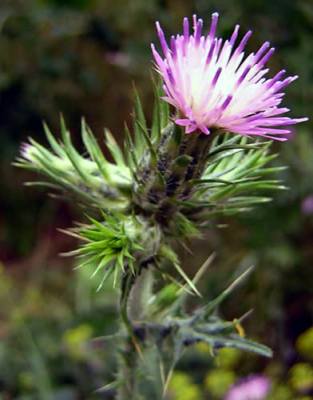
Musk thistle has dark-green, prickly, coarsely lobed leaves with a smooth, waxy surface. Its stems are covered with cottony hairs and have thin ribs.[1][2]
Its globose flower heads contain hundreds of small individual flowers and have purple-red bracts. The flowers range from deep rose to violet, with white flowers occurring rarely.[3][4][5]
Mature flower heads droop at an angle of 90 to 120 degrees from the stem. The fruits are achenes bearing seeds with a hair-like pappus.[6][7]
Habitat
Musk thistle commonly grows in meadows and grasslands. It colonizes heavily grazed pastures, disturbed pastures, roadside ditches, ditch banks, hayfields, and disturbed prairies.[8][9][10]
It occurs in neutral to acidic soils and does not grow well in excessively wet, dry, or shady conditions. It can form dense stands on highly disturbed sites with little competition.[11][12][13]
Reproduction and life cycle
Musk thistle is typically biennial but can complete its life cycle as an annual. Its florets mature progressively from the outside of the flower head toward the centre, and each floret contains both male and female reproductive organs.[14][15][16]
Fertilization occurs primarily through cross-pollination, although the species can produce seeds through self-pollination. Bees, bumblebees, and various Lepidoptera participate in its pollination.[17][18][19]
A single plant can produce approximately 20,000 seeds. Seeds are primarily dispersed by wind and can remain viable in the soil seed bank for up to 20 years.[20][21][22]
Flowering generally occurs between June and October. Seed dissemination occurs approximately one month after flower formation.[23][24]
Behaviour
Musk thistle overwinters in its basal rosette stage, which measures four to eighteen inches wide. Second-year plants usually begin stem elongation in late May.[25][26]
Its seeds detach quickly but generally remain close to the parent plant.[27]
Diet
Livestock generally do not consume musk thistle.[28]
Conservation
According to the 2002 report, musk thistle is classified as a noxious, restricted, or prohibited weed or weed seed in 22 US states and four Canadian provinces. The species has no special federal legal status in the United States according to the report.[29][30]
Similar species
Musk thistle hybridizes with spiny plumeless thistle (Carduus acanthoides). Musk thistle and plumeless thistles are difficult to distinguish during the rosette stage.[31][32]
Uses
Turkish folk medicine has used parts of the flowering branches to treat prostate disease. Herbal preparations containing musk thistle have historically been used for liver disease, malaria, constipation, and kidney stones.[33][34]
Classification of the Musk Thistle
| Kingdom | Plantae |
|---|---|
| Subkingdom | Pteridobiotina |
| Phylum | Tracheophyta |
| Class | Magnoliopsida |
| Order | Asterales |
| Family | Asteraceae (Composite) |
| Subfamily | Carduoideae |
| Tribe | Cardueae |
| Subtribe | Carduinae |
| Genus | Carduus (Thistle) |
| Species | Carduus nutans L. |
Where the Musk Thistle is found
Checklists and occurrence records place Carduus nutans in 73 countries across Africa, Asia, Europe, North America, Oceania and South America. GBIF holds 152,450 georeferenced records of it.
Countries where it is native or its origin is not stated
- Afghanistan 1
- Albania 36
- Algeria 14
- Andorra 16
- Armenia 65
- Austria 852
- Azerbaijan 24
- Belarus 9
- Belgium 725
- Bosnia and Herzegovina 18
- Bulgaria 146
- China 106
- Croatia 184
- Czechia 626
- Denmark 180
- Estonia 103
- Finland 283
- France 32,552
- Georgia 73
- Greece 270
- Guernsey 5
- Hungary 216
- India 51
- Iran 1
- Isle of Man 44
- Italy 1,313
- Kazakhstan 290
- Kosovo 8
- Kyrgyzstan 28
- Latvia 26
- Lithuania 2
- Luxembourg 534
- Moldova 25
- Mongolia 11
- Montenegro 39
- Morocco 24
- Nepal 4
- North Macedonia 16
- Norway 148
- Pakistan 6
- Poland 231
- Portugal 10
- Romania 162
- Russia 4,378
- Serbia 29
- Slovakia 683
- Slovenia 183
- South Africa 53
- Spain 1,776
- Sweden 2,160
- Switzerland 2,345
- Syria 6
- Tajikistan 2
- The Netherlands 13,180
- Tunisia 4
- Turkey 218
- Ukraine 822
- Uzbekistan 6
Countries where it has been introduced
- Argentina 542
- Australia 2,576
- Bolivia 68
- Brazil 28
- Canada 1,936
- Chile 69
- Germany 13,222
- Ireland 4
- Mexico 4
- New Zealand 540
- San Marino 1
- South Korea 8
- United Kingdom 42,507
- United States 25,617
- Uruguay 6
Regions and cities with the most records
- England, United Kingdom 38,583
- Auvergne-Rhône-Alpes, France 6,588
- Centre-Val de Loire, France 6,352
- Bourgogne-Franche-Comté, France 4,339
- Bavaria, Germany 4,165
- Texas, United States 4,165
- Colorado, United States 3,859
- Île-de-France, France 2,518
- Gelderland, The Netherlands 2,405
- Hellevoetsluis, The Netherlands 2,075
- Hauts-de-France, France 1,984
- Grand Est, France 1,938
- Provence-Alpes-Côte d'Azur, France 1,906
- North Rhine-Westphalia, Germany 1,815
- Pays de la Loire, France 1,779
- New South Wales, Australia 1,754
- Middelharnis, The Netherlands 1,739
- Velp, The Netherlands 1,707
- Didam, The Netherlands 1,695
- Nijmegen, The Netherlands 1,658
- Huissen, The Netherlands 1,621
- Zevenaar, The Netherlands 1,621
- Duiven, The Netherlands 1,605
- Arnhem, The Netherlands 1,586
- Elst, The Netherlands 1,576
- Salisbury, United Kingdom 1,524
- Maassluis, The Netherlands 1,512
- Mecklenburg-Vorpommern, Germany 1,504
- Maastricht, The Netherlands 1,502
- Occitanie, France 1,498
- Groesbeek, The Netherlands 1,441
- Wales, United Kingdom 1,313
- Beuningen, The Netherlands 1,298
- Kleve, Germany 1,282
- Visé, Belgium 1,273
- Middelburg, The Netherlands 1,260
2 more countries have a few records outside this range
These countries hold a few records of Carduus nutans but lie outside the range the checklists give for it. Such records are often zoo or garden specimens, museum material or vagrants, so the species is not counted as occurring there.
A number beside a place is its count of GBIF occurrence records. A place without a number comes from a checklist alone. Records show where a species has been observed or collected, which can include escapes and vagrants.
Common names
English
- Musk Thistle
- Nodding Plumeless-thistle
- Nodding Thistle
Names in 9 other languages
- Danish
- Nikkende tidsel
- Dutch
- Knikkende distel
- Finnish
- nuokkukarhiainen
- French
- chardon penché
- German
- Artengruppe Nickende Distel, Nickende Distel
- Norwegian Bokmål
- nikketistel
- Portuguese
- cardo-pendente
- Swedish
- nicktistel
- Welsh
- Ysgall Pendrwm, Ysgall Pengrwn, Ysgallen Bendrom, Ysgallen Ogwydd, Ysgallen Pendrymus
Synonyms
3 other scientific names have been used for this species and are now treated as synonyms of Carduus nutans.
- Carduus nutans
- Carduus nutans f. nutans
- Carduus nutans var. nutans
Subspecies and varieties
- Carduus nutans subsp. alpicola subspecies
- Carduus nutans subsp. falcatoincurvus subspecies
- Carduus nutans subsp. leiophyllus subspecies
- Carduus nutans subsp. micropterus subspecies
- Carduus nutans subsp. nutans (Musk Thistle) subspecies
- Carduus nutans subsp. perspinosus subspecies
- Carduus nutans subsp. platylepis subspecies
- Carduus nutans subsp. siculus subspecies
- Carduus nutans subsp. taygeteus subspecies
- Carduus nutans subsp. trojanus subspecies
Related species
-
 Plumeless ThistleCarduus acanthoides
-
 Italian ThistleCarduus pycnocephalus
-
 Curly Plumeless-thistleCarduus crispus
-
 Slender ThistleCarduus tenuiflorus
-
 Great Marsh ThistleCarduus personata
-
 Alpine ThistleCarduus defloratus
- Carduus carlinifolius
- Carduus nigrescens
Compare
Questions and answers
What is the scientific name of the Musk Thistle?
The scientific name of the Musk Thistle is Carduus nutans. Written with its author, the full name is Carduus nutans L..
Which family does the Musk Thistle belong to?
Carduus nutans belongs to the family Asteraceae, in the order Asterales and the class Magnoliopsida.
Where is the Musk Thistle found?
Checklists and occurrence records place Carduus nutans in 73 countries, including France, The Netherlands, Russia, Switzerland, Sweden and Spain.
What other names does the Musk Thistle have?
Carduus nutans is also known in English as Nodding Plumeless-thistle and Nodding Thistle.
Are musk thistles invasive?
Yes. Musk thistle has become invasive in North America, Australia, New Zealand, and Southern Africa.[35]
Is musk thistle good for anything?
Turkish folk medicine has used parts of its flowering branches to treat prostate disease. Herbal preparations containing the species have historically been used for liver disease, malaria, constipation, and kidney stones.[33][34]
Where does musk thistle come from?
Musk thistle is native to Europe, Western Siberia, Asia, and North Africa.[36]
Sources
Passages the profile rests on
- The plant has dark-green, prickly, coarsely lobed leaves with a smooth, waxy surface. Source passage: “The leaves are dark green, coarsely bipinnately lobed, with a smooth, waxy surface and sharp yellow-brown to whitish spines at the tips of the lobes.” — English Wikipedia
- Its stems are covered with cottony hairs and have thin ribs. Source passage: “The stem is cottony/hairy, with thin ribs along them.” — English Wikipedia
- Its flower heads are globose and contain hundreds of small individual flowers. Source passage: “The large globose flower heads, containing hundreds of tiny individual flowers” — English Wikipedia
- The flowers range from deep rose to violet, with white flowers occurring rarely. Source passage: “The plant bears showy flowers that range from a deep rose to violet color, rarely white.” — English Wikipedia
- The flower heads have purple-red bracts. Source passage: “with purple-red bracts.” — English Wikipedia
- Mature flower heads droop at an angle of 90 to 120 degrees from the stem. Source passage: “The flower heads commonly droop to a 90° to 120° angle from the stem when mature” — English Wikipedia
- The fruits are achenes bearing seeds with a hair-like pappus. Source passage: “The fruit is an achene bearing 0.3-0.5 cm seeds with a hair-like pappus” — fs.usda.gov
- The species commonly grows in meadows and grasslands. Source passage: “It typically grows in meadows and grasslands” — English Wikipedia
- It colonizes heavily grazed pastures and other open disturbed soils. Source passage: “in heavily grazed land in areas such as pastures, and on open disturbed soil such as roadsides and building sites.” — English Wikipedia
- It colonizes disturbed pastures, roadside ditches, ditch banks, hayfields, and disturbed prairies. Source passage: “Musk thistle colonizes in disturbed areas, such as pastures, roadside ditches, ditch banks, hayfields and disturbed prairies.” — extension.umn.edu
- It occurs in neutral to acidic soils. Source passage: “It is found in neutral to acidic soils.” — English Wikipedia
- It does not grow well in excessively wet, dry, or shady conditions. Source passage: “but does not grow well in excessively wet, dry, or shady conditions.” — English Wikipedia
- It can form dense stands on highly disturbed sites with little competition. Source passage: “Musk thistle is capable of forming dense stands, especially on highly disturbed sites where competition is low” — fs.usda.gov
- Musk thistle is typically biennial but can complete its life cycle as an annual. Source passage: “Musk thistle is typically a biennial, but it may complete its life cycle as an annual” — fs.usda.gov
- Its florets mature progressively from the outside of the flower head toward the centre. Source passage: “Musk thistle florets mature progressively from the periphery of the capitula inward.” — fs.usda.gov
- Each floret contains both male and female reproductive organs. Source passage: “Each floret bears male and female organs” — fs.usda.gov
- Fertilization occurs primarily through cross-pollination. Source passage: “fertilization is primarily by outcrossing” — fs.usda.gov
- The species can produce seeds through self-pollination. Source passage: “Musk thistle can also produce a large number of seeds through self-pollination.” — fs.usda.gov
- Bees, bumblebees, and various Lepidoptera participate in its pollination. Source passage: “including bees, bumblebees, and various Lepidoptera” — fs.usda.gov
- A single plant can produce approximately 20,000 seeds. Source passage: “up to about 20,000 seeds per plant.” — English Wikipedia
- Seeds are primarily dispersed by wind. Source passage: “Seeds are mainly wind dispersed” — English Wikipedia
- Seeds can remain viable in the soil seed bank for up to 20 years. Source passage: “can survive in the soil seed bank for up to 20 years.” — English Wikipedia
- Flowering generally occurs between June and October. Source passage: “Flowering occurs from June to October” — English Wikipedia
- Seed dissemination occurs approximately one month after flower formation. Source passage: “seed dissemination occurs approximately one month after the flowers form.” — English Wikipedia
- The plant overwinters in its basal rosette stage, which measures four to eighteen inches wide. Source passage: “overwinters in the rosette stage, four to eighteen inches wide.” — extension.umn.edu
- Second-year plants usually begin stem elongation in late May. Source passage: “Second year plants usually bolt in late May.” — extension.umn.edu
- Its seeds detach quickly but generally remain close to the parent plant. Source passage: “Seeds detach quickly and don’t fall far from parent plant, creating monoculture carpet.” — extension.umn.edu
- Livestock generally do not consume musk thistle. Source passage: “Livestock do not eat it, giving it a competitive edge against native species.” — extension.umn.edu
- Musk thistle is classified as a noxious, restricted, or prohibited weed or weed seed in 22 US states and four Canadian provinces, according to the 2002 report. Source passage: “At the time of this writing (2002), musk thistle is classified as a noxious, restricted or prohibited weed or weed seed in 22 states in the United States and 4 Canadian provinces” — fs.usda.gov
- The species has no special federal legal status in the United States according to the report. Source passage: “FEDERAL LEGAL STATUS: No special status” — fs.usda.gov
- Musk thistle hybridizes with spiny plumeless thistle (Carduus acanthoides). Source passage: “Hybridization and introgression between musk thistle and spiny plumeless thistle (Carduus acanthoides) have been reported.” — fs.usda.gov
- Musk thistle and plumeless thistles are difficult to distinguish during the rosette stage. Source passage: “Musk and plumeless thistles hybridize and are very similar in the rosette stage.” — extension.umn.edu
- Turkish folk medicine has used parts of the flowering branches to treat prostate disease. Source passage: “Turkish folk medicine has used parts of the flowering branches to treat prostate disease.” — English Wikipedia
- Herbal preparations containing the species have historically been used for liver disease, malaria, constipation, and kidney stones. Source passage: “it has been used for treatment of liver disease, malaria, constipation, and kidney stones.” — English Wikipedia
- It has become invasive in North America, Australia, New Zealand, and Southern Africa. Source passage: “It has become invasive in North America, Australia, New Zealand, and Southern Africa.” — English Wikipedia
- The species is native to Europe, Western Siberia, Asia, and North Africa. Source passage: “Carduus nutans is native to Europe, Western Siberia, Asia, and North Africa.” — English Wikipedia
Data
- Catalogue of Life, 2026-10-16 XR cc by
- Global Biodiversity Information Facility CC BY 4.0
- Wikidata CC0
- GeoNames CC BY 4.0
- Wikimedia Commons per image; credit shown with each image
- Within the Catalogue of Life, this name comes from Synonymic Checklists of the Vascular Plants of the World cc by
References
- L. where the name was published
This species in other databases
Page built on 26 November 2026. See how the catalog is made and all sources and licences.
Cite this page
ScientificNames.org. (2026). Carduus nutans (Musk Thistle). Retrieved November 26, 2026, from https://scientificnames.org/species/carduus-nutans
“Carduus nutans (Musk Thistle).” ScientificNames.org, 2026, scientificnames.org/species/carduus-nutans. Accessed 26 Nov. 2026.
ScientificNames.org. “Carduus nutans (Musk Thistle).” Accessed November 26, 2026. https://scientificnames.org/species/carduus-nutans.
@misc{scientificnames_carduus_nutans_musk_thistle,
  author = {{ScientificNames.org}},
  title = {Carduus nutans (Musk Thistle)},
  year = {2026},
  url = {https://scientificnames.org/species/carduus-nutans},
  note = {Accessed 2026-11-26}
}