Species · Crustaceans
Tiger Shrimp Caridina mariae
The scientific name of the Tiger Shrimp is Caridina mariae. It is a species of crustacean in the family Atyidae (atyid shrimps), order Decapoda. The name dates from 2014.
- Scientific name
- Caridina mariae Klotz & von Rintelen, 2014
- Common name
- Tiger Shrimp
- Genus
- Caridina
- Family
- Atyidae (Atyid Shrimps)
- Order
- Decapoda
- Class
- Malacostraca
- Environment
- freshwater
- Recorded in
- 1 country
- Name status
- accepted in the Catalogue of Life

Overview
Caridina mariae has a semitransparent body with dark brown to black carapace blotches and stripes, and lacks dark markings on its tail fan.
Written 26 November 2026 from the sources listed below. Each statement was checked against the passage it cites; statements that could not be supported were removed.
Appearance
The tiger shrimp has a semitransparent body with dark brown to black blotches on its carapace. Dark brown to black stripes extend along the posterior carapace and first six abdominal segments.[1][2]
Some individuals have orange eyes and orange highlights on their tail fins. The species lacks dark markings on its tail fan.[3][4]
Adult individuals reach approximately 25–38 mm in length, and females are larger than males. Females have a curved underbelly.[5][6][7]
Habitat
The species prefers very clean, soft water with a pH of approximately 6.5. Its preferred water temperature is approximately 18–24 °C.[8][9][10]
Diet
The tiger shrimp is omnivorous.[11]
Behaviour
The tiger shrimp is peaceful and non-aggressive.[12]
Reproduction and life cycle
The tiger shrimp exhibits direct larval development, with one larval stage before becoming juvenile. The larval stage is well developed and resembles the adult form.[13][14]
Larvae possess functional walking pereiopods and swimming pleopods. The larval stage is non-feeding and lecithotrophic.[15][16]
Newly hatched larvae measure no more than 3 mm in length. They grow to adult size through molting, and the gestation period is approximately 30 days.[17][18][19]
Juveniles resemble adult tiger shrimp and may display blue, orange, or yellow coloration. Their coloration becomes darker and more intense as they mature.[20][21]
Uses
The tiger shrimp is popular in hobby aquariums.[22]
Similar species
Phylogenetic analysis identified Caridina cantonensis as a sister species of Caridina mariae. The original 2014 description identified both Caridina cantonensis and Caridina logemanni as sister species.[23][24]
Classification of the Tiger Shrimp
| Kingdom | Animalia |
|---|---|
| Phylum | Arthropoda |
| Subphylum | Crustacea |
| Class | Malacostraca |
| Order | Decapoda |
| Suborder | Pleocyemata |
| Infraorder | Caridea |
| Superfamily | Atyoidea |
| Family | Atyidae (Atyid Shrimps) |
| Genus | Caridina |
| Species | Caridina mariae Klotz & von Rintelen, 2014 |
Origin of the name. Etymology. Caridina mariae n. sp. is named after the wife of the first author, Maria, for her support during several field trips and her abundant patience when the first author is spending most evenings behind the microscope.
Where the Tiger Shrimp is found
Checklists and occurrence records place Caridina mariae in 1 country across Asia. GBIF holds 12 georeferenced records of it.
Countries
Regions and cities with the most records
Range as the checklists state it
Southern Asia
A number beside a place is its count of GBIF occurrence records. A place without a number comes from a checklist alone. Records show where a species has been observed or collected, which can include escapes and vagrants.
Common names
English
- Tiger Shrimp
Names in 2 other languages
- Chinese
- 瑪麗米蝦/虎紋蝦
- German
- Supertigergarnele, Tigergarnele
Related species
-
 Amano ShrimpCaridina multidentata
-
 Bee ShrimpCaridina cantonensis
-
 Sulawesi Cardinal ShrimpCaridina dennerli
-
 Needlenose CaridinaCaridina gracilirostris
-
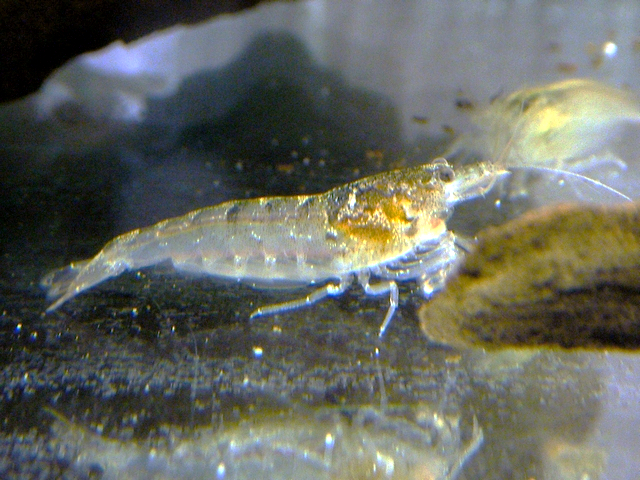 Typical CaridinaCaridina typus
-
 Ninja ShrimpCaridina serratirostris
- Common CaridinaCaridina nilotica
-
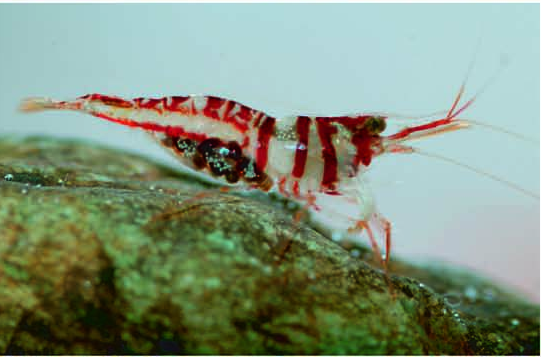 Towuti Sponge-associated ShrimpCaridina spongicola
Compare
Questions and answers
What is the scientific name of the Tiger Shrimp?
The scientific name of the Tiger Shrimp is Caridina mariae. Written with its author, the full name is Caridina mariae Klotz & von Rintelen, 2014.
Which family does the Tiger Shrimp belong to?
Caridina mariae belongs to the family Atyidae, in the order Decapoda and the class Malacostraca.
Where is the Tiger Shrimp found?
Checklists and occurrence records place Caridina mariae in 1 country: China.
What is special about tiger shrimp?
The tiger shrimp has a semitransparent body with dark brown to black carapace blotches and stripes along the posterior carapace and first six abdominal segments. It lacks dark markings on its tail fan.[1][2][4]
What do caridina shrimp eat?
The tiger shrimp is omnivorous.[11]
Sources
Passages the profile rests on
- The species has a semitransparent body with dark brown to black blotches on its carapace. Source passage: “The natural coloration of the shrimp is a semitransparent body, with dark brown to black blotches on the carapace” — English Wikipedia
- The species has dark brown to black stripes along the posterior carapace and first six abdominal segments. Source passage: “dark brown to black "tiger" stripes along the posterior part of the carapace and along the first six abdominal segments.” — English Wikipedia
- Some individuals have orange eyes and orange highlights on their tail fins. Source passage: “Variations of the species may also have orange eyes, and orange highlights in the tail fins.” — English Wikipedia
- The species lacks dark markings on its tail fan. Source passage: “There is also a lack of dark markings on the tail fan” — English Wikipedia
- Adult individuals reach approximately 25–38 mm in length. Source passage: “At full size, these shrimp reach about 1–1.5 in (25–38 mm) in length” — English Wikipedia
- Females are larger than males. Source passage: “with females of the species being larger than the males” — English Wikipedia
- Females have a curved underbelly. Source passage: “and having a curved underbelly.” — English Wikipedia
- The species prefers very clean, soft water. Source passage: “They prefer very clean, soft water” — English Wikipedia
- The species prefers water with a pH of approximately 6.5. Source passage: “preferring a pH of about 6.5” — English Wikipedia
- The preferred water temperature is approximately 18–24 °C. Source passage: “and a temperature of 65–75 °F (18–24 °C).” — English Wikipedia
- The species is omnivorous. Source passage: “Caridina mariae are peaceful, non-aggressive omnivores” — English Wikipedia
- The species is peaceful and non-aggressive. Source passage: “Caridina mariae are peaceful, non-aggressive omnivores” — English Wikipedia
- The species exhibits direct larval development and has one larval stage before becoming juvenile. Source passage: “exhibits direct larval development and has only one larval stage before becoming juvenile.” — English Wikipedia
- The larval stage is well developed and resembles the adult form. Source passage: “Their larval stage is well-developed and resembles the adult” — English Wikipedia
- Larvae possess functional walking pereiopods and swimming pleopods. Source passage: “with functional walking pereiopods and swimming pleopods.” — English Wikipedia
- The larval stage is non-feeding and lecithotrophic. Source passage: “The larval stage does not feed and can be classified as lecithotrophic.” — English Wikipedia
- Newly hatched larvae measure no more than 3 mm in length. Source passage: “Larvae are born not more than 3 mm (0.12 in) in length” — English Wikipedia
- Larvae grow to adult size through molting. Source passage: “and grow to full size through molting.” — English Wikipedia
- The gestation period is approximately 30 days. Source passage: “The gestation period is about 30 days.” — English Wikipedia
- Juveniles resemble adult tiger shrimp and may display blue, orange, or yellow coloration. Source passage: “The young of this species will resemble adult tiger shrimp, with blue, orange, or yellow coloration, when applicable” — English Wikipedia
- Juvenile coloration becomes darker and more intense as individuals mature. Source passage: “becoming darker and more intense as the young mature.” — English Wikipedia
- The species is popular in hobby aquariums. Source passage: “that are popular in hobby aquariums.” — English Wikipedia
- Phylogenetic analysis identified Caridina cantonensis as a sister species of Caridina mariae. Source passage: “likewise found Caridina mariae to be sister to C. cantonensis.” — English Wikipedia
- The original 2014 description identified Caridina cantonensis and Caridina logemanni as sister species of Caridina mariae. Source passage: “the species was recovered as sister to C. cantonensis and C. logemanni (also described in that paper).” — English Wikipedia
Data
- Catalogue of Life, 2026-10-16 XR cc by
- Global Biodiversity Information Facility CC BY 4.0
- Wikidata CC0
- GeoNames CC BY 4.0
- Wikimedia Commons per image; credit shown with each image
- Within the Catalogue of Life, this name comes from The Integrated Taxonomic Information System cc0
References
- Klotz, Werner, & and Thomas von Rintelen. (2014). To “bee” or not to be--on some ornamental shrimp from Guangdong Province, Southern China and Hong Kong SAR, with descriptions of three new species. Zootaxa, Vol. 3889, No. 2. Link where the name was published
This species in other databases
- Catalogue of Life 8VKBF
- Wikidata Q18028618
- iNaturalist 1070654
- WoRMS urn:lsid:marinespecies.org:taxname:877336
Page built on 30 November 2026. See how the catalog is made and all sources and licences.
Cite this page
ScientificNames.org. (2026). Caridina mariae (Tiger Shrimp). Retrieved November 30, 2026, from https://scientificnames.org/species/caridina-mariae
“Caridina mariae (Tiger Shrimp).” ScientificNames.org, 2026, scientificnames.org/species/caridina-mariae. Accessed 30 Nov. 2026.
ScientificNames.org. “Caridina mariae (Tiger Shrimp).” Accessed November 30, 2026. https://scientificnames.org/species/caridina-mariae.
@misc{scientificnames_caridina_mariae_tiger_shrimp,
  author = {{ScientificNames.org}},
  title = {Caridina mariae (Tiger Shrimp)},
  year = {2026},
  url = {https://scientificnames.org/species/caridina-mariae},
  note = {Accessed 2026-11-30}
}