Species · Crustaceans
Amano Shrimp Caridina multidentata
The scientific name of the Amano Shrimp is Caridina multidentata. It is a species of crustacean in the family Atyidae (atyid shrimps), order Decapoda. The name dates from 1860.
- Scientific name
- Caridina multidentata Stimpson, 1860
- Common name
- Amano Shrimp
- Genus
- Caridina
- Family
- Atyidae (Atyid Shrimps)
- Order
- Decapoda
- Class
- Malacostraca
- Red List category
- LC Least Concern
- Environment
- freshwater
- Recorded in
- 3 countries
- Name status
- accepted in the Catalogue of Life

Overview
Caridina multidentata is native to Japan and Taiwan. It has a translucent body with broken lines of reddish-brown spots along its sides and a white dorsal stripe extending from head to tail.
Written 26 November 2026 from the sources listed below. Each statement was checked against the passage it cites; statements that could not be supported were removed.
Appearance
Amano Shrimp has a translucent body marked with broken lines of reddish-brown spots along its sides. A white stripe extends along the dorsal surface from the head to the tail, and its eyes are black.[1][2][3]
Females have a more elongated lower row of spots than males. The species has a wide and short rostrum associated with living in fast-flowing water.[4][5]
Adults typically reach 25–35 millimetres in length.[6]
Habitat
Amano Shrimp is native to Japan and Taiwan. It is adapted to fast-flowing aquatic environments.[7][8]
Diet
Amano Shrimp feeds primarily on algae.[9]
Behaviour
Amano Shrimp becomes more active at higher temperatures. Higher temperatures may shorten its lifespan.[10][11]
Reproduction and life cycle
Amano Shrimp reproduces through an amphidromous life cycle. Egg laying and hatching occur in freshwater, and the eggs are oval-shaped and contain abundant yolk.[12][13][14]
Newly hatched larvae migrate to saltwater, develop into juveniles, and return to freshwater as adults. The larvae begin consuming food during the third zoeal stage.[15][16]
Amano Shrimp larvae rely on internal nutrition for longer than Caridina leucosticta and Caridina typus. Its large geographic distribution suggests high levels of larval dispersal.[17][18][19]
Uses
Amano Shrimp is used in aquariums to control algae growth. Takashi Amano introduced the species to the aquarium hobby in the early 1980s.[20][21]
Classification of the Amano Shrimp
| Kingdom | Animalia |
|---|---|
| Phylum | Arthropoda |
| Subphylum | Crustacea |
| Class | Malacostraca |
| Order | Decapoda |
| Suborder | Pleocyemata |
| Infraorder | Caridea |
| Superfamily | Atyoidea |
| Family | Atyidae (Atyid Shrimps) |
| Genus | Caridina |
| Species | Caridina multidentata Stimpson, 1860 |
Where the Amano Shrimp is found
Checklists and occurrence records place Caridina multidentata in 3 countries across Africa and Asia. GBIF holds 410 georeferenced records of it.
Countries
Regions and cities with the most records
- Gohyakkoku, Japan 81
- Kamiichi, Japan 81
- Kurobe-shi, Japan 81
- Namerikawa, Japan 81
- Nyūzen, Japan 81
- Toyama, Japan 81
- Uozu, Japan 81
- Taiwan, Taiwan 44
- Hengchun, Taiwan 14
- Daigo, Japan 6
- Karasuyama, Japan 6
- Nasukarasuyama, Japan 6
- Ogawa, Japan 6
- Sakura, Japan 6
- Tochigi, Japan 6
- Yilan, Taiwan 6
- Fukuoka, Japan 5
- Itoshima, Japan 5
- Karatsu, Japan 5
- Maebaru-chūō, Japan 5
- Shimane, Japan 5
- Miyazaki, Japan 3
- Okinawa, Japan 3
- Xiulin, Taiwan 3
1 more country has a few records outside this range
These countries hold a few records of Caridina multidentata but lie outside the range the checklists give for it. Such records are often zoo or garden specimens, museum material or vagrants, so the species is not counted as occurring there.
Range as the checklists state it
Southern Asia
Africa
A number beside a place is its count of GBIF occurrence records. A place without a number comes from a checklist alone. Records show where a species has been observed or collected, which can include escapes and vagrants.
Common names
English
- Amano Shrimp
- Amano's Shrimp
- Japanese Shrimp
- Yamato Shrimp
- Algae Shrimp
Names in 8 other languages
- Chinese
- 多齒米蝦, 大和米蝦, 大和藻蝦, 日本米蝦
- Czech
- krevetka japonská
- French
- crevette d'Amano
- German
- Amanogarnele, Japanische Süßwassergarnele, YamatoSüßwassergarnele, Yamatonuma Garnele
- Japanese
- ヤマトヌマエビ, 大和沼蝦
- Korean
- 왜생이
- Polish
- krewetka amano
- Spanish
- Gamba Amano, Gamba de Amano
Synonyms
3 other scientific names have been used for this species and are now treated as synonyms of Caridina multidentata.
- Caridina japonica De Man, 1892
- Caridina japonica sikokuensis Kubo, 1938
- Caridina voeltzkowi Lenz, 1910
Related species
-
 Bee ShrimpCaridina cantonensis
-
 Sulawesi Cardinal ShrimpCaridina dennerli
-
 Needlenose CaridinaCaridina gracilirostris
-
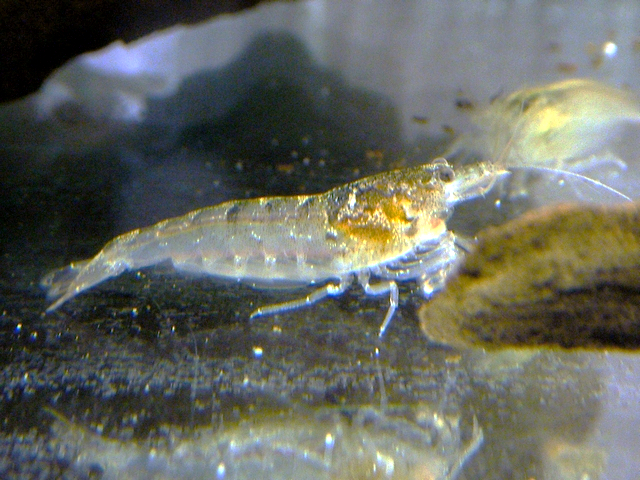 Typical CaridinaCaridina typus
-
 Ninja ShrimpCaridina serratirostris
-
 Tiger ShrimpCaridina mariae
- Common CaridinaCaridina nilotica
-
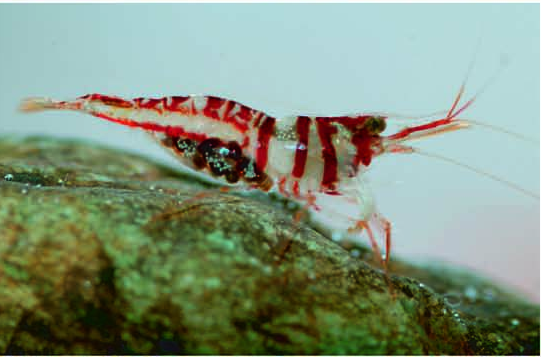 Towuti Sponge-associated ShrimpCaridina spongicola
Compare
Questions and answers
What is the scientific name of the Amano Shrimp?
The scientific name of the Amano Shrimp is Caridina multidentata. Written with its author, the full name is Caridina multidentata Stimpson, 1860.
Which family does the Amano Shrimp belong to?
Caridina multidentata belongs to the family Atyidae, in the order Decapoda and the class Malacostraca.
Where is the Amano Shrimp found?
Checklists and occurrence records place Caridina multidentata in 3 countries: Japan, Taiwan and Madagascar.
What is the conservation status of the Amano Shrimp?
The IUCN Red List category recorded for Caridina multidentata is Least Concern (LC).
What other names does the Amano Shrimp have?
Caridina multidentata is also known in English as Amano's Shrimp, Japanese Shrimp, Yamato Shrimp and Algae Shrimp.
Why is it called Amano shrimp?
Takashi Amano introduced Caridina multidentata to the aquarium hobby in the early 1980s.[21]
Where do Amano shrimp live in their natural habitat?
Amano Shrimp is native to Japan and Taiwan and is adapted to fast-flowing aquatic environments.[7][8]
What do caridina shrimp eat?
Amano Shrimp feeds primarily on algae.[9]
Sources
Passages the profile rests on
- The species has a translucent body marked with broken lines of reddish-brown spots along its sides. Source passage: “This species has a translucent body covered with a broken line of reddish brown points on its sides.” — English Wikipedia
- A white stripe extends along the dorsal surface from the head to the tail. Source passage: “The dorsal surface has a white stripe that runs from the head to the tail” — English Wikipedia
- The eyes are black. Source passage: “and the eyes are black.” — English Wikipedia
- Females have a more elongated lower row of spots than males. Source passage: “Females are easily distinguished from males by their more elongated lower row of dots.” — English Wikipedia
- The species has a wide and short rostrum, an adaptation associated with living in fast-flowing water. Source passage: “The species has adapted to live in fast-flowing water, having a wide and short rostrum.” — English Wikipedia
- Adults typically reach 25–35 millimetres in length. Source passage: “They typically grow to 25–35 millimetres (0.98–1.38 in).” — English Wikipedia
- Caridina multidentata is native to Japan and Taiwan. Source passage: “It is native to Japan and Taiwan.” — English Wikipedia
- Caridina multidentata is adapted to fast-flowing aquatic environments. Source passage: “The species has adapted to live in fast-flowing water” — English Wikipedia
- Caridina multidentata feeds primarily on algae. Source passage: “they feed primarily on algae” — English Wikipedia
- Caridina multidentata becomes more active at higher temperatures. Source passage: “They are more active at higher temperatures” — English Wikipedia
- Higher temperatures may shorten the species' lifespan. Source passage: “but may also have a shorter lifespan.” — English Wikipedia
- Caridina multidentata reproduces through an amphidromous life cycle. Source passage: “This species of shrimp is amphidromous.” — English Wikipedia
- Egg laying and hatching occur in freshwater. Source passage: “Oviposition and hatching occurs in freshwater” — English Wikipedia
- The eggs are oval-shaped and contain abundant yolk. Source passage: “The eggs of Caridina multidentata are rich in yolk and are oval-shaped.” — English Wikipedia
- Newly hatched larvae migrate to saltwater, develop into juveniles, and return to freshwater as adults. Source passage: “newly hatched larvae drift to saltwater and develop as juveniles, returning to freshwater in their adult forms.” — English Wikipedia
- Larvae begin consuming food during the third zoeal stage. Source passage: “Caridina multidentata begin to take in food in the third zoeal stage” — English Wikipedia
- Caridina multidentata larvae rely on internal nutrition for longer than Caridina leucosticta and Caridina typus. Source passage: “relying on internal nutrition longer than distant relatives such as the Caridina leucosticta and Caridina typus.” — English Wikipedia
- The species has a large geographic distribution. Source passage: “They have a large geographic distribution” — English Wikipedia
- The species' large geographic distribution suggests high levels of larval dispersal. Source passage: “suggesting high levels of larval dispertion.” — English Wikipedia
- Caridina multidentata is used in aquariums to control algae growth. Source passage: “They are usually used in an aquarium because they feed primarily on algae” — English Wikipedia
- Takashi Amano introduced Caridina multidentata to the aquarium hobby in the early 1980s. Source passage: “Caridina multidentata was introduced into the world of aquaria by Takashi Amano in the early 1980s.” — English Wikipedia
- The species fares best at water temperatures between 18 °C and 28 °C. Source passage: “Caridina multidentata fare best in temperatures of 18 °C to 28 °C” — English Wikipedia
- The species prefers water with a pH between 6.5 and 7.5. Source passage: “They prefer a pH of 6.5 to 7.5.” — English Wikipedia
- Caridina multidentata is extremely sensitive to copper. Source passage: “As with all crustaceans, they are extremely averse to copper due to their haemocyanin blood.” — English Wikipedia
Data
- Catalogue of Life, 2026-10-16 XR cc by
- Global Biodiversity Information Facility CC BY 4.0
- Wikidata CC0
- GeoNames CC BY 4.0
- Wikimedia Commons per image; credit shown with each image
- Within the Catalogue of Life, this name comes from The Integrated Taxonomic Information System cc0
References
- Stimpson, W. (1860). Prodromus descriptionis animalium evertebratorum, quae in Expeditione ad Oceanum Pacificum Septentrionalem, a Republic Federata missa, Cadwaladore Ringgold et Johanne Rodgers Ducibus, observavit et descripsit. Pars VIII, Crustacea Macrura. Proceedings of the Academy of Natural Sciences of Philadelphia. 12: 22-47 [91-116 in separate]. where the name was published
- De Grave, Sammy, and C. H. J. M. Fransen. (2011). Carideorum catalogus: the recent species of the Dendrobranchiate, Stenopodidean, Procarididean and Caridean Shrimps (Crustacea: Decapoda). Zoologische Mededelingen, Vol. 85, No. 9.
This species in other databases
- Catalogue of Life 8VKC6
- Wikidata Q609311
- iNaturalist 434771
- WoRMS urn:lsid:marinespecies.org:taxname:586329
Page built on 27 November 2026. See how the catalog is made and all sources and licences.
Cite this page
ScientificNames.org. (2026). Caridina multidentata (Amano Shrimp). Retrieved November 27, 2026, from https://scientificnames.org/species/caridina-multidentata
“Caridina multidentata (Amano Shrimp).” ScientificNames.org, 2026, scientificnames.org/species/caridina-multidentata. Accessed 27 Nov. 2026.
ScientificNames.org. “Caridina multidentata (Amano Shrimp).” Accessed November 27, 2026. https://scientificnames.org/species/caridina-multidentata.
@misc{scientificnames_caridina_multidentata_amano_shrimp,
  author = {{ScientificNames.org}},
  title = {Caridina multidentata (Amano Shrimp)},
  year = {2026},
  url = {https://scientificnames.org/species/caridina-multidentata},
  note = {Accessed 2026-11-27}
}