Species · Crustaceans
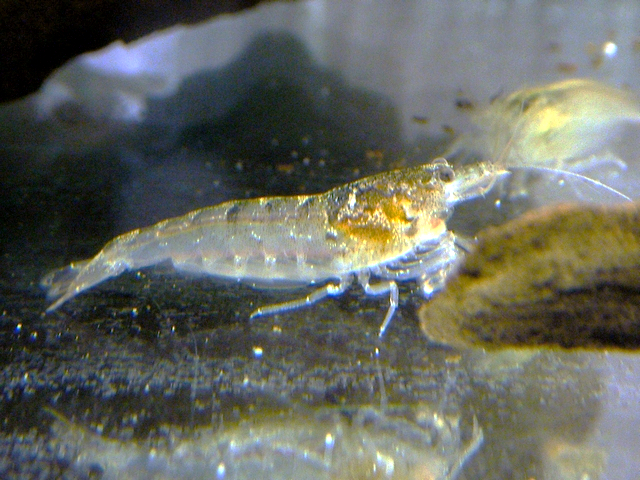
Typical Caridina Caridina typus
The scientific name of the Typical Caridina is Caridina typus. It is a species of crustacean in the family Atyidae (atyid shrimps), order Decapoda. The name dates from 1837.
- Scientific name
- Caridina typus H. Milne Edwards, 1837
- Common name
- Typical Caridina
- Genus
- Caridina
- Family
- Atyidae (Atyid Shrimps)
- Order
- Decapoda
- Class
- Malacostraca
- Red List category
- LC Least Concern
- Environment
- freshwater
- Recorded in
- 26 countries
- Name status
- accepted in the Catalogue of Life
Overview
Caridina typus is amphidromous, with adults reproducing in freshwater and larvae requiring saline water for development.
Written 26 November 2026 from the sources listed below. Each statement was checked against the passage it cites; statements that could not be supported were removed.
Appearance
Some populations in Pohnpei have adults without teeth along the ventral rostral margin. The species has five pairs of walking legs, with epipods on the first four pairs.[1][2]
Adults typically measure 2.0–2.5 cm in total length, although individuals outside this range occur. The carapace length of egg-carrying females ranges from 3.9 to 4.2 mm.[3][4]
Individual eggs measure approximately 0.45–0.48 mm by 0.23–0.26 mm. Females can carry broods averaging over 3,000 eggs, with a recorded maximum of 3,700.[5][6]
Habitat
Typical Caridina commonly inhabits tropical freshwater rivers and streams in coastal areas and on islands. Individuals can occur in both marine and freshwater environments but not on land.[7][8]
The species tolerates high salinity levels and frequently occurs near the sea. Although generally associated with lower river and stream sections, it has been recorded at elevations of 300 m above sea level.[9][10]
Larvae develop in brackish water.[11]
The species occurs across the Indo-West Pacific, from eastern and southern Africa to Polynesia. It has been recorded in Japan, Southeast Asia, Australia, and the Indian Ocean islands.[12][13]
Diet
Juveniles and adults primarily consume algae, leaf litter, and detritus. Adults can also feed on juvenile insects and oligochaetes.[14][15]
Larvae consume phytoplankton, zooplankton, and fine detritus. Early larvae obtain phytoplankton through suspension feeding.[16][17]
Larvae can survive and develop into juveniles when fed cultured Tetraselmis phytoplankton alone. Combining Tetraselmis with rotifers improves larval survival and development speed compared with feeding Tetraselmis alone.[18][19]
Starved larvae stop developing because they do not molt.[20]
Behaviour
The species hides under rocks and stones during daylight and generally forages at night. Individuals use their walking legs and setaceous claws to redistribute sediment and shred leaf litter.[21][22]
The species uses chemical signals to avoid predatory heterospecifics and locate conspecifics. It avoids chemical cues from redclaw crayfish and barramundi but shows no response to chemical cues from the non-predatory Nerite snail.[23][24][25]
Conspecific chemical cues help individuals locate mates or defend territories under low-visibility conditions.[26]
Reproduction and life cycle
Typical Caridina is amphidromous, with adults inhabiting and reproducing in freshwater while larvae require saline water for development. The breeding season extends from March through December.[27][28]
Reproduction is sexual, and males transfer spermatophores to females. Females produce eggs several hours after mating and carry them beneath the abdomen.[29][30]
Females migrate downstream or into brackish water to spawn. The species passes through nine zoeal larval stages.[31][32]
Larvae emerge downstream after sunset, with their numbers increasing as darkness progresses. Juveniles migrate back upstream toward their parental freshwater habitat after completing larval development.[33][34]
Juveniles begin recruiting into adult populations in August.[35]
Conservation
As of 2011, the species was assessed as Least Concern because it was widespread and lacked known major threats.[36]
Uses
The species can be maintained as a pet in aquariums. Pohnpei islanders historically consumed this shrimp as a food resource.[37][38]
Classification of the Typical Caridina
| Kingdom | Animalia |
|---|---|
| Phylum | Arthropoda |
| Subphylum | Crustacea |
| Class | Malacostraca |
| Order | Decapoda |
| Suborder | Pleocyemata |
| Infraorder | Caridea |
| Superfamily | Atyoidea |
| Family | Atyidae (Atyid Shrimps) |
| Genus | Caridina |
| Species | Caridina typus H. Milne Edwards, 1837 |
Where the Typical Caridina is found
Checklists and occurrence records place Caridina typus in 26 countries across Africa, Asia and Oceania. GBIF holds 1,817 georeferenced records of it.
Countries
- Australia 23
- Fiji 17
- Hong Kong 9
- India 3
- Indonesia 286
- Japan 809
- Kiribati 17
- Madagascar 24
- Malaysia 44
- Mauritius 9
- Mayotte 16
- Micronesia 11
- New Caledonia 38
- Palau 145
- Papua New Guinea 8
- Philippines 34
- Reunion 183
- Seychelles 36
- Solomon Islands 5
- South Africa 20
- Taiwan 55
- Tanzania 3
- Thailand 7
- Timor Leste 9
- Vanuatu 3
- Wallis and Futuna 3
Regions and cities with the most records
- Sainte-Suzanne, Reunion 97
- Bali, Indonesia 93
- Sainte-Marie, Reunion 86
- Saint-André, Reunion 85
- Saint-Benoît, Reunion 80
- Saint-Denis, Reunion 59
- Gohyakkoku, Japan 51
- Kamiichi, Japan 51
- Kurobe-shi, Japan 51
- La Possession, Reunion 51
- Namerikawa, Japan 51
- Nyūzen, Japan 51
- Toyama, Japan 51
- Uozu, Japan 51
- Le Port, Reunion 49
- Sukawati, Indonesia 47
- Tabanan, Indonesia 43
- Le Tampon, Reunion 37
- Saint-Leu, Reunion 37
- Piton Saint-Leu, Reunion 36
- Taiwan, Taiwan 35
- Saint-Pierre, Reunion 33
- Saint-Paul, Reunion 31
- Maluku, Indonesia 30
- Sofifi, Indonesia 24
- Banjar, Indonesia 23
- Seririt, Indonesia 23
- Kampung Baru Ulu Melaka, Malaysia 21
- Kedah, Malaysia 21
- Kuah, Malaysia 21
- Saint-Joseph, Reunion 20
- Saint-Louis, Reunion 18
- Queensland, Australia 17
- Dzaoudzi, Mayotte 15
- Kaouéni, Mayotte 15
- Koungou, Mayotte 15
Range as the checklists state it
Southern Asia
Australia
Oceania
Africa
A number beside a place is its count of GBIF occurrence records. A place without a number comes from a checklist alone. Records show where a species has been observed or collected, which can include escapes and vagrants.
Common names
English
- Typical Caridina
- Type Shrimp
Names in 4 other languages
- Chinese
- 典型米蝦, 真米蝦
- French
- Caridine type, Caridine à rostre inerme, Chevaquine, Chevaquines
- Japanese
- トゲナシヌマエビ
- Malagasy
- Patsa
Synonyms
9 other scientific names have been used for this species and are now treated as synonyms of Caridina typus.
- Caridina exilirostris Stimpson, 1860
- Caridina siamensis Giebel, 1863
- Caridina spencebatei De Man, 1892
- Caridina typa Bouvier, 1905
- Caridina typa acuminata
- Caridina typus f. caledonica Bouvier, 1925
- Caridina typus typca Bouvier, 1925
- Caridina typus var. acuminata
- Paratya typus f. caledonica Bouvier, 1925
Related species
-
 Amano ShrimpCaridina multidentata
-
 Bee ShrimpCaridina cantonensis
-
 Sulawesi Cardinal ShrimpCaridina dennerli
-
 Needlenose CaridinaCaridina gracilirostris
-
 Ninja ShrimpCaridina serratirostris
-
 Tiger ShrimpCaridina mariae
- Common CaridinaCaridina nilotica
-
 Towuti Sponge-associated ShrimpCaridina spongicola
Compare
Questions and answers
What is the scientific name of the Typical Caridina?
The scientific name of the Typical Caridina is Caridina typus. Written with its author, the full name is Caridina typus H. Milne Edwards, 1837.
Which family does the Typical Caridina belong to?
Caridina typus belongs to the family Atyidae, in the order Decapoda and the class Malacostraca.
Where is the Typical Caridina found?
Checklists and occurrence records place Caridina typus in 26 countries, including Japan, Indonesia, Reunion, Palau, Taiwan and Malaysia.
What is the conservation status of the Typical Caridina?
The IUCN Red List category recorded for Caridina typus is Least Concern (LC).
What other names does the Typical Caridina have?
Caridina typus is also known in English as Type Shrimp.
Sources
Passages the profile rests on
- Some populations in Pohnpei have adults without teeth along the ventral rostral margin. Source passage: “in a study of C. typus in Pohnpei, adults were observed to lack teeth on the ventral margin of their rostrum.” — English Wikipedia
- The species possesses five pairs of walking legs, with epipods on the first four pairs. Source passage: “It possesses five pereiopods, the first four having epipods.” — English Wikipedia
- Adult individuals typically measure 2.0–2.5 cm in total length, although individuals outside this range occur. Source passage: “As an adult, it measures 2.0-2.5 cm in total length, though adult individuals can be smaller or larger than this range.” — English Wikipedia
- The carapace length of egg-carrying females ranges from 3.9 to 4.2 mm. Source passage: “The carapace length of ovigerous females ranges between 3.9 and 4.2 mm.” — English Wikipedia
- Individual eggs measure approximately 0.45–0.48 mm by 0.23–0.26 mm. Source passage: “each which measure approximately 0.45-0.48 mm x 0.23-0.26 mm in diameter.” — English Wikipedia
- Females can carry broods averaging over 3,000 eggs, with a recorded maximum of 3,700. Source passage: “Broods of over 3000 eggs on average, up to a record 3700” — English Wikipedia
- The species commonly inhabits tropical freshwater rivers and streams in coastal areas and on islands. Source passage: “It is commonly found in rivers and streams in coastal areas or on islands.” — English Wikipedia
- Individuals can occur in both marine and freshwater environments but not on land. Source passage: “C. typus can be found in marine and freshwater environments, but not terrestrial environments.” — English Wikipedia
- The species can tolerate high salinity levels and frequently occurs near the sea. Source passage: “they are also highly tolerant to high salinity levels and can often be found near the sea” — English Wikipedia
- Although generally associated with lower river and stream sections, the species has been recorded at elevations of 300 m above sea level. Source passage: “Although it is usually found in the lower regions of rivers and streams, it has been found in altitudes of 300 m above sea level.” — English Wikipedia
- Larvae develop in brackish water. Source passage: “The zoea develop in brackish water” — English Wikipedia
- The species occurs across the Indo-West Pacific, from eastern and southern Africa to Polynesia. Source passage: “Caridina typus is widely distributed throughout the Indo-west Pacific, extending from eastern and southern Africa to the Indian Ocean islands, Australia, Polynesia, Southeast Asia, and Japan.” — English Wikipedia
- The species has been recorded in Japan, Southeast Asia, Australia, and the Indian Ocean islands. Source passage: “Australia, Polynesia, Southeast Asia, and Japan.” — English Wikipedia
- Juveniles and adults primarily consume algae, leaf litter, and detritus. Source passage: “Juveniles and adults will eat primarily algae, leaf litter, and detritus.” — English Wikipedia
- Adults can feed on juvenile insects and oligochaetes. Source passage: “invertebrates such as juvenile insects and oligochaetes.” — English Wikipedia
- Larvae consume phytoplankton, zooplankton, and fine detritus. Source passage: “Caridina typus larvae can eat a variety of phytoplankton, zooplankton, and fine detritus.” — English Wikipedia
- Early larvae obtain phytoplankton through suspension feeding. Source passage: “Early larvae ingest phytoplankton by means of suspension feeding.” — English Wikipedia
- Larvae can survive and develop into juveniles when fed cultured Tetraselmis phytoplankton alone. Source passage: “A captive study observed that C. typus larvae could survive and develop into juveniles when fed only cultured phytoplankton Tetraselmis sp.” — English Wikipedia
- Combining Tetraselmis with rotifers improves larval survival and development speed compared with feeding Tetraselmis alone. Source passage: “When fed Tetraselmis mixed with zooplankton rotifers, the survival of larvae improved and larval development velocity increased as compared to a Tetraselmis-only diet.” — English Wikipedia
- Starved larvae stop developing because they do not molt. Source passage: “If starved, the larvae will not molt and therefore stop developing.” — English Wikipedia
- The species hides under rocks and stones during daylight and generally forages at night. Source passage: “During the day, it hides under rocks and stones and usually comes out to forage at night.” — English Wikipedia
- Individuals use their walking legs and setaceous claws to redistribute sediment and shred leaf litter. Source passage: “C. typus is known to play a role in sediment distribution and shredding leaf litter, manipulating the environment using their pereiopods and setaceous chelae.” — English Wikipedia
- The species uses chemical signals to avoid predatory heterospecifics and locate conspecifics. Source passage: “Caridina typus uses chemoreception to avoid heterospecific predators and find conspecifics.” — English Wikipedia
- It avoids chemical cues from redclaw crayfish and barramundi. Source passage: “They avoid chemical cues from predatory heterospecifics such as the redclaw crayfish Cherax quadricarinatus and barramundi Lates calcarife.” — English Wikipedia
- The species shows no response to chemical cues from the non-predatory Nerite snail. Source passage: “C. typus shows no response to non-predatory heterospecific cues such as from Nerite snail Nerita atramentosa” — English Wikipedia
- Conspecific chemical cues help individuals locate mates or defend territories under low-visibility conditions. Source passage: “Conspecific cues are useful in low visibility conditions to help find mates or to defend a territory from potential competitors.” — English Wikipedia
- The species is amphidromous, with adults inhabiting and reproducing in freshwater while larvae require saline water for development. Source passage: “The adults inhabit and reproduce in freshwater environments, but the larvae require saline water to develop.” — English Wikipedia
- The breeding season extends from March through December. Source passage: “Their breeding season lasts from March to December.” — English Wikipedia
- Reproduction is sexual, and males transfer spermatophores to females. Source passage: “Reproduction occurs sexually, with the male passing a spermatophore to the female” — English Wikipedia
- Females produce eggs several hours after mating and carry them beneath the abdomen. Source passage: “the female producing eggs several hours after mating, carrying the eggs under her abdomen for development.” — English Wikipedia
- Females migrate downstream or into brackish water to spawn. Source passage: “Females migrate downstream (to the mouth of a river or stream) or into brackish waters to spawn” — English Wikipedia
- The species passes through nine zoeal larval stages. Source passage: “Caridina typus has nine zoeal instars or stages” — English Wikipedia
- Larvae emerge downstream after sunset, with their numbers increasing as darkness progresses. Source passage: “C. typus larvae recruit to the mouth of a coastal river or stream, emerging after sunset and increasing as darkness progresses.” — English Wikipedia
- Juveniles migrate back upstream toward their parental freshwater habitat after completing larval development. Source passage: “After the larval stages are complete, C. typus will metamorphose into a juvenile stage, which will begin to migrate back to its parental freshwater habitat.” — English Wikipedia
- Juveniles begin recruiting into adult populations in August. Source passage: “Juveniles will enter their adult stage in freshwater and begin recruiting in August.” — English Wikipedia
- As of 2011, the species was assessed as Least Concern because it was widespread and lacked known major threats. Source passage: “as of 2011, C. typus is one of the most widespread species of freshwater shrimp and lacks any known major threats, and therefore is a least concern species.” — English Wikipedia
- The species can be maintained as a pet in aquariums. Source passage: “It can be kept in captivity by aquarists as pets.” — English Wikipedia
- Pohnpei islanders historically consumed this shrimp as a food resource. Source passage: “Historically, Pohnpei islanders utilized shrimp such as C. typus as a food source when technology for harvesting marine resources was not advanced or readily available.” — English Wikipedia
Data
- Catalogue of Life, 2026-10-16 XR cc by
- Global Biodiversity Information Facility CC BY 4.0
- Wikidata CC0
- GeoNames CC BY 4.0
- Wikimedia Commons per image; credit shown with each image
- Within the Catalogue of Life, this name comes from The Integrated Taxonomic Information System cc0
References
- Milne Edwards, H. (1834–1840). Histoire Naturelle des Crustacés, Comprenant l´Anatomie, la Physiologie et la Classification de ces Animaux, Vol I (1834): i–xxxv + 1–468, Vol. II (1837): 1–532, Vol. III (1840): 1–638; atlas: 1–32, pls. 1–42. Encyclopédique Roret, Paris. where the name was published
- De Grave, Sammy, and C. H. J. M. Fransen. (2011). Carideorum catalogus: the recent species of the Dendrobranchiate, Stenopodidean, Procarididean and Caridean Shrimps (Crustacea: Decapoda). Zoologische Mededelingen, Vol. 85, No. 9.
- de Mazancourt, Valentin, David Boseto, & Gérard Marquet and Philippe Keith. (2020). Solomon’s Gold Mine: Description or redescription of 24 species of Caridina (Crustacea: Decapoda: Atyidae) freshwater shrimps from the Solomon Islands, including 11 new species. European Journal of Taxonomy, Vol. 696. Link
- Vijayamma, Kunjuraman Jayachandran, Amruta Dhamorikar, & and Shirish Manchi. (2021). A new species of Caridina H. Milne Edwards, 1837 (Family: Atyidae) from a limestone cave on Interview Island, Andaman and Nicobar Islands, India. Zootaxa, Vol. 5057, No. 3. Link
This species in other databases
- Catalogue of Life 8VKGK
- Wikidata Q11321186
- iNaturalist 370281
- WoRMS urn:lsid:marinespecies.org:taxname:582125
Page built on 27 November 2026. See how the catalog is made and all sources and licences.
Cite this page
ScientificNames.org. (2026). Caridina typus (Typical Caridina). Retrieved November 27, 2026, from https://scientificnames.org/species/caridina-typus
“Caridina typus (Typical Caridina).” ScientificNames.org, 2026, scientificnames.org/species/caridina-typus. Accessed 27 Nov. 2026.
ScientificNames.org. “Caridina typus (Typical Caridina).” Accessed November 27, 2026. https://scientificnames.org/species/caridina-typus.
@misc{scientificnames_caridina_typus_typical_caridina,
  author = {{ScientificNames.org}},
  title = {Caridina typus (Typical Caridina)},
  year = {2026},
  url = {https://scientificnames.org/species/caridina-typus},
  note = {Accessed 2026-11-27}
}