Species · Birds
Pale Rosefinch Carpodacus stoliczkae
The scientific name of the Pale Rosefinch is Carpodacus stoliczkae. It is a species of bird in the family Fringillidae (finch), order Passeriformes. The name dates from 1874.
- Scientific name
- Carpodacus stoliczkae (Hume, 1874)
- Common name
- Pale Rosefinch
- Genus
- Carpodacus
- Family
- Fringillidae (Finch)
- Order
- Passeriformes
- Class
- Aves
- Red List category
- LC Least Concern
- Recorded in
- 3 countries
- Name status
- accepted in the Catalogue of Life

Overview
The species occurs in Afghanistan and China. It has sandy-colored plumage, and adult males have a bright pink face.
Written 27 November 2026 from the sources listed below. Each statement was checked against the passage it cites; statements that could not be supported were removed.
Appearance
The Pale Rosefinch has sandy-colored plumage. Adult males have a bright pink face.[1][2]
Habitat
The Pale Rosefinch inhabits hot deserts and other dry areas. It particularly occurs in valleys and hilly regions with scrubby vegetation.[3][4]
Conservation
The species was most recently assessed for the IUCN Red List in 2024.[5]
Similar species
The Pale Rosefinch was formerly treated as conspecific with the Sinai Rosefinch.[6]
Classification of the Pale Rosefinch
| Kingdom | Animalia |
|---|---|
| Phylum | Chordata |
| Subphylum | Vertebrata |
| Infraphylum | Gnathostomata |
| Parvphylum | Osteichthyes |
| Megaclass | Tetrapoda |
| Class | Aves (Bird) |
| Order | Passeriformes (Passerine) |
| Family | Fringillidae (Finch) |
| Genus | Carpodacus (Rosefinch) |
| Species | Carpodacus stoliczkae (Hume, 1874) |
Where the Pale Rosefinch is found
Checklists and occurrence records place Carpodacus stoliczkae in 3 countries across Asia. GBIF holds 360 georeferenced records of it.
Countries
Regions and cities with the most records
- Qinghai, China 238
- Qabqa, China 95
- Xining, China 78
- Gansu, China 59
- Bamyan, Afghanistan 14
- Duoba, China 5
- Qiaotou, China 3
Range as the checklists state it
Europe & Northern Asia (excluding China)
Southern Asia
A number beside a place is its count of GBIF occurrence records. A place without a number comes from a checklist alone. Records show where a species has been observed or collected, which can include escapes and vagrants.
Common names
English
- Pale Rosefinch
Names in 20 other languages
- Arabic
- جزم شاحب
- Chinese
- 沙色朱雀, 淡色朱雀
- Croatian
- svijetla rujnica
- Danish
- Bleg Karmindompap
- Dutch
- Bleke Roodmus
- Esperanto
- pala fringo
- Finnish
- ylänköpunavarpunen
- French
- Roselin pâle
- German
- Fahlgimpel
- Italian
- Carpodaco pallido
- Japanese
- ウスマシコ
- Polish
- dziwonia blada
- Portuguese
- peito-rosado-pálido, pintarroxo-pálido
- Russian
- Уйгурская чечевица
- Serbian
- Bleda rumenka
- Slovak
- červenák Stoličkov
- Spanish
- Camachuelo pálido
- Swedish
- blek rosenfink
- Turkish
- Solgun Çütre
- Ukrainian
- чечевиця синьцзянська
Synonyms
One other scientific name has been used for this species and is now treated as a synonym of Carpodacus stoliczkae.
- Propasser stoliczkae Hume, AO, 1874
Subspecies and varieties
- Carpodacus stoliczkae beicki subspecies
- Carpodacus stoliczkae salimalii subspecies
- Carpodacus stoliczkae stoliczkae subspecies
Related species
-
 Common RosefinchCarpodacus erythrinus
-
 Sinai RosefinchCarpodacus synoicus
-
 Bonin GrosbeakCarpodacus ferreorostris
-
 Pallas's RosefinchCarpodacus roseus
-
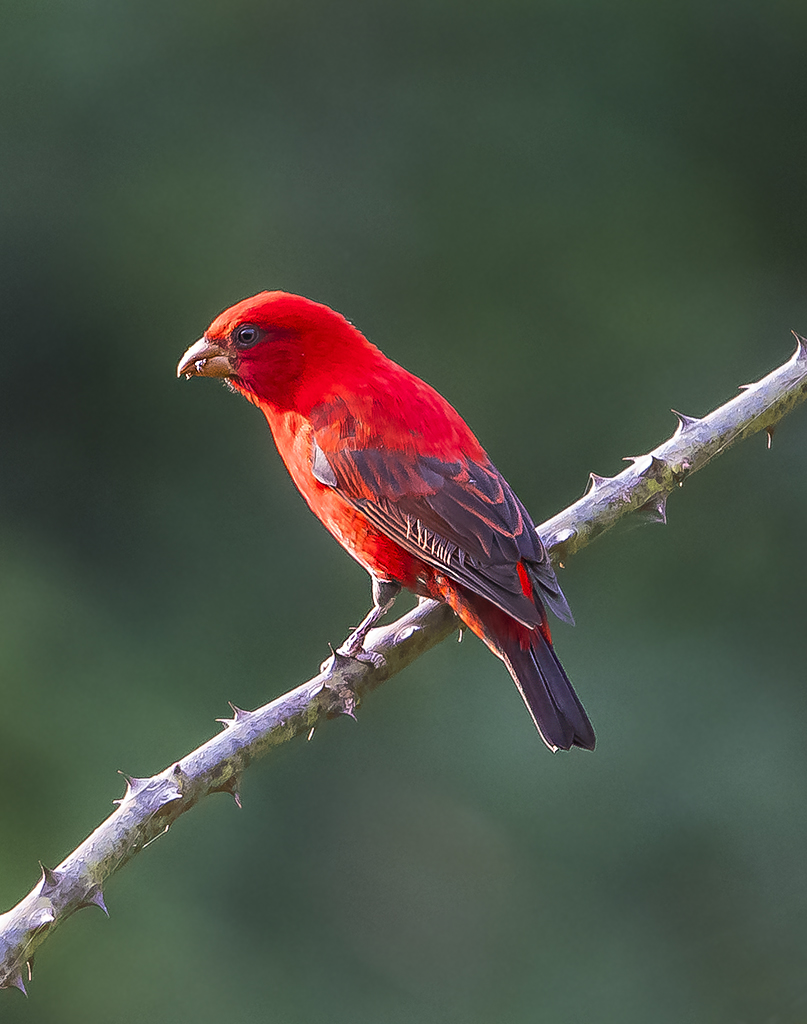 Scarlet FinchCarpodacus sipahi
-
 Siberian Long-tailed RosefinchCarpodacus sibiricus
-
 Great RosefinchCarpodacus rubicilla
-
 Pink-browed RosefinchCarpodacus rodochroa
Compare
Questions and answers
What is the scientific name of the Pale Rosefinch?
The scientific name of the Pale Rosefinch is Carpodacus stoliczkae. Written with its author, the full name is Carpodacus stoliczkae (Hume, 1874).
Which family does the Pale Rosefinch belong to?
Carpodacus stoliczkae belongs to the family Fringillidae, in the order Passeriformes and the class Aves.
Where is the Pale Rosefinch found?
Checklists and occurrence records place Carpodacus stoliczkae in 3 countries: China, Afghanistan and India.
What is the conservation status of the Pale Rosefinch?
The IUCN Red List category recorded for Carpodacus stoliczkae is Least Concern (LC).
Sources
Passages the profile rests on
- The species has sandy-colored plumage. Source passage: “sandy-colored rosefinch” — ebird.org
- Adult males have a bright pink face. Source passage: “Male has bright pink face” — ebird.org
- The species inhabits hot deserts. Source passage: “Its natural habitat is hot deserts.” — English Wikipedia
- The Pale Rosefinch inhabits dry areas, particularly valleys and hilly regions with scrubby vegetation. Source passage: “of dry areas, particularly valleys and hilly regions with scrubby cover.” — ebird.org
- The species was most recently assessed for the IUCN Red List in 2024. Source passage: “has most recently been assessed for The IUCN Red List of Threatened Species in 2024.” — iucnredlist.org
- The Pale Rosefinch was formerly treated as conspecific with the Sinai Rosefinch. Source passage: “It was formerly considered conspecific with the Sinai rosefinch.” — English Wikipedia
Data
- Catalogue of Life, 2026-10-16 XR cc by
- Global Biodiversity Information Facility CC BY 4.0
- Wikidata CC0
- GeoNames CC BY 4.0
- Wikimedia Commons per image; credit shown with each image
- Within the Catalogue of Life, this name comes from The Integrated Taxonomic Information System cc0
This species in other databases
Page built on 28 November 2026. See how the catalog is made and all sources and licences.
Cite this page
ScientificNames.org. (2026). Carpodacus stoliczkae (Pale Rosefinch). Retrieved November 28, 2026, from https://scientificnames.org/species/carpodacus-stoliczkae
“Carpodacus stoliczkae (Pale Rosefinch).” ScientificNames.org, 2026, scientificnames.org/species/carpodacus-stoliczkae. Accessed 28 Nov. 2026.
ScientificNames.org. “Carpodacus stoliczkae (Pale Rosefinch).” Accessed November 28, 2026. https://scientificnames.org/species/carpodacus-stoliczkae.
@misc{scientificnames_carpodacus_stoliczkae_pale_rosefinch,
  author = {{ScientificNames.org}},
  title = {Carpodacus stoliczkae (Pale Rosefinch)},
  year = {2026},
  url = {https://scientificnames.org/species/carpodacus-stoliczkae},
  note = {Accessed 2026-11-28}
}