Species · Birds
Black-tipped Cotinga Carpodectes hopkei
The scientific name of the Black-tipped Cotinga is Carpodectes hopkei. It is a species of bird in the family Cotingidae (contingas), order Passeriformes. The name dates from 1897.
- Scientific name
- Carpodectes hopkei Berlepsch, 1897
- Common name
- Black-tipped Cotinga
- Genus
- Carpodectes
- Family
- Cotingidae (Contingas)
- Order
- Passeriformes
- Class
- Aves
- Red List category
- LC Least Concern
- Recorded in
- 3 countries
- Name status
- accepted in the Catalogue of Life

Overview
Carpodectes hopkei occurs in Colombia, Ecuador, and Panama, primarily inhabiting the canopy of humid tropical forests. Adult males are almost entirely white, with faint gray coloration and small blackish spots at the tips of their outer primary feathers and innermost tail feathers.
Written 26 November 2026 from the sources listed below. Each statement was checked against the passage it cites; statements that could not be supported were removed.
Appearance
Adult males are almost entirely white, with faint gray coloration on the crown, back, and tail. They have small blackish spots at the tips of their outer primary feathers and innermost tail feathers, and broad flight feathers with rounded tips.[1][2][3]
Adult females have dark grayish heads and upperparts, blackish tails, and mostly blackish wings with white edges on the coverts and inner flight feathers. Their breasts are pale gray, becoming white toward the vent, and their secondary feathers are thinner than those of males.[4][5][6][7]
Both sexes have orange to dark red irises and blackish legs and feet. The bill is black, with a wide base, ridged culmen, and notched maxilla tip.[8][9]
Immature birds of both sexes resemble adult females. Subadult males have plumage resembling adults but retain additional dark markings on their wing feathers and black tips on most tail feathers.[10][11]
The species measures between 22 and 25 cm in length. Males are also described as entirely snowy white.[12][13]
Habitat
The Black-tipped Cotinga primarily inhabits the canopy of humid tropical forests. It occasionally occurs in secondary woodland near its primary forest habitat.[14][15]
In Panama, the species occurs from sea level to elevations of 1,000 m. In Colombia, it occurs from sea level to elevations of 1,200 m.[16][17]
In Ecuador, the species is found mostly below 500 m elevation.[18]
Its range extends from Darién Province in southeastern Panama through western Colombia to northwestern Ecuador, reaching northern Pichincha Province. Scattered sightings have been reported farther south in Ecuador.[19][20]
The species is also reported from extreme eastern Panama to northwestern Ecuador.[21]
Diet
The Black-tipped Cotinga feeds primarily on fruits. It appears to favor fruits of Cecropia trees.[22][23]
Behaviour
Black-tipped Cotingas sometimes forage in groups containing up to approximately six individuals. The species is believed to be resident throughout the year, although seasonal movements are suspected.[24][25]
Males perform display fights involving very slow wing flapping.[26]
Conservation
The IUCN initially classified the Black-tipped Cotinga as Near Threatened in 1994 and has classified it as Least Concern since 2000.[27]
The estimated population of mature individuals is between 20,000 and 50,000. BirdLife places the global population estimate in the range of 20,000 to 49,999 mature individuals.[28][29]
The species' population is believed to be decreasing. Its population has been reduced by recent lowland forest destruction, particularly in northwestern Ecuador.[30][31]
No immediate threats to the species have been identified. It is considered rare to locally fairly common and occurs in some protected areas.[32][33]
Similar species
The Black-tipped Cotinga shares its genus with the Yellow-billed Cotinga and Snowy Cotinga. The three species form a superspecies.[34][35]
The Black-tipped Cotinga is treated as a monotypic species.[36]
Classification of the Black-tipped Cotinga
| Kingdom | Animalia |
|---|---|
| Phylum | Chordata |
| Subphylum | Vertebrata |
| Infraphylum | Gnathostomata |
| Parvphylum | Osteichthyes |
| Megaclass | Tetrapoda |
| Class | Aves (Bird) |
| Order | Passeriformes (Passerine) |
| Family | Cotingidae (Contingas) |
| Genus | Carpodectes (Cotingas) |
| Species | Carpodectes hopkei Berlepsch, 1897 |
Where the Black-tipped Cotinga is found
Checklists and occurrence records place Carpodectes hopkei in 3 countries across North America and South America. GBIF holds 2,294 georeferenced records of it.
Countries
Regions and cities with the most records
- Valle del Cauca Department, Colombia 773
- Buenaventura, Colombia 643
- Pichincha, Ecuador 407
- Esmeraldas, Ecuador 326
- Chocó, Colombia 324
- Darién, Panama 244
- Buenaventura, Colombia 93
- Nariño, Colombia 87
- Antioquia, Colombia 14
- San Lorenzo de Esmeraldas, Ecuador 13
- Darien, Colombia 8
- Cauca Department, Colombia 7
- Risaralda Department, Colombia 7
- Tadó, Colombia 6
- Imbabura, Ecuador 5
- Abejorral, Colombia 4
- Santo Domingo de los Tsáchilas, Ecuador 4
- Sonsón, Colombia 4
- Timbiquí, Colombia 4
Range as the checklists state it
Middle America
South America
A number beside a place is its count of GBIF occurrence records. A place without a number comes from a checklist alone. Records show where a species has been observed or collected, which can include escapes and vagrants.
Common names
English
- Black-tipped Cotinga
Names in 24 other languages
- Arabic
- قطنجة سوداء الطرف
- Chinese
- 南美白伞鸟, 南美白傘鳥
- Croatian
- bijela kotinga
- Czech
- kotinga stříbrná
- Danish
- Sortplettet Snekotinga
- Dutch
- Witte Cotinga
- Esperanto
- blanka kotingo
- Finnish
- valkokotinga
- French
- Cotinga blanc
- German
- Schwarzfleckenkotinga, Silberschmuckvogel
- Italian
- Cotinga bianca
- Japanese
- クロボシユキカザリドリ
- Lithuanian
- paprastoji baltoji kotinga
- Norwegian
- svarttippkotinga
- Polish
- wawrzynowiec czarnoplamy
- Portuguese
- cotinga-branca, cotinga-de-pontas-pretas
- Russian
- Белая котинга, Серебристая белая котинга
- Serbian
- Crnokljuna bela kotinga
- Slovak
- kotinga biela
- Spanish
- Cotinga blanco
- Swedish
- svartspetsad kotinga
- Turkish
- Kara Uçlu Kotinga
- Ukrainian
- блаватник чорнодзьобий
- Welsh
- cotinga gwyn y De
Related species
-
 Snowy CotingaCarpodectes nitidus
-
 Yellow-billed CotingaCarpodectes antoniae
-
 CapuchinbirdPerissocephalus tricolor
-
 Andean Cock-of-the-rockRupicola peruvianus
-
 White BellbirdProcnias albus
-
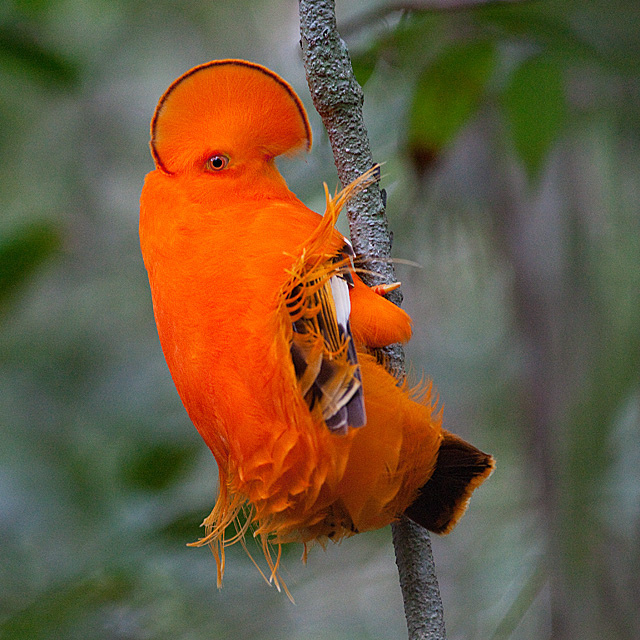 Guianan Cock-of-the-rockRupicola rupicola
-
 Screaming PihaLipaugus vociferans
-
 Bare-throated BellbirdProcnias nudicollis
Compare
Questions and answers
What is the scientific name of the Black-tipped Cotinga?
The scientific name of the Black-tipped Cotinga is Carpodectes hopkei. Written with its author, the full name is Carpodectes hopkei Berlepsch, 1897.
Which family does the Black-tipped Cotinga belong to?
Carpodectes hopkei belongs to the family Cotingidae, in the order Passeriformes and the class Aves.
Where is the Black-tipped Cotinga found?
Checklists and occurrence records place Carpodectes hopkei in 3 countries: Colombia, Ecuador and Panama.
What is the conservation status of the Black-tipped Cotinga?
The IUCN Red List category recorded for Carpodectes hopkei is Least Concern (LC).
Sources
Passages the profile rests on
- Adult male Black-tipped Cotingas are almost entirely white, with faint gray coloration on the crown, back, and tail. Source passage: “Adult males are almost entirely white. They have a very faint gray tinge on their crown, back, and tail” — English Wikipedia
- Adult male Black-tipped Cotingas have small blackish spots at the tips of their outer primary feathers and innermost tail feathers. Source passage: “small blackish spots on the tips of the outer primaries and innermost pair of tail feathers.” — English Wikipedia
- Adult male Black-tipped Cotingas have broad flight feathers with rounded tips. Source passage: “Their flight feathers are wide and have rounded tips.” — English Wikipedia
- Adult females have dark grayish heads and upperparts and blackish tails. Source passage: “Adult females have a dark grayish head and upperparts and a blackish tail.” — English Wikipedia
- Adult females have mostly blackish wings with white edges on the coverts and inner flight feathers. Source passage: “Their wings are mostly blackish with white edges on the coverts and inner flight feathers.” — English Wikipedia
- Adult females have pale gray breasts that become white toward the vent. Source passage: “Their breast is pale gray that fades to white towards the vent.” — English Wikipedia
- Female Black-tipped Cotingas have thinner secondary feathers than males. Source passage: “Their secondaries are much thinner than the male's.” — English Wikipedia
- Both sexes have orange to dark red irises and blackish legs and feet. Source passage: “Both sexes have an orange to dark red iris and blackish legs and feet.” — English Wikipedia
- The species has a black bill with a wide base, ridged culmen, and notched maxilla tip. Source passage: “Their black bill has a wide base, a ridged culmen, and a notch on the tip of the maxilla.” — English Wikipedia
- Immature birds of both sexes resemble adult females. Source passage: “Immature birds of both sexes resemble adult females.” — English Wikipedia
- Subadult males have plumage resembling adults but retain additional dark markings on their wing feathers and black tips on most tail feathers. Source passage: “Subadult males have almost adult plumage but have more dark markings on the wing feathers and black tips on most tail feathers.” — English Wikipedia
- The Black-tipped Cotinga measures between 22 and 25 cm in length. Source passage: “The black-tipped cotinga is 22 to 25 cm (8.7 to 9.8 in) long.” — English Wikipedia
- Male Black-tipped Cotingas are described as entirely snowy white. Source passage: “Males are unmistakable in range: entirely snowy white with a reddish ...” — ebird.org
- The species primarily inhabits the canopy of humid tropical forests. Source passage: “It primarily inhabits the canopy of humid forest in the tropical zone” — English Wikipedia
- The species occasionally occurs in secondary woodland near its primary forest habitat. Source passage: “and occasionally is found in nearby secondary woodland.” — English Wikipedia
- In Panama, the species occurs from sea level to elevations of 1,000 m. Source passage: “from sea level to 1,000 m (3,300 ft) in Panama” — English Wikipedia
- In Colombia, the species occurs from sea level to elevations of 1,200 m. Source passage: “and to 1,200 m (3,900 ft) in Colombia” — English Wikipedia
- In Ecuador, the species is found mostly below 500 m elevation. Source passage: “it is found mostly below 500 m (1,600 ft) in Ecuador.” — English Wikipedia
- Its range extends from Darién Province in southeastern Panama through western Colombia to northwestern Ecuador, reaching northern Pichincha Province. Source passage: “The black-tipped cotinga is found from Darién Province in southeastern Panama south in the lowlands through western Colombia into northwestern Ecuador as far as northern Pichincha Province.” — English Wikipedia
- Scattered sightings of the species have been reported farther south in Ecuador. Source passage: “There are also scattered sightings further south in Ecuador.” — English Wikipedia
- The species is reported from extreme eastern Panama to northwestern Ecuador. Source passage: “This stunning cotinga is found only from extreme eastern Panama to northwest Ecuador.” — ebird.org
- The Black-tipped Cotinga feeds primarily on fruits. Source passage: “The black-tipped cotinga feeds mostly on fruits though details are lacking.” — English Wikipedia
- The species appears to favor fruits of Cecropia trees. Source passage: “It does seem to favor those of Cecropia trees.” — English Wikipedia
- Black-tipped Cotingas sometimes forage in groups containing up to approximately six individuals. Source passage: “It sometimes forages in groups of up to about six individuals.” — English Wikipedia
- The species is believed to be resident throughout the year, although seasonal movements are suspected. Source passage: “Though the black-tipped cotinga is believed to be a year-round resident, some seasonal movements are suspected.” — English Wikipedia
- Males perform display fights involving very slow wing flapping. Source passage: “Males make a display fight during which they flap their wings very slowly.” — English Wikipedia
- The IUCN initially classified the Black-tipped Cotinga as Near Threatened in 1994 and has classified it as Least Concern since 2000. Source passage: “The IUCN originally in 1994 assessed the black-tipped cotinga as Near Threatened but since 2000 as being of Least Concern.” — English Wikipedia
- The estimated population of mature individuals is between 20,000 and 50,000. Source passage: “Its estimated population of between 20,000 and 50,000 mature individuals is believed to be decreasing.” — English Wikipedia
- BirdLife places the global population estimate in the range of 20,000 to 49,999 mature individuals. Source passage: “The global population is estimated to number fewer than 50,000 mature individuals (Partners in Flight 2019); thus it is here placed in the band 20,000-49,999” — datazone.birdlife.org
- The species' population is believed to be decreasing. Source passage: “is believed to be decreasing.” — English Wikipedia
- The species' population has been reduced by recent lowland forest destruction, particularly in northwestern Ecuador. Source passage: “undoubtedly reduced by recent destruction of lowland forest, especially in NW Ecuador” — English Wikipedia
- No immediate threats to the species have been identified. Source passage: “No immediate threats have been identified.” — English Wikipedia
- The species is considered rare to locally fairly common and occurs in some protected areas. Source passage: “It is considered rare to locally fairly common and occurs in some protected areas.” — English Wikipedia
- The Black-tipped Cotinga shares its genus with the Yellow-billed Cotinga and Snowy Cotinga. Source passage: “The black-tipped cotinga shares genus Carpodectes with the yellow-billed cotinga (C. antoniae) and the snowy cotinga (C. nitidus).” — English Wikipedia
- The Black-tipped Cotinga and the Yellow-billed and Snowy Cotingas form a superspecies. Source passage: “The three form a superspecies.” — English Wikipedia
- The Black-tipped Cotinga is treated as a monotypic species. Source passage: “The black-tipped cotinga is monotypic.” — English Wikipedia
Data
- Catalogue of Life, 2026-10-16 XR cc by
- Global Biodiversity Information Facility CC BY 4.0
- Wikidata CC0
- GeoNames CC BY 4.0
- Wikimedia Commons per image; credit shown with each image
- Within the Catalogue of Life, this name comes from The Integrated Taxonomic Information System cc0
References
- Berlspsch, Hans Graf von. (1897). Beschreibung vier neuer Vogelarten aus West-Columbien. Ornithologische Monatsberichte, Vol. 5, No. 11. where the name was published
- Gill, Frank, & and Minturn Wright. (2006). Birds of the World: Recommended English Names.
This species in other databases
Page built on 29 November 2026. See how the catalog is made and all sources and licences.
Cite this page
ScientificNames.org. (2026). Carpodectes hopkei (Black-tipped Cotinga). Retrieved November 29, 2026, from https://scientificnames.org/species/carpodectes-hopkei
“Carpodectes hopkei (Black-tipped Cotinga).” ScientificNames.org, 2026, scientificnames.org/species/carpodectes-hopkei. Accessed 29 Nov. 2026.
ScientificNames.org. “Carpodectes hopkei (Black-tipped Cotinga).” Accessed November 29, 2026. https://scientificnames.org/species/carpodectes-hopkei.
@misc{scientificnames_carpodectes_hopkei_black_tipped_cotinga,
  author = {{ScientificNames.org}},
  title = {Carpodectes hopkei (Black-tipped Cotinga)},
  year = {2026},
  url = {https://scientificnames.org/species/carpodectes-hopkei},
  note = {Accessed 2026-11-29}
}