Species · Other invertebrates
Carybdea brevipedalia
Carybdea brevipedalia has no English name on record in the checklists used here. It is a species of animal in the family Carybdeidae, order Carybdeida. The name dates from 1891.
- Scientific name
- Carybdea brevipedalia Kishinouye, 1891
- Genus
- Carybdea
- Family
- Carybdeidae
- Order
- Carybdeida
- Class
- Cubozoa
- Environment
- marine
- Recorded in
- 2 countries
- Name status
- accepted in the Catalogue of Life

Overview
The species occurs in the coastal waters of Japan, including off Hokkaido, Honshu, Shikoku, and Kyushu, and in Korean coastal waters. It has a translucent, milky white bell-shaped body, long tentacles, and specialized sensory organs called rhopalia.
Written 26 November 2026 from the sources listed below. Each statement was checked against the passage it cites; statements that could not be supported were removed.
Appearance
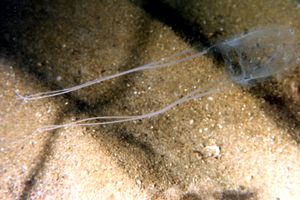
Carybdea brevipedalia has a gelatinous, translucent body with a milky white coloration. Its body is radially symmetrical and bell-shaped, with long tentacles extending from each corner of the bell.[1][2][3][4]
The tentacles contain nematocysts used for defense and prey capture. The species also possesses specialized sensory organs called rhopalia, which contain different types of eyes that detect light and movement.[5][6][7]
The bell diameter ranges from 2 to 4 cm, and the tentacles can reach a length of 2 m.[8][9]
Habitat
The species primarily inhabits shallow tropical waters at approximately 3 m depth. It commonly occurs in environments containing sand and small rocks.[10][11]
It is associated with water temperatures around 25 °C and is most active under salinity conditions ranging from 26 to 28 PSU.[12][13]
Diet
Carybdea brevipedalia is a carnivorous predator that targets larger zooplankton and small marine organisms. Its diet includes copepods, mysids, zoeae, megalopae, polychaetes, and fish larvae.[14][15]
Behaviour
Carybdea brevipedalia is a nocturnal predator that captures most of its prey at night.[16][17]
The species swims actively using jet propulsion, controlled by contraction and relaxation of the bell. Its average swimming speed is approximately 6 cm per second, and its swimming propulsion is faster than that of other cubozoan species.[18][19][20][21]
The species is most active during warm summer months.[22]
Reproduction and life cycle
Carybdea brevipedalia has a metagenic life cycle consisting of an asexual polyp stage and a sexually reproducing medusa stage. Fertilized eggs attach to benthic substrates at the beginning of the life cycle.[23][24]
The species favors hard surfaces such as rocks and shells for polyp formation. The polyp stage reproduces asexually through budding, and polyps develop into medusae during the life cycle.[25][26][27]
Uses
The species is known in Japan by the common name Andon-Kurage. The name refers to the resemblance of its body shape to a Japanese lamp.[28][29]
Classification of Carybdea brevipedalia
| Kingdom | Animalia |
|---|---|
| Phylum | Cnidaria |
| Class | Cubozoa (Box Jellyfish) |
| Order | Carybdeida |
| Family | Carybdeidae |
| Genus | Carybdea |
| Species | Carybdea brevipedalia Kishinouye, 1891 |
Where Carybdea brevipedalia is found
Checklists and occurrence records place Carybdea brevipedalia in 2 countries. GBIF holds 43 georeferenced records of it.
Countries
Regions and cities with the most records
- Hayama, Japan 8
- Kamakura, Japan 8
- Zushi, Japan 8
- Yokosuka, Japan 7
- Fujisawa, Japan 6
- Chigasaki, Japan 5
- Ebina, Japan 5
- Isogo, Japan 5
- Kurihama, Japan 5
- Miura, Japan 5
- Nihammatsu, Japan 5
- Sugita, Japan 5
- Fukuoka, Japan 4
- Itoshima, Japan 4
- Kanagawa, Japan 4
- Maebaru-chūō, Japan 4
- Shingū, Japan 4
- Geoje, South Korea 3
- Hiratsuka, Japan 3
- Kyosai, South Korea 3
- Sinhyeon, South Korea 3
- Tongyeong, South Korea 3
- Ōiso, Japan 3
A number beside a place is its count of GBIF occurrence records. A place without a number comes from a checklist alone. Records show where a species has been observed or collected, which can include escapes and vagrants.
Common names
Names in 3 other languages
- Japanese
- アンドンクラゲ
- Korean
- 작은상자해파리
- Portuguese
- Vespa-do-mar-japonesa
Synonyms
One other scientific name has been used for this species and is now treated as a synonym of Carybdea brevipedalia.
- Carybdea mora Kishinouye, 1910
Related species
-
 Mediterranean Box JellyCarybdea marsupialis
-
 JimbleCarybdea rastonii
-
 Box JellyCarybdea xaymacana
- Californian Box JellyCarybdea confusa
- Carybdea arborifera
- Carybdea wayamba
- South African Box JellyCarybdea murrayana
- Carybdea aurifera
Compare
Questions and answers
What is the diet of jellyfish?
Carybdea brevipedalia is carnivorous and feeds on larger zooplankton and small marine organisms, including copepods, mysids, zoeae, megalopae, polychaetes, and fish larvae.[14][15]
What food do box jellyfish eat?
Carybdea brevipedalia eats copepods, mysids, zoeae, megalopae, polychaetes, and fish larvae.[14][15]
Is a jellyfish a carnivore or omnivore?
Carybdea brevipedalia is a carnivorous predator that feeds on larger zooplankton and small marine organisms.[14]
Sources
Passages the profile rests on
- Carybdea brevipedalia has a gelatinous, translucent body with a milky white coloration. Source passage: “a gelatinous, translucent body structure with a milky white hue.” — English Wikipedia
- The species has a radially symmetrical body. Source passage: “C. brevipedalia are radially symmetric.” — English Wikipedia
- The species has a bell-shaped body. Source passage: “This species possesses a bell shaped body” — English Wikipedia
- The species has long tentacles extending from each corner of its bell. Source passage: “Extending from each corner of their bell lie long tentacles” — English Wikipedia
- The tentacles contain nematocysts used for defense and prey capture. Source passage: “Nematocysts lining the tentacles act as a defense and prey capture mechanism.” — English Wikipedia
- The species possesses specialized sensory organs called rhopalia. Source passage: “they also have specialized sensory organs called rhopalia.” — English Wikipedia
- The rhopalia contain different types of eyes that detect light and movement. Source passage: “There are different types of eyes in the rhopalia that detect light and movement for safety and during navigation.” — English Wikipedia
- The bell diameter ranges from 2 to 4 cm. Source passage: “a diameter of 2–4 cm.” — English Wikipedia
- The tentacles can reach a length of 2 m. Source passage: “tentacles that can lengthen up to 2m.” — English Wikipedia
- The species primarily inhabits shallow tropical waters at approximately 3 m depth. Source passage: “C. brevipedalia can primarily be found in shallow tropical waters around 3m deep” — English Wikipedia
- The species commonly occurs in environments containing sand and small rocks. Source passage: “They commonly gravitate towards sand and small rocks” — English Wikipedia
- The species is associated with water temperatures around 25 °C. Source passage: “at preferred temperatures around 25 °C.” — English Wikipedia
- The species is most active under salinity conditions ranging from 26 to 28 PSU. Source passage: “Carybdea brevipedalia are most active during warm summer months, under salinity conditions that range from 26 to 28 PSU.” — English Wikipedia
- Carybdea brevipedalia is a carnivorous predator that targets larger zooplankton and small marine organisms. Source passage: “Carybdea brevipedalia are carnivorous predators that display selective trophic behavior, targeting larger zooplankton and various small marine organisms.” — English Wikipedia
- The species consumes copepods, mysids, zoeae, megalopae, polychaetes, and fish larvae. Source passage: “These organisms include copepods, mysids, zoeae, megalopae, polychaete, and fish larvae.” — English Wikipedia
- Carybdea brevipedalia is a nocturnal predator. Source passage: “They are nocturnal predators known for their active swimming behavior” — English Wikipedia
- The species captures most of its prey at night. Source passage: “they capture a majority of their prey at night.” — English Wikipedia
- The species swims actively using jet propulsion. Source passage: “The swimming behavior of C. brevipedalia consists of active movement through jet propulsion” — English Wikipedia
- Its average swimming speed is approximately 6 cm per second. Source passage: “at an average speed of 6 cm per second.” — English Wikipedia
- Its swimming propulsion is faster than that of other cubozoan species. Source passage: “This propulsion rate is notably higher than other cubozoan species.” — English Wikipedia
- Swimming propulsion is controlled by contraction and relaxation of the bell. Source passage: “The movement of Carybdea brevipedalia is controlled by the contraction and relaxation of their bell” — English Wikipedia
- The species is most active during warm summer months. Source passage: “Carybdea brevipedalia are most active during warm summer months” — English Wikipedia
- The species has a metagenic life cycle consisting of an asexual polyp stage and a sexually reproducing medusa stage. Source passage: “C. brevipedalia sustain a metagenic life cycle, consisting of an asexual polyp stage and sexual reproducing medusa.” — English Wikipedia
- Fertilized eggs attach to benthic substrates at the beginning of the life cycle. Source passage: “This process is initiated when fertilized eggs attach to benthic substrates.” — English Wikipedia
- The species favors hard surfaces such as rocks and shells for polyp formation. Source passage: “They tend to favor hard surfaces such as rocks or shells, which offer stability during polyp formation.” — English Wikipedia
- The polyp stage reproduces asexually through budding. Source passage: “they reproduce asexually through budding.” — English Wikipedia
- Polyps develop into medusae during the life cycle. Source passage: “polyps develop into medusae.” — English Wikipedia
- The species is known in Japan by the common name Andon-Kurage. Source passage: “C. brevipedalia was given the common name "Andon-Kurage" in Japan” — English Wikipedia
- The Japanese common name Andon-Kurage refers to the resemblance of the species' body shape to a Japanese lamp. Source passage: “as their body figure resembles a Japanese lamp structure.” — English Wikipedia
Data
- Catalogue of Life, 2026-10-16 XR cc by
- Global Biodiversity Information Facility CC BY 4.0
- Wikidata CC0
- GeoNames CC BY 4.0
- Wikimedia Commons per image; credit shown with each image
- Within the Catalogue of Life, this name comes from World Register of Marine Species cc by
References
- Kishinouye, K. (1891). Zwei neue Medusen von Charybdea (Ch. brevipedalia n. sp., Ch. latigenitalia n. sp.). Dobutsugaku Zasshi, 3: 437–440. where the name was published
This species in other databases
- Catalogue of Life RHX3
- Wikidata Q2509675
- iNaturalist 784488
- WoRMS urn:lsid:marinespecies.org:taxname:527654
Page built on 28 November 2026. See how the catalog is made and all sources and licences.
Cite this page
ScientificNames.org. (2026). Carybdea brevipedalia. Retrieved November 28, 2026, from https://scientificnames.org/species/carybdea-brevipedalia
“Carybdea brevipedalia.” ScientificNames.org, 2026, scientificnames.org/species/carybdea-brevipedalia. Accessed 28 Nov. 2026.
ScientificNames.org. “Carybdea brevipedalia.” Accessed November 28, 2026. https://scientificnames.org/species/carybdea-brevipedalia.
@misc{scientificnames_carybdea_brevipedalia,
  author = {{ScientificNames.org}},
  title = {Carybdea brevipedalia},
  year = {2026},
  url = {https://scientificnames.org/species/carybdea-brevipedalia},
  note = {Accessed 2026-11-28}
}