Species · Other invertebrates
Jimble Carybdea rastonii
The scientific name of the Jimble is Carybdea rastonii. It is a species of animal in the family Carybdeidae, order Carybdeida. The name dates from 1886.
- Scientific name
- Carybdea rastonii Haacke, 1886
- Common name
- Jimble
- Genus
- Carybdea
- Family
- Carybdeidae
- Order
- Carybdeida
- Class
- Cubozoa
- Environment
- marine
- Recorded in
- 1 country
- Name status
- accepted in the Catalogue of Life

Overview
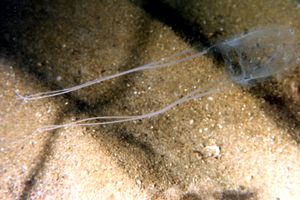
Jimble is a small box jellyfish in the family Carybdeidae, order Carybdeida and class Cubozoa. It occurs in shallow coastal waters at depths reaching 30 metres and has also been recorded in the open ocean. It has a box-shaped bell with white stinging warts and four single pinkish tentacles.
Written 26 November 2026 from the sources listed below. Each statement was checked against the passage it cites; statements that could not be supported were removed.
Habitat
Jimble occurs in shallow coastal waters at depths reaching 30 metres. It has also been recorded in the open ocean.[1][2]
Behaviour
Jimble is most commonly observed during autumn and winter.[3]
Conservation
Jimble has not been evaluated by the IUCN. No official assessment of its extinction status has been conducted.[4][5]
Appearance
Jimble has a box-shaped bell bearing white stinging warts on its surface. It has four single tentacles that are pinkish in colour.[6][7]
The species is described as a small box jellyfish.[8]
Classification of the Jimble
| Kingdom | Animalia |
|---|---|
| Phylum | Cnidaria |
| Class | Cubozoa (Box Jellyfish) |
| Order | Carybdeida |
| Family | Carybdeidae |
| Genus | Carybdea |
| Species | Carybdea rastonii Haacke, 1886 |
Where the Jimble is found
Checklists and occurrence records place Carybdea rastonii in 1 country. GBIF holds 215 georeferenced records of it.
Countries
Regions and cities with the most records
- Sydney, Australia 52
- New South Wales, Australia 32
- Adelaide, Australia 20
- Hornsby, Australia 19
- South Australia, Australia 10
- Kwinana, Australia 5
- Western Australia, Australia 5
- Busselton, Australia 4
- Tasmania, Australia 4
2 more countries have a few records outside this range
These countries hold a few records of Carybdea rastonii but lie outside the range the checklists give for it. Such records are often zoo or garden specimens, museum material or vagrants, so the species is not counted as occurring there.
A number beside a place is its count of GBIF occurrence records. A place without a number comes from a checklist alone. Records show where a species has been observed or collected, which can include escapes and vagrants.
Common names
English
- Jimble
Names in 4 other languages
- Czech
- čtyřhranka tichomořská
- Japanese
- アンドンクラゲ, アンドンクラゲ旧名
- Korean
- 라스톤입방해파리
- Portuguese
- Vespa-do-mar-do-Pacífico
Related species
-
 Mediterranean Box JellyCarybdea marsupialis
-
 Carybdea brevipedalia
-
 Box JellyCarybdea xaymacana
- Californian Box JellyCarybdea confusa
- Carybdea arborifera
- Carybdea wayamba
- South African Box JellyCarybdea murrayana
- Carybdea aurifera
Compare
Questions and answers
What is the scientific name of the Jimble?
The scientific name of the Jimble is Carybdea rastonii. Written with its author, the full name is Carybdea rastonii Haacke, 1886.
Which family does the Jimble belong to?
Carybdea rastonii belongs to the family Carybdeidae, in the order Carybdeida and the class Cubozoa.
Where is the Jimble found?
Checklists and occurrence records place Carybdea rastonii in 1 country: Australia.
Are box jellyfish in Australia?
Jimble is commonly found in southern Australia.[9]
Sources
Passages the profile rests on
- The species occurs in shallow coastal waters at depths reaching 30 metres. Source passage: “is found in shallow coastal waters to 30 m depths” — pmc.ncbi.nlm.nih.gov
- The species has also been recorded in the open ocean. Source passage: “and in the open ocean” — pmc.ncbi.nlm.nih.gov
- The species is most commonly observed during autumn and winter. Source passage: “Carybdea rastonii is most commonly seen in autumn (State Library of South Australia (SLSA): PRG 233/9.10, 1958) to winter (Gershwin, 2023)” — pmc.ncbi.nlm.nih.gov
- The species has not been evaluated by the IUCN. Source passage: “The IUCN has not evaluated this species of jellyfish” — English Wikipedia
- No official assessment of the species' extinction status has been conducted. Source passage: “no official assessment of its extinction status has been done yet.” — English Wikipedia
- The species has a box-shaped bell bearing white stinging warts on its surface. Source passage: “Carybdea rastonii is characterised by its box-shaped bell with white “stinging warts” on the surface” — pmc.ncbi.nlm.nih.gov
- The species has four single tentacles that are pinkish in colour. Source passage: “four, single tentacles (Haacke, 1886), which are pinkish in colour (Acevedo et al., 2019).” — pmc.ncbi.nlm.nih.gov
- The species is described as a small box jellyfish. Source passage: “a small box jellyfish common to southern Australia” — pmc.ncbi.nlm.nih.gov
- The species is commonly found in southern Australia. Source passage: “a small box jellyfish common to southern Australia” — pmc.ncbi.nlm.nih.gov
Data
- Catalogue of Life, 2026-10-16 XR cc by
- Global Biodiversity Information Facility CC BY 4.0
- Wikidata CC0
- GeoNames CC BY 4.0
- Wikimedia Commons per image; credit shown with each image
- Within the Catalogue of Life, this name comes from World Register of Marine Species cc by
References
- Haacke, W. (1886) Die Scyphomedusen des St. Vincent Golfes. In: Verlag von Gustav Fischer (Ed.), Jenaische Naturwissenschaftliche Zeitschrift, 20, pp. 588 - 638. where the name was published
This species in other databases
- Catalogue of Life RHX9
- Wikidata Q2477458
- iNaturalist 1199890
- WoRMS urn:lsid:marinespecies.org:taxname:287143
- ITIS 51462
Page built on 29 November 2026. See how the catalog is made and all sources and licences.
Cite this page
ScientificNames.org. (2026). Carybdea rastonii (Jimble). Retrieved November 29, 2026, from https://scientificnames.org/species/carybdea-rastonii
“Carybdea rastonii (Jimble).” ScientificNames.org, 2026, scientificnames.org/species/carybdea-rastonii. Accessed 29 Nov. 2026.
ScientificNames.org. “Carybdea rastonii (Jimble).” Accessed November 29, 2026. https://scientificnames.org/species/carybdea-rastonii.
@misc{scientificnames_carybdea_rastonii_jimble,
  author = {{ScientificNames.org}},
  title = {Carybdea rastonii (Jimble)},
  year = {2026},
  url = {https://scientificnames.org/species/carybdea-rastonii},
  note = {Accessed 2026-11-29}
}