Species · Other invertebrates
Mediterranean Box Jelly Carybdea marsupialis
The scientific name of the Mediterranean Box Jelly is Carybdea marsupialis. It is a species of animal in the family Carybdeidae, order Carybdeida. The name dates from 1758.
- Scientific name
- Carybdea marsupialis (Linnaeus, 1758)
- Common name
- Mediterranean Box Jelly
- Genus
- Carybdea
- Family
- Carybdeidae
- Order
- Carybdeida
- Class
- Cubozoa
- Environment
- marine
- Recorded in
- 6 countries
- Name status
- accepted in the Catalogue of Life
Overview
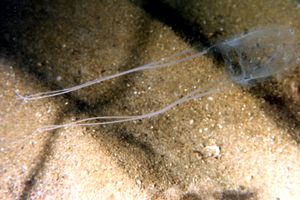
Carybdea marsupialis is essentially restricted to the Mediterranean Sea, where it is the only box jellyfish species found. It is distinguished from similar species by red banding on its four tentacles.
Written 26 November 2026 from the sources listed below. Each statement was checked against the passage it cites; statements that could not be supported were removed.
Appearance
The Mediterranean Box Jelly has a transparent, box-shaped bell measuring approximately 3 cm across. Four elongated tentacles extend from the lower corners of the bell and can reach 30 cm in length.[1][2][3][4]
Small white or yellowish warts containing stinging cells cover its bell. Four rhopalia containing sensory structures with ocelli are positioned near the bell margin.[5][6]
Red banding on the tentacles distinguishes this species from similar species. It also possesses comparatively sophisticated eyes with lenses.[7][8]
Habitat
The Mediterranean Box Jelly is pelagic and occurs in the upper few metres of the sea. It often captures prey in shallow waters.[9][10]
Diet
The Mediterranean Box Jelly feeds on invertebrates and small fish. It captures prey using nematocysts in its tentacles.[11][12]
Behaviour
The Mediterranean Box Jelly swims through rapid contractions of its bell. Its swimming speed ranges from 3 to 6 metres per minute.[13][14]
Its lens-equipped eyes help it detect and avoid obstacles such as posts and ship rudders. The species often occurs in small groups.[15][8][16]
Reproduction and life cycle
The species has separate sexes, and sexual reproduction occurs through the release of gametes into open water. Fertilisation produces a planula larva that subsequently develops into a cubopolyp.[17][18][19]
The cubopolyp can reproduce asexually through budding, and the buds soon detach. During its mobile polyp stage, the organism creeps across the substrate with its tentacular region leading.[20][21][22]
Fragments produced during the mobile polyp stage regenerate missing parts within 72 hours. The resulting polyps attach themselves to the substrate and develop 24 tentacles.[23][24]
Approximately one month later, the polyps detach and develop the four tentacles characteristic of the medusa phase.[25]
Classification of the Mediterranean Box Jelly
| Kingdom | Animalia |
|---|---|
| Phylum | Cnidaria |
| Class | Cubozoa (Box Jellyfish) |
| Order | Carybdeida |
| Family | Carybdeidae |
| Genus | Carybdea |
| Species | Carybdea marsupialis (Linnaeus, 1758) |
Where the Mediterranean Box Jelly is found
Checklists and occurrence records place Carybdea marsupialis in 6 countries. GBIF holds 822 georeferenced records of it.
Countries
Regions and cities with the most records
- Lido, Italy 81
- Venice, Italy 79
- Marghera, Italy 75
- Bellaria-Igea Marina, Italy 62
- San Benedetto del Tronto, Italy 60
- Cervia, Italy 59
- Giulianova, Italy 57
- Cesenatico, Italy 55
- Friuli Venezia Giulia, Italy 53
- Cesena, Italy 50
- Mira Taglio, Italy 46
- Veneto, Italy 46
- Roseto degli Abruzzi, Italy 44
- Chioggia, Italy 43
- Mestre, Italy 43
- Monfalcone, Italy 41
- Rimini, Italy 40
- Osimo, Italy 39
- Termoli, Italy 37
- Ancona, Italy 36
- Cattolica, Italy 28
- Falconara Marittima, Italy 27
- Porto San Giorgio, Italy 27
- Riccione, Italy 27
- Fermo, Italy 26
- Senigallia, Italy 25
- Spinea-Orgnano, Italy 25
- Civitanova Marche, Italy 23
- Mogliano Veneto, Italy 23
- Porto Sant'Elpidio, Italy 23
- Barletta, Italy 22
- Pescara, Italy 19
- Ravenna, Italy 19
- Trieste, Italy 19
- Cecina, Italy 18
- Montesilvano, Italy 18
3 more countries have a few records outside this range
These countries hold a few records of Carybdea marsupialis but lie outside the range the checklists give for it. Such records are often zoo or garden specimens, museum material or vagrants, so the species is not counted as occurring there.
A number beside a place is its count of GBIF occurrence records. A place without a number comes from a checklist alone. Records show where a species has been observed or collected, which can include escapes and vagrants.
Common names
English
- Mediterranean Box Jelly
- Mediterranean Box Jellyfish
- Mediterranean Seawasp
- Sea Wasp
Names in 7 other languages
- Czech
- čtyřhranka středomořská
- Dutch
- zeewesp
- French
- Carybdée marsupiale
- German
- Mittelmeer - Seewespe, Mittelmeer Seewespe, Mittelmeer-Würfelqualle
- Italian
- Cubomedusa mediterranea, Medusa cubo mediterranea, Medusa scatola mediterranea
- Portuguese
- Vespa-do-mar-do-Mediterrâneo
- Spanish
- avispón marino
Synonyms
3 other scientific names have been used for this species and are now treated as synonyms of Carybdea marsupialis.
- Charybdea marsupialis (Linnaeus, 1758)
- Charybdea marsupialis Milne-Edwards, 1833
- Medusa marsupialis Linnaeus, 1758
Related species
-
 Carybdea brevipedalia
-
 JimbleCarybdea rastonii
-
 Box JellyCarybdea xaymacana
- Californian Box JellyCarybdea confusa
- Carybdea arborifera
- Carybdea wayamba
- South African Box JellyfishCarybdea murrayana
- Carybdea aurifera
Compare
Questions and answers
What is the scientific name of the Mediterranean Box Jelly?
The scientific name of the Mediterranean Box Jelly is Carybdea marsupialis. Written with its author, the full name is Carybdea marsupialis (Linnaeus, 1758).
Which family does the Mediterranean Box Jelly belong to?
Carybdea marsupialis belongs to the family Carybdeidae, in the order Carybdeida and the class Cubozoa.
Where is the Mediterranean Box Jelly found?
Checklists and occurrence records place Carybdea marsupialis in 6 countries: Italy, Spain, France, Albania, Greece and Malta.
What other names does the Mediterranean Box Jelly have?
Carybdea marsupialis is also known in English as Mediterranean Box Jellyfish, Mediterranean Seawasp and Sea Wasp.
How bad is a sea wasp sting?
The Mediterranean Box Jelly has a venomous sting. Some swimmers experience no noticeable painful sensation, but severe stings can cause systemic symptoms including pain, paresthesia, hyperesthesia and skin lesions. Symptoms following severe stings may take several months to disappear completely.[26][27][28][29]
What do sea wasps eat?
The Mediterranean Box Jelly feeds on invertebrates and small fish. It captures prey using nematocysts in its tentacles.[11][12]
Are box jellyfish carnivores?
The Mediterranean Box Jelly feeds on invertebrates and small fish.[11]
Sources
Passages the profile rests on
- Carybdea marsupialis has a transparent, box-shaped bell. Source passage: “a small transparent jellyfish with a box-shaped bell” — English Wikipedia
- The bell measures approximately 3 cm across. Source passage: “bell about 3 cm (1 in) across” — English Wikipedia
- The jellyfish has four elongated tentacles extending from the lower corners of its bell. Source passage: “at the four lower corners of which are four elongated tentacles” — English Wikipedia
- Its tentacles can reach 30 cm in length. Source passage: “four elongated tentacles up to 30 cm (12 in) long” — English Wikipedia
- Its bell bears small white or yellowish warts containing stinging cells. Source passage: “The bell has a number of small white or yellowish warts with stinging cells” — English Wikipedia
- It has four rhopalia containing sensory structures with ocelli near the bell margin. Source passage: “four rhopalia (sensory structures with ocelli)” — English Wikipedia
- Red banding on its tentacles distinguishes this species from similar species. Source passage: “This species can be distinguished from other similar species by the red banding on the tentacles.” — English Wikipedia
- It possesses comparatively sophisticated eyes with lenses. Source passage: “it has comparatively sophisticated eyes with lenses.” — English Wikipedia
- The species is pelagic and occurs in the upper few metres of the sea. Source passage: “It is pelagic and is present in the upper few metres of the sea.” — English Wikipedia
- The species captures prey often in shallow waters. Source passage: “often in shallow waters.” — English Wikipedia
- It feeds on invertebrates and small fish. Source passage: “feeds on invertebrates and even small fish” — English Wikipedia
- It captures prey using nematocysts in its tentacles. Source passage: “which it captures with the nematocysts (stinging cells) in its tentacles” — English Wikipedia
- It swims through rapid contractions of its bell. Source passage: “It swims by making rapid contractions of the bell” — English Wikipedia
- Its swimming speed ranges from 3 to 6 metres per minute. Source passage: “can move at a speed of between 3 and 6 m (10 and 20 ft) per minute.” — English Wikipedia
- Its lens-equipped eyes help it detect and avoid obstacles such as posts and ship rudders. Source passage: “it can detect obstacles such as posts or a ship's rudder and avoid them.” — English Wikipedia
- The species often occurs in small groups. Source passage: “It often occurs in small groups.” — English Wikipedia
- The species has separate sexes. Source passage: “The sexes are separate” — English Wikipedia
- Sexual reproduction occurs through the release of gametes into open water. Source passage: “sexual reproduction takes place with the emission of gametes into the open water.” — English Wikipedia
- Fertilisation produces a planula larva that subsequently develops into a cubopolyp. Source passage: “After fertilisation, a planula larva forms which later develops into a cubopolyp” — English Wikipedia
- The cubopolyp can reproduce asexually through budding. Source passage: “This can reproduce asexually by budding” — English Wikipedia
- The buds produced by the cubopolyp soon detach. Source passage: “the buds soon becoming detached.” — English Wikipedia
- During its mobile polyp stage, the organism creeps across the substrate with its tentacular region leading. Source passage: “At first they creep across the substrate with the tentacular region leading.” — English Wikipedia
- Fragments produced during the mobile polyp stage regenerate missing parts within 72 hours. Source passage: “these fragments regenerate their missing parts within 72 hours.” — English Wikipedia
- The resulting polyps attach themselves to the substrate and develop 24 tentacles. Source passage: “The resulting polyps then attach themselves to the substrate and grow a full complement of 24 tentacles.” — English Wikipedia
- Approximately one month later, the polyps detach and develop the four tentacles characteristic of the medusa phase. Source passage: “About a month later they become detached, the multiple tentacles are reabsorbed and the four tentacles typical of the medusa phase develop.” — English Wikipedia
- Its sting is venomous to humans. Source passage: “The sting is venomous to humans” — English Wikipedia
- Some swimmers experience no noticeable painful sensation after being stung. Source passage: “some swimmers do not notice any painful sensation.” — English Wikipedia
- Severe stings can cause systemic symptoms, including pain, paresthesia, hyperesthesia and skin lesions. Source passage: “the symptoms can be systemic, including pain at the sting site and elsewhere, paresthesia, hyperesthesia and skin lesions” — English Wikipedia
- Symptoms following severe stings may take several months to disappear completely. Source passage: “may take a few months to fully disappear.” — English Wikipedia
Data
- Catalogue of Life, 2026-10-16 XR cc by
- Global Biodiversity Information Facility CC BY 4.0
- Wikidata CC0
- GeoNames CC BY 4.0
- Wikimedia Commons per image; credit shown with each image
- Within the Catalogue of Life, this name comes from World Register of Marine Species cc by
References
- Linnaeus, C. (1758) Systema naturae per regna tria naturae, secundum classes, ordines, genera, species, cum characteribus, differentiis, synonymis, locis. Tomus I. Editio decima, reformata. Impensis L. Salvii, Holmiae, 824 pp. where the name was published
This species in other databases
- Catalogue of Life RHX5
- Wikidata Q148576
- iNaturalist 255959
- WoRMS urn:lsid:marinespecies.org:taxname:135279
- ITIS 51460
Page built on 29 November 2026. See how the catalog is made and all sources and licences.
Cite this page
ScientificNames.org. (2026). Carybdea marsupialis (Mediterranean Box Jelly). Retrieved November 29, 2026, from https://scientificnames.org/species/carybdea-marsupialis
“Carybdea marsupialis (Mediterranean Box Jelly).” ScientificNames.org, 2026, scientificnames.org/species/carybdea-marsupialis. Accessed 29 Nov. 2026.
ScientificNames.org. “Carybdea marsupialis (Mediterranean Box Jelly).” Accessed November 29, 2026. https://scientificnames.org/species/carybdea-marsupialis.
@misc{scientificnames_carybdea_marsupialis_mediterranean_box_jelly,
  author = {{ScientificNames.org}},
  title = {Carybdea marsupialis (Mediterranean Box Jelly)},
  year = {2026},
  url = {https://scientificnames.org/species/carybdea-marsupialis},
  note = {Accessed 2026-11-29}
}