Species · Birds
Orange-billed Nightingale-thrush Catharus aurantiirostris
The scientific name of the Orange-billed Nightingale-thrush is Catharus aurantiirostris. It is a species of bird in the family Turdidae (thrush), order Passeriformes. The name dates from 1850.
- Scientific name
- Catharus aurantiirostris (Hartlaub, 1850)
- Common name
- Orange-billed Nightingale-thrush
- Genus
- Catharus
- Family
- Turdidae (Thrush)
- Order
- Passeriformes
- Class
- Aves
- Red List category
- LC Least Concern
- Environment
- terrestrial
- Recorded in
- 12 countries
- Name status
- accepted in the Catalogue of Life

Overview
Catharus aurantiirostris inhabits forest types in upper tropical and subtropical zones, from northern Mexico through Central America, excluding Belize, into northern South America, and has also been documented in Brazil. It has olive-brown plumage, a long, strong orange bill, and brownish-orange legs and feet.
Written 26 November 2026 from the sources listed below. Each statement was checked against the passage it cites; statements that could not be supported were removed.
Appearance
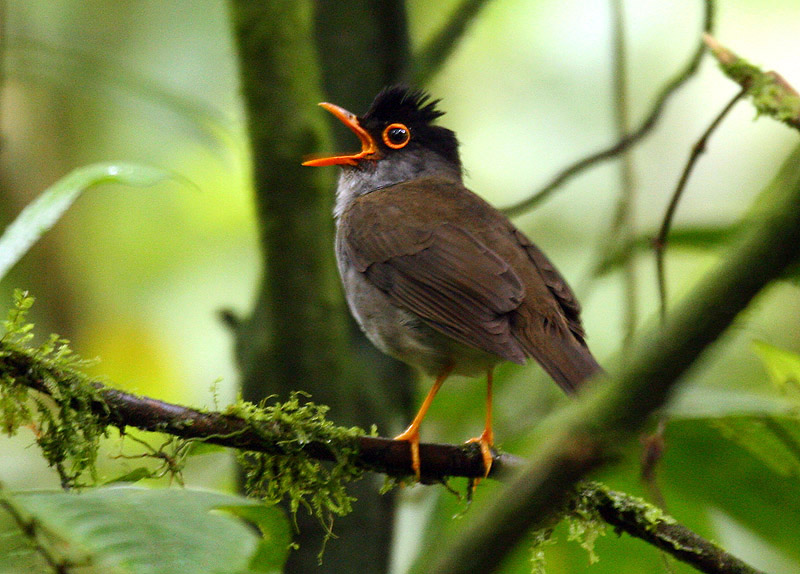
Adults of the nominate subspecies have olive-brown plumage with a rufous tinge on the crown, nape, back, rump, wings, and tail. The face is grayish-brown with a thin orange eye-ring, while the throat is whitish and transitions to pale gray on the remaining underparts.[1][2][3]
The species has a long, strong orange bill and brownish-orange legs and feet. Males and females have the same plumage.[4][5]
Juveniles are predominantly brown with extensive buff flecking and mottling. The species measures 15.5–17 cm in length and weighs between 21 and 32 g.[6][7][8]
Habitat
The species inhabits forest types in upper tropical and subtropical zones, including the edges of lowland and montane evergreen forests. It also occurs in pine-oak forest interiors, deciduous forests, and secondary forests.[9][10][11]
In Central and South America, its habitats also include semi-deciduous forests, gardens, and coffee plantations. It has been recorded in urban areas in Venezuela.[12][13]
In Guatemala and Honduras, it occurs at elevations between 600 and 2,850 m. In Costa Rica, it occurs between 500 and 2,200 m, and in Panama between 900 and 1,650 m.[14][15][16]
In Colombia, the species occurs at elevations between 600 and 2,300 m. In Venezuela, it occurs between 800 and 2,900 m.[17][18]
Diet
The species feeds on insects, spiders, and worms. Its diet also includes seeds and berries.[19][20]
Behaviour
The species forages in forest understory vegetation and on the ground, where it flips over leaf litter. It has been observed following army ant swarms on Trinidad.[21][22][23]
The species is a year-round resident across most of its geographical range. Much of the population on Mexico's Pacific slope moves from highlands to near sea level during winter, while birds in the northernmost part of Mexico are thought to migrate south during winter.[24][25][26]
The species usually sings from dense vegetation.[27]
Reproduction and life cycle
The breeding season in Mexico extends from April through September, in Costa Rica from March through August, and in Colombia from March through July.[28][29][30]
The species constructs bulky cup-shaped nests using moss, rootlets, and coarse grass, with a lining of finer materials. Most nests are placed in shrubs, thickets, or other dense sites approximately 1–2 m above the ground.[31][32]
Clutches contain two or three eggs. The eggs are pale blue to greenish white with reddish-brown and pale lilac markings.[33][34]
Egg incubation lasts between 13 and 15 days. Young birds fledge between 13 and 17 days after hatching.[35][36]
Conservation
The IUCN classifies the Orange-billed Nightingale-thrush as Least Concern. Its estimated population is at least 500,000 mature individuals, although the population is believed to be decreasing.[37][38][39]
No immediate threats to the species have been identified.[40]
Classification of the Orange-billed Nightingale-thrush
| Kingdom | Animalia |
|---|---|
| Phylum | Chordata |
| Subphylum | Vertebrata |
| Infraphylum | Gnathostomata |
| Parvphylum | Osteichthyes |
| Megaclass | Tetrapoda |
| Class | Aves (Bird) |
| Order | Passeriformes (Passerine) |
| Family | Turdidae (Thrush) |
| Genus | Catharus (American Thrushes) |
| Species | Catharus aurantiirostris (Hartlaub, 1850) |
Where the Orange-billed Nightingale-thrush is found
Checklists and occurrence records place Catharus aurantiirostris in 12 countries across North America and South America. GBIF holds 109,749 georeferenced records of it.
Countries
- Brazil 12
- Colombia 15,606
- Costa Rica 37,290
- El Salvador 1,533
- Guatemala 14,765
- Honduras 4,197
- Mexico 22,731
- Nicaragua 2,220
- Panama 7,748
- Trinidad and Tobago 62
- United States 72
- Venezuela 3,513
Regions and cities with the most records
- Puntarenas Province, Costa Rica 15,929
- San José, Costa Rica 7,256
- Chiriquí Province, Panama 7,084
- Cartago, Costa Rica 6,320
- San Diego, Costa Rica 6,050
- Curridabat, Costa Rica 6,033
- Patarrá, Costa Rica 5,816
- San Miguel, Costa Rica 5,630
- Paraíso, Costa Rica 5,607
- San Pedro, Costa Rica 5,571
- Alajuela Province, Costa Rica 5,560
- Guadalupe, Costa Rica 5,459
- San José, Costa Rica 5,444
- Cartago Province, Costa Rica 5,442
- San Juan, Costa Rica 5,423
- San Vicente, Costa Rica 5,304
- San Vicente de Moravia, Costa Rica 5,302
- San Rafael Arriba, Costa Rica 5,267
- Purral, Costa Rica 5,246
- San Felipe, Costa Rica 5,238
- San Juan de Dios, Costa Rica 5,222
- San Pablo, Costa Rica 5,194
- Aserrí, Costa Rica 4,969
- San Rafael, Costa Rica 4,878
- Heredia, Costa Rica 4,772
- Alta Verapaz, Guatemala 4,630
- Villa Nueva, Guatemala 4,545
- Petapa, Guatemala 4,526
- Cobán, Guatemala 4,463
- Alajuela, Costa Rica 4,410
- Mixco, Guatemala 4,405
- San Cristóbal Verapaz, Guatemala 4,297
- San Pedro Carchá, Guatemala 4,081
- Santiago Atitlán, Guatemala 4,012
- Villa Canales, Guatemala 3,994
- Santa Catarina Pinula, Guatemala 3,923
Range as the checklists state it
Middle America
North America
South America
Caribbean
A number beside a place is its count of GBIF occurrence records. A place without a number comes from a checklist alone. Records show where a species has been observed or collected, which can include escapes and vagrants.
Common names
English
- Orange-billed Nightingale-Thrush
Names in 25 other languages
- Catalan
- griveta becgroga
- Chinese
- 橙嘴夜鶇, 橙腹夜鸫
- Croatian
- narančastokljuni drozd
- Czech
- drozd oranžovozobý
- Danish
- Orangenæbbet Skovdrossel
- Dutch
- Geelbekdwerglijster
- Esperanto
- oranĝbeka turdo
- Estonian
- ruugenokk-värbrästas
- Finnish
- kultanokkarastas
- French
- Grive à bec orange
- German
- Goldschnabel-Musendrossel, Goldschnabelmusendrossel
- Hungarian
- aranycsőrű fülemülerigó
- Italian
- Tordo usignolo beccoarancio
- Japanese
- アカハシチャツグミ
- Lithuanian
- rudasis trumpasnapis strazdas
- Norwegian
- oransjenebbskogtrost
- Polish
- drozdek żółtodzioby
- Portuguese
- sabiazinho-de-bico-laranja, tordo-de-bico-laranja
- Russian
- Желтоносый короткоклювый дрозд, Оранжевоклювый соловей-дрозд, Оранжевоклювый соловьиный дрозд
- Serbian
- Narandžastokljuni slavujasti drozdić
- Spanish
- Thrush Zorzal Piquianaranjado, Zorzal pico naranja, Zorzalito Piquigualda, Zorzalito piquigualdo
- Swedish
- orangenäbbad skogstrast
- Turkish
- Turuncu Gagalı Bülbül Ardıcı
- Ukrainian
- дрізд-короткодзьоб південний
- Welsh
- eos-frych picoch
Synonyms
2 other scientific names have been used for this species and are now treated as synonyms of Catharus aurantiirostris.
- Turdus aurantiirostris Hartlaub, 1850
- Turdus immaculatus Bonaparte, CLJL, 1850
Subspecies and varieties
- Catharus aurantiirostris aurantiirostris subspecies
- Catharus aurantiirostris barbaritoi subspecies
- Catharus aurantiirostris birchalli subspecies
- Catharus aurantiirostris clarus subspecies
- Catharus aurantiirostris costaricensis subspecies
- Catharus aurantiirostris griseiceps subspecies
- Catharus aurantiirostris inornatus subspecies
- Catharus aurantiirostris insignis subspecies
- Catharus aurantiirostris melpomene subspecies
- Catharus aurantiirostris phaeopleurus subspecies
- Catharus aurantiirostris sierrae subspecies
Related species
-
 Hermit ThrushCatharus guttatus
-
 Swainson's ThrushCatharus ustulatus
-
 VeeryCatharus fuscescens
-
 Bicknell's ThrushCatharus bicknelli
-
 Gray-cheeked ThrushCatharus minimus
-
 Black-headed Nightingale-thrushCatharus mexicanus
-
 Slaty-backed Nightingale-thrushCatharus fuscater
-
 Black-billed Nightingale-thrushCatharus gracilirostris
Compare
Questions and answers
What is the scientific name of the Orange-billed Nightingale-thrush?
The scientific name of the Orange-billed Nightingale-thrush is Catharus aurantiirostris. Written with its author, the full name is Catharus aurantiirostris (Hartlaub, 1850).
Which family does the Orange-billed Nightingale-thrush belong to?
Catharus aurantiirostris belongs to the family Turdidae, in the order Passeriformes and the class Aves.
Where is the Orange-billed Nightingale-thrush found?
Checklists and occurrence records place Catharus aurantiirostris in 12 countries, including Costa Rica, Mexico, Colombia, Guatemala, Panama and Honduras.
What is the conservation status of the Orange-billed Nightingale-thrush?
The IUCN Red List category recorded for Catharus aurantiirostris is Least Concern (LC).
Is a thrush bird rare?
The Orange-billed Nightingale-thrush is classified as Least Concern by the IUCN and has an estimated population of at least 500,000 mature individuals. Its population is believed to be decreasing.[37][38][39]
Are there nightingales in the USA?
The Orange-billed Nightingale-thrush has been recorded as a vagrant in the United States. One bird was photographed in southern Texas in 1996, and another was photographed in South Dakota in 2010.[41][42][43]
Sources
Passages the profile rests on
- Adults of the nominate subspecies have olive-brown plumage with a rufous tinge on the crown, nape, back, rump, wings, and tail. Source passage: “Adults of the nominate subspecies C. a. aurantiirostris are olive-brown with a rufous tinge on their crown, nape, back, rump, wings, and tail.” — English Wikipedia
- The nominate subspecies has a grayish-brown face with a thin orange eye-ring. Source passage: “Their face is grayish brown with a thin orange eye-ring.” — English Wikipedia
- The nominate subspecies has a whitish throat that transitions to pale gray on the remaining underparts. Source passage: “Their throat is whitish that darkens to pale gray on the rest of the underparts.” — English Wikipedia
- The species has a long, strong orange bill and brownish-orange legs and feet. Source passage: “They have a long, strong, orange bill and brownish orange legs and feet.” — English Wikipedia
- Male and female orange-billed nightingale-thrushes have the same plumage. Source passage: “The sexes have the same plumage.” — English Wikipedia
- Juveniles are predominantly brown with extensive buff flecking and mottling. Source passage: “Juveniles are mostly brown with much buff flecking and mottling.” — English Wikipedia
- The orange-billed nightingale-thrush measures 15.5–17 cm in length. Source passage: “The orange-billed nightingale-thrush is 15.5 to 17 cm (6.1 to 6.7 in) long” — English Wikipedia
- The species weighs between 21 and 32 g. Source passage: “weighs 21 to 32 g (0.74 to 1.1 oz).” — English Wikipedia
- The species inhabits forest types in upper tropical and subtropical zones. Source passage: “The orange-billed nightingale-thrush inhabits a variety of forest types in the upper tropical and subtropical zones.” — English Wikipedia
- Its habitats include the edges of lowland and montane evergreen forests. Source passage: “These include the edges of both lowland and montane evergreen forest” — English Wikipedia
- The species also inhabits pine-oak forest interiors, deciduous forests, and secondary forests. Source passage: “the interior of pine-oak forest, deciduous forest, and secondary forest.” — English Wikipedia
- In Central and South America, the species also occurs in semi-deciduous forests, gardens, and coffee plantations. Source passage: “In Central and South America it also occurs in semi-deciduous forest, gardens, coffee plantations” — English Wikipedia
- The species has also been recorded in urban areas in Venezuela. Source passage: “and (at least in Venezuela) urban areas.” — English Wikipedia
- In Guatemala and Honduras, the species occurs at elevations between 600 and 2,850 m. Source passage: “It ranges from 600 to 2,850 m (2,000 to 9,400 ft) in Guatemala and Honduras” — English Wikipedia
- In Costa Rica, the species occurs at elevations between 500 and 2,200 m. Source passage: “500 to 2,200 m (1,600 to 7,200 ft) in Costa Rica” — English Wikipedia
- In Panama, the species occurs at elevations between 900 and 1,650 m. Source passage: “900 to 1,650 m (3,000 to 5,400 ft) in Panama” — English Wikipedia
- In Colombia, the species occurs at elevations between 600 and 2,300 m. Source passage: “600 to 2,300 m (2,000 to 7,500 ft) in Colombia” — English Wikipedia
- In Venezuela, the species occurs at elevations between 800 and 2,900 m. Source passage: “800 to 2,900 m (2,600 to 9,500 ft) in Venezuela.” — English Wikipedia
- The species feeds on insects, spiders, and worms. Source passage: “The orange-billed nightingale-thrush feeds on invertebrates such as insects, spiders, and worms” — English Wikipedia
- Its diet also includes seeds and berries. Source passage: “and also on seeds and berries.” — English Wikipedia
- The species forages in forest understory vegetation and on the ground. Source passage: “It forages in the forest understory and on the ground” — English Wikipedia
- While foraging on the ground, the species flips over leaf litter. Source passage: “where it flips over leaf litter.” — English Wikipedia
- The species has been observed following army ant swarms on Trinidad. Source passage: “It has been observed following army ant swarms on Trinidad.” — English Wikipedia
- The species is a year-round resident across most of its geographical range. Source passage: “The orange-billed nightingale thrush is a year-round resident in most of its range.” — English Wikipedia
- Much of the population on Mexico's Pacific slope moves from highlands to near sea level during winter. Source passage: “Much of the population on the Pacific slope of Mexico moves from the highlands to near sea level for the winter” — English Wikipedia
- Birds in the northernmost part of Mexico are thought to migrate south during winter. Source passage: “birds in the more northern part of Mexico are thought to move south for the same period.” — English Wikipedia
- The species usually sings from dense vegetation. Source passage: “The orange-billed nightingale thrush usually sings from dense cover.” — English Wikipedia
- The breeding season in Mexico extends from April through September. Source passage: “includes April to September in Mexico” — English Wikipedia
- The breeding season in Costa Rica extends from March through August. Source passage: “March to August in Costa Rica” — English Wikipedia
- The breeding season in Colombia extends from March through July. Source passage: “March to July in Colombia” — English Wikipedia
- The species constructs bulky cup-shaped nests using moss, rootlets, and coarse grass, with a lining of finer materials. Source passage: “It builds a bulky cup nest from moss, rootlets, and coarse grass with a lining of finer materials.” — English Wikipedia
- Most nests are placed in shrubs, thickets, or other dense sites approximately 1–2 m above the ground. Source passage: “Most are built in a shrub, thicket, or other dense site between about 1 and 2 m (3 and 7 ft) above the ground.” — English Wikipedia
- The species lays clutches of two or three eggs. Source passage: “The clutch is two or three eggs” — English Wikipedia
- The eggs are pale blue to greenish white and bear reddish-brown and pale lilac markings. Source passage: “that are pale blue to greenish white with reddish brown and pale lilac markings.” — English Wikipedia
- Egg incubation lasts between 13 and 15 days. Source passage: “The incubation period is 13 to 15 days” — English Wikipedia
- Young birds fledge between 13 and 17 days after hatching. Source passage: “fledging occurs 13 to 17 days after hatch.” — English Wikipedia
- The IUCN classifies the orange-billed nightingale-thrush as Least Concern. Source passage: “The IUCN has assessed the orange-billed nightingale-thrush as being of Least Concern.” — English Wikipedia
- The species has an estimated population of at least 500,000 mature individuals. Source passage: “its estimated population of at least 500,000 mature individuals” — English Wikipedia
- The species' population is believed to be decreasing. Source passage: “is believed to be decreasing.” — English Wikipedia
- No immediate threats to the species have been identified. Source passage: “No immediate threats have been identified.” — English Wikipedia
- The species has been recorded as a vagrant in the United States. Source passage: “and as a vagrant to the United States.” — English Wikipedia
- One United States record involved a bird photographed in southern Texas in 1996. Source passage: “One bird was photographed in southern Texas in 1996.” — English Wikipedia
- A second United States record involved a bird photographed in South Dakota in 2010. Source passage: “The other was photographed in South Dakota in 2010” — English Wikipedia
Data
- Catalogue of Life, 2026-10-16 XR cc by
- Global Biodiversity Information Facility CC BY 4.0
- Wikidata CC0
- GeoNames CC BY 4.0
- Wikimedia Commons per image; credit shown with each image
- Within the Catalogue of Life, this name comes from The Integrated Taxonomic Information System cc0
References
- Rev. Zool. [Paris], ser. 2, 1: 158. 1850 where the name was published
- Gill, Frank, & and Minturn Wright. (2006). Birds of the World: Recommended English Names.
- Howell, Steve N. G., Ian Lewington, and Will Russell. (2014). Rare Birds of North America.
This species in other databases
Page built on 29 November 2026. See how the catalog is made and all sources and licences.
Cite this page
ScientificNames.org. (2026). Catharus aurantiirostris (Orange-billed Nightingale-thrush). Retrieved November 29, 2026, from https://scientificnames.org/species/catharus-aurantiirostris
“Catharus aurantiirostris (Orange-billed Nightingale-thrush).” ScientificNames.org, 2026, scientificnames.org/species/catharus-aurantiirostris. Accessed 29 Nov. 2026.
ScientificNames.org. “Catharus aurantiirostris (Orange-billed Nightingale-thrush).” Accessed November 29, 2026. https://scientificnames.org/species/catharus-aurantiirostris.
@misc{scientificnames_catharus_aurantiirostris_orange_billed_nightingale_thrush,
  author = {{ScientificNames.org}},
  title = {Catharus aurantiirostris (Orange-billed Nightingale-thrush)},
  year = {2026},
  url = {https://scientificnames.org/species/catharus-aurantiirostris},
  note = {Accessed 2026-11-29}
}