Species · Birds
Black-billed Nightingale-thrush Catharus gracilirostris
The scientific name of the Black-billed Nightingale-thrush is Catharus gracilirostris. It is a species of bird in the family Turdidae (thrush), order Passeriformes. The name dates from 1865.
- Scientific name
- Catharus gracilirostris Salvin, 1865
- Common name
- Black-billed Nightingale-thrush
- Genus
- Catharus
- Family
- Turdidae (Thrush)
- Order
- Passeriformes
- Class
- Aves
- Red List category
- LC Least Concern
- Recorded in
- 2 countries
- Name status
- accepted in the Catalogue of Life

Overview
The Black-billed Nightingale-thrush is a bird with the scientific name Catharus gracilirostris. It occurs in Costa Rica and Panama, primarily inhabiting montane evergreen forest, elfin forest, and paramo. It has a disjunct distribution and the smallest range among Catharus thrushes.
Written 26 November 2026 from the sources listed below. Each statement was checked against the passage it cites; statements that could not be supported were removed.
Appearance
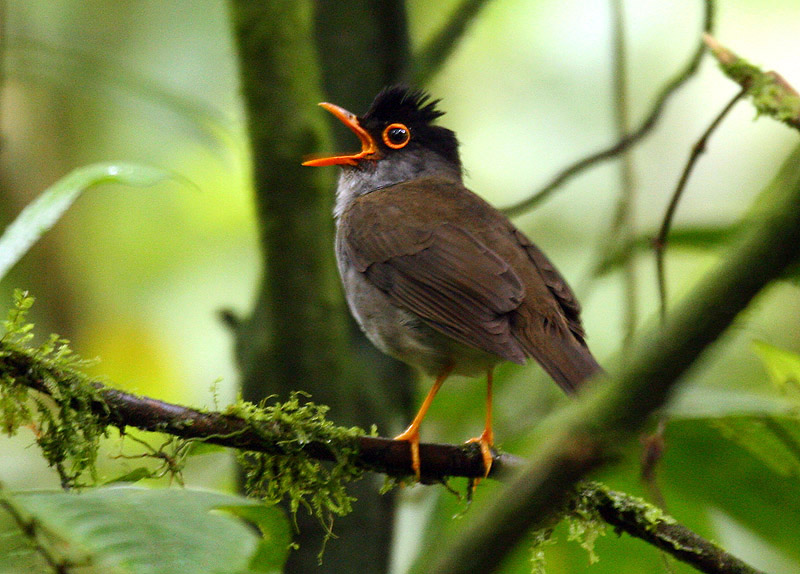
Adults of the nominate subspecies have a slate-gray forecrown and face, an olive-brown crown, and olive-brown upperparts, wings, and upper tail surfaces. Their throat is whitish, their middle lower belly is light gray to whitish, and their slate-gray underparts have an olivaceous breast band.[1][2][3][4]
Adults have a dark brown iris, black bill, and dark gray legs and feet. The sexes have the same plumage.[5][6]
Juveniles have more olive in their upperparts than adults, with an olive-tinged sooty gray face and throat. Their underparts are darker, with spotting on the breast and upper belly.[7][8][9]
The subspecies C. g. accentor has more reddish-brown upperparts, a paler breast band, and blacker legs and feet than the nominate subspecies. C. g. bensoni has reddish-brown upperparts, a blackish-brown forecrown, and a dark reddish-brown breast band.[10][11]
The species measures approximately 15 cm in length and weighs approximately 20 g.[12][13]
Habitat
The species primarily inhabits montane evergreen forest, elfin forest, and paramo in upper subtropical and temperate zones.[14][15][16]
It also visits pastures, gardens, and roadsides while seeking food. One reported elevational range extends from 1,800 m to the timberline.[17][18]
In Costa Rica, the species occurs from 2,200 m to above the timberline.[19]
Diet
The species feeds primarily on small insects and also consumes spiders. It eats small amounts of fruit.[20][21][22]
Behaviour
The species is a year-round resident and usually forages on the ground. During the breeding season, it forages alone and in pairs.[23][24][25]
It tosses leaves and leaf litter to uncover prey. It also forages in the forest canopy at heights reaching approximately 25 m.[26][27]
The species often exhibits tame behaviour.[28]
Its songs contain up to approximately 18 distinct phrases and typically alternate between higher and lower pitches. Males usually sing from within understory vegetation and countersing during the breeding season.[29][30][31][32]
Reproduction and life cycle
The breeding season of the species has not been defined. It builds a bulky cup-shaped nest primarily from mosses and roots, with a lining of softer materials.[33][34][35]
The nest is typically situated in dense vegetation up to approximately 5 m above the ground. Clutches contain two eggs, which are greenish blue with chestnut-brown markings.[36][37][38]
Conservation
The species is classified as Least Concern by the IUCN. Its estimated population comprises between 20,000 and 50,000 mature individuals, and the population is believed to be stable.[39][40][41]
BirdLife International reports between 20,000 and 49,999 mature individuals. The species is considered common overall, and no immediate threats have been identified.[42][43][44]
Much of the species' range in Costa Rica is protected within a national park. The IUCN Red List assessment was most recently conducted in 2022.[45][46]
Classification of the Black-billed Nightingale-thrush
| Kingdom | Animalia |
|---|---|
| Phylum | Chordata |
| Subphylum | Vertebrata |
| Infraphylum | Gnathostomata |
| Parvphylum | Osteichthyes |
| Megaclass | Tetrapoda |
| Class | Aves (Bird) |
| Order | Passeriformes (Passerine) |
| Family | Turdidae (Thrush) |
| Genus | Catharus (American Thrushes) |
| Species | Catharus gracilirostris Salvin, 1865 |
Where the Black-billed Nightingale-thrush is found
Checklists and occurrence records place Catharus gracilirostris in 2 countries across North America. GBIF holds 18,664 georeferenced records of it.
Countries
Regions and cities with the most records
- San José, Costa Rica 12,110
- Cartago Province, Costa Rica 3,381
- Paraíso, Costa Rica 2,005
- Cartago, Costa Rica 1,560
- San Diego, Costa Rica 1,285
- Turrialba, Costa Rica 1,234
- Alajuela, Costa Rica 1,183
- Alajuela Province, Costa Rica 1,089
- Chiriquí Province, Panama 1,002
- Purral, Costa Rica 523
- San Isidro, Costa Rica 521
- Curridabat, Costa Rica 499
- San Pablo, Costa Rica 494
- San Vicente, Costa Rica 488
- San Vicente de Moravia, Costa Rica 488
- Guadalupe, Costa Rica 476
- San Pedro, Costa Rica 464
- San Juan, Costa Rica 450
- Patarrá, Costa Rica 373
- Heredia, Costa Rica 357
- Heredia Province, Costa Rica 348
- San José, Costa Rica 226
- Bocas del Toro Province, Panama 131
- Quesada, Costa Rica 90
- San Rafael, Costa Rica 80
- Limón Province, Costa Rica 55
- San Miguel, Costa Rica 51
- San Felipe, Costa Rica 43
- Aserrí, Costa Rica 40
- Puntarenas Province, Costa Rica 40
- San Rafael Arriba, Costa Rica 39
- San Juan de Dios, Costa Rica 22
- Guápiles, Costa Rica 15
- Tejar, Costa Rica 12
- San Rafael Abajo, Costa Rica 8
- Veraguas Province, Panama 3
Range as the checklists state it
Middle America
A number beside a place is its count of GBIF occurrence records. A place without a number comes from a checklist alone. Records show where a species has been observed or collected, which can include escapes and vagrants.
Common names
English
- Black-billed Nightingale-Thrush
Names in 26 other languages
- Catalan
- griveta capgrisa
- Chinese
- 黑嘴夜鶇, 黑嘴夜鸫
- Croatian
- crnokljuni drozd
- Czech
- drozd šedohrdlý
- Danish
- Sortnæbbet Skovdrossel
- Dutch
- Grijskeel-dwerglijster, Grijskeeldwerglijster
- Esperanto
- Nigrabeka najtingalturdo, grizgorĝa turdo
- Estonian
- mustnokk-värbrästas
- Finnish
- panamanrastas
- French
- Grive à bec noir
- German
- Graukehl-Musendrossel, Graukehlmusendrossel
- Hungarian
- hegyi fülemülerigó
- Italian
- Tordo usignolo beccofine, Tordo usignolo becconero
- Japanese
- ハシグロチャツグミ
- Lithuanian
- juodasnapis trumpasnapis strazdas
- Norwegian
- svartnebbskogtrost
- Polish
- drozdek cienkodzioby
- Portuguese
- tordo-de-bico-preto, tordo-de-talamanca
- Russian
- Сероголовый соловьиный дрозд, Серогорлый короткоклювый дрозд
- Serbian
- Crnokljuni slavujasti drozdić
- Slovak
- drozd hájový
- Spanish
- Zorzal Piquinegro, Zorzalito piquinegro
- Swedish
- svartnäbbad skogstrast
- Turkish
- Kara Gagalı Bülbül Ardıcı
- Ukrainian
- дрізд-короткодзьоб сіроголовий
- Welsh
- eos-frych pigfain
Subspecies and varieties
- Catharus gracilirostris accentor subspecies
- Catharus gracilirostris bensoni subspecies
- Catharus gracilirostris gracilirostris subspecies
Related species
-
 Hermit ThrushCatharus guttatus
-
 Swainson's ThrushCatharus ustulatus
-
 VeeryCatharus fuscescens
-
 Bicknell's ThrushCatharus bicknelli
-
 Gray-cheeked ThrushCatharus minimus
-
 Black-headed Nightingale-thrushCatharus mexicanus
-
 Orange-billed Nightingale-thrushCatharus aurantiirostris
-
 Slaty-backed Nightingale-thrushCatharus fuscater
Compare
Questions and answers
What is the scientific name of the Black-billed Nightingale-thrush?
The scientific name of the Black-billed Nightingale-thrush is Catharus gracilirostris. Written with its author, the full name is Catharus gracilirostris Salvin, 1865.
Which family does the Black-billed Nightingale-thrush belong to?
Catharus gracilirostris belongs to the family Turdidae, in the order Passeriformes and the class Aves.
Where is the Black-billed Nightingale-thrush found?
Checklists and occurrence records place Catharus gracilirostris in 2 countries: Costa Rica and Panama.
What is the conservation status of the Black-billed Nightingale-thrush?
The IUCN Red List category recorded for Catharus gracilirostris is Least Concern (LC).
Sources
Passages the profile rests on
- Adult nominate-subspecies individuals have a slate-gray forecrown, olive-brown crown, and slate-gray face. Source passage: “Adults of the nominate subspecies have a slate-gray forecrown, an olive-brown crown, and a slate-gray face.” — English Wikipedia
- The nominate subspecies has olive-brown upperparts, wings, and upper tail surfaces. Source passage: “Their upperparts, wings, and the upper side of their tail are olive-brown.” — English Wikipedia
- The nominate subspecies has a whitish throat and a light gray to whitish middle lower belly. Source passage: “Their throat is whitish, the middle of their lower belly light gray to whitish” — English Wikipedia
- The nominate subspecies has slate-gray underparts with an olivaceous breast band. Source passage: “the rest of their underparts slate-gray with an olivaceous band across the breast.” — English Wikipedia
- Adults have a dark brown iris, black bill, and dark gray legs and feet. Source passage: “They have a dark brown iris, a black bill, and dark gray legs and feet.” — English Wikipedia
- The sexes have the same plumage. Source passage: “The sexes have the same plumage.” — English Wikipedia
- Juveniles have more olive in their upperparts than adults. Source passage: “Juveniles have more olive in their upperparts than adults” — English Wikipedia
- Juveniles have an olive-tinged sooty gray face and throat. Source passage: “with an olive-tinged sooty gray face and throat” — English Wikipedia
- Juveniles have darker underparts with spotting on the breast and upper belly. Source passage: “darker underparts with some spotting on the breast and upper belly.” — English Wikipedia
- The subspecies C. g. accentor has more reddish-brown upperparts, a paler breast band, and blacker legs and feet than the nominate subspecies. Source passage: “Subspecies C. g. accentor has more reddish-brown upperparts, a paler breast band, and blacker legs and feet than the nominate.” — English Wikipedia
- The subspecies C. g. bensoni has reddish-brown upperparts, a blackish-brown forecrown, and a dark reddish-brown breast band. Source passage: “C. g. bensoni also has more reddish-brown upperparts, with a blackish brown forecrown, a dark reddish brown breast band” — English Wikipedia
- The species measures approximately 15 cm in length. Source passage: “The black-billed nightingale-thrush is about 15 cm (5.9 in) long” — English Wikipedia
- The species weighs approximately 20 g. Source passage: “weighs about 20 g (0.71 oz)” — English Wikipedia
- The species primarily inhabits montane evergreen forest. Source passage: “primarily inhabits montane evergreen forest” — English Wikipedia
- The species also primarily inhabits elfin forest and paramo. Source passage: “elfin forest, and paramo” — English Wikipedia
- The species occupies upper subtropical and temperate zones. Source passage: “in the upper subtropical and temperate zones.” — English Wikipedia
- The species also visits pastures, gardens, and roadsides while seeking food. Source passage: “It also occurs in pastures, gardens, and along roads when seeking food.” — English Wikipedia
- One reported elevational range extends from 1,800 m to the timberline. Source passage: “One source states that overall it ranges from 1,800 m (5,900 ft) up to the timber line.” — English Wikipedia
- In Costa Rica, the species occurs from 2,200 m to above the timberline. Source passage: “In Costa Rica it ranges from 2,200 m (7,200 ft) to above timberline.” — English Wikipedia
- The species feeds primarily on small insects. Source passage: “feeds mostly on small insects” — English Wikipedia
- The species also consumes spiders. Source passage: “also includes spiders” — English Wikipedia
- The species consumes small amounts of fruit. Source passage: “and small amounts of fruit in its diet.” — English Wikipedia
- The species is a year-round resident. Source passage: “The black-billed nightingale-thrush is a year-round resident.” — English Wikipedia
- The species usually forages on the ground. Source passage: “and usually on the ground.” — English Wikipedia
- The species forages alone and in pairs during the breeding season. Source passage: “It forages singly and, during the breeding season, in pairs” — English Wikipedia
- The species tosses leaves and leaf litter to uncover prey. Source passage: “On the ground it tosses leaves and leaf litter to expose prey.” — English Wikipedia
- The species forages in the forest canopy at heights reaching approximately 25 m. Source passage: “It will forage in the forest canopy as high as about 25 m (80 ft)” — English Wikipedia
- The species often exhibits tame behaviour. Source passage: “It often is quite tame.” — English Wikipedia
- The species produces songs containing up to approximately 18 distinct phrases. Source passage: “Its song is composed of up to about 18 phrases” — English Wikipedia
- Its song typically alternates between higher and lower pitches. Source passage: “and typically alternating between higher and lower pitches.” — English Wikipedia
- Males usually sing from within understory vegetation. Source passage: “Males usually sing from within understory vegetation” — English Wikipedia
- Males countersing during the breeding season. Source passage: “During the breeding season males countersing.” — English Wikipedia
- The breeding season of the species has not been defined. Source passage: “The black-billed nightingale-thrush's breeding season has not been defined.” — English Wikipedia
- The species builds a bulky cup-shaped nest primarily from mosses and roots. Source passage: “Its nest is a bulky cup made mostly from mosses and roots” — English Wikipedia
- The nest is lined with softer materials. Source passage: “with a lining of softer materials.” — English Wikipedia
- The nest is typically situated in dense vegetation up to approximately 5 m above the ground. Source passage: “It typically is in dense vegetation up to about 5 m (15 ft) above the ground.” — English Wikipedia
- The species lays clutches of two eggs. Source passage: “The clutch is two eggs” — English Wikipedia
- The eggs are greenish blue with chestnut-brown markings. Source passage: “that are greenish blue with chestnut-brown markings.” — English Wikipedia
- The species is classified as Least Concern by the IUCN. Source passage: “The IUCN has assessed the black-billed nightingale-thrush as being of Least Concern.” — English Wikipedia
- The estimated population comprises between 20,000 and 50,000 mature individuals. Source passage: “its estimated population of between 20,000 and 50,000 mature individuals” — English Wikipedia
- The population is believed to be stable. Source passage: “is believed to be stable.” — English Wikipedia
- No immediate threats to the species have been identified. Source passage: “No immediate threats have been identified.” — English Wikipedia
- The species is considered common overall. Source passage: “It is considered common overall” — English Wikipedia
- BirdLife International reports between 20,000 and 49,999 mature individuals. Source passage: “Number of mature individuals 20,000 - 49,999” — datazone.birdlife.org
- Much of the species' range in Costa Rica is protected within a national park. Source passage: “much of its range in Costa Rica is protected in a national park.” — English Wikipedia
- The IUCN Red List assessment for the species was most recently conducted in 2022. Source passage: “has most recently been assessed for The IUCN Red List of Threatened Species in 2022.” — iucnredlist.org
Data
- Catalogue of Life, 2026-10-16 XR cc by
- Global Biodiversity Information Facility CC BY 4.0
- Wikidata CC0
- GeoNames CC BY 4.0
- Wikimedia Commons per image; credit shown with each image
- Within the Catalogue of Life, this name comes from The Integrated Taxonomic Information System cc0
References
- Salvin, & Osbert. (1865). Descriptions of Seventeen New Species of Birds from Costa Rica. Proceedings of the Zoological Society of London, Vol. 32. where the name was published
- Gill, Frank, & and Minturn Wright. (2006). Birds of the World: Recommended English Names.
This species in other databases
Page built on 28 November 2026. See how the catalog is made and all sources and licences.
Cite this page
ScientificNames.org. (2026). Catharus gracilirostris (Black-billed Nightingale-thrush). Retrieved November 28, 2026, from https://scientificnames.org/species/catharus-gracilirostris
“Catharus gracilirostris (Black-billed Nightingale-thrush).” ScientificNames.org, 2026, scientificnames.org/species/catharus-gracilirostris. Accessed 28 Nov. 2026.
ScientificNames.org. “Catharus gracilirostris (Black-billed Nightingale-thrush).” Accessed November 28, 2026. https://scientificnames.org/species/catharus-gracilirostris.
@misc{scientificnames_catharus_gracilirostris_black_billed_nightingale_thrush,
  author = {{ScientificNames.org}},
  title = {Catharus gracilirostris (Black-billed Nightingale-thrush)},
  year = {2026},
  url = {https://scientificnames.org/species/catharus-gracilirostris},
  note = {Accessed 2026-11-28}
}