Species · Birds
Ruddy-capped Nightingale-thrush Catharus frantzii
The scientific name of the Ruddy-capped Nightingale-thrush is Catharus frantzii. It is a species of bird in the family Turdidae (thrush), order Passeriformes. The name dates from 1861.
- Scientific name
- Catharus frantzii Cabanis, 1861
- Common name
- Ruddy-capped Nightingale-thrush
- Genus
- Catharus
- Family
- Turdidae (Thrush)
- Order
- Passeriformes
- Class
- Aves
- Red List category
- LC Least Concern
- Environment
- terrestrial
- Recorded in
- 7 countries
- Name status
- accepted in the Catalogue of Life

Overview
Catharus frantzii occurs from Mexico through Central America to Panama, with a geographically discontinuous distribution. It is a small thrush with a plain breast, and adults of both sexes have the same plumage.
Written 26 November 2026 from the sources listed below. Each statement was checked against the passage it cites; statements that could not be supported were removed.
Appearance
Adult males and females have the same plumage. Adults of the nominate subspecies have a rich rufous-brown to russet crown and a grayish face that may have an olive tinge.[1][2]
The nominate subspecies has brownish-olive back and rump feathers with a russet wash. Its chin and throat are whitish with dark flecks, while its pale gray breast has an olive tinge and dark flecks.[3][4][5]
Juveniles have a dark olive-brown to reddish-brown crown and upperparts. All subspecies have dark irises, blackish upper mandibles, orange-yellow lower mandibles, and pale pink to grayish or brownish-pink legs and feet.[6][7]
The species is described as a small thrush with a plain breast. Adults measure approximately 15–18 cm in length and weigh approximately 30 g.[8][9][10]
Habitat
The species primarily inhabits montane evergreen cloudforest and pine-oak forest in subtropical and lower temperate zones. It is particularly associated with humid pine-oak highland forests.[11][12]
It also occurs in secondary forest, thickets, clearings, and other modified habitats near its primary forest habitat. Its overall elevation range is mostly 1,200–3,100 m.[13][14]
In Mexico, it occurs at elevations of 1,500–3,500 m. In northern Central America, it occurs at elevations of 1,500–3,050 m.[15][16]
In Costa Rica, it occurs at elevations of 1,500–2,500 m. In Panama, it occurs at elevations of 1,200–2,400 m.[17][18]
Diet
The species primarily consumes insects, other invertebrates, and berries. It has also been observed eating a small frog.[19][20]
It feeds mainly on the ground but also forages in fruiting bushes and trees.[21]
Behaviour
The species usually forages alone but feeds in pairs during the breeding season. It forages on or close to the ground in forest undergrowth.[22][23]
It has been observed following army ant swarms. It usually sings in the morning or evening and also in misty weather.[24][25]
Reproduction and life cycle
The species breeds between February and June or July. It constructs cup-shaped nests from moss and lines them with rootlets, fine grass, and other soft plant fibers.[26][27]
Its nests have been recorded up to approximately 2.3 m above the ground in understory vegetation. The clutch consists of two pale-blue eggs with cinnamon-rufous and lilac speckles and blotches.[28][29]
Incubation lasts approximately 15–16 days and is performed exclusively by the female. Young birds fledge approximately 14–16 days after hatching.[30][31]
Both parents provision the nestlings.[32]
Conservation
The species is classified as Least Concern by the IUCN. Its most recent IUCN Red List assessment cited in the document was conducted in 2020.[33][34]
Its estimated population contains at least 50,000 mature individuals. BirdLife DataZone reports a population estimate of 50,000–499,999 individuals and a decreasing population trend.[35][36]
The species' population is believed to be decreasing, and no immediate threats have been identified. Human exploitation and disturbance of habitats may threaten populations across much of its range.[37][38][39]
The species is considered endangered in Mexico and El Salvador. It is considered uncommon in northern Central America and common in Costa Rica.[40][41]
Uses
The species was originally described by Jean Cabanis in 1861 under its current scientific name. The specific epithet frantzii commemorates German naturalist Alexander von Frantzius.[42][43]
The IOC, AviList, and BirdLife International's Handbook of the Birds of the World recognize eight subspecies. Its taxonomic treatment below the species level remains unsettled.[44][45]
The subspecies C. f. omiltemensis occurs in southwestern Mexico, and C. f. nelsoni occurs in south-central Mexico.[46][47]
The subspecies C. f. chiapensis occurs in southern Mexico and western Guatemala. C. f. alticola occurs from Chiapas in southern Mexico through Guatemala to El Salvador.[48][49]
The subspecies C. f. juancitonis occurs in El Salvador and Honduras. C. f. waldroni occurs in northern Nicaragua.[50][51]
The nominate subspecies C. f. frantzii occurs in Costa Rica. C. f. wetmorei occurs in Chiriquí Province in western Panama.[52][53]
Classification of the Ruddy-capped Nightingale-thrush
| Kingdom | Animalia |
|---|---|
| Phylum | Chordata |
| Subphylum | Vertebrata |
| Infraphylum | Gnathostomata |
| Parvphylum | Osteichthyes |
| Megaclass | Tetrapoda |
| Class | Aves (Bird) |
| Order | Passeriformes (Passerine) |
| Family | Turdidae (Thrush) |
| Genus | Catharus (American Thrushes) |
| Species | Catharus frantzii Cabanis, 1861 |
Where the Ruddy-capped Nightingale-thrush is found
Checklists and occurrence records place Catharus frantzii in 7 countries across North America. GBIF holds 32,735 georeferenced records of it.
Countries
- Costa Rica 18,935
- El Salvador 441
- Guatemala 4,498
- Honduras 1,139
- Mexico 4,353
- Nicaragua 52
- Panama 3,317
Regions and cities with the most records
- San José, Costa Rica 12,289
- Chiriquí Province, Panama 3,090
- Paraíso, Costa Rica 2,576
- Chiapas, Mexico 2,439
- Cartago, Costa Rica 2,405
- Cartago Province, Costa Rica 2,380
- San Diego, Costa Rica 2,111
- San Pablo, Costa Rica 1,610
- Curridabat, Costa Rica 1,579
- Alajuela Province, Costa Rica 1,519
- Purral, Costa Rica 1,492
- San Vicente, Costa Rica 1,484
- San Vicente de Moravia, Costa Rica 1,483
- Guadalupe, Costa Rica 1,478
- Patarrá, Costa Rica 1,474
- San Pedro, Costa Rica 1,463
- San Juan, Costa Rica 1,415
- San Isidro, Costa Rica 1,405
- Alajuela, Costa Rica 1,151
- San Cristóbal de las Casas, Mexico 1,149
- Cantel, Guatemala 1,145
- San Miguel, Costa Rica 1,128
- Heredia, Costa Rica 1,118
- Quetzaltenango, Guatemala 1,102
- La Esperanza, Guatemala 1,100
- Guanacaste Province, Costa Rica 1,097
- San Rafael Arriba, Costa Rica 1,046
- El Palmar, Guatemala 1,036
- Aserrí, Costa Rica 999
- Quesada, Costa Rica 956
- Sololá, Guatemala 942
- Salcajá, Guatemala 933
- San Andrés Xecul, Guatemala 912
- Santiago Atitlán, Guatemala 906
- San Felipe, Guatemala 880
- San José, Costa Rica 859
Range as the checklists state it
Middle America
A number beside a place is its count of GBIF occurrence records. A place without a number comes from a checklist alone. Records show where a species has been observed or collected, which can include escapes and vagrants.
Common names
English
- Ruddy-capped Nightingale-Thrush
Names in 25 other languages
- Catalan
- griveta de Frantzius
- Chinese
- 紅頂夜鶇, 红顶夜鸫
- Croatian
- riđokapi drozd
- Czech
- drozd hnědohlavý
- Danish
- Hætteskovdrossel
- Dutch
- Bergdwerglijster
- Esperanto
- Ruĝkrona najtingalturdo, rufĉapa turdo
- Estonian
- kuru-värbrästas
- Finnish
- ruskolakkirastas
- French
- Grive à calotte rousse
- German
- Bergmusendrossel
- Italian
- Tordo usignolo caporossiccio, Tordo usignolo di Frantzius
- Japanese
- チャボウシツグミ
- Lithuanian
- kalninis trumpasnapis strazdas
- Norwegian
- brunkroneskogtrost
- Polish
- drozdek rdzawogłowy
- Portuguese
- tordo-de-barrete-ruivo, tordo-de-coroa-ruiva
- Russian
- Горный короткоклювый дрозд, Рыжеголовый соловьиный дрозд
- Serbian
- Riđokapi slavujasti drozdić
- Slovak
- drozd dubový
- Spanish
- Zorzal Gorrirojizo, Zorzal de Frantzius, Zorzalito de Frantzius
- Swedish
- rosthättad skogstrast
- Turkish
- Kızıl Taçlı Bülbül Ardıcı
- Ukrainian
- дрізд-короткодзьоб гірський
- Welsh
- eos-frych Frantius
Subspecies and varieties
- Catharus frantzii alticola subspecies
- Catharus frantzii chiapensis subspecies
- Catharus frantzii frantzii subspecies
- Catharus frantzii juancitonis subspecies
- Catharus frantzii nelsoni subspecies
- Catharus frantzii omiltemensis subspecies
- Catharus frantzii waldroni subspecies
- Catharus frantzii wetmorei subspecies
Related species
-
 Hermit ThrushCatharus guttatus
-
 Swainson's ThrushCatharus ustulatus
-
 VeeryCatharus fuscescens
-
 Bicknell's ThrushCatharus bicknelli
-
 Gray-cheeked ThrushCatharus minimus
-
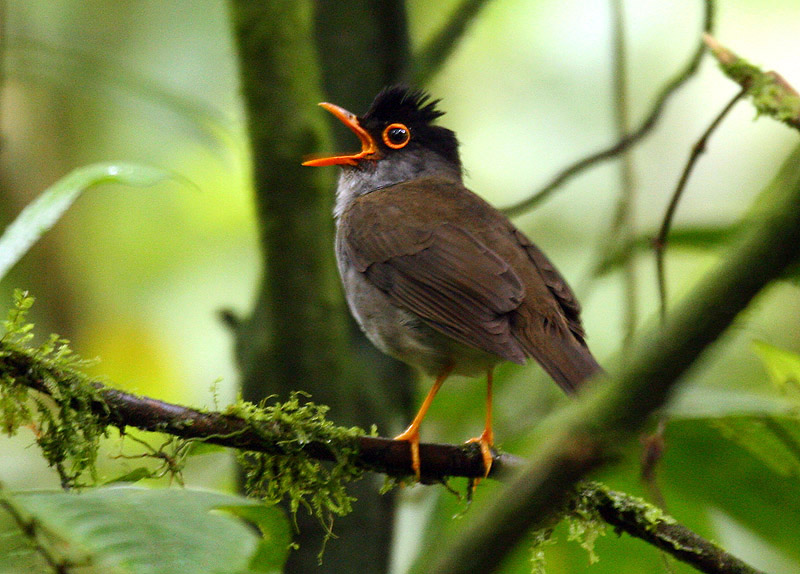 Black-headed Nightingale-thrushCatharus mexicanus
-
 Orange-billed Nightingale-thrushCatharus aurantiirostris
-
 Slaty-backed Nightingale-thrushCatharus fuscater
Compare
Questions and answers
What is the scientific name of the Ruddy-capped Nightingale-thrush?
The scientific name of the Ruddy-capped Nightingale-thrush is Catharus frantzii. Written with its author, the full name is Catharus frantzii Cabanis, 1861.
Which family does the Ruddy-capped Nightingale-thrush belong to?
Catharus frantzii belongs to the family Turdidae, in the order Passeriformes and the class Aves.
Where is the Ruddy-capped Nightingale-thrush found?
Checklists and occurrence records place Catharus frantzii in 7 countries, including Costa Rica, Guatemala, Mexico, Panama, Honduras and El Salvador.
What is the conservation status of the Ruddy-capped Nightingale-thrush?
The IUCN Red List category recorded for Catharus frantzii is Least Concern (LC).
Sources
Passages the profile rests on
- Adult males and females have the same plumage. Source passage: “The sexes have the same plumage.” — English Wikipedia
- Adults of the nominate subspecies have a rich rufous-brown to russet crown and a grayish face that may have an olive tinge. Source passage: “Adults of the nominate subspecies C. f. frantzii have a rich rufous-brown to russet crown and a grayish face that sometimes has an olive tinge.” — English Wikipedia
- The nominate subspecies has brownish-olive back and rump feathers with a russet wash. Source passage: “Their back and rump are brownish olive with a russet wash” — English Wikipedia
- The nominate subspecies has a whitish chin and throat marked with dark flecks. Source passage: “Their chin and throat are whitish with dark flecks.” — English Wikipedia
- The nominate subspecies has a pale gray breast with an olive tinge and dark flecks. Source passage: “Their breast is pale gray with an olive tinge and dark flecks.” — English Wikipedia
- Juveniles have a dark olive-brown to reddish-brown crown and upperparts. Source passage: “Juveniles have a dark olive-brown to reddish brown crown and upperparts.” — English Wikipedia
- All subspecies have dark irises, blackish upper mandibles, orange-yellow lower mandibles, and pale pink to grayish or brownish-pink legs and feet. Source passage: “All subspecies have a dark iris, a blackish maxilla, an orange-yellow mandible, and pale pink to grayish or brownish pink legs and feet.” — English Wikipedia
- The species is described as a small thrush with a plain breast. Source passage: “Small, plain-breasted thrush of highland forests, especially humid pine-oak.” — ebird.org
- Adults measure approximately 15–18 cm in length. Source passage: “The ruddy-capped nightingale-thrush is about 15 to 18 cm (5.9 to 7.1 in) long” — English Wikipedia
- Adults weigh approximately 30 g. Source passage: “weighs about 30 g (1.1 oz).” — English Wikipedia
- The species primarily inhabits montane evergreen cloudforest and pine-oak forest in subtropical and lower temperate zones. Source passage: “The ruddy-capped nightingale-thrush primarily inhabits montane evergreen forest (cloudforest) and pine-oak forest in the subtropical and lower temperate zones.” — English Wikipedia
- The species is particularly associated with humid pine-oak highland forests. Source passage: “Small, plain-breasted thrush of highland forests, especially humid pine-oak.” — ebird.org
- The species also occurs in secondary forest, thickets, clearings, and other modified habitats near its primary forest habitat. Source passage: “It also occurs in nearby secondary forest, thickets, and modified habitats such as clearings.” — English Wikipedia
- Its overall elevation range is mostly 1,200–3,100 m. Source passage: “Overall it ranges in elevation mostly between 1,200 and 3,100 m (3,900 and 10,200 ft).” — English Wikipedia
- In Mexico, the species occurs at elevations of 1,500–3,500 m. Source passage: “In Mexico it occurs between 1,500 and 3,500 m (4,900 and 11,500 ft)” — English Wikipedia
- In northern Central America, the species occurs at elevations of 1,500–3,050 m. Source passage: “in northern Central America between 1,500 and 3,050 m (4,900 and 10,000 ft)” — English Wikipedia
- In Costa Rica, the species occurs at elevations of 1,500–2,500 m. Source passage: “in Costa Rica between 1,500 and 2,500 m (4,900 and 8,200 ft)” — English Wikipedia
- In Panama, the species occurs at elevations of 1,200–2,400 m. Source passage: “and in Panama between 1,200 and 2,400 m (3,900 and 7,900 ft).” — English Wikipedia
- The species primarily consumes insects, other invertebrates, and berries. Source passage: “The ruddy-capped nightingale-thrush feeds primarily on insects, other invertebrates, and berries.” — English Wikipedia
- The species has been observed eating a small frog. Source passage: “It has been observed following army ant swarms and also feeding on a small frog.” — English Wikipedia
- The species feeds mainly on the ground but also forages in fruiting bushes and trees. Source passage: “Feeds mainly on the ground, but also in fruiting bushes and trees.” — ebird.org
- The species usually forages alone but feeds in pairs during the breeding season. Source passage: “It usually forages singly but in pairs during the breeding season.” — English Wikipedia
- The species forages on or close to the ground in forest undergrowth. Source passage: “It forages on the ground and near it in the forest undergrowth.” — English Wikipedia
- The species has been observed following army ant swarms. Source passage: “It has been observed following army ant swarms” — English Wikipedia
- The species usually sings in the morning or evening and also in misty weather. Source passage: “It is usually sung in the morning or evening and also in misty weather.” — English Wikipedia
- The species breeds between February and June or July. Source passage: “The ruddy-capped nightingale-thrush breeds between February and June or July.” — English Wikipedia
- The species constructs cup-shaped nests from moss and lines them with rootlets, fine grass, and other soft plant fibers. Source passage: “It builds a cup nest from moss lined with rootlets, fine grass, and other soft plant fibers.” — English Wikipedia
- Its nests have been recorded up to approximately 2.3 m above the ground in understory vegetation. Source passage: “Nests have been found up to about 2.3 m (8 ft) above the ground in understory vegetation.” — English Wikipedia
- The clutch consists of two pale-blue eggs with cinnamon-rufous and lilac speckles and blotches. Source passage: “The clutch is two eggs that are pale blue with cinnamon-rufous and lilac speckles and blotches.” — English Wikipedia
- Incubation lasts approximately 15–16 days and is performed exclusively by the female. Source passage: “The incubation period is 15 to 16 days and only the female incubates.” — English Wikipedia
- Young birds fledge approximately 14–16 days after hatching. Source passage: “Fledging occurs 14 to 16 days after hatch” — English Wikipedia
- Both parents provision the nestlings. Source passage: “both parents provision nestlings.” — English Wikipedia
- The species is classified as Least Concern by the IUCN. Source passage: “The IUCN has assessed the ruddy-capped nightingale-thrush as being of Least Concern.” — English Wikipedia
- The species' most recent IUCN Red List assessment cited in the document was conducted in 2020. Source passage: “has most recently been assessed for The IUCN Red List of Threatened Species in 2020.” — iucnredlist.org
- Its estimated population contains at least 50,000 mature individuals. Source passage: “its estimated population of at least 50,000 mature individuals” — English Wikipedia
- BirdLife DataZone reports a population estimate of 50,000–499,999 individuals and a decreasing population trend. Source passage: “50,000 - 499,999 · Decreasing” — datazone.birdlife.org
- The species' population is believed to be decreasing. Source passage: “is believed to be decreasing.” — English Wikipedia
- No immediate threats have been identified for the species. Source passage: “No immediate threats have been identified.” — English Wikipedia
- Human exploitation and disturbance of habitats may threaten populations across much of the species' range. Source passage: “this species is potentially threatened by the exploitation and disturbance of its habitats by human activities” — English Wikipedia
- The species is considered endangered in Mexico and El Salvador. Source passage: “However, it is deemed endangered in Mexico and El Salvador.” — English Wikipedia
- The species is considered uncommon in northern Central America and common in Costa Rica. Source passage: “It is considered uncommon in northern Central America and common in Costa Rica.” — English Wikipedia
- The species was originally described by Jean Cabanis in 1861 under its current scientific name. Source passage: “The ruddy-capped nightingale-thrush was originally described by German ornithologist Jean Cabanis in 1861 with its current binomial Catharus frantzii.” — English Wikipedia
- The specific epithet frantzii commemorates German naturalist Alexander von Frantzius. Source passage: “Its specific epithet commemorates the German naturalist Alexander von Frantzius.” — English Wikipedia
- The IOC, AviList, and BirdLife International's Handbook of the Birds of the World recognize eight subspecies. Source passage: “The IOC, AviList, and BirdLife International's Handbook of the Birds of the World (HBW) assign it these eight subspecies:” — English Wikipedia
- The species' taxonomic treatment below the species level remains unsettled. Source passage: “The ruddy-capped nightingale-thrush's further taxonomy is unsettled.” — English Wikipedia
- The subspecies C. f. omiltemensis occurs in southwestern Mexico. Source passage: “C. f. omiltemensis: southwestern Mexico” — English Wikipedia
- The subspecies C. f. nelsoni occurs in south-central Mexico. Source passage: “C. f. nelsoni: south-central Mexico” — English Wikipedia
- The subspecies C. f. chiapensis occurs in southern Mexico and western Guatemala. Source passage: “C. f. chiapensis: southern Mexico into western Guatemala” — English Wikipedia
- The subspecies C. f. alticola occurs from Chiapas in southern Mexico through Guatemala to El Salvador. Source passage: “C. f. alticola: from Chiapas in southern Mexico south through Guatemala into El Salvador” — English Wikipedia
- The subspecies C. f. juancitonis occurs in El Salvador and Honduras. Source passage: “C. f. juancitonis: El Salvador and Honduras” — English Wikipedia
- The subspecies C. f. waldroni occurs in northern Nicaragua. Source passage: “C. f. waldroni: northern Nicaragua” — English Wikipedia
- The nominate subspecies C. f. frantzii occurs in Costa Rica. Source passage: “C. f. frantzii: Costa Rica” — English Wikipedia
- The subspecies C. f. wetmorei occurs in Chiriquí Province in western Panama. Source passage: “C. f. wetmorei: western Panama's Chiriquí Province” — English Wikipedia
Data
- Catalogue of Life, 2026-10-16 XR cc by
- Global Biodiversity Information Facility CC BY 4.0
- Wikidata CC0
- GeoNames CC BY 4.0
- Wikimedia Commons per image; credit shown with each image
- Within the Catalogue of Life, this name comes from The Integrated Taxonomic Information System cc0
References
- Cabanis, & Jean Louis. (1861). Uebersicht der im Berliner Museum befindlichen Vögel von Costa Rica. Journal Für Ornithologie, Vol. 8, No. 47. where the name was published
- Gill, Frank, & and Minturn Wright. (2006). Birds of the World: Recommended English Names.
This species in other databases
Page built on 29 November 2026. See how the catalog is made and all sources and licences.
Cite this page
ScientificNames.org. (2026). Catharus frantzii (Ruddy-capped Nightingale-thrush). Retrieved November 29, 2026, from https://scientificnames.org/species/catharus-frantzii
“Catharus frantzii (Ruddy-capped Nightingale-thrush).” ScientificNames.org, 2026, scientificnames.org/species/catharus-frantzii. Accessed 29 Nov. 2026.
ScientificNames.org. “Catharus frantzii (Ruddy-capped Nightingale-thrush).” Accessed November 29, 2026. https://scientificnames.org/species/catharus-frantzii.
@misc{scientificnames_catharus_frantzii_ruddy_capped_nightingale_thrush,
  author = {{ScientificNames.org}},
  title = {Catharus frantzii (Ruddy-capped Nightingale-thrush)},
  year = {2026},
  url = {https://scientificnames.org/species/catharus-frantzii},
  note = {Accessed 2026-11-29}
}