Species · Flowering plants
Field Chickweed Cerastium arvense
The scientific name of the Field Chickweed is Cerastium arvense. It is a species of flowering plant in the family Caryophyllaceae (carnation), order Caryophyllales.
- Scientific name
- Cerastium arvense L.
- Common name
- Field Chickweed
- Genus
- Cerastium
- Family
- Caryophyllaceae (Carnation)
- Order
- Caryophyllales
- Class
- Magnoliopsida
- Red List category
- LC Least Concern
- Recorded in
- 60 countries
- Name status
- accepted in the Catalogue of Life

Overview
Field chickweed is a perennial flowering herb in the family Caryophyllaceae, order Caryophyllales, and class Magnoliopsida. It occurs throughout Europe and North America and in parts of South America. It has five white, two-lobed petals per flower and produces capsules containing several brown seeds.
Written 26 November 2026 from the sources listed below. Each statement was checked against the passage it cites; statements that could not be supported were removed.
Appearance
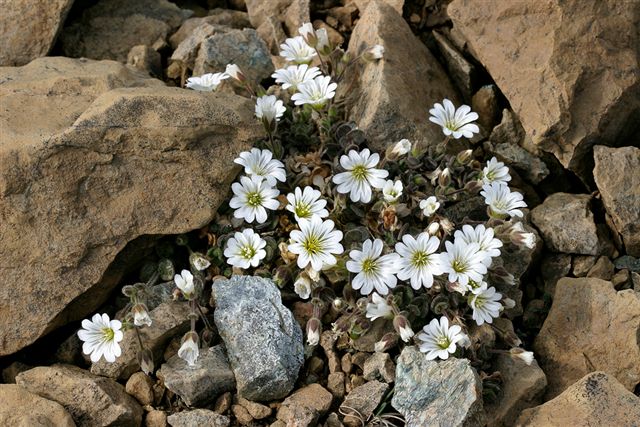
Field chickweed is a variable plant that grows as a mat, clump, creeping plant, or upright flowering plant. It can reach a height of 30–45 cm and usually has a somewhat hairy surface, often with glandular hairs.[1][2][3]
Its leaves can be linear, lance-shaped, or oblong and measure a few centimeters in length. Its inflorescence ranges from a single flower to a dense cluster of numerous flowers.[4][5]
Each flower has five white petals divided into two lobes and five hairy green sepals at its base. Its fruit is a capsule containing several brown seeds, measuring up to 1.5 cm long and bearing ten tiny teeth at its tip.[6][7][8][9]
Habitat
Field chickweed occurs in various open habitats.[10]
Reproduction and life cycle
Field chickweed produces capsules containing several brown seeds.[11]
Uses
Field chickweed has been considered suitable as a groundcover in difficult shady garden locations. Some gardeners recommend against cultivating field mouse-ears in gardens.[12][13]
Classification of the Field Chickweed
| Kingdom | Plantae |
|---|---|
| Subkingdom | Pteridobiotina |
| Phylum | Tracheophyta |
| Class | Magnoliopsida |
| Order | Caryophyllales |
| Family | Caryophyllaceae (Carnation) |
| Tribe | Alsineae |
| Genus | Cerastium (Chickweed) |
| Species | Cerastium arvense L. |
Where the Field Chickweed is found
Checklists and occurrence records place Cerastium arvense in 60 countries across Africa, Asia, Europe, North America and Oceania. GBIF holds 222,471 georeferenced records of it.
Countries where it is native or its origin is not stated
- Aland Islands 46
- Albania 2
- Andorra 70
- Argentina 695
- Armenia 2
- Austria 4,240
- Azerbaijan 2
- Belarus 158
- Belgium 6,870
- Bosnia and Herzegovina 14
- Bulgaria 27
- Canada 4,963
- Chile 464
- China 443
- Croatia 16
- Czechia 4,134
- Denmark 2,781
- Estonia 1,163
- France 41,273
- Georgia 15
- Germany 41,369
- Greece 21
- Hungary 30
- Iceland 7
- Ireland 128
- Isle of Man 69
- Italy 1,406
- Japan 38
- Kazakhstan 74
- Kosovo 1
- Kyrgyzstan 6
- Latvia 162
- Liechtenstein 1
- Lithuania 101
- Luxembourg 852
- Moldova 1
- Mongolia 114
- Montenegro 4
- Morocco 55
- Poland 5,474
- Portugal 6
- Romania 85
- Russia 3,844
- Serbia 4
- Slovakia 2,517
- Slovenia 59
- Spain 3,658
- Sweden 14,784
- Switzerland 6,953
- Taiwan 22
- Tajikistan
- The Netherlands 44,627
- Ukraine 553
- United Kingdom 14,520
- Uzbekistan 2
Countries where it has been introduced
Regions and cities with the most records
- Bavaria, Germany 20,210
- Provence-Alpes-Côte d'Azur, France 14,357
- Auvergne-Rhône-Alpes, France 13,366
- England, United Kingdom 11,400
- Gelderland, The Netherlands 8,443
- Katwijk aan Zee, The Netherlands 6,647
- Noordwijk-Binnen, The Netherlands 6,595
- Sassenheim, The Netherlands 6,570
- Oegstgeest, The Netherlands 6,562
- Leiden, The Netherlands 6,208
- Wassenaar, The Netherlands 6,184
- Leiderdorp, The Netherlands 5,990
- Voorburg, The Netherlands 5,988
- Scheveningen, The Netherlands 5,943
- The Hague, The Netherlands 5,916
- Voorschoten, The Netherlands 5,913
- Ypenburg, The Netherlands 5,770
- Lisse, The Netherlands 5,642
- Nootdorp, The Netherlands 5,616
- Rijswijk, The Netherlands 5,550
- Hillegom, The Netherlands 5,368
- Pijnacker, The Netherlands 5,074
- Delft, The Netherlands 5,069
- Nieuw-Vennep, The Netherlands 5,001
- IJmuiden, The Netherlands 4,992
- Velserbroek, The Netherlands 4,936
- Zoetermeer, The Netherlands 4,797
- Naaldwijk, The Netherlands 4,762
- Benthuizen, The Netherlands 4,695
- Velsen-Noord, The Netherlands 4,695
- Haarlem, The Netherlands 4,689
- 's-Gravenzande, The Netherlands 4,607
- Beverwijk, The Netherlands 4,488
- Zandvoort, The Netherlands 4,445
- Hellevoetsluis, The Netherlands 4,277
- Assendelft, The Netherlands 4,253
10 more countries have a few records outside this range
These countries hold a few records of Cerastium arvense but lie outside the range the checklists give for it. Such records are often zoo or garden specimens, museum material or vagrants, so the species is not counted as occurring there.
A number beside a place is its count of GBIF occurrence records. A place without a number comes from a checklist alone. Records show where a species has been observed or collected, which can include escapes and vagrants.
Common names
English
- Field Chickweed
- Field Mouse-Ear
- Field Mouse-ear Chickweed
- Meadow Chickweed
- Prairie Mouse-ear Chickweed
- Starry Grasswort
Names in 21 other languages
- Chinese
- 卷耳, 原野卷耳, 田野卷耳, 糕菜
- Czech
- rožec rolní
- Danish
- Storblomstret hønsetarm
- Dutch
- Akkerhoornbloem
- Estonian
- Põld-kadakkaer
- Finnish
- ketohärkki
- French
- Ceraiste des champs, céraiste des champs
- German
- Acker-Hornkraut, Ackerhornkraut
- Italian
- Peverina dei campi
- Lithuanian
- Dirvinė glažutė
- Macedonian
- Полски рожец
- Norwegian Bokmål
- storarve
- Polish
- Rogownica polna
- Romanian
- Cornuț de munte
- Slovak
- rožec roľný
- Slovenian
- njivska smiljka
- Spanish
- oreja de ratón
- Swedish
- fältarv
- Ukrainian
- Роговик польовий
- Welsh
- Clust Llygoden y Caeau, Clust Llygoden y Tywod, Clust-y-Llygoden y Meysydd, Cornwlydd yr Ŷd
- nav
- Táłkááʼ sikaadí
Synonyms
3 other scientific names have been used for this species and are now treated as synonyms of Cerastium arvense.
- Cerastium arvense f. arvense
- Cerastium arvense var. arvense
- Cerastium fueguianum Albov
Subspecies and varieties
- Cerastium arvense subsp. arvense (Field Chickweed) subspecies
- Cerastium arvense subsp. lerchenfeldianum subspecies
- Cerastium arvense subsp. suffruticosum subspecies
Related species
-
 Snow in SummerCerastium tomentosum
-
 Common Mouse-EarCerastium fontanum
-
 Sticky Mouse-EarCerastium glomeratum
-
 Alpine ChickweedCerastium alpinum
-
 Cerastium nigrescens
-
 Gray ChickweedCerastium brachypetalum
-
 Common Mouse-ear ChickweedCerastium holosteoides
-
 Little Mouse-earCerastium semidecandrum
Compare
Questions and answers
What is the scientific name of the Field Chickweed?
The scientific name of the Field Chickweed is Cerastium arvense. Written with its author, the full name is Cerastium arvense L..
Which family does the Field Chickweed belong to?
Cerastium arvense belongs to the family Caryophyllaceae, in the order Caryophyllales and the class Magnoliopsida.
Where is the Field Chickweed found?
Checklists and occurrence records place Cerastium arvense in 60 countries, including The Netherlands, Germany, France, Sweden, United Kingdom and Switzerland.
What is the conservation status of the Field Chickweed?
The IUCN Red List category recorded for Cerastium arvense is Least Concern (LC).
What other names does the Field Chickweed have?
Cerastium arvense is also known in English as Field Mouse-Ear, Field Mouse-ear Chickweed, Meadow Chickweed, Prairie Mouse-ear Chickweed and Starry Grasswort.
Where does chickweed usually grow?
Field chickweed occurs in various open habitats. It is widespread in Montana and occurs throughout Europe and North America and in parts of South America.[10][14][15]
What is mouse ear chickweed good for?
Field chickweed has been considered suitable as a groundcover in difficult shady garden locations.[12]
Sources
Passages the profile rests on
- Cerastium arvense is a variable perennial herb that can grow as a mat, clump, creeping plant, or upright flowering plant. Source passage: “It takes the form of a mat, clump, creeper, or upright flower” — English Wikipedia
- Cerastium arvense can reach a height of 30–45 cm. Source passage: “growing up to 30–45 cm (12–18 in) tall.” — English Wikipedia
- Cerastium arvense usually has a somewhat hairy surface, often bearing glandular hairs. Source passage: “It is usually somewhat hairy in texture, often with glandular hairs.” — English Wikipedia
- Its leaves can be linear, lance-shaped, or oblong and measure a few centimeters in length. Source passage: “The leaves are linear, lance-shaped, or oblong, and a few centimeters in length.” — English Wikipedia
- Its inflorescence ranges from a single flower to a dense cluster of numerous flowers. Source passage: “The inflorescence may consist of a single flower to a dense cluster of many.” — English Wikipedia
- Each flower has five white petals, with each petal divided into two lobes. Source passage: “The flower has five white petals, each with two lobes” — English Wikipedia
- Its flowers have five hairy green sepals at their base. Source passage: “and five hairy green sepals at the base.” — English Wikipedia
- Its fruit is a capsule containing several brown seeds and measuring up to 1.5 cm long. Source passage: “The fruit is a capsule up to 1.5 cm (0.59 in) long with ten tiny teeth at the tip, which contains several brown seeds.” — English Wikipedia
- The fruit capsule has ten tiny teeth at its tip. Source passage: “with ten tiny teeth at the tip” — English Wikipedia
- Cerastium arvense occurs in various open habitats. Source passage: “Cerastium arvense is common in various open habitats” — fieldguide.mt.gov
- Cerastium arvense produces capsules containing several brown seeds. Source passage: “which contains several brown seeds.” — English Wikipedia
- Cerastium arvense has been considered suitable as a groundcover in difficult shady garden locations. Source passage: “such as a groundcover in difficult shady spots.” — English Wikipedia
- Some gardeners recommend against cultivating field mouse-ears in gardens. Source passage: “Noted rock gardener Louise Beebe Wilder recommended against it in the strongest terms.” — English Wikipedia
- Cerastium arvense is widespread in Montana. Source passage: “widespread in Montana.” — fieldguide.mt.gov
- Cerastium arvense occurs throughout Europe and North America and in parts of South America. Source passage: “occurring throughout Europe and North America, as well as parts of South America.” — English Wikipedia
Data
- Catalogue of Life, 2026-10-16 XR cc by
- Global Biodiversity Information Facility CC BY 4.0
- Wikidata CC0
- GeoNames CC BY 4.0
- Wikimedia Commons per image; credit shown with each image
- Within the Catalogue of Life, this name comes from Synonymic Checklists of the Vascular Plants of the World cc by
References
- L. where the name was published
This species in other databases
Page built on 29 November 2026. See how the catalog is made and all sources and licences.
Cite this page
ScientificNames.org. (2026). Cerastium arvense (Field Chickweed). Retrieved November 29, 2026, from https://scientificnames.org/species/cerastium-arvense
“Cerastium arvense (Field Chickweed).” ScientificNames.org, 2026, scientificnames.org/species/cerastium-arvense. Accessed 29 Nov. 2026.
ScientificNames.org. “Cerastium arvense (Field Chickweed).” Accessed November 29, 2026. https://scientificnames.org/species/cerastium-arvense.
@misc{scientificnames_cerastium_arvense_field_chickweed,
  author = {{ScientificNames.org}},
  title = {Cerastium arvense (Field Chickweed)},
  year = {2026},
  url = {https://scientificnames.org/species/cerastium-arvense},
  note = {Accessed 2026-11-29}
}