Species · Flowering plants
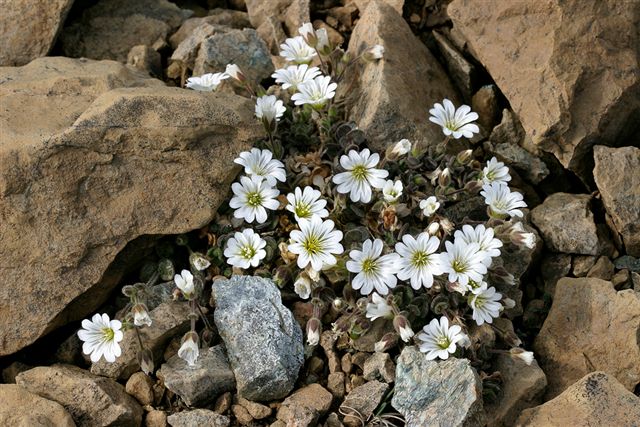
Clammy Chickweed Cerastium glomeratum
The scientific name of the Clammy Chickweed is Cerastium glomeratum. It is a species of flowering plant in the family Caryophyllaceae (carnation), order Caryophyllales.
- Scientific name
- Cerastium glomeratum Thuill.
- Common name
- Clammy Chickweed
- Genus
- Cerastium
- Family
- Caryophyllaceae (Carnation)
- Order
- Caryophyllales
- Class
- Magnoliopsida
- Recorded in
- 115 countries
- Name status
- accepted in the Catalogue of Life

Overview
Cerastium glomeratum is a species of flowering plant in the family Caryophyllaceae known by the common names sticky mouse-ear chickweed and clammy chickweed. It is native to Europe, Macaronesia to Assam but is known on most continents as an introduced species. It grows in many types of habitat. The blooming period is February, March, April, and May.
Classification of the Clammy Chickweed
| Kingdom | Plantae |
|---|---|
| Subkingdom | Pteridobiotina |
| Phylum | Tracheophyta |
| Class | Magnoliopsida |
| Order | Caryophyllales |
| Family | Caryophyllaceae (Carnation) |
| Tribe | Alsineae |
| Genus | Cerastium (Chickweed) |
| Species | Cerastium glomeratum Thuill. |
Where the Clammy Chickweed is found
Checklists and occurrence records place Cerastium glomeratum in 115 countries across Africa, Asia, Europe, North America, Oceania and South America. GBIF holds 427,351 georeferenced records of it.
Countries where it is native or its origin is not stated
- Afghanistan 30
- Aland Islands 3
- Albania 4
- Algeria 46
- Andorra 1
- Armenia 4
- Austria 3,238
- Azerbaijan 3
- Belarus 3
- Belgium 18,297
- Bhutan 5
- Bosnia and Herzegovina 4
- Bulgaria 20
- Cabo Verde 7
- China 693
- Croatia 79
- Cyprus 27
- Czechia 922
- Denmark 2,842
- Egypt
- Estonia 1,078
- Faroe Islands 10
- Finland 627
- France 103,083
- Georgia 17
- Germany 22,503
- Gibraltar 2
- Greece 1,064
- Guernsey 12
- Hungary 56
- Iceland 100
- India 63
- Indonesia 36
- Iran 24
- Iraq 15
- Ireland 662
- Isle of Man 482
- Israel 467
- Italy 1,827
- Jersey 13
- Jordan 7
- Kazakhstan 6
- Kosovo
- Lebanon 6
- Libya 1
- Liechtenstein 18
- Lithuania
- Luxembourg 913
- Malaysia 7
- Malta 3
- Moldova 1
- Mongolia 1
- Montenegro 13
- Morocco 216
- Nepal 45
- North Macedonia 3
- Norway 1,052
- Pakistan 39
- Palestinian Territory 14
- Poland 1,299
- Portugal 4,244
- Reunion 76
- Romania 41
- Russia 238
- Saint Helena 8
- San Marino
- Saudi Arabia 9
- Serbia 10
- Slovakia 380
- Slovenia 59
- Somalia 4
- Spain 10,280
- Sri Lanka 7
- Sweden 6,340
- Switzerland 9,521
- Syria 17
- Taiwan 230
- Tajikistan 4
- Tanzania 5
- The Netherlands 43,372
- Tunisia 53
- Turkey 100
- Turkmenistan 3
- Ukraine 116
- United Kingdom 161,809
- Uzbekistan 8
- Yemen
Countries where it has been introduced
- Argentina 190
- Australia 12,913
- Bolivia 20
- Brazil 324
- Canada 542
- Chile 53
- Colombia 28
- Costa Rica 34
- Ecuador 26
- Guatemala 9
- Honduras
- Jamaica 11
- Japan 2,281
- Madagascar 8
- Mauritius 6
- Mexico 222
- New Caledonia 13
- New Zealand 924
- Nicaragua 3
- Panama 12
- Peru 79
- Philippines
- South Africa 308
- South Korea 1,186
- United States 9,096
- Uruguay 109
- Venezuela 4
- Zimbabwe 3
Regions and cities with the most records
- England, United Kingdom 117,130
- Scotland, United Kingdom 27,069
- Auvergne-Rhône-Alpes, France 19,136
- Centre-Val de Loire, France 13,882
- Bavaria, Germany 11,535
- Île-de-France, France 10,076
- Occitanie, France 8,699
- Bourgogne-Franche-Comté, France 8,006
- Wales, United Kingdom 7,573
- Hauts-de-France, France 6,818
- Victoria, Australia 6,430
- Gelderland, The Netherlands 6,223
- Pays de la Loire, France 5,810
- Grand Est, France 4,431
- Limburg, The Netherlands 4,106
- New South Wales, Australia 3,863
- Beuningen, The Netherlands 3,783
- Maastricht, The Netherlands 3,641
- Truro, United Kingdom 3,594
- Hoensbroek, The Netherlands 3,577
- Elst, The Netherlands 3,542
- Nijmegen, The Netherlands 3,478
- Falmouth, United Kingdom 3,477
- Provence-Alpes-Côte d'Azur, France 3,468
- Redruth, United Kingdom 3,412
- Zeeland, The Netherlands 3,401
- Geleen, The Netherlands 3,399
- Berkel en Rodenrijs, The Netherlands 3,378
- Pijnacker, The Netherlands 3,363
- Overijssel, The Netherlands 3,324
- Bergschenhoek, The Netherlands 3,322
- Wijchen, The Netherlands 3,272
- Benthuizen, The Netherlands 3,234
- Camborne, United Kingdom 3,215
- Paris 09 Opéra, France 3,144
- Salpêtrière, France 3,142
8 more countries have a few records outside this range
These countries hold a few records of Cerastium glomeratum but lie outside the range the checklists give for it. Such records are often zoo or garden specimens, museum material or vagrants, so the species is not counted as occurring there.
Range as the checklists state it
Iceland; Faeroe Isl.; England (England, Wales, Isle of Man, Scotland, Outer Hebrides, Orkney Isl., Shetland Isl., Isles of Scilly, St. Kilda Isl.); Ireland (Ireland, Northern Ireland); Denmark; Norway; Sweden; Netherlands; Belgium; Luxembourg; Germany (Brandenburg, Berlin, Baden-Württemberg, Bayern, Hessen, Hamburg, Mecklenburg-Vorpommern, Niedersachsen, Nordrhein-Westfalen, Rheinland-Pfalz, Schleswig-Holstein, Saarland, Sachsen, Sachsen-Anhalt, Thüringen); Switzerland; Liechtenstein; Austria; Poland; Czech Republic; Slovakia; Hungary; Portugal; Spain; Andorra; Gibraltar; Baleares; France; Channel Isl. (Alderney, Guernsey, Jersey, Sark); Corsica; Sardinia; Italy; Sicily; Pantelleria; Isole Pelagie (Lampedusa); Malta; San Marino; Slovenia; Croatia; Bosnia & Hercegovina; Montenegro; Serbia; Kosovo; North Macedonia; Albania; Romania; Bulgaria; European Turkey; Greece (widespread incl. most islands); Crete (incl. islets); +Estonia; Lithuania; Belarus; C-European Russia; E-European Russia; W-European Russia; Moldova; Ukraine; Crimea; Morocco; Algeria; Tunisia; Libya; Egypt (NE-Egypt); Azores (Santa Maria Isl., Sao Miguel Isl., Terceira, Graciosa, Sao Jorge, Pico, Faial, Flores Isl., Corvo Isl.); Madeira (Madeira Isl., Ilhas Desertas, Porto Santo Isl.); Canary Isl. (Fuerteventura, Gran Canaria, Tenerife, La Gomera, Hierro, La Palma, Lanzarote); Cape Verde Isl. (Ilha de Sao Tiago); Somalia; Zimbabwe [I]; South Africa [I]; St. Helena [I]; Madagascar [I]; Mauritius [I]; La Réunion [I]; Kazakhstan; Turkmenistan; Uzbekistan; Tajikistan; Northern Caucasus; Georgia [Caucasus]; Armenia; Azerbaijan; East Aegaean Isl. (widespread, incl. Rhodos); Turkey (N-Anatolia, NE-Anatolia, NW-Anatolia: Bithynia, S-Anatolia, SE-Anatolia: Mesopotamian Anatolia, SSW-Anatolia, SW-Anatolia, W-Anatolia, WN-Anatolia); Iraq (NE-Iraq); Iran (EC-Iran, N-Iran, Iranian Aserbaijan, W-Iran); Afghanistan (Baghlan, Balkh, Kabul, Kunar / Nuristan, Laghman, Nangarhar, Parwan, Takhar); Cyprus (C-Mountains, E-Cyprus, N-Cyprus, W-Cyprus); Lebanon (Antilebanon, C-Lebanon, coastal W-Lebanon); Syria (Jazira, NW-Syria, Jbel Druze, W-Syrian Mountains); Israel (coastal W-Israel, Rift Valley, N-Israel, N-Negev Desert, Judean Desert); Sinai peninsula (C-Sinai, S-Sinai); Jordania (W-Jordania); Saudi Arabia (Asir); Yemen; China (Fujian, Guangxi, Guizhou, Henan, Hubei, Hunan, Jiangsu, Jiangxi, Shandong, Yunnan, Zhejiang); Tibet; Mongolia; South Korea [I]; Japan [I] (Honshu [I], Shikoku [I], Kyushu [I]); Ogasawara Isl. [I] (Keetaajima [I], Chichijima [I], Anijima [I]); Pakistan (Peshawar, Swat, Hazara, Chitral, Dir, Gilgit); Nepal; Bhutan; India (Arunachal Pradesh, Assam, Himachal Pradesh, Meghalaya, Sikkim, Uttar Pradesh); Sri Lanka; peninsular Malaysia [I] (Genting Highlands [I], Pahang [I]); Philippines [I] (Luzon[I]); Jawa; New Guinea [I]; Australia [I] (Western Australia [I], Northern Territory [I], South Australia [I], Queensland [I], New South Wales [I], Victoria [I], Tasmania [I]); Lord Howe Isl. [I]; Norfolk Isl. [I]; New Zealand [I]; Chatham Isl. [I]; New Caledonia [I]; Easter Isl.; Alaska [I]; Canada [I] (British Columbia [I], Newfoundland [I], Nova Scotia [I], Ontario [I], Quebec [I], Yukon [I]); USA [I] (Alabama [I], Arizona [I], Arkansas [I], California [I], Connecticut [I], Delaware [I], District of Columbia [I], Florida [I], Georgia [I], Idaho [I], Illinois [I], Indiana [I], Kansas [I], Kentucky [I], Louisiana [I], Maryland [I], Massachusetts [I], Michigan [I], Mississippi [I], Missouri [I], Montana [I], Nevada [I], New Jersey [I], New Mexico [I], New York [I], North Carolina [I], Ohio [I], Oklahoma [I], Oregon [I], Pennsylvania [I], Rhode Island [I], South Carolina [I], Tennessee [I], Texas [I], Virginia [I], Washington [I], West Virginia [I]); Mexico [I]; Isla Guadalupe [I]; Guatemala [I]; Honduras [I]; Nicaragua [I]; Costa Rica [I]; Panama [I]; Jamaica [I]; Hispaniola [I]; Colombia [I]; Venezuela [I]; Ecuador [I]; Peru [I]; Bolivia [I]; Brazil [I]; Uruguay [I]; Argentina [I]; Chile [I] (Coquimbo [I], Valparaíso [I], Metropolitana de Santiago [I], O'Higgins [I], Maule [I], Ñuble [I], Biobío [I], Araucanía [I], Los Rios [I], Los Lagos [I], Aisén [I], Magallanes [I]); Juan Fdz. Isl.; Îles Kerguélen [I]
A number beside a place is its count of GBIF occurrence records. A place without a number comes from a checklist alone. Records show where a species has been observed or collected, which can include escapes and vagrants.
Common names
English
- Clammy Chickweed
- Annual Mouse Ear Chickweed
- Sticky Mouse-Ear
- Mouse-ear Chickweed
- Mouseear Chickweed
- Sticky Chickweed
- Sticky Mouse-ear Chickweed
Names in 29 other languages
- Arabic
- قرناء أذن الفأر اللزجة
- Chinese
- 婆婆指甲菜, 小白绵参, 球序卷耳, 短果卷耳
- Czech
- rožec klubkatý
- Danish
- Opret hønsetarm
- Dutch
- Kluwenhoornbloem
- Estonian
- kera-kadakkaer
- Faroese
- tættblømt høsnagras
- Finnish
- sykeröhärkki
- French
- céraiste aggloméré, céraiste visqueux
- German
- Knäuel-Hornkraut, Knäuelblütiges Hornkraut
- Hebrew
- קרנונית דביקה
- Hungarian
- gomolyos madárhúr
- Irish
- Cluas luchóige ghreamaitheach
- Italian
- Peverina dei campi
- Japanese
- アオミミナグサ, オランダミミナグサ
- Korean
- 유럽점나도나물
- Lithuanian
- Glaustažiedė glažutė
- Northern Sami
- snárkesáhpánrássi
- Norwegian Bokmål
- vegarve, veiarve
- Polish
- Rogownica skupiona
- Portuguese
- Cerástio-enovelado, Orelha-de-rato
- Russian
- Ясколка скученная, Ясколка скученноцветковая
- Slovak
- rožec klbkatý
- Slovenian
- klobčasta smiljka
- Spanish
- moruquilla, pamplinillas
- Swedish
- knipparv
- Turkish
- Boynuzotu
- Ukrainian
- Роговик скупчений
- Welsh
- Clust Llygoden Llydanddail, Clust-y-Llygoden Lydanddail, Cornwlydd Gludiog, Cornwlyddyn Llydanddail, Gludiog, Gwlydd Pyngog
Synonyms
74 other scientific names have been used for this species and are now treated as synonyms of Cerastium glomeratum.
- Cerastium acutatum Suksd.
- Cerastium apetalum Dumort.
- Cerastium arenosum Kit
- Cerastium caespitosum subsp. triviale (E.H.L.Krause) Hiitonen
- Cerastium caespitosum var. triviale (E.H.L.Krause) Hiitonen
- Cerastium consanguineum Wedd.
- Cerastium constantinopolitanum Nyman
- Cerastium fontanum subsp. triviale (E.H.L.Krause) Jalas
- Cerastium fulvum Raf.
- Cerastium glomeratum f. abbreviatum Zapał.
- Cerastium glomeratum f. acorollatum Zapał.
- Cerastium glomeratum f. apetalum (Dumort.) Trinajstić
- Cerastium glomeratum f. apetalum (Dumort.) Murb.
- Cerastium glomeratum f. eglandulosum (Mert. & W.D.J.Koch) Hegi
- Cerastium glomeratum f. hirsutissimum Zapał.
- Cerastium glomeratum f. macrophyllum Zapał.
- Cerastium glomeratum subsp. megacalyx Kamelin
- Cerastium glomeratum subvar. confertum Rouy & Foucaud
- Cerastium glomeratum var. apetalum (Dumort.) Mert. & W.D.J.Koch
- Cerastium glomeratum var. brachycarpum L.H.Zhou & Q.Z.Han
- Cerastium glomeratum var. corollinum (Fenzl) Rouy & Foucaud
- Cerastium glomeratum var. eglandulosum Mert. & W.D.J.Koch
- Cerastium glomeratum var. glandulosum W.D.J.Koch
- Cerastium glomeratum var. glomeratum
- Cerastium glomeratum var. kotulae Zapał.
- Cerastium glomeratum var. laxum Erdner
- Cerastium glomeratum var. mauritianum Baker
- Cerastium glomeratum var. medium Zapał.
- Cerastium glomeratum var. pygmaeum Zapał.
- Cerastium glomeratum var. robustum Pamp.
- Cerastium glomeratum var. strictum Erdner
- Cerastium glomeratum var. subviscosum (Rchb.) Briq.
- Cerastium mauritianum Bouton ex Baker
- Cerastium membranaceum Jacquem. ex Hook.fil.
- Cerastium minutulum Des Moul. ex Steud.
- Cerastium mutabile var. ovale K.F.Schimp. & Spenn.
- Cerastium ovale var. apetalum Weihe
- Cerastium pseudoviscosum Schur
- Cerastium sibiricum Turcz. ex Ledeb.
- Cerastium stevenii Schischk.
Showing 40 of 74.
Related species
-
 Snow in SummerCerastium tomentosum
-
 Common Mouse-EarCerastium fontanum
-
 Field ChickweedCerastium arvense
-
 Alpine ChickweedCerastium alpinum
-
 Cerastium nigrescens
-
 Grey Mouse-EarCerastium brachypetalum
-
 Big ChickweedCerastium holosteoides
-
 Small ChickweedCerastium semidecandrum
Compare
Questions and answers
What is the scientific name of the Clammy Chickweed?
The scientific name of the Clammy Chickweed is Cerastium glomeratum. Written with its author, the full name is Cerastium glomeratum Thuill..
Which family does the Clammy Chickweed belong to?
Cerastium glomeratum belongs to the family Caryophyllaceae, in the order Caryophyllales and the class Magnoliopsida.
Where is the Clammy Chickweed found?
Checklists and occurrence records place Cerastium glomeratum in 115 countries, including United Kingdom, France, The Netherlands, Germany, Belgium and Spain.
What other names does the Clammy Chickweed have?
Cerastium glomeratum is also known in English as Annual Mouse Ear Chickweed, Sticky Mouse-Ear, Mouse-ear Chickweed, Mouseear Chickweed, Sticky Chickweed and Sticky Mouse-ear Chickweed.
Sources
Data
- Catalogue of Life, 2026-10-16 XR cc by
- Global Biodiversity Information Facility CC BY 4.0
- Wikidata CC0
- English Wikipedia CC BY-SA 4.0
- GeoNames CC BY 4.0
- Wikimedia Commons per image; credit shown with each image
- Within the Catalogue of Life, this name comes from Synonymic Checklists of the Vascular Plants of the World cc by
References
- Thuill. (1799). Fl. Env. Paris, éd. 2: 226 (1799). where the name was published
This species in other databases
- Catalogue of Life SK93
- Wikidata Q1753184
- iNaturalist 52973
- World Flora Online wfo-0000595603
- GRIN 407894
Page built on 26 November 2026. See how the catalog is made and all sources and licences.
Cite this page
ScientificNames.org. (2026). Cerastium glomeratum (Clammy Chickweed). Retrieved November 26, 2026, from https://scientificnames.org/species/cerastium-glomeratum
“Cerastium glomeratum (Clammy Chickweed).” ScientificNames.org, 2026, scientificnames.org/species/cerastium-glomeratum. Accessed 26 Nov. 2026.
ScientificNames.org. “Cerastium glomeratum (Clammy Chickweed).” Accessed November 26, 2026. https://scientificnames.org/species/cerastium-glomeratum.
@misc{scientificnames_cerastium_glomeratum_clammy_chickweed,
  author = {{ScientificNames.org}},
  title = {Cerastium glomeratum (Clammy Chickweed)},
  year = {2026},
  url = {https://scientificnames.org/species/cerastium-glomeratum},
  note = {Accessed 2026-11-26}
}