Species · Flowering plants
Common Mouse-ear Chickweed Cerastium holosteoides
The scientific name of the Common Mouse-ear Chickweed is Cerastium holosteoides. It is a species of flowering plant in the family Caryophyllaceae (carnation), order Caryophyllales.
- Scientific name
- Cerastium holosteoides Fr.
- Common name
- Common Mouse-ear Chickweed
- Genus
- Cerastium
- Family
- Caryophyllaceae (Carnation)
- Order
- Caryophyllales
- Class
- Magnoliopsida
- Recorded in
- 94 countries
- Name status
- accepted in the Catalogue of Life

Overview
Cerastium holosteoides is native to temperate and subarctic regions of the Old World, with a distribution extending across nearly all of Eurasia to New Guinea and including scattered African countries. It has been introduced to most of North America, western countries of South America, New Zealand, South Africa and many islands around the world.
Written 26 November 2026 from the sources listed below. Each statement was checked against the passage it cites; statements that could not be supported were removed.
Classification of the Common Mouse-ear Chickweed
| Kingdom | Plantae |
|---|---|
| Subkingdom | Pteridobiotina |
| Phylum | Tracheophyta |
| Class | Magnoliopsida |
| Order | Caryophyllales |
| Family | Caryophyllaceae (Carnation) |
| Tribe | Alsineae |
| Genus | Cerastium (Chickweed) |
| Species | Cerastium holosteoides Fr. |
Where the Common Mouse-ear Chickweed is found
Checklists and occurrence records place Cerastium holosteoides in 94 countries across Africa, Asia, Europe, North America, Oceania and South America. GBIF holds 505,237 georeferenced records of it.
Countries where it is native or its origin is not stated
- Afghanistan 4
- Aland Islands 1,112
- Albania 1
- Algeria 8
- Andorra 47
- Armenia 5
- Austria 12,528
- Azerbaijan 5
- Belarus 102
- Belgium 6,447
- Bhutan 4
- Bulgaria 6
- China 425
- Croatia 7
- Czechia 8,535
- Denmark 41,163
- Estonia 2,196
- Faroe Islands 8
- Finland 20,444
- France 92,668
- Georgia 8
- Germany 47,393
- Greece 61
- Hungary 46
- Iceland 31
- India 102
- Indonesia 21
- Iran 2
- Iraq 1
- Ireland 45
- Isle of Man 24
- Italy 641
- Japan 1,329
- Kazakhstan 14
- Kosovo
- Kyrgyzstan
- Latvia 33
- Libya 3
- Liechtenstein 3
- Lithuania 16
- Luxembourg 678
- Moldova 5
- Mongolia 4
- Montenegro 2
- Morocco 26
- Nepal 23
- North Korea 35
- North Macedonia 4
- Norway 13,352
- Pakistan 43
- Poland 4,054
- Portugal 2,347
- Reunion 45
- Romania 14
- Russia 8,492
- San Marino
- Serbia 3
- Slovakia 8,345
- Slovenia 229
- South Korea 779
- Spain 3,728
- Sri Lanka
- Sweden 19,270
- Switzerland 18,711
- Taiwan 26
- The Netherlands 148,983
- Tunisia
- Turkey 4
- Ukraine 1,348
- United Kingdom 31,954
- Uzbekistan
- Vietnam
Countries where it has been introduced
- Argentina 46
- Australia 1,362
- Bolivia 16
- Canada 666
- Chile 31
- Colombia 29
- Costa Rica 24
- Ecuador 9
- Greenland 45
- Guatemala 4
- Haiti 1
- Lesotho
- Mexico 41
- New Zealand 1,168
- Panama 4
- Papua New Guinea 3
- Philippines
- Pitcairn 1
- Saint Helena 19
- South Africa 9
- United States 3,763
- Venezuela 4
Regions and cities with the most records
- England, United Kingdom 25,976
- Bavaria, Germany 23,405
- Gelderland, The Netherlands 19,525
- Waddinxveen, The Netherlands 17,904
- Auvergne-Rhône-Alpes, France 17,782
- Gouda, The Netherlands 17,334
- Benthuizen, The Netherlands 17,112
- Boskoop, The Netherlands 16,845
- Bourgogne-Franche-Comté, France 16,331
- Hauts-de-France, France 15,973
- Zoetermeer, The Netherlands 15,246
- Krimpen aan den IJssel, The Netherlands 15,137
- Alphen aan den Rijn, The Netherlands 15,031
- Alblasserdam, The Netherlands 14,852
- North Rhine-Westphalia, Germany 14,836
- Capelle aan den IJssel, The Netherlands 14,779
- Bergschenhoek, The Netherlands 14,354
- Ridderkerk, The Netherlands 14,253
- Sliedrecht, The Netherlands 14,251
- Bodegraven, The Netherlands 14,049
- Hendrik-Ido-Ambacht, The Netherlands 13,837
- Papendrecht, The Netherlands 13,827
- Berkel en Rodenrijs, The Netherlands 13,745
- Zeeland, The Netherlands 13,578
- Central Jutland, Denmark 13,538
- Barendrecht, The Netherlands 12,994
- Rotterdam, The Netherlands 12,873
- Woerden, The Netherlands 12,543
- Dordrecht, The Netherlands 12,533
- Pijnacker, The Netherlands 12,360
- Zwijndrecht, The Netherlands 12,360
- Leiderdorp, The Netherlands 12,339
- Gorinchem, The Netherlands 12,058
- Drenthe, The Netherlands 11,587
- Voorschoten, The Netherlands 11,327
- Leiden, The Netherlands 11,237
8 more countries have a few records outside this range
These countries hold a few records of Cerastium holosteoides but lie outside the range the checklists give for it. Such records are often zoo or garden specimens, museum material or vagrants, so the species is not counted as occurring there.
Range as the checklists state it
Iceland; Faeroe Isl.; England (England, Wales, Isle of Man, Scotland); Ireland (Ireland, Northern Ireland); Denmark; Norway; Sweden; Netherlands; Belgium; Germany (Brandenburg, Berlin, Baden-Württemberg, Bayern, Hessen, Hamburg, Mecklenburg-Vorpommern, Niedersachsen, Nordrhein-Westfalen, Rheinland-Pfalz, Schleswig-Holstein, Saarland, Sachsen, Sachsen-Anhalt, Thüringen); Switzerland; Liechtenstein; Austria; Poland; Czech Republic; Slovakia; Hungary; Portugal; Spain; Andorra; Baleares (Mallorca, Menorca); France; Channel Isl.; Corsica; Sardinia; Italy; Sicily; San Marino; Slovenia; Croatia; Bosnia & Hercegovina; Montenegro; Serbia; Kosovo; North Macedonia; Albania; Romania; Bulgaria; Greece (mainland of N- & C-Greece); Estonia; Latvia; Lithuania; Belarus; European Russia; Moldova; Ukraine; Crimea; Morocco; ?Tunisia; Azores (Santa Maria Isl., Sao Miguel Isl., Terceira, Graciosa, Sao Jorge, Pico, Faial, Flores Isl., Corvo Isl.); Madeira (Madeira Isl., Ilhas Desertas, Porto Santo Isl.); Canary Isl. (Gran Canaria, Tenerife); South Africa [I]; Lesotho [I]; Ascension Isl. [I]; Siberia (Altay, Buryatia, Chita, Irkutsk, Krasnoyarsk, Tuva, W-Siberia, Yakutia); Russian Far East (Upper Amur, Kamchatka, Khabarovsk, Kuril Isl., Magadan, Primorye, Sakhalin); Kazakhstan; Uzbekistan; Kyrgyzstan; Northern Caucasus; Georgia [Caucasus]; Armenia; Azerbaijan; Turkey (Anatolia) (widespread); Iraq (NE-Iraq); Iran (EC-Iran, N-Iran, Iranian Aserbaijan, W-Iran); Afghanistan (Kunar / Nuristan); China (Hebei, Shanxi, Shaanxi, Ningxia, Gansu, Qinghai, Henan, Jiangxi, Anhui, Fujian, Zhejiang, Hubei, Hunan, Sichuan, Yunnan); Japan (Hokkaido); Pakistan (Kurram, Dir, Swat, Hazara, Murree, Astor, Deosai, Azad Kashmir); N-India (Ladakh, Poonch, Jammu & Kashmir, Himachal Pradesh, Uttarakhand, Arunachal Pradesh, Assam, Meghalaya, Sikkim); Sri Lanka; Vietnam; Philippines [I]; Jawa; New Guinea [I] (Papua New Guinea [I]); Australia [I] (South Australia [I], Queensland [I], New South Wales [I], Victoria [I], Tasmania [I]); Lord Howe Isl. [I]; Norfolk Isl. [I]; New Zealand [I]; Chatham Isl. [I]; Auckland Isl. [I]; Austral Isl. [I] (Rapa Iti [I]); Pitcairn Isl. [I]; Hawaii [I] (Kauai [I], Oahu [I], Molokai [I], Lanai [I], Maui [I], Hawaii Isl. [I]); Alaska [I]; Greenland [I]; Canada [I] (Alberta [I], British Columbia [I], Manitoba [I], New Brunswick [I], Newfoundland [I], Labrador [I], N. W. T. [I], Nova Scotia [I], Ontario [I], Prince Edward Isl. [I], Quebec [I], Saskatchewan [I], Yukon [I]); St. Pierre and Miquelon [I]; USA [I] (Alabama [I], Arizona [I], Arkansas [I], California [I], Colorado [I], Connecticut [I], Delaware [I], District of Columbia [I], Florida [I], Georgia [I], Idaho [I], Illinois [I], Indiana [I], Iowa [I], Kansas [I], Kentucky [I], Louisiana [I], Maine [I], Maryland [I], Massachusetts [I], Michigan [I], Minnesota [I], Mississippi [I], Missouri [I], Montana [I], Nebraska [I], Nevada [I], New Hampshire [I], New Jersey [I], New Mexico [I], New York [I], North Carolina [I], North Dakota [I], Ohio [I], Oklahoma [I], Oregon [I], Pennsylvania [I], Rhode Island [I], South Carolina [I], South Dakota [I], Tennessee [I], Texas [I], Utah [I], Vermont [I], Virginia [I], Washington [I], West Virginia [I], Wisconsin [I], Wyoming [I]); Mexico [I]; Guatemala [I]; Costa Rica [I]; Panama [I]; Hispaniola [I] (Haiti [I]); Colombia [I]; Venezuela [I]; Ecuador [I]; Bolivia [I]; Argentina [I]; Chile [I] (Atacama [I], Coquimbo [I], Valparaíso [I], Metropolitana de Santiago [I], O'Higgins [I], Maule [I], Ñuble [I], Biobío [I], Araucanía [I], Los Rios [I], Los Lagos [I], Aisén [I], Magallanes [I]); Juan Fdz. Isl. [I]; Macquarie Isl. [I]; Marion Isl. [I]; Îles Kerguélen [I]; Falkland Isl. [I]; Tristan da Cunha [I]; South Georgia Isl. [I]
A number beside a place is its count of GBIF occurrence records. A place without a number comes from a checklist alone. Records show where a species has been observed or collected, which can include escapes and vagrants.
Common names
English
- Common Mouse-ear Chickweed
- Common Mouse-ear
- Big Chickweed
Names in 21 other languages
- Arabic
- حشيشة القزاز الكبيرة
- Chinese
- 簇生泉卷耳
- Czech
- rožec obecný
- Dutch
- Gewone hoornbloem
- Finnish
- kainuunnurmihärkki, piennarnurmihärkki
- French
- Céraiste commun, Mouron d'alouette
- German
- Gemeines Hornkraut, Gewöhnliches Hornkraut
- Hungarian
- réti madárhúr
- Italian
- Peverina dei prati
- Japanese
- オオミミナグサ, ミミナグサ
- Korean
- 점나도나물
- Lithuanian
- Paprastoji glažutė
- Norwegian Bokmål
- Snau skogarve
- Polish
- Rogownica pospolita
- Portuguese
- Orelha-de-rato-das-fontes
- Russian
- Ясколка костенцовая
- Slovak
- rožec obyčajný
- Slovenian
- navadna smiljka
- Spanish
- Oreja de ratón
- Swedish
- hårig hönsarv, kal hönsarv, vanlig hönsarv
- Ukrainian
- Роговик ланцетоподібний
Synonyms
141 other scientific names have been used for this species and are now treated as synonyms of Cerastium holosteoides.
- Cerastium alpestre Schur
- Cerastium alpigenum Schur
- Cerastium caespitosum f. carpaticum Zapał.
- Cerastium caespitosum f. glabratum (Neilr.) Zapał.
- Cerastium caespitosum f. glandulosum (Boenn.) Lindm.
- Cerastium caespitosum f. glandulosum (Boenn.) Sved., Junell & Örtendahl
- Cerastium caespitosum f. glareosum Zapał.
- Cerastium caespitosum f. holosteoides (Fr.) Hegi
- Cerastium caespitosum f. intercedens Zapał.
- Cerastium caespitosum f. janoviense Zapał.
- Cerastium caespitosum f. kolomejense Zapał.
- Cerastium caespitosum f. latiusculum Zapał.
- Cerastium caespitosum f. leopoliense Zapał.
- Cerastium caespitosum f. lituanicum Zapał.
- Cerastium caespitosum f. niwrense Zapał.
- Cerastium caespitosum f. parvulum Zapał.
- Cerastium caespitosum f. platyphyllum Zapał.
- Cerastium caespitosum f. pocuticum Zapał.
- Cerastium caespitosum f. pusillum Zapał.
- Cerastium caespitosum f. remotifolium Zapał.
- Cerastium caespitosum f. riparium Zapał.
- Cerastium caespitosum f. serpentini Novák
- Cerastium caespitosum f. subalpestre Zapał.
- Cerastium caespitosum f. sublineare Zapał.
- Cerastium caespitosum f. subsimplex Zapał.
- Cerastium caespitosum subsp. glandulosum (Boenn.) Vălev
- Cerastium caespitosum var. cracoviense Zapał.
- Cerastium caespitosum var. glandulosum (Boenn.) Murr
- Cerastium caespitosum var. holosteoides (Fr.)
- Cerastium caespitosum var. montevidense (Rohrb.) Malme
- Cerastium caespitosum var. polesicum Zapał.
- Cerastium caespitosum var. pseudoalpestre Bech.
- Cerastium caespitosum var. sarmaticum Zapał.
- Cerastium ceretanum Sennen
- Cerastium cespitosum Gilib.
- Cerastium fontanum f. glutinosum (Möschl) M.B.Wyse Jacks.
- Cerastium fontanum f. gracile (Hayek) M.B.Wyse Jacks.
- Cerastium fontanum f. holosteoides (Fr.) M.B.Wyse Jacks.
- Cerastium fontanum f. vulgare (Hartm.) M.B.Wyse Jacks.
- Cerastium fontanum subsp. balcanum Gartner
Showing 40 of 141.
Related species
-
 Snow in SummerCerastium tomentosum
-
 Common Mouse-EarCerastium fontanum
-
 Sticky Mouse-EarCerastium glomeratum
-
 Field ChickweedCerastium arvense
-
 Alpine ChickweedCerastium alpinum
-
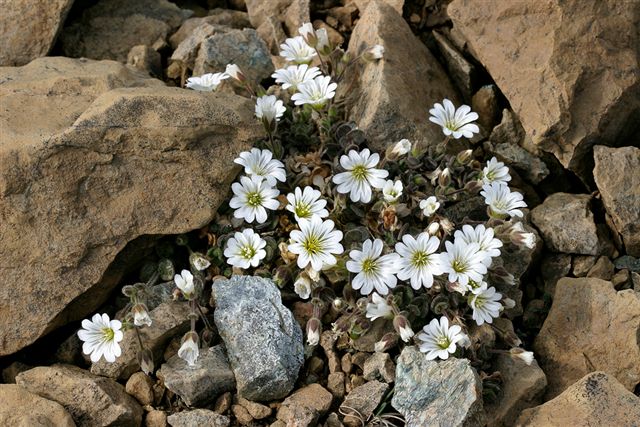 Cerastium nigrescens
-
 Gray ChickweedCerastium brachypetalum
-
 Little Mouse-earCerastium semidecandrum
Compare
Questions and answers
What is the scientific name of the Common Mouse-ear Chickweed?
The scientific name of the Common Mouse-ear Chickweed is Cerastium holosteoides. Written with its author, the full name is Cerastium holosteoides Fr..
Which family does the Common Mouse-ear Chickweed belong to?
Cerastium holosteoides belongs to the family Caryophyllaceae, in the order Caryophyllales and the class Magnoliopsida.
Where is the Common Mouse-ear Chickweed found?
Checklists and occurrence records place Cerastium holosteoides in 94 countries, including The Netherlands, France, Germany, Denmark, United Kingdom and Finland.
What other names does the Common Mouse-ear Chickweed have?
Cerastium holosteoides is also known in English as Common Mouse-ear and Big Chickweed.
Sources
Passages the profile rests on
- Cerastium holosteoides is native to temperate and subarctic regions of the Old World. Source passage: “Its native range is temperate and subarctic areas of the Old World” — English Wikipedia
- The species' native distribution extends across nearly all of Eurasia to New Guinea and includes scattered African countries. Source passage: “scattered countries in Africa, nearly all of Eurasia to New Guinea.” — English Wikipedia
Data
- Catalogue of Life, 2026-10-16 XR cc by
- Global Biodiversity Information Facility CC BY 4.0
- Wikidata CC0
- GeoNames CC BY 4.0
- Wikimedia Commons per image; credit shown with each image
- Within the Catalogue of Life, this name comes from Synonymic Checklists of the Vascular Plants of the World cc by
References
- Fr. Novit. Fl. Svec. 52 (1817). where the name was published
This species in other databases
- Catalogue of Life 5XJFV
- Wikidata Q157797
- iNaturalist 1005385
- World Flora Online wfo-0000595659-2026-06
- GRIN 465015
Page built on 27 November 2026. See how the catalog is made and all sources and licences.
Cite this page
ScientificNames.org. (2026). Cerastium holosteoides (Common Mouse-ear Chickweed). Retrieved November 27, 2026, from https://scientificnames.org/species/cerastium-holosteoides
“Cerastium holosteoides (Common Mouse-ear Chickweed).” ScientificNames.org, 2026, scientificnames.org/species/cerastium-holosteoides. Accessed 27 Nov. 2026.
ScientificNames.org. “Cerastium holosteoides (Common Mouse-ear Chickweed).” Accessed November 27, 2026. https://scientificnames.org/species/cerastium-holosteoides.
@misc{scientificnames_cerastium_holosteoides_common_mouse_ear_chickweed,
  author = {{ScientificNames.org}},
  title = {Cerastium holosteoides (Common Mouse-ear Chickweed)},
  year = {2026},
  url = {https://scientificnames.org/species/cerastium-holosteoides},
  note = {Accessed 2026-11-27}
}