Species · Mammals
Goldman's Pocket Mouse Chaetodipus goldmani
The scientific name of the Goldman's Pocket Mouse is Chaetodipus goldmani. It is a species of mammal in the family Heteromyidae (pocket mice), order Rodentia. The name dates from 1900.
- Scientific name
- Chaetodipus goldmani (Osgood, 1900)
- Common name
- Goldman's Pocket Mouse
- Genus
- Chaetodipus
- Family
- Heteromyidae (Pocket Mice)
- Order
- Rodentia
- Class
- Mammalia
- Red List category
- NT Near Threatened
- Recorded in
- 1 country
- Name status
- accepted in the Catalogue of Life
Overview
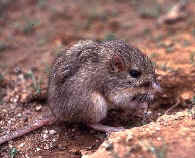
Chaetodipus goldmani inhabits dry, thorny scrubland, sandy areas containing mesquite, and cultivated land in Mexico. It has brown upperparts, creamy-white underparts, distinctive black ears with white flecks, and a dark-backed tail.
Written 27 November 2026 from the sources listed below. Each statement was checked against the passage it cites; statements that could not be supported were removed.
Appearance
Goldman's Pocket Mouse has brown upperparts, a slightly darker rump, and creamy-white underparts. Its ears are black with white flecks and whitish hind edges, with a pale spot below each ear. Its tail is dark on the upper side and pale on the underside.[1][2][3]
Individuals from lava fields near Moctezuma, Sonora, are darker than those in other populations.[4]
Habitat
Goldman's Pocket Mouse inhabits dry, thorny scrubland and sandy areas containing mesquite. It also occurs on cultivated land.[5][6][7]
Diet
Grass seeds are part of its diet.[8]
Reproduction and life cycle
The reproductive habits of Goldman's Pocket Mouse have not been studied.[9]
Conservation
Goldman's Pocket Mouse is assessed as near threatened by the International Union for Conservation of Nature. It is uncommon, and its population trend is thought to be declining.[10][11][12]
Conversion of natural habitat into agricultural land is the principal threat to the species. Although it can adapt to farmland, rodenticides used there to control pests pose a threat.[13][14]
Classification of the Goldman's Pocket Mouse
| Kingdom | Animalia |
|---|---|
| Phylum | Chordata |
| Subphylum | Vertebrata |
| Infraphylum | Gnathostomata |
| Parvphylum | Osteichthyes |
| Megaclass | Tetrapoda |
| Class | Mammalia (Mammal) |
| Subclass | Theria |
| Infraclass | Eutheria |
| Order | Rodentia (Rodent) |
| Suborder | Castorimorpha |
| Family | Heteromyidae (Pocket Mice) |
| Subfamily | Perognathinae (Silky Pocket Mice) |
| Genus | Chaetodipus (Hispid Pocket Mice) |
| Species | Chaetodipus goldmani (Osgood, 1900) |
Where the Goldman's Pocket Mouse is found
Checklists and occurrence records place Chaetodipus goldmani in 1 country across North America. GBIF holds 1,569 georeferenced records of it.
Countries
Regions and cities with the most records
- Sonora, Mexico 823
- Sinaloa, Mexico 578
- Navojoa, Mexico 101
- Ciudad Obregón, Mexico 45
- Guamúchil, Mexico 40
- Esperanza, Mexico 27
- Los Mochis, Mexico 27
- Durango, Mexico 8
- Guanajuato, Mexico 3
Range as the checklists state it
Middle America
A number beside a place is its count of GBIF occurrence records. A place without a number comes from a checklist alone. Records show where a species has been observed or collected, which can include escapes and vagrants.
Common names
English
- Goldman's Pocket Mouse
- Goldman S Pocket Mouse
Names in 6 other languages
- Finnish
- rannikkotaskuhiiri
- German
- Goldman-Taschenmaus
- Japanese
- ゴルドポケットマウス
- Polish
- chomikomyszka piaskowa
- Russian
- Мешотчатый прыгун Голдмана
- Spanish
- Ratón de bolsas Sonorense, ratón de abazones de Goldman
Synonyms
One other scientific name has been used for this species and is now treated as a synonym of Chaetodipus goldmani.
- Perognathus goldmani Osgood, 1900
Related species
-
 Rock Pocket MouseChaetodipus intermedius
-
 Desert Pocket MouseChaetodipus penicillatus
-
 Spiny Pocket MouseChaetodipus spinatus
-
 Little Desert Pocket MouseChaetodipus arenarius
-
 Hispid Pocket MouseChaetodipus hispidus
-
 California Pocket MouseChaetodipus californicus
-
 Bailey's Pocket MouseChaetodipus baileyi
-
 Nelson's Pocket MouseChaetodipus nelsoni
Compare
Questions and answers
What is the scientific name of the Goldman's Pocket Mouse?
The scientific name of the Goldman's Pocket Mouse is Chaetodipus goldmani. Written with its author, the full name is Chaetodipus goldmani (Osgood, 1900).
Which family does the Goldman's Pocket Mouse belong to?
Chaetodipus goldmani belongs to the family Heteromyidae, in the order Rodentia and the class Mammalia.
Where is the Goldman's Pocket Mouse found?
Checklists and occurrence records place Chaetodipus goldmani in 1 country: Mexico.
What is the conservation status of the Goldman's Pocket Mouse?
The IUCN Red List category recorded for Chaetodipus goldmani is Near Threatened (NT).
What other names does the Goldman's Pocket Mouse have?
Chaetodipus goldmani is also known in English as Goldman S Pocket Mouse.
What do pocket mice eat?
Grass seeds are part of Goldman's Pocket Mouse's diet.[8]
Sources
Passages the profile rests on
- Goldman's pocket mouse has brown upperparts, a slightly darker rump, and creamy-white underparts. Source passage: “The upper parts of this mouse are brown, the rump being a little darker than the back, while the underparts are creamy-white.” — English Wikipedia
- Its ears are black with white flecks and whitish hind edges, and it has a pale spot below each ear. Source passage: “The ears are black with white flecks, with the hind edges being whitish; there is a pale spot just below the ear.” — English Wikipedia
- Its tail is dark on the upper side and pale on the underside. Source passage: “The tail is dark above and pale below.” — English Wikipedia
- Individuals from lava fields near Moctezuma, Sonora, are darker than those in other populations. Source passage: “A population inhabiting an area of lava fields near Moctezuma, Sonora is darker than other populations.” — English Wikipedia
- The species inhabits dry, thorny scrubland. Source passage: “It occurs in dry thorny, scrubby areas” — English Wikipedia
- The species inhabits sandy areas containing mesquite. Source passage: “in sandy areas with mesquite” — English Wikipedia
- The species also occurs on cultivated land. Source passage: “and on cultivated land.” — English Wikipedia
- Grass seeds are part of the species' diet. Source passage: “it is known that it consumes grass seeds.” — English Wikipedia
- The reproductive habits of Goldman's pocket mouse have not been studied. Source passage: “Nor have its reproductive habits been studied” — English Wikipedia
- The species is assessed as near threatened by the International Union for Conservation of Nature. Source passage: “the International Union for Conservation of Nature has assessed the conservation status of this mouse as "near threatened".” — English Wikipedia
- Goldman's pocket mouse is uncommon. Source passage: “C. goldmani is not common” — English Wikipedia
- The population trend of Goldman's pocket mouse is thought to be declining. Source passage: “the population trend is thought to be downwards.” — English Wikipedia
- Conversion of natural habitat into agricultural land is the principal threat to the species. Source passage: “The chief threat it faces is the conversion of its natural habitat to agricultural land.” — English Wikipedia
- Although the species can adapt to farmland, rodenticides used there to control pests pose a threat. Source passage: “It is able to adapt to farmland but suffers from the increasing use there of rodenticides to control pests.” — English Wikipedia
Data
- Catalogue of Life, 2026-10-16 XR cc by
- Global Biodiversity Information Facility CC BY 4.0
- Wikidata CC0
- GeoNames CC BY 4.0
- Within the Catalogue of Life, this name comes from The Integrated Taxonomic Information System cc0
References
- N. Am. Fauna vol.18 p.54 where the name was published
- Wilson, Don E., and DeeAnn M. Reeder, eds. (1993). Mammal Species of the World: A Taxonomic and Geographic Reference, 2nd Ed., 3rd Printing.
- Wilson, Don E., and F. Russell Cole. (2000). Common Names of Mammals of the World.
- Wilson, Don E., and DeeAnn M. Reeder, eds. (2005). Mammal Species of the World: A Taxonomic and Geographic Reference, 3rd Ed., Vols. 1 & 2.
- Hafner, M. S. / Wilson, Don E., T. E. Lacher Jr., and R. A. Mittermeier, eds. (2016). Family Heteromyidae (Pocket Mice, Kangaroo Mice and Kangaroo Rats). Handbook of the Mammals of the World. Vol. 6: Lagomorphs and Rodents I.
- Burgin, Connor J., Don E. Wilson, Russell A. Mittermeier, Anthony B. Rylands, et al. (2020). Illustrated Checklist of the Mammals of the World. Vol. 1. Monotremata to Rodentia.
This species in other databases
Page built on 29 November 2026. See how the catalog is made and all sources and licences.
Cite this page
ScientificNames.org. (2026). Chaetodipus goldmani (Goldman's Pocket Mouse). Retrieved November 29, 2026, from https://scientificnames.org/species/chaetodipus-goldmani
“Chaetodipus goldmani (Goldman's Pocket Mouse).” ScientificNames.org, 2026, scientificnames.org/species/chaetodipus-goldmani. Accessed 29 Nov. 2026.
ScientificNames.org. “Chaetodipus goldmani (Goldman's Pocket Mouse).” Accessed November 29, 2026. https://scientificnames.org/species/chaetodipus-goldmani.
@misc{scientificnames_chaetodipus_goldmani_goldmans_pocket_mouse,
  author = {{ScientificNames.org}},
  title = {Chaetodipus goldmani (Goldman's Pocket Mouse)},
  year = {2026},
  url = {https://scientificnames.org/species/chaetodipus-goldmani},
  note = {Accessed 2026-11-29}
}