Species · Mammals
Lined Pocket Mouse Chaetodipus lineatus
The scientific name of the Lined Pocket Mouse is Chaetodipus lineatus. It is a species of mammal in the family Heteromyidae (pocket mice), order Rodentia. The name dates from 1951.
- Scientific name
- Chaetodipus lineatus (Dalquest, 1951)
- Common name
- Lined Pocket Mouse
- Genus
- Chaetodipus
- Family
- Heteromyidae (Pocket Mice)
- Order
- Rodentia
- Class
- Mammalia
- Red List category
- DD Data Deficient
- Recorded in
- 1 country
- Name status
- accepted in the Catalogue of Life
Overview
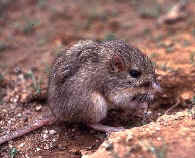
The Lined Pocket Mouse is smaller than most pocket mice in the genus Chaetodipus. It occurs only in the Mexican states of San Luis Potosi and Zacatecas. It has gray dorsal fur faintly marked with buff lines and lacks the stiff rump spines found in Nelson's pocket mouse.
Written 27 November 2026 from the sources listed below. Each statement was checked against the passage it cites; statements that could not be supported were removed.
Appearance
The species has gray dorsal fur faintly marked with buff lines, gray sides, and white underparts separated by a fine buff line. It lacks the stiff rump spines found in Nelson's pocket mouse.[1][2]
The species averages 165 mm in total length, including a tail measuring 92 mm.[3]
Similar species
The Lined Pocket Mouse resembles Nelson's pocket mouse in size and general appearance but lacks its stiff rump spines.[2][4]
Habitat
The species inhabits desert plains characterized by xerophile scrub. It occurs at elevations between 1,600 and 2,400 metres above sea level.[5][6]
The species occurs only in the Mexican states of San Luis Potosi and Zacatecas and is endemic to a small area of central Mexico.[7][8]
Behaviour
The species lives in burrows and is nocturnal. Burrow entrances are usually located at the base of plants, in crevices, or in other concealed places.[9][10][11]
After emerging after dark, the species moves slowly while remaining under cover as much as possible. It moves more rapidly when crossing open spaces.[12][13]
Diet
The species eats fallen seeds, including seeds from prickly pear cacti (Opuntia). It does not consume the pulp of cactus fruits.[14][15]
Conservation
The species has a restricted geographical range and is relatively uncommon. Its population trend is unknown.[16][17][18]
The IUCN lists the species as data deficient because it cannot assess its conservation status.[19]
Classification of the Lined Pocket Mouse
| Kingdom | Animalia |
|---|---|
| Phylum | Chordata |
| Subphylum | Vertebrata |
| Infraphylum | Gnathostomata |
| Parvphylum | Osteichthyes |
| Megaclass | Tetrapoda |
| Class | Mammalia (Mammal) |
| Subclass | Theria |
| Infraclass | Eutheria |
| Order | Rodentia (Rodent) |
| Suborder | Castorimorpha |
| Family | Heteromyidae (Pocket Mice) |
| Subfamily | Perognathinae (Silky Pocket Mice) |
| Genus | Chaetodipus (Hispid Pocket Mice) |
| Species | Chaetodipus lineatus (Dalquest, 1951) |
Where the Lined Pocket Mouse is found
Checklists and occurrence records place Chaetodipus lineatus in 1 country across North America. GBIF holds 88 georeferenced records of it.
Countries
Regions and cities with the most records
- San Luis Potosí, Mexico 59
- Salinas de Hidalgo, Mexico 7
- Zacatecas, Mexico 7
- Ciudad Fernández, Mexico 3
- Rioverde, Mexico 3
Range as the checklists state it
Middle America
A number beside a place is its count of GBIF occurrence records. A place without a number comes from a checklist alone. Records show where a species has been observed or collected, which can include escapes and vagrants.
Common names
English
- Lined Pocket Mouse
- Lined Pocket Gopher
Names in 7 other languages
- Czech
- pytlouš lemovaný
- Finnish
- potosintaskuhiiri
- German
- Gestreifte Taschenmaus
- Japanese
- スジポケットマウス
- Polish
- chomikomyszka prążkowana
- Russian
- Полосатый мешотчатый прыгун
- Spanish
- ratón de abazones rayado
Synonyms
One other scientific name has been used for this species and is now treated as a synonym of Chaetodipus lineatus.
- Perognathus lineatus Dalquest, 1951
Related species
-
 Rock Pocket MouseChaetodipus intermedius
-
 Desert Pocket MouseChaetodipus penicillatus
-
 Spiny Pocket MouseChaetodipus spinatus
-
 Little Desert Pocket MouseChaetodipus arenarius
-
 Hispid Pocket MouseChaetodipus hispidus
-
 California Pocket MouseChaetodipus californicus
-
 Bailey's Pocket MouseChaetodipus baileyi
-
 Nelson's Pocket MouseChaetodipus nelsoni
Compare
Questions and answers
What is the scientific name of the Lined Pocket Mouse?
The scientific name of the Lined Pocket Mouse is Chaetodipus lineatus. Written with its author, the full name is Chaetodipus lineatus (Dalquest, 1951).
Which family does the Lined Pocket Mouse belong to?
Chaetodipus lineatus belongs to the family Heteromyidae, in the order Rodentia and the class Mammalia.
Where is the Lined Pocket Mouse found?
Checklists and occurrence records place Chaetodipus lineatus in 1 country: Mexico.
What is the conservation status of the Lined Pocket Mouse?
The IUCN Red List category recorded for Chaetodipus lineatus is Data Deficient (DD).
What other names does the Lined Pocket Mouse have?
Chaetodipus lineatus is also known in English as Lined Pocket Gopher.
Sources
Passages the profile rests on
- The species has gray dorsal fur faintly marked with buff lines, gray sides, and white underparts separated by a fine buff line. Source passage: “the dorsal surface is gray faintly lined with buff giving a drab appearance, the sides are gray and the underparts are white, with a fine buff line delineating the margin between sides and belly.” — English Wikipedia
- The species lacks the stiff rump spines found in Nelson's pocket mouse. Source passage: “but lacks the stiff spines that that species has among the hairs on its rump.” — English Wikipedia
- The species averages 165 mm in total length, including a tail measuring 92 mm. Source passage: “averaging 165 mm (6.5 in) in total length including a tail of 92 mm (3.6 in).” — English Wikipedia
- The species resembles Nelson's pocket mouse in size and general appearance. Source passage: “It resembles Nelson's pocket mouse (Chaetodipus nelsonii) in size and general appearance” — English Wikipedia
- The species inhabits desert plains characterized by xerophile scrub. Source passage: “where it inhabits desert plains with xerophile scrub” — English Wikipedia
- The species occurs at elevations between 1,600 and 2,400 metres above sea level. Source passage: “at altitudes between 1,600 and 2,400 metres (5,200 and 7,900 ft) above sea level.” — English Wikipedia
- The species occurs only in the Mexican states of San Luis Potosi and Zacatecas. Source passage: “found only in the states of San Luis Potosi and Zacatecas in central Mexico” — English Wikipedia
- The species is endemic to a small area of central Mexico. Source passage: “This pocket mouse is endemic to a small area of central Mexico.” — English Wikipedia
- The species lives in burrows. Source passage: “The lined pocket mouse lives in a burrow” — English Wikipedia
- The species is nocturnal. Source passage: “The lined pocket mouse lives in a burrow and is nocturnal.” — English Wikipedia
- Burrow entrances are usually located at the base of plants, in crevices, or in other concealed places. Source passage: “The entrance of the burrow is usually at the base of a plant, in a crevice or in some other concealed location.” — English Wikipedia
- After emerging after dark, the species moves slowly while remaining under cover as much as possible. Source passage: “When it emerges after dark, the pocket mouse moves slowly around staying under cover as much as possible.” — English Wikipedia
- The species moves more rapidly when crossing open spaces. Source passage: “If it needs to cross an open space it moves much more rapidly.” — English Wikipedia
- The species eats fallen seeds, including seeds from prickly pear cacti (Opuntia). Source passage: “It feeds on seeds such as those of the prickly pear (Opuntia) which fall to the ground” — English Wikipedia
- The species does not consume the pulp of cactus fruits. Source passage: “but it does not eat the pulp of the cactus fruit.” — English Wikipedia
- The species has a restricted geographical range. Source passage: “The lined pocket mouse has a restricted range” — English Wikipedia
- The species is relatively uncommon. Source passage: “is relatively uncommon” — English Wikipedia
- The population trend of the species is unknown. Source passage: “its population trend is unknown.” — English Wikipedia
- The IUCN lists the species as data deficient because it cannot assess its conservation status. Source passage: “The International Union for Conservation of Nature is unable to assess its conservation status and lists it as "data deficient".” — English Wikipedia
Data
- Catalogue of Life, 2026-10-16 XR cc by
- Global Biodiversity Information Facility CC BY 4.0
- Wikidata CC0
- GeoNames CC BY 4.0
- Within the Catalogue of Life, this name comes from The Integrated Taxonomic Information System cc0
References
- J. Washington Acad. Sci vol.41 p.362 where the name was published
- Wilson, Don E., and DeeAnn M. Reeder, eds. (1993). Mammal Species of the World: A Taxonomic and Geographic Reference, 2nd Ed., 3rd Printing.
- Wilson, Don E., and F. Russell Cole. (2000). Common Names of Mammals of the World.
- Wilson, Don E., and DeeAnn M. Reeder, eds. (2005). Mammal Species of the World: A Taxonomic and Geographic Reference, 3rd Ed., Vols. 1 & 2.
- Hafner, M. S. / Wilson, Don E., T. E. Lacher Jr., and R. A. Mittermeier, eds. (2016). Family Heteromyidae (Pocket Mice, Kangaroo Mice and Kangaroo Rats). Handbook of the Mammals of the World. Vol. 6: Lagomorphs and Rodents I.
- Burgin, Connor J., Don E. Wilson, Russell A. Mittermeier, Anthony B. Rylands, et al. (2020). Illustrated Checklist of the Mammals of the World. Vol. 1. Monotremata to Rodentia.
This species in other databases
Page built on 27 November 2026. See how the catalog is made and all sources and licences.
Cite this page
ScientificNames.org. (2026). Chaetodipus lineatus (Lined Pocket Mouse). Retrieved November 27, 2026, from https://scientificnames.org/species/chaetodipus-lineatus
“Chaetodipus lineatus (Lined Pocket Mouse).” ScientificNames.org, 2026, scientificnames.org/species/chaetodipus-lineatus. Accessed 27 Nov. 2026.
ScientificNames.org. “Chaetodipus lineatus (Lined Pocket Mouse).” Accessed November 27, 2026. https://scientificnames.org/species/chaetodipus-lineatus.
@misc{scientificnames_chaetodipus_lineatus_lined_pocket_mouse,
  author = {{ScientificNames.org}},
  title = {Chaetodipus lineatus (Lined Pocket Mouse)},
  year = {2026},
  url = {https://scientificnames.org/species/chaetodipus-lineatus},
  note = {Accessed 2026-11-27}
}