Species · Flowering plants
Fringed Polygala Chamaebuxus paucifolia
The scientific name of the Fringed Polygala is Chamaebuxus paucifolia. It is a species of flowering plant in the family Polygalaceae (milkwort family), order Fabales.
- Scientific name
- Chamaebuxus paucifolia (Willd.) J.F.B.Pastore & Agust.Martinez
- Common name
- Fringed Polygala
- Genus
- Chamaebuxus
- Family
- Polygalaceae (Milkwort Family)
- Order
- Fabales
- Class
- Magnoliopsida
- Recorded in
- 2 countries
- Name status
- accepted in the Catalogue of Life

Overview
Chamaebuxus paucifolia is native to temperate regions of North America. Its pink and white flowers resemble birds in flight.
Written 26 November 2026 from the sources listed below. Each statement was checked against the passage it cites; statements that could not be supported were removed.
Appearance
The plant has smooth, slender, green stems and typically reaches a mature height of 3 to 6 inches. Its leaves are oblong to lanceolate, with narrow bases, pointed tips and a thin texture.[1][2][3][4]
The leaves are arranged alternately along the stems and appear whorled near the tips. Their edges lack hairs and have small teeth.[5][6][7]
Habitat
Fringed polygala grows in rich, moist woodland environments. Its habitats include fields, meadows, forests, woodlands and field edges.[8][9]
The species is native to North America and occurs in temperate regions of the continent.[10][11]
Diet
The plant's seeds contain substantial quantities of lipids, proteins and starches.[12]
Reproduction and life cycle
The plant spreads laterally through thin underground rhizomes. It also produces capsule-like fruits containing seeds.[13][14]
Spring is identified as the ideal season for propagation. Planting seeds directly in the ground is recommended instead of transplanting young seedlings.[15][16]
Seeds may be stored for up to four months under dry and cold conditions, although a more cautious recommendation limits their viability to three months.[17]
Uses
Fringed polygala was historically used in traditional medicine for skin irritation and respiratory complaints, including asthma and pneumonia. Native American medicinal practices also associated the plant with respiratory and cardiovascular health.[18][19][20]
A compound poultice made from the plant was traditionally applied to sore legs. A plant decoction was also used as a wash for babies with syphilitic sores.[21][22]
The plant was historically regarded as a home remedy intended to prevent conception.[23]
Classification of the Fringed Polygala
| Kingdom | Plantae |
|---|---|
| Subkingdom | Pteridobiotina |
| Phylum | Tracheophyta |
| Class | Magnoliopsida |
| Order | Fabales |
| Family | Polygalaceae (Milkwort Family) |
| Tribe | Polygaleae |
| Genus | Chamaebuxus (Milkwort) |
| Species | Chamaebuxus paucifolia (Willd.) J.F.B.Pastore & Agust.Martinez |
Where the Fringed Polygala is found
Checklists and occurrence records place Chamaebuxus paucifolia in 2 countries across North America. GBIF holds 16,609 georeferenced records of it.
Countries
Regions and cities with the most records
- Ontario, Canada 3,383
- Michigan, United States 1,795
- New York, United States 1,370
- Massachusetts, United States 1,362
- Pennsylvania, United States 1,300
- New Hampshire, United States 972
- Wisconsin, United States 885
- Maine, United States 718
- Vermont, United States 699
- Virginia, United States 449
- Gardner, United States 401
- Connecticut, United States 388
- Amherst Center, United States 260
- Amherst, United States 259
- Burlington, United States 230
- South Burlington, United States 229
- Minnesota, United States 228
- Colchester, United States 217
- Quebec, Canada 216
- Nashua, United States 194
- Northampton, United States 192
- South Hadley, United States 188
- Concord, United States 186
- New Jersey, United States 185
- Ithaca, United States 180
- Merrimack, United States 176
- West Virginia, United States 175
- Brunswick, United States 172
- North Carolina, United States 170
- Maryland, United States 166
- East Concord, United States 165
- Westford, United States 154
- Easthampton, United States 153
- Manchester, United States 153
- Manitoba, Canada 151
- Holyoke, United States 140
Range as the checklists state it
Canada (Alberta, Manitoba, New Brunswick, Newfoundland, Ontario, Québec, Saskatchewan); USA (Connecticut, Delaware, Georgia, Illinois, Indiana, Kentucky, Massachusetts, Maryland, Maine, Michigan, Minnesota, North Carolina, New Hampshire, New Jersey, New York, Ohio, Pennsylvania, Rhode Island, South Carolina, Tennessee, Virginia, Vermont, Wisconsin, West Virginia)
A number beside a place is its count of GBIF occurrence records. A place without a number comes from a checklist alone. Records show where a species has been observed or collected, which can include escapes and vagrants.
Common names
English
- Fringed Polygala
- False Box
- Flowering Wintergreen
- Fringed Milkwort
- Gaywing Milkwort
- Pink-fringed Milkwort
Names in 1 other language
- French
- polygala paucifolié, polygale paucifolié
Synonyms
18 other scientific names have been used for this species and are now treated as synonyms of Chamaebuxus paucifolia.
- Polygala commutata Sweet
- Polygala paucifolia Willd.
- Polygala paucifolia f. alba Wheelock
- Polygala paucifolia f. alba (Eights ex L.C.Beck) House
- Polygala paucifolia f. albiflora O.W.Knight
- Polygala paucifolia f. albiflora Farw.
- Polygala paucifolia f. caerulea R.J.Eaton
- Polygala paucifolia f. paucifolia
- Polygala paucifolia f. vestita Fernald
- Polygala paucifolia var. alba Eights ex L.C.Beck
- Polygala paucifolia var. pubescens Eaton
- Polygala purpurea W.T.Aiton
- Polygala uniflora Michx.
- Polygaloides paucifolia (Willd.) J.R.Abbott
- Trichlisperma grandiflorum Raf.
- Trichlisperma paucifolium (Willd.) Nieuwl.
- Triclisperma grandiflora Raf.
- Triclisperma paucifolia (Willd.) Nieuwl.
Related species
- Chamaebuxus unguiculata
- Polígala de VayredaChamaebuxus vayredae
- Chamaebuxus balansae
- Chamaebuxus webbiana
- Chamaebuxus munbyana
-
 Myrtle-leaf MilkwortPolygala myrtifolia
-
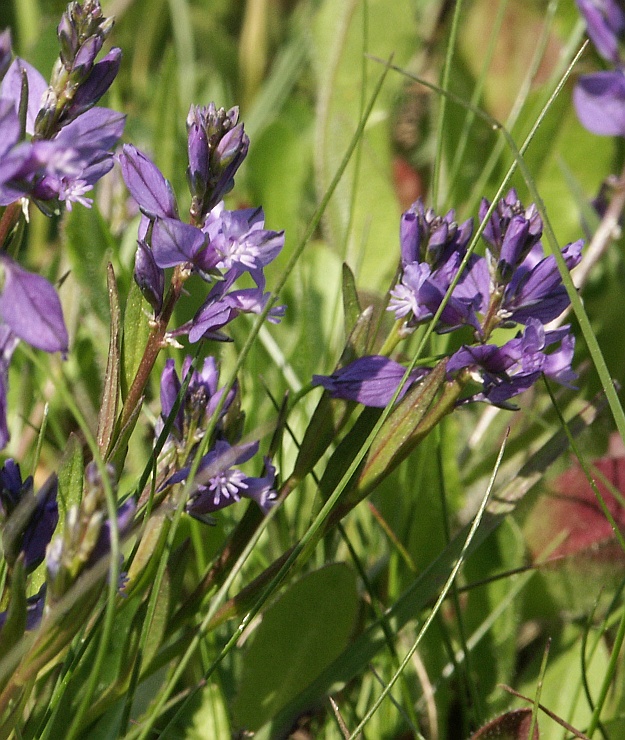 Common MilkwortPolygala vulgaris
-
 Chinese Senega-rootPolygala tenuifolia
Compare
Questions and answers
What is the scientific name of the Fringed Polygala?
The scientific name of the Fringed Polygala is Chamaebuxus paucifolia. Written with its author, the full name is Chamaebuxus paucifolia (Willd.) J.F.B.Pastore & Agust.Martinez.
Which family does the Fringed Polygala belong to?
Chamaebuxus paucifolia belongs to the family Polygalaceae, in the order Fabales and the class Magnoliopsida.
Where is the Fringed Polygala found?
Checklists and occurrence records place Chamaebuxus paucifolia in 2 countries: United States and Canada.
What other names does the Fringed Polygala have?
Chamaebuxus paucifolia is also known in English as False Box, Flowering Wintergreen, Fringed Milkwort, Gaywing Milkwort and Pink-fringed Milkwort.
Sources
Passages the profile rests on
- The plant has smooth, slender, green stems. Source passage: “Stems are smooth, slender and green.” — English Wikipedia
- Its leaves are oblong to lanceolate, with narrow bases and pointed tips. Source passage: “Leaflets are oblong to lanceolate—narrow at the base with a pointed tip.” — English Wikipedia
- The leaves have entire margins and a thin texture. Source passage: “Leaves have an entire margin and are thin.” — English Wikipedia
- Mature plants typically reach a height of 3 to 6 inches. Source passage: “mature plants are perennials that are 3 to 6 inches tall.” — English Wikipedia
- The leaves are clustered near the stem tips in an arrangement that appears whorled. Source passage: “Leaves are clustered at the top, appearing to be whorled, but they are not.” — English Wikipedia
- The leaves are arranged alternately along the stem and appear whorled near its tip. Source passage: “Leaves are whorled nearing the tip of the stem of the plant and they are alternate in arrangement.” — English Wikipedia
- The leaf edges lack hairs and have small teeth. Source passage: “The edges are without hair, but with small "teeth" on the surface.” — English Wikipedia
- The species grows in rich, moist woodland environments. Source passage: “It grows in rich, moist woods, and field edges.” — English Wikipedia
- Its habitats include fields, meadows, forests, woodlands, and field edges. Source passage: “This plant is native to North America and grows in fields, meadows, forests, woodlands, and field edges.” — English Wikipedia
- The species is native to North America. Source passage: “This plant is native to North America” — English Wikipedia
- The species occurs in temperate regions of North America. Source passage: “Chamaebuxus paucifolia is native to more temperate regions of North America.” — English Wikipedia
- The plant's seeds contain substantial quantities of lipids, proteins, and starches. Source passage: “the plant itself is heavily concentrated in lipids, proteins, and starches, but their seeds are especially so” — English Wikipedia
- The plant spreads laterally through thin underground rhizomes. Source passage: “The plant grows laterally through very thin rhibozomes” — English Wikipedia
- The species produces capsule-like fruits containing seeds. Source passage: “The fruits of this plant are ¼ to 1/3 inch capsule-like structures that are obovoid.” — English Wikipedia
- Spring is identified as the ideal season for propagation. Source passage: “Propagation in the spring is ideal” — English Wikipedia
- Planting seeds directly in the ground is recommended instead of transplanting young seedlings. Source passage: “It is recommended for this plant, as well as the broader milkwort family, to plant from seed in the ground, opposed to transplanting the seedlings early on.” — English Wikipedia
- Seeds may be stored for up to four months under dry and cold conditions, although a more cautious recommendation limits viability to three months. Source passage: “some say that they can be stored up to four months in dry and cold conditions, but more precautionary efforts state a maximum viability of three months when properly stored.” — English Wikipedia
- The plant was historically used in traditional medicine for skin irritation and respiratory complaints. Source passage: “Historically, the plant was used in medicinal practices for skin irritation and respiratory illnesses like coughing and phlegm.” — English Wikipedia
- Traditional medicinal applications included treating asthma and pneumonia. Source passage: “it is specifically recommended for use with asthma patients, as well as proving to be helpful with patients with cases of pneumonia.” — English Wikipedia
- Native American medicinal practices associated the plant with respiratory and cardiovascular health. Source passage: “Native Americans used the plant for both respiratory illnesses as well as linking the medicinal use of the plant to cardiovascular health.” — English Wikipedia
- A compound poultice made from the plant was traditionally applied to sore legs. Source passage: “Compound poultice of plants applied to sore legs.” — English Wikipedia
- A plant decoction was traditionally used as a wash for babies with syphilitic sores. Source passage: “Decoction of plant used as a wash for babies with syphilitic sores.” — English Wikipedia
- The plant was historically regarded as a home remedy intended to prevent conception. Source passage: “This plant was seen as a "home remedy" to prevent conception” — English Wikipedia
Data
- Catalogue of Life, 2026-10-16 XR cc by
- Global Biodiversity Information Facility CC BY 4.0
- Wikidata CC0
- GeoNames CC BY 4.0
- Wikimedia Commons per image; credit shown with each image
- Within the Catalogue of Life, this name comes from Synonymic Checklists of the Vascular Plants of the World cc by
References
- J.F.B.Pastore & Agust.Martinez. (2024). Taxon 73(3): 873 (2024). where the name was published
This species in other databases
Page built on 29 November 2026. See how the catalog is made and all sources and licences.
Cite this page
ScientificNames.org. (2026). Chamaebuxus paucifolia (Fringed Polygala). Retrieved November 29, 2026, from https://scientificnames.org/species/chamaebuxus-paucifolia
“Chamaebuxus paucifolia (Fringed Polygala).” ScientificNames.org, 2026, scientificnames.org/species/chamaebuxus-paucifolia. Accessed 29 Nov. 2026.
ScientificNames.org. “Chamaebuxus paucifolia (Fringed Polygala).” Accessed November 29, 2026. https://scientificnames.org/species/chamaebuxus-paucifolia.
@misc{scientificnames_chamaebuxus_paucifolia_fringed_polygala,
  author = {{ScientificNames.org}},
  title = {Chamaebuxus paucifolia (Fringed Polygala)},
  year = {2026},
  url = {https://scientificnames.org/species/chamaebuxus-paucifolia},
  note = {Accessed 2026-11-29}
}