Species · Fishes
Chaunacops coloratus
Chaunacops coloratus has no English name on record in the checklists used here. It is a species of fish in the family Chaunacidae (sea toad), order Lophiiformes. The name dates from 1899.
- Scientific name
- Chaunacops coloratus (Garman, 1899)
- Genus
- Chaunacops
- Family
- Chaunacidae (Sea Toad)
- Order
- Lophiiformes
- Class
- Teleostei
- Red List category
- LC Least Concern
- Environment
- marine
- Recorded in
- 5 countries
- Name status
- accepted in the Catalogue of Life

Overview
Chaunacops coloratus lives in marine, offshore rocky bottom habitats near manganese-encrusted volcanic talus slopes. It occurs in bright red and blue color forms and typically has prominent prickles on its head and body, along with short cirri.
Written 28 November 2026 from the sources listed below. Each statement was checked against the passage it cites; statements that could not be supported were removed.
Appearance
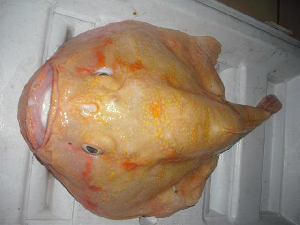
Chaunacops coloratus occurs in bright red and blue color forms. Individuals typically have prominent prickles on their heads and bodies and have short cirri.[1][2][3]
Blue specimens have an average length of approximately 110 mm, while red specimens have an average length of approximately 184 mm.[4][5]
Habitat
Chaunacops coloratus lives in marine environments and is restricted to offshore habitats. It occupies rocky bottom habitats near manganese-encrusted volcanic talus slopes.[6][7][8][9]
The average oxygen concentration reported at its observed depths was approximately 1.59 mL/L. The average habitat temperature was approximately 1.68 °C, and average salinity was approximately 34.64 psu.[10][11][12]
Behaviour
Chaunacops coloratus commonly rests with one pectoral fin braced against a rock and the other positioned on sediment. It can also use its pectoral fins to brace itself between a rock and sediment.[13][14]
It uses its pectoral and pelvic fins to maneuver across the ocean floor and can walk backwards using these fins.[15][16]
Chaunacops coloratus can swim vertically with its head oriented upwards. During rapid upward swimming, it uses its dorsal, caudal, and anal fins for propulsion.[17][18]
Observed ascending specimens had average velocities of 0.036 m/s and 0.021 m/s.[19]
Reproduction and life cycle
Chaunacops coloratus develops from a transparent larval form before becoming blue and eventually red as an adult.[20]
Classification of Chaunacops coloratus
| Kingdom | Animalia |
|---|---|
| Phylum | Chordata |
| Subphylum | Vertebrata |
| Infraphylum | Gnathostomata |
| Parvphylum | Osteichthyes |
| Gigaclass | Actinopterygii |
| Superclass | Actinopteri |
| Class | Teleostei (Teleost) |
| Order | Lophiiformes (Anglerfish) |
| Suborder | Chaunacoidei |
| Family | Chaunacidae (Sea Toad) |
| Genus | Chaunacops |
| Species | Chaunacops coloratus (Garman, 1899) |
Where Chaunacops coloratus is found
Checklists and occurrence records place Chaunacops coloratus in 5 countries. GBIF holds 58 georeferenced records of it.
Countries
A number beside a place is its count of GBIF occurrence records. A place without a number comes from a checklist alone. Records show where a species has been observed or collected, which can include escapes and vagrants.
Common names
Names in 1 other language
- Czech
- žaboškleb barevný
Synonyms
2 other scientific names have been used for this species and are now treated as synonyms of Chaunacops coloratus.
- Bathychaunax coloratus (Garman, 1899)
- Chaunax coloratus Garman, 1899
Related species
- Tadpole CoffinfishChaunacops melanostomus
- Chaunacops roseus
- Eastern Tadpole CoffinfishChaunacops spinosus
-
 Furry CoffinfishChaunax endeavouri
-
 Pink FrogmouthChaunax pictus
-
 Suttkus Sea ToadChaunax suttkusi
-
 Redeye GaperChaunax stigmaeus
-
 Abe's FrogmouthChaunax abei
Compare
Sources
Passages the profile rests on
- Chaunacops coloratus occurs in bright red and blue color forms. Source passage: “The Chaunacops coloratus are another species that were discovered and are known for their bright red and blue colors.” — English Wikipedia
- Individuals of Chaunacops coloratus typically have prominent prickles on their heads and bodies. Source passage: “Most individuals are pink or pinkish-red, with prominent prickles on the head and body, and short cirri.” — fisheries.noaa.gov
- Chaunacops coloratus has short cirri. Source passage: “Most individuals are pink or pinkish-red, with prominent prickles on the head and body, and short cirri.” — fisheries.noaa.gov
- Blue specimens of Chaunacops coloratus have an average length of approximately 110 mm. Source passage: “It was found that the blue C. coloratus often had an average length of about 110 mm” — English Wikipedia
- Red specimens of Chaunacops coloratus have an average length of approximately 184 mm. Source passage: “whereas the red specimen had an average length of 184 mm.” — English Wikipedia
- Chaunacops coloratus occurs near manganese-encrusted volcanic talus slopes. Source passage: “In addition, it was found that the Chaunacops coloratus are also often found near "manganese-encrusted volcanic talus slopes".” — English Wikipedia
- Chaunacops coloratus occupies rocky bottom habitats. Source passage: “Water Column Position. Bottom. Bottom only. Habitat. Rocks.” — biogeodb.stri.si.edu
- Chaunacops coloratus is found in marine environments. Source passage: “Habitat. Salinity. Marine.” — biogeodb.stri.si.edu
- Chaunacops coloratus is restricted to offshore habitats. Source passage: “Inshore/Offshore. Offshore Only. Offshore.” — biogeodb.stri.si.edu
- The average oxygen concentration reported at the depths where Chaunacops coloratus was found was approximately 1.59 mL/L. Source passage: “The average oxygen concentration was found to be about 1.59 mL/L at the depths they were found” — English Wikipedia
- The average temperature reported in the habitat of Chaunacops coloratus was approximately 1.68 °C. Source passage: “and the average temperature was about 1.68 °C.” — English Wikipedia
- The average salinity reported in the habitat of Chaunacops coloratus was approximately 34.64 psu. Source passage: “Salinity in their habitats did not change much and was found to be an average of 34.64 psu.” — English Wikipedia
- Chaunacops coloratus commonly rests with one pectoral fin braced against a rock and the other positioned on sediment. Source passage: “They are usually, but not always, seen in a characteristic posture with one pectoral fin braced like a hand against a rock and the other placed down on sand or sediment.” — fisheries.noaa.gov
- Chaunacops coloratus can use its pectoral fins to brace itself between a rock and sediment. Source passage: “The fish were observed to often have one of their pectoral fins in sediment and another one on a rock in order to make it seem as though they were wedged between two substrates.” — English Wikipedia
- Chaunacops coloratus uses its pectoral and pelvic fins to maneuver across the ocean floor. Source passage: “As for maneuvering across the ocean floor, observations found that the specimen use their pectoral and pelvic fins.” — English Wikipedia
- Chaunacops coloratus is capable of walking backwards using its pectoral and pelvic fins. Source passage: “It was also observed that these specimen are capable of walking backwards using their pectoral and pelvic fins.” — English Wikipedia
- Chaunacops coloratus can swim vertically with its head oriented upwards. Source passage: “Through observations made by an ROV, it was found that the C. coloratus swim vertically with their head oriented upwards.” — English Wikipedia
- Chaunacops coloratus uses its dorsal, caudal, and anal fins to propel itself during rapid upward swimming. Source passage: “While in rapid ascent, the specimen will use their dorsal, caudal, and anal fins to propel themselves upwards” — English Wikipedia
- Observed ascending Chaunacops coloratus specimens had average velocities of 0.036 m/s and 0.021 m/s. Source passage: “The observation collected found that the specimen had average velocities of 0.036 m/s and 0.021 m/s while ascending.” — English Wikipedia
- Chaunacops coloratus develops from a transparent larval form before becoming blue and eventually red as an adult. Source passage: “It was observed that the specimen begin in a transparent larval form, then become blue, and eventually reach their adult red color.” — English Wikipedia
Data
- Catalogue of Life, 2026-10-16 XR cc by
- Global Biodiversity Information Facility CC BY 4.0
- Wikidata CC0
- GeoNames CC BY 4.0
- Wikimedia Commons per image; credit shown with each image
- Within the Catalogue of Life, this name comes from World Register of Marine Species cc by
This species in other databases
- Catalogue of Life TQRX
- Wikidata Q2961637
- iNaturalist 611090
- WoRMS urn:lsid:marinespecies.org:taxname:280133
Page built on 29 November 2026. See how the catalog is made and all sources and licences.
Cite this page
ScientificNames.org. (2026). Chaunacops coloratus. Retrieved November 29, 2026, from https://scientificnames.org/species/chaunacops-coloratus
“Chaunacops coloratus.” ScientificNames.org, 2026, scientificnames.org/species/chaunacops-coloratus. Accessed 29 Nov. 2026.
ScientificNames.org. “Chaunacops coloratus.” Accessed November 29, 2026. https://scientificnames.org/species/chaunacops-coloratus.
@misc{scientificnames_chaunacops_coloratus,
  author = {{ScientificNames.org}},
  title = {Chaunacops coloratus},
  year = {2026},
  url = {https://scientificnames.org/species/chaunacops-coloratus},
  note = {Accessed 2026-11-29}
}