Species · Fishes
Humpback Grouper Chromileptes altivelis
The scientific name of the Humpback Grouper is Chromileptes altivelis. It is a species of fish in the family Epinephelidae (groupers), order Perciformes. The name dates from 1828.
- Scientific name
- Chromileptes altivelis (Valenciennes, 1828)
- Common name
- Humpback Grouper
- Genus
- Chromileptes
- Family
- Epinephelidae (Groupers)
- Order
- Perciformes
- Class
- Teleostei
- Environment
- marine
- Recorded in
- 15 countries
- Name status
- accepted in the Catalogue of Life

Overview
Chromileptes altivelis inhabits clear waters in lagoons and seaward reefs, preferring dead or silty areas.
Written 26 November 2026 from the sources listed below. Each statement was checked against the passage it cites; statements that could not be supported were removed.
Appearance
The Humpback Grouper has a laterally compressed, relatively tall body with an elevated profile behind its depressed anterior head. A pronounced hump is present at the nape of its head.[1][2]
Juveniles are white with round black spots, generally fewer in number than those of adults, although their spots can be as large as their eyes. Adults have grey and beige coloration with darker blotches of varying sizes and small black spots covering the body.[3][4][5][6]
Changes in pH have been observed to alter its coloration. Its pectoral and caudal fins are rounded.[7][8]
The pectoral fins contain 17–18 rays. The dorsal fin contains approximately 10 spines and 17–19 rays, while the anal fin contains approximately three spines and 9–10 rays.[9][10][11]
The species has brush-like villiform teeth and smooth body scales.[12]
The maximum reported length is 70 cm.[13]
Habitat
The Humpback Grouper inhabits clear waters in lagoons and seaward reefs, preferring dead or silty areas. It occurs at depths of 2–40 m, usually shallower than 10 m.[14][15]
Its reported preferred temperature is 24.5 °C.[16]
Diet
The Humpback Grouper feeds on small fishes and crustaceans. Documented food items include krill, shrimp, squid and clams.[17][18]
It is an ambush predator, with feeding activity greatest around sunrise and sunset.[19][20]
Behaviour
The Humpback Grouper is demersal and primarily solitary. It sometimes swims in pairs or groups of three to six individuals.[21][22]
Reproduction and life cycle
The Humpback Grouper is a protogynous hermaphrodite, with individuals born female and capable of changing into males. Females can begin transitioning at approximately three years of age, and most individuals are male by nine years of age.[23][24][25]
The transition to male generally occurs in dominant mature females when a dominant male is absent.[26]
The peak spawning period occurs between October and January. A single spawning event lasts between four and eight days.[27][28]
Eggs collected for aquaculture are buoyant and generally measure 0.80–0.83 mm in diameter.[29]
Conservation
The Humpback Grouper is classified as Data Deficient by the IUCN. Its population is suspected to have declined historically, and it is considered overexploited in Southeast Asia.[30][31][32]
Australia prohibits harvesting the species on the Great Barrier Reef.[33]
Uses
The Humpback Grouper is commercially valued as a food fish and is popular in live fish markets throughout Asia, particularly Hong Kong.[34][35]
The species is used in aquaculture production, mainly in Taiwan and Indonesia.[36]
Classification of the Humpback Grouper
| Kingdom | Animalia |
|---|---|
| Phylum | Chordata |
| Subphylum | Vertebrata |
| Infraphylum | Gnathostomata |
| Parvphylum | Osteichthyes |
| Gigaclass | Actinopterygii |
| Superclass | Actinopteri |
| Class | Teleostei (Teleost) |
| Order | Perciformes |
| Suborder | Percoidei |
| Family | Epinephelidae (Groupers) |
| Genus | Chromileptes (Humpback Groupers) |
| Species | Chromileptes altivelis (Valenciennes, 1828) |
Where the Humpback Grouper is found
Checklists and occurrence records place Chromileptes altivelis in 15 countries. GBIF holds 1,382 georeferenced records of it.
Countries
- Australia 682
- China 4
- India 4
- Indonesia 342
- Japan 11
- Malaysia 24
- New Caledonia 196
- Palau 26
- Papua New Guinea 5
- Philippines 38
- Singapore 4
- Solomon Islands 10
- Taiwan 21
- Thailand 12
- Vietnam 3
Regions and cities with the most records
- Nouméa, New Caledonia 154
- Mont-Dore, New Caledonia 138
- Dumbéa, New Caledonia 95
- Bitung, Indonesia 58
- Queensland, Australia 38
- Western Australia, Australia 13
- Keelung, Taiwan 10
- Ambon, Indonesia 9
- Gold Coast, Australia 9
- Labuan Bajo, Indonesia 9
- Maluku, Indonesia 9
- Culion, Philippines 7
- Bali, Indonesia 6
- Airmadidi, Indonesia 5
- Amlapura, Indonesia 5
- Amlapura city, Indonesia 5
- Batubulan, Indonesia 5
- Bedugul, Indonesia 5
- Benoa, Indonesia 5
- Dalung, Indonesia 5
- Denpasar, Indonesia 5
- Kuta, Indonesia 5
- Tuban, Indonesia 5
- Klungkung, Indonesia 4
- New South Wales, Australia 4
- Coffs Harbour, Australia 3
- Daanbantayan, Philippines 3
1 more country has a few records outside this range
These countries hold a few records of Chromileptes altivelis but lie outside the range the checklists give for it. Such records are often zoo or garden specimens, museum material or vagrants, so the species is not counted as occurring there.
A number beside a place is its count of GBIF occurrence records. A place without a number comes from a checklist alone. Records show where a species has been observed or collected, which can include escapes and vagrants.
Common names
English
- Humpback Grouper
- Barramundi Cod
- Barramundi Rock-cod
- Hump-backed Cod
- Hump-backed Rock Cod
- Humpback Rockcod
- Humpback Sea-bass
- Panther Grouper
- Plum Pudding Cod
- Polka Dot Cod
Names in 22 other languages
- Cebuano
- Bantol, Batol, Jahong, Kugtong, Lilug, Mamonbong, Ogaw, Pugapo
- Chinese
- 扁鮨, 老鼠斑, 青斑, 駝背鱸
- Czech
- kanic tečkovaný
- Danish
- Kamelbars
- French
- Loche Truite, Mérou de Grace Kelly
- German
- Pantherbarsch
- Italian
- Cernia a pois, Cernia gobba, Cernia pantera
- Japanese
- サラサハタ
- Polish
- panterka
- Portuguese
- Garoupa-pantera
- Russian
- Горбатый каменный окунь
- Spanish
- Mero pantera
- Tagalog
- Alatan, Kaltang, Kulapo, Lapu-lapung lupot, Lubo, Sigapo
- Tamil
- Kalava
- Thai
- ปลากะรังหน้างอน
- Turkish
- benekli hani
- bik
- Inid, Kigting, Kugtung
- cbk
- Mantis
- ilo
- Kakab, Kurapo, Kurapu, Labungan, Maskad, Matkad
- nlg
- Iga piu
- sgd
- Badiangon
- war
- Tingag
Synonyms
6 other scientific names have been used for this species and are now treated as synonyms of Chromileptes altivelis.
- Cromileptes altiveles (Valenciennes, 1828)
- Cromileptis altivales (Valenciennes, 1828)
- Cromileptis altiveles (Valenciennes, 1828)
- Cromileptis altivelis (Valenciennes, 1828)
- Epinephelus altivelis (Valenciennes, 1828)
- Serranus altivelis Valenciennes, 1828
Related species
-
 Atlantic Goliath GrouperEpinephelus itajara
-
 Giant GrouperEpinephelus lanceolatus
-
 Dusky GrouperEpinephelus marginatus
-
 Leopard Coral GrouperPlectropomus leopardus
-
 Nassau GrouperEpinephelus striatus
-
 Red GrouperEpinephelus morio
-
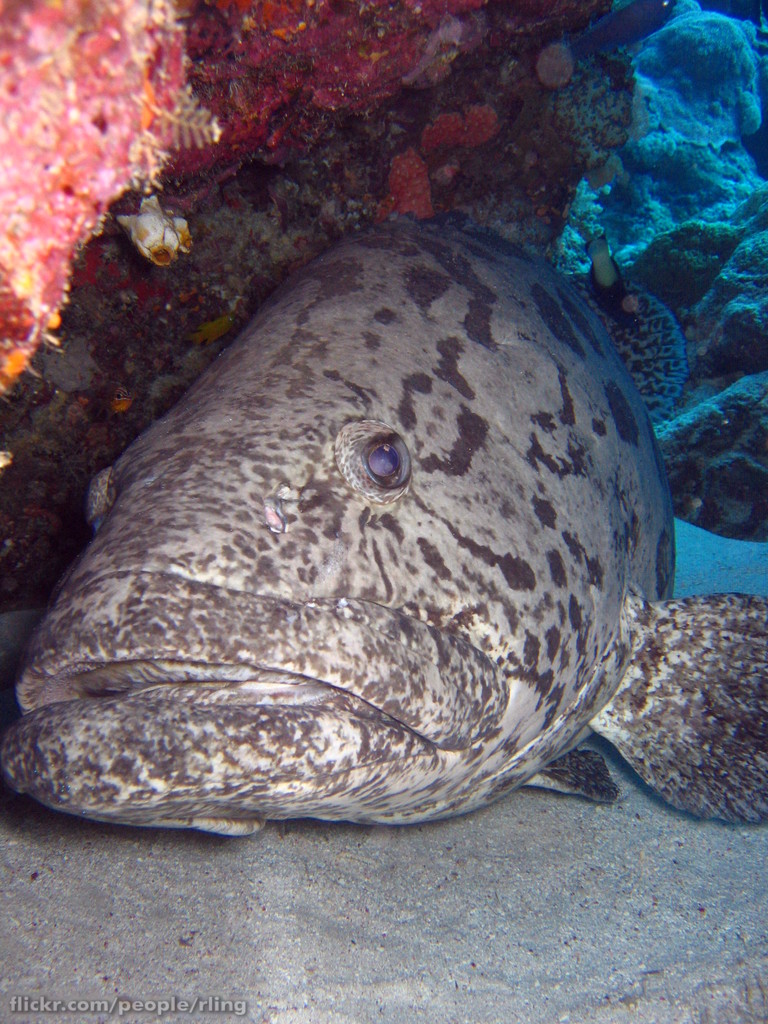 Potato GrouperEpinephelus tukula
-
 Black GrouperMycteroperca bonaci
Compare
Questions and answers
What is the scientific name of the Humpback Grouper?
The scientific name of the Humpback Grouper is Chromileptes altivelis. Written with its author, the full name is Chromileptes altivelis (Valenciennes, 1828).
Which family does the Humpback Grouper belong to?
Chromileptes altivelis belongs to the family Epinephelidae, in the order Perciformes and the class Teleostei.
Where is the Humpback Grouper found?
Checklists and occurrence records place Chromileptes altivelis in 15 countries, including Australia, Indonesia, New Caledonia, Philippines, Palau and Malaysia.
What other names does the Humpback Grouper have?
Chromileptes altivelis is also known in English as Barramundi Cod, Barramundi Rock-cod, Hump-backed Cod, Hump-backed Rock Cod, Humpback Rockcod and Humpback Sea-bass.
How big do humpback groupers get?
The Humpback Grouper can grow to a maximum reported length of 70 cm.[13]
Sources
Passages the profile rests on
- The species has a laterally compressed, relatively tall body with a distinctive elevated profile behind its depressed anterior head. Source passage: “Its body is compressed laterally, is relatively high, and has a unique head profile compared to other groupers.” — English Wikipedia
- The species has a pronounced hump at the nape of its head. Source passage: “The head is depressed anteriorly and elevated posteriorly, with a sharp rise at the nape.” — English Wikipedia
- Juveniles are white with round black spots. Source passage: “The young are white with round black spots.” — English Wikipedia
- Adults have grey and beige coloration with darker blotches of varying sizes. Source passage: “The adults have a body colouration with variances of grey and beige, with darker blotches variable in size on the body.” — English Wikipedia
- Small black spots cover the adult body. Source passage: “Small black spots cover the whole body.” — English Wikipedia
- Juveniles generally have fewer black spots than adults, although their spots can be as large as their eyes. Source passage: “In comparison, juveniles have fewer of these black spots than adults, but the spots can be larger, or as large, as their eyes.” — English Wikipedia
- Changes in pH have been observed to alter the species' coloration. Source passage: “Furthermore, their coloration has been observed to change with a drop in pH.” — English Wikipedia
- The pectoral and caudal fins are rounded. Source passage: “In terms of its fins, the grouper has rounded pectoral and caudal fins, aiding in stability.” — English Wikipedia
- The pectoral fins contain 17–18 rays. Source passage: “Their pectoral fins range between 17 and 18 rays, with the middle rays being the longest.” — English Wikipedia
- The dorsal fin contains approximately 10 spines and 17–19 rays. Source passage: “The dorsal fin consists of around 10 spines and 17–19 rays, which greatly aids in stability against turning.” — English Wikipedia
- The anal fin contains approximately three spines and 9–10 rays. Source passage: “The anal fin, which is about half in length of the dorsal fin, consists of around 3 spines, and 9–10 rays.” — English Wikipedia
- The species has brush-like villiform teeth and smooth body scales. Source passage: “Their brush-like villiform teeth are adequate for eating smaller fish, and have smooth body scales.” — English Wikipedia
- The species can grow to a maximum reported length of 70 cm. Source passage: “The humpback grouper is a medium-sized fish which grows up to 70 cm (28 in).” — English Wikipedia
- The species inhabits clear waters in lagoons and seaward reefs, preferring dead or silty areas. Source passage: “The humpback grouper lives in clear waters from lagoons and seaward reefs with a preference for dead or silty areas.” — English Wikipedia
- The species occurs at depths of 2–40 m, usually shallower than 10 m. Source passage: “They are found in a range of depth from 2 to 40 m (10 to 130 ft), but usually found at depths less than 10 m (30 ft).” — English Wikipedia
- The species has a reported preferred temperature of 24.5 °C. Source passage: “The humpback fish has a preferendum temperature of 24.5 C” — English Wikipedia
- The species feeds on small fishes and crustaceans. Source passage: “The diet of this grouper is based on small fishes and crustaceans, such as krill, shrimp, squids, and clams.” — English Wikipedia
- Its documented food items include krill, shrimp, squid and clams. Source passage: “such as krill, shrimp, squids, and clams.” — English Wikipedia
- The species is an ambush predator. Source passage: “the humpback grouper is demersal, solitary (except during mating periods), defends a territory, and is an ambush predator.” — English Wikipedia
- Its feeding activity is greatest around sunrise and sunset. Source passage: “Its feeding activity is maximal at sunrise and/or at sunset.” — English Wikipedia
- The species is primarily solitary but sometimes swims in pairs or groups of three to six individuals. Source passage: “Although primarily solitary, they are also known to swim in pairs, or sometimes in groups of 3–6.” — English Wikipedia
- The species is demersal. Source passage: “the humpback grouper is demersal” — English Wikipedia
- The species is a protogynous hermaphrodite, with individuals born female and capable of changing into males. Source passage: “This species is a protogynous hermaphrodite; in other words, all individuals are born female, with the ability to transform to males as they grow older.” — English Wikipedia
- Female individuals can begin transitioning into males at approximately three years of age. Source passage: “Female humpback groupers start transitioning to males as early as 3 years.” — English Wikipedia
- Most individuals are male by nine years of age. Source passage: “By the age of 9, most humpback groupers are male.” — English Wikipedia
- The transition to male generally occurs in dominant mature females when a dominant male is absent. Source passage: “Typically, only the most dominant, mature females undergo this transformation in the absence of a dominant male.” — English Wikipedia
- The species' peak spawning period occurs between October and January. Source passage: “The humpback grouper's peak spawning time is between October and January” — English Wikipedia
- A single spawning event lasts between four and eight days. Source passage: “with a single spawn event lasting from 4 to 8 days.” — English Wikipedia
- Eggs collected for aquaculture are buoyant and generally measure 0.80–0.83 mm in diameter. Source passage: “buoyant eggs are selected, and are usually 0.80–0.83 mm in diameter.” — English Wikipedia
- The species is classified as Data Deficient by the IUCN. Source passage: “The humpback grouper has been given the Data Deficient status by the IUCN.” — English Wikipedia
- The species is considered overexploited in Southeast Asia. Source passage: “It is a highly valued food fish, especially in Southeast Asia where it is also overexploited.” — English Wikipedia
- The species' population is suspected to have declined historically. Source passage: “Despite this, it is suspected that the population has declined historically.” — English Wikipedia
- Australia prohibits harvesting the species on the Great Barrier Reef. Source passage: “no take species on the Great Barrier Reef” — English Wikipedia
- The species is commercially valued as a food fish. Source passage: “It is a highly valued food fish, especially in Southeast Asia” — English Wikipedia
- The species is popular in live fish markets throughout Asia, particularly Hong Kong. Source passage: “The humpback grouper is a popular fish amongst live fish markets, mainly throughout Asia, but more so in Hong Kong.” — English Wikipedia
- The species is used in aquaculture production, mainly in Taiwan and Indonesia. Source passage: “aquaculture production mainly in Taiwan and Indonesia.” — English Wikipedia
Data
- Catalogue of Life, 2026-10-16 XR cc by
- Global Biodiversity Information Facility CC BY 4.0
- Wikidata CC0
- GeoNames CC BY 4.0
- Wikimedia Commons per image; credit shown with each image
- Within the Catalogue of Life, this name comes from World Register of Marine Species cc by
References
- Cuvier and Valenciennes, 1828 where the name was published
This species in other databases
- Catalogue of Life 5YFVV
- Wikidata Q664133
- iNaturalist 1316661
- WoRMS urn:lsid:marinespecies.org:taxname:401295
- ITIS 643423
Page built on 27 November 2026. See how the catalog is made and all sources and licences.
Cite this page
ScientificNames.org. (2026). Chromileptes altivelis (Humpback Grouper). Retrieved November 27, 2026, from https://scientificnames.org/species/chromileptes-altivelis
“Chromileptes altivelis (Humpback Grouper).” ScientificNames.org, 2026, scientificnames.org/species/chromileptes-altivelis. Accessed 27 Nov. 2026.
ScientificNames.org. “Chromileptes altivelis (Humpback Grouper).” Accessed November 27, 2026. https://scientificnames.org/species/chromileptes-altivelis.
@misc{scientificnames_chromileptes_altivelis_humpback_grouper,
  author = {{ScientificNames.org}},
  title = {Chromileptes altivelis (Humpback Grouper)},
  year = {2026},
  url = {https://scientificnames.org/species/chromileptes-altivelis},
  note = {Accessed 2026-11-27}
}