Species · Fishes
Dusky Grouper Epinephelus marginatus
The scientific name of the Dusky Grouper is Epinephelus marginatus. It is a species of fish in the family Epinephelidae (groupers), order Perciformes. The name dates from 1834.
- Scientific name
- Epinephelus marginatus (Lowe, 1834)
- Common name
- Dusky Grouper
- Genus
- Epinephelus
- Family
- Epinephelidae (Groupers)
- Order
- Perciformes
- Class
- Teleostei
- Red List category
- VU Vulnerable
- Environment
- marine
- Recorded in
- 42 countries
- Name status
- accepted in the Catalogue of Life

Overview
Epinephelus marginatus occurs in the eastern Atlantic, southwestern Indian Ocean, Mediterranean Sea and southwestern Atlantic off southern Brazil, Uruguay and northern Argentina. It is a protogynous hermaphrodite, with individuals beginning adult life as females and potentially changing into males.
Written 26 November 2026 from the sources listed below. Each statement was checked against the passage it cites; statements that could not be supported were removed.
Appearance
The dusky grouper has an oval body, a large head, a wide mouth and a protruding lower jaw. Its dorsal fin has 11 spines and 13–16 soft rays.[1][2]
Its head and upper body are dark reddish brown or greyish, usually with yellowish-gold coloration on the underside. Irregular pale greenish-yellow, silvery-grey or whitish blotches occur on its body and head.[3][4]
Its median fins are dark brown, while its pelvic fins are black towards their tips.[5]
The species can reach 150 cm in standard length, although its more common length is approximately 90 cm.[6]
Habitat
The dusky grouper normally inhabits rocky reefs from surface waters to depths of 300 metres. It frequently occurs near beds of Posidonia seagrass.[7][8]
Juveniles generally occupy shallower coastal habitats than adults and can occur in rock pools. Adults and juveniles can enter brackish habitats such as estuaries.[9][10]
Diet
The dusky grouper feeds principally on molluscs, crustaceans and octopuses. Fish become increasingly important in its diet as it grows, with reef fishes being preferred.[11][12]
Behaviour
Adult dusky groupers are generally solitary and territorial. The species is sedentary.[13][14]
Reproduction and life cycle
The dusky grouper is a protogynous hermaphrodite. Individuals begin adult life as females and can subsequently become males.[15]
Females begin breeding at approximately five years of age. Sex change from female to male generally occurs between ages nine and sixteen, most commonly at age twelve.[16][17]
Sex transformation begins at approximately 65 cm in length, although most individuals change sex between 80 and 90 cm in total length. Some populations contain large females, suggesting that not all females undergo sex change.[18][19]
In southern Brazil, females reach maturity at approximately five years of age and 380 mm in length. Sex inversion peaks at approximately twelve years of age and occurs at a body weight of around 9 kg.[20][21]
Spawning occurs in small aggregations of several dozen individuals at specific sites. Known Mediterranean spawning aggregation locations include the Medes Islands Marine Reserve in Spain, waters off Lampedusa in Italy and Port-Cros National Park in France.[22][23]
Mediterranean spawning takes place between June and September, while Brazilian populations reproduce during early summer, between November and December. Mediterranean spawning groups normally contain approximately seven females per male.[24][25][26]
Dominant males establish territories and aggressively defend them during spawning. Commercial catches of the species in Brazil frequently take place during summer spawning aggregations.[27][28]
The dusky grouper has been reported to live for up to 50 years.[29]
Conservation
The dusky grouper has been assessed as Vulnerable because of suspected population reductions exceeding 50% over the last three generations and continuing threats. Reported catches declined by 88% across seven countries between 1990 and 2001.[30][31]
Its slow growth and reproductive characteristics increase its vulnerability to overexploitation. The species is considered overexploited in Mediterranean areas.[32][33]
Researchers have recommended precautionary and data-limited management approaches for Brazilian coastal populations.[34]
Uses
The dusky grouper is commercially caught as a food fish throughout its distribution. Large adults are targeted as trophies by spearfishers and are also caught by anglers.[35][36]
The species is an important catch for artisanal small-scale fisheries along the Brazilian coast. It is sold and consumed locally in Brazil.[37][38]
Attempts have been made to cultivate and breed the species in aquaculture in Italy.[39]
Classification of the Dusky Grouper
| Kingdom | Animalia |
|---|---|
| Phylum | Chordata |
| Subphylum | Vertebrata |
| Infraphylum | Gnathostomata |
| Parvphylum | Osteichthyes |
| Gigaclass | Actinopterygii |
| Superclass | Actinopteri |
| Class | Teleostei (Teleost) |
| Order | Perciformes |
| Suborder | Percoidei |
| Family | Epinephelidae (Groupers) |
| Genus | Epinephelus (Groupers) |
| Species | Epinephelus marginatus (Lowe, 1834) |
Where the Dusky Grouper is found
Checklists and occurrence records place Epinephelus marginatus in 42 countries. GBIF holds 17,854 georeferenced records of it.
Countries
- Albania 47
- Algeria 16
- Angola 45
- Argentina 5
- Benin 16
- Brazil 2,598
- Cabo Verde 22
- Cameroon 43
- Croatia 56
- Cyprus 84
- Democratic Republic of the Congo 11
- Egypt 6
- Equatorial Guinea 19
- Faroe Islands 6
- France 8,668
- Gabon 78
- Germany 7
- Ghana 79
- Greece 810
- Guinea 34
- Guinea-Bissau 22
- Italy 591
- Ivory Coast 72
- Liberia 63
- Libya 12
- Madagascar 3
- Malta 86
- Mauritania 43
- Monaco 15
- Montenegro 16
- Morocco 4
- Mozambique 211
- Nigeria 120
- Portugal 274
- Republic of the Congo 13
- Reunion 6
- Senegal 7
- Sierra Leone 41
- South Africa 392
- Spain 3,152
- Togo 12
- Tunisia 49
Regions and cities with the most records
- Marseille 09, France 1,188
- Marseille 08, France 1,121
- Marseille 07, France 1,095
- Marseille 06, France 1,072
- Marseille 10, France 1,067
- Marseille 02, France 1,052
- Marseille, France 1,040
- Marseille 01, France 1,038
- Marseille 03, France 1,032
- Marseille 05, France 1,026
- Marseille 04, France 1,005
- Marseille 11, France 1,000
- Marseille 12, France 967
- Marseille 13, France 964
- Bombinhas, Brazil 901
- Corsica, France 894
- Marseille 14, France 876
- La Ciotat, France 858
- Provence-Alpes-Côte d'Azur, France 792
- Allauch, France 778
- Catalonia, Spain 689
- Mandelieu-la-Napoule, France 625
- Saint-Raphaël, France 611
- Aubagne, France 609
- Roses, Spain 609
- Fréjus, France 608
- Palafrugell, Spain 605
- Governador Celso Ramos, Brazil 599
- Marseille 16, France 582
- Ajaccio, France 560
- Sanary-sur-Mer, France 543
- Six-Fours-les-Plages, France 538
- Ribeirão da Ilha, Brazil 515
- Trindade, Brazil 457
- Florianópolis, Brazil 434
- Marseille 15, France 426
6 more countries have a few records outside this range
These countries hold a few records of Epinephelus marginatus but lie outside the range the checklists give for it. Such records are often zoo or garden specimens, museum material or vagrants, so the species is not counted as occurring there.
A number beside a place is its count of GBIF occurrence records. A place without a number comes from a checklist alone. Records show where a species has been observed or collected, which can include escapes and vagrants.
Common names
English
- Dusky Grouper
- Brown Perch
- Yellow Belly
- Dusky Perch
- Yellowbelly Rockcod
Names in 21 other languages
- Afrikaans
- Koningklip
- Catalan
- anfós, nero
- Chinese
- 烏鰭石斑魚
- Czech
- kanic vroubený
- Danish
- Mørk havaborre
- Dutch
- bruine tandbaars, geelpens, tandbaars
- Finnish
- tummameriahven
- French
- Cabot noir, Merou Brun, Mérou brun, mérou noir, mérou sombre
- German
- Riesen-Zackenbarsch, brauner Zackenbarsch
- Greek
- Ροφός
- Hebrew
- דקר הסלעים
- Italian
- cernia bruna
- Polish
- granik wielki
- Portuguese
- Mero-legítimo, galinha-do-mar, garoupa, garoupa-crioula, garoupa-gigante, garoupa-preta, garoupa-verdadeira, mero
- Russian
- Тёмный групер, бурый групер, гигантский мероу, темный групер
- Slovenian
- kirnja
- Spanish
- Mero de Vientre Amarillo, chernia marrón, garopa, mero, mero moreno, mero nebuloso
- Swedish
- brun havsabborre
- Turkish
- orfoz
- cos
- lucerna
- tpn
- pirakúka
Synonyms
21 other scientific names have been used for this species and are now treated as synonyms of Epinephelus marginatus.
- Cerna gigas Bonaparte, 1833
- Cerna gigas (Brünnich, 1768)
- Cernua gigas Costa, 1849
- Epinephelus brachysoma Cope, 1871
- Epinephelus gicas Liebman, 1934
- Epinephelus gigas W. Steinitz, 1927
- Epinephelus gigas (Brünnich, 1768)
- Epinephelus guaza Anonymous
- Epinephelus guaza (Linneaus, 1758)
- Epinephelus guaza Ben-Tuvia, 1953
- Holocentrus gigas (Brünnich, 1768)
- Mycteroperca marginata (Lowe, 1834)
- Perca gigas Brünnich, 1768
- Serranus aspersus Jenyns, 1840
- Serranus aspersus J ENYNS, 1843
- Serranus aspesus Jenyns, 1840
- Serranus cernioides de Brito Capello, 1867
- Serranus fimbriatus Lowe, 1838
- Serranus gigas (Brünnich, 1768)
- Serranus guaza Ben-Tuvia, 1953
- Serranus marginatus Lowe, 1834
Related species
-
 Atlantic Goliath GrouperEpinephelus itajara
-
 Giant GrouperEpinephelus lanceolatus
-
 Nassau GrouperEpinephelus striatus
-
 Red GrouperEpinephelus morio
-
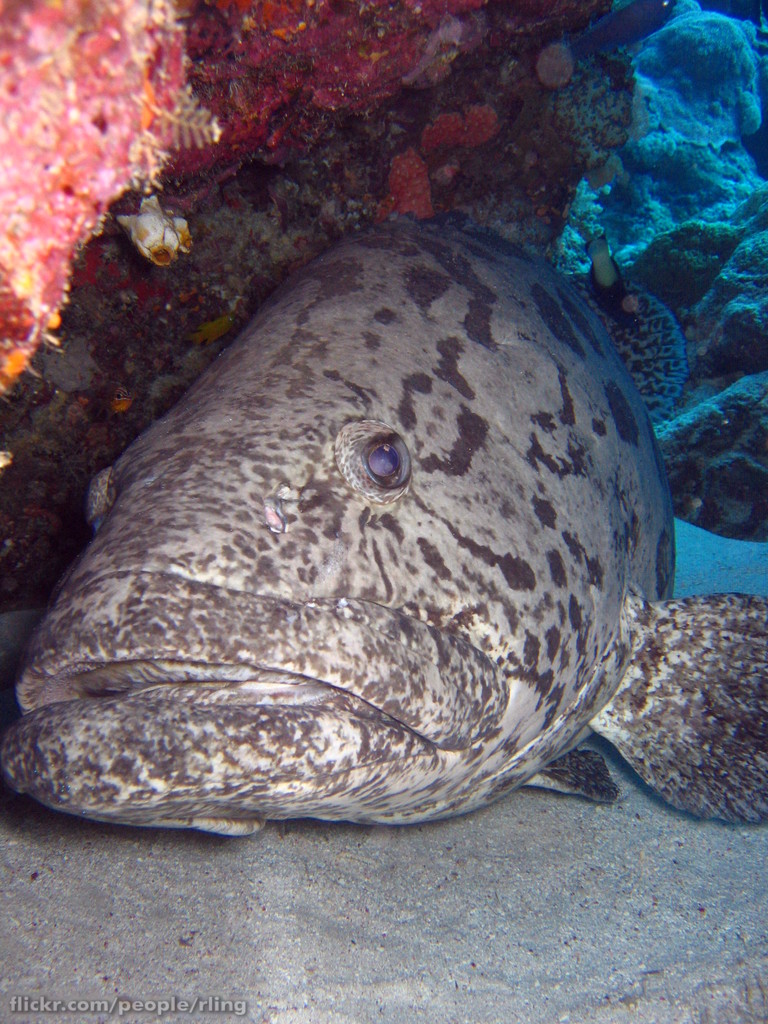 Potato GrouperEpinephelus tukula
-
 Pacific Goliath GrouperEpinephelus quinquefasciatus
-
 Orange-spotted GrouperEpinephelus coioides
-
 White GrouperEpinephelus aeneus
Compare
Questions and answers
What is the scientific name of the Dusky Grouper?
The scientific name of the Dusky Grouper is Epinephelus marginatus. Written with its author, the full name is Epinephelus marginatus (Lowe, 1834).
Which family does the Dusky Grouper belong to?
Epinephelus marginatus belongs to the family Epinephelidae, in the order Perciformes and the class Teleostei.
Where is the Dusky Grouper found?
Checklists and occurrence records place Epinephelus marginatus in 42 countries, including France, Spain, Brazil, Greece, Italy and South Africa.
What is the conservation status of the Dusky Grouper?
The IUCN Red List category recorded for Epinephelus marginatus is Vulnerable (VU).
What other names does the Dusky Grouper have?
Epinephelus marginatus is also known in English as Brown Perch, Yellow Belly, Dusky Perch and Yellowbelly Rockcod.
What do grouper fish eat?
The dusky grouper feeds principally on molluscs, crustaceans and octopuses. Fish become increasingly important in its diet as it grows, with reef fishes being preferred.[11][12]
How do you describe grouper fish?
The dusky grouper has an oval body, a large head, a wide mouth and a protruding lower jaw. Its head and upper body are dark reddish brown or greyish, usually with yellowish-gold coloration on the underside, and its body and head have irregular pale greenish-yellow, silvery-grey or whitish blotches.[1][3][4]
Sources
Passages the profile rests on
- The species has an oval body, a large head, a wide mouth and a protruding lower jaw. Source passage: “Epinephelus marginatus is a very large, oval-bodied, large-headed fish with a wide mouth, which has a protruding lower jaw.” — English Wikipedia
- Its dorsal fin has 11 spines and 13–16 soft rays. Source passage: “Eleven spines and 13–16 soft rays are in the dorsal fin.” — English Wikipedia
- Its head and upper body are dark reddish brown or greyish, usually with yellowish-gold coloration on the underside. Source passage: “The head and upper body are coloured dark reddish brown or greyish, usually with yellowish gold countershading on the ventral surfaces” — English Wikipedia
- Its body and head have irregular pale greenish-yellow, silvery-grey or whitish blotches. Source passage: “the base colour is marked by a vertical series of irregular pale greenish-yellow or silvery-grey or whitish blotching” — English Wikipedia
- Its median fins are dark brown, while the pelvic fins are black towards their tips. Source passage: “dark brown median fins; distal edges of the anal and caudal fins and also often pectoral fins have narrow white terminal bands; the pelvic fins are black towards their tips” — English Wikipedia
- The species can reach 150 cm in standard length, although its more common length is approximately 90 cm. Source passage: “This species can grow up to 150 cm (59 in) in standard length, but is more commonly 90 cm (35 in).” — English Wikipedia
- The species normally inhabits rocky reefs from surface waters to depths of 300 metres. Source passage: “normally found in and around rocky reefs from surface waters down to as much as 300 metres (980 ft) in depth.” — English Wikipedia
- It frequently occurs near beds of Posidonia seagrass. Source passage: “It often occurs in the vicinity of beds of Posidonia sea grass.” — English Wikipedia
- Juveniles generally occupy shallower coastal habitats than adults and can occur in rock pools. Source passage: “Juveniles are generally found more inshore than the adult fish, even being found in rock pools.” — English Wikipedia
- Adults and juveniles can enter brackish habitats such as estuaries. Source passage: “but both adults and juveniles enter brackish waters, such as estuaries.” — English Wikipedia
- Its principal foods include molluscs, crustaceans and octopuses. Source passage: “Their main foods are molluscs, crustaceans, and octopuses.” — English Wikipedia
- Fish become increasingly important in its diet as it grows, with reef fishes being preferred. Source passage: “As E. marginatus grows larger, other fishes form an increasingly important part of their diet, with reef fish being preferred.” — English Wikipedia
- Adult individuals are generally solitary and territorial. Source passage: “Epinephelus marginatus adults are solitary and territorial” — English Wikipedia
- The species is sedentary. Source passage: “It is a sedentary, monandric, and late maturing protogynous species” — pmc.ncbi.nlm.nih.gov
- The species is a protogynous hermaphrodite in which individuals begin adult life as females and can subsequently become males. Source passage: “all fish begin adult life as females, but as they grow larger and older, they develop into males.” — English Wikipedia
- Females begin breeding at approximately five years of age. Source passage: “females begin to breed when they are around five years of age” — English Wikipedia
- Sex change from female to male generally occurs between ages nine and sixteen, most commonly at age twelve. Source passage: “between their 9th and 16th years, they change into males, most commonly at age 12.” — English Wikipedia
- Sex transformation begins at approximately 65 cm in length, although most individuals change sex between 80 and 90 cm in total length. Source passage: “The fish start to transform into males at a length of 65 cm (26 in), although most change sex when they are between 80 and 90 cm (31 and 35 in) in total length.” — English Wikipedia
- Some populations contain large females, suggesting that not all females undergo sex change. Source passage: “In some populations, the presence of large female fish suggests that not all females change sex.” — English Wikipedia
- Females in southern Brazil reach maturity at approximately five years of age and 380 mm in length. Source passage: “Female maturity occurs when females are 5 years old and 380 mm long” — pmc.ncbi.nlm.nih.gov
- In southern Brazil, sex inversion peaks at approximately twelve years of age and occurs at a body weight of around 9 kg. Source passage: “Sex inversion, from female to male, occurs between the 9th and 16th years, peaking at 12 years, at a body weight of 9 kg [9].” — pmc.ncbi.nlm.nih.gov
- Spawning occurs in small aggregations of several dozen individuals at specific sites. Source passage: “small clusters of a few tens of individuals form at specific spawning sites” — English Wikipedia
- Known Mediterranean spawning aggregation locations include the Medes Islands Marine Reserve in Spain, waters off Lampedusa in Italy and Port-Cros National Park in France. Source passage: “Known sites where E. marginatus traditionally gathers to spawn include the Medes Islands Marine Reserve in Spain, off Lampedusa in Italy, and Port-Cros National Park in France” — English Wikipedia
- Mediterranean spawning takes place between June and September. Source passage: “In the Mediterranean, spawning lasts from June to September” — English Wikipedia
- Brazilian populations reproduce during early summer, between November and December. Source passage: “Off Brazil, E. marginatus reproduces in the early summer, between November and December.” — English Wikipedia
- Mediterranean spawning groups normally contain approximately seven females per male. Source passage: “the spawning clusters normally have seven females to each male.” — English Wikipedia
- Dominant males establish territories and aggressively defend them during spawning. Source passage: “the dominant males set up territories and aggressively defend them from neighbouring males and smaller females.” — English Wikipedia
- Commercial catches of the species in Brazil frequently take place during summer spawning aggregations. Source passage: “Much of the commercial catch is taken during summer spawning aggregations at specific sites known to fishermen [8].” — pmc.ncbi.nlm.nih.gov
- The species has been reported to live for up to 50 years. Source passage: “They are reported to live for up to 50 years.” — English Wikipedia
- The species has been assessed as Vulnerable because of suspected population reductions exceeding 50% over the last three generations and continuing threats. Source passage: “the International Union for Conservation of Nature has assessed E. marginatus as being vulnerable, citing a suspected reduction in the population size in excess of 50% over the last three generations and with ongoing threats.” — English Wikipedia
- Reported catches declined by 88% across seven countries between 1990 and 2001. Source passage: “Epinephelus marginatus catch declined by 88% in seven countries between 1990 and 2001” — English Wikipedia
- Its slow growth and reproductive characteristics increase its vulnerability to overexploitation. Source passage: “The slow growth rate of this species and its particular mode of reproduction make it vulnerable to overexploitation” — English Wikipedia
- The species is considered overexploited in Mediterranean areas. Source passage: “Dusky grouper is considered to be overexploited in Mediterranean areas” — pmc.ncbi.nlm.nih.gov
- Researchers have recommended precautionary and data-limited management approaches for Brazilian coastal populations. Source passage: “We conclude that precautionary approaches and 'data-less' management approaches are needed in the coast of Brazil.” — pmc.ncbi.nlm.nih.gov
- The species is commercially caught as a food fish throughout its distribution. Source passage: “Epinephelus marginatus is a popular food fish and is caught across its range by commercial fishermen” — English Wikipedia
- Large adults are targeted as trophies by spearfishers and are also caught by anglers. Source passage: “large adult fish are targeted as trophies by spear fishing, and are readily taken by anglers.” — English Wikipedia
- The species is an important catch for artisanal small-scale fisheries along the Brazilian coast. Source passage: “Dusky grouper (garoupa, Epinephelus marginatus) is an important catch for several artisanal small-scale fisheries along the Brazilian coast.” — pmc.ncbi.nlm.nih.gov
- The species is sold and consumed locally in Brazil. Source passage: “Being a highly prized fish, it is also sold and consumed locally [3-6].” — pmc.ncbi.nlm.nih.gov
- Attempts have been made to cultivate and breed the species in aquaculture in Italy. Source passage: “Attempts to grow and breed this fish in aquaculture have been made in Italy.” — English Wikipedia
Data
- Catalogue of Life, 2026-10-16 XR cc by
- Global Biodiversity Information Facility CC BY 4.0
- Wikidata CC0
- GeoNames CC BY 4.0
- Wikimedia Commons per image; credit shown with each image
- Within the Catalogue of Life, this name comes from World Register of Marine Species cc by
References
- FRANQUET F. & BRITO A., 1995. - Especies de interes pesquero de Canarias. 146 p. Santa Cruz de Tenerife, Gobierno de Canarias. where the name was published
This species in other databases
- Catalogue of Life 6FTQB
- Wikidata Q192167
- iNaturalist 100119
- WoRMS urn:lsid:marinespecies.org:taxname:127036
- ITIS 551078
Page built on 26 November 2026. See how the catalog is made and all sources and licences.
Cite this page
ScientificNames.org. (2026). Epinephelus marginatus (Dusky Grouper). Retrieved November 26, 2026, from https://scientificnames.org/species/epinephelus-marginatus
“Epinephelus marginatus (Dusky Grouper).” ScientificNames.org, 2026, scientificnames.org/species/epinephelus-marginatus. Accessed 26 Nov. 2026.
ScientificNames.org. “Epinephelus marginatus (Dusky Grouper).” Accessed November 26, 2026. https://scientificnames.org/species/epinephelus-marginatus.
@misc{scientificnames_epinephelus_marginatus_dusky_grouper,
  author = {{ScientificNames.org}},
  title = {Epinephelus marginatus (Dusky Grouper)},
  year = {2026},
  url = {https://scientificnames.org/species/epinephelus-marginatus},
  note = {Accessed 2026-11-26}
}