Species · Fishes
Red Grouper Epinephelus morio
The scientific name of the Red Grouper is Epinephelus morio. It is a species of fish in the family Epinephelidae (groupers), order Perciformes. The name dates from 1828.
- Scientific name
- Epinephelus morio (Valenciennes, 1828)
- Common name
- Red Grouper
- Genus
- Epinephelus
- Family
- Epinephelidae (Groupers)
- Order
- Perciformes
- Class
- Teleostei
- Red List category
- VU Vulnerable
- Environment
- marine
- Recorded in
- 15 countries
- Name status
- accepted in the Catalogue of Life

Overview
Epinephelus morio has a stout, almond-shaped body with a dark reddish-brown upper surface, lighter spots and blotches, and darker fin margins.
Written 26 November 2026 from the sources listed below. Each statement was checked against the passage it cites; statements that could not be supported were removed.
Appearance
The Red Grouper has a stout, almond-shaped body with a dark reddish-brown upper surface that fades to pink underneath. Lighter spots and blotches cover the body, and the fins have darker margins.[1][2]
It has a pointed snout and large, round eyes. Small black dots may occur around the eyes.[3][4]
The caudal fin is truncate, and the pectoral fins are longer than the pelvic fins. The dorsal fin contains 11 spines and 16 or 17 soft rays, while the anal fin contains three spines and eight soft rays.[5][6][7]
The gill cover has three flat spines, with the central spine being the longest. The caudal peduncle lacks a saddle marking.[8][9]
Habitat
The Red Grouper inhabits muddy and rocky bottoms in coastal waters at depths of 5–330 m. It is demersal and largely sedentary.[10][11]
Juveniles occupy seagrass beds in shallow water and settle in shallow coastal hardbottom habitats after their pelagic larval stage. Adults inhabit offshore hardbottom habitats, particularly along the continental shelf edge.[12][13][14]
Diet
The Red Grouper primarily feeds on benthic invertebrates. Its diet commonly includes xanthid and portunid crabs, juvenile spiny lobsters, and snapping shrimp.[15][16]
It occasionally consumes fish. Other documented prey include octopuses, snappers, and parrotfish.[17][18]
Behaviour
The species can rapidly change its coloration when aggravated or participating in spawning activities. It is non-migratory.[19][20]
Reproduction and life cycle
The Red Grouper is a protogynous hermaphrodite, with individuals beginning life as females. Most females transform into males between 7 and 14 years of age, generally after reaching at least 23 inches in length.[21][22][23]
Females reach sexual maturity at 4–6 years of age. Males are considered reproductively significant from 10 years of age onward.[24][25]
Spawning in the Gulf of Mexico and Caribbean Sea occurs from January through April. Red Groupers spawn offshore.[26][27]
Fertilized eggs require a salinity of 32 ppt to maintain buoyancy. The eggs hatch into larvae approximately 30 hours after spawning.[28][29]
Larvae settle onto the bottom substrate approximately 35–50 days after hatching. The pelagic larval stage lasts approximately 40 days.[30][31]
Conservation
The IUCN classifies the Red Grouper as vulnerable. Its global population is estimated to have declined by at least 30 percent over three generations or 51 years.[32][33]
Overfishing is identified as the major threat to the species. Populations are considered overfished and undergoing overfishing in the northeastern and southern Gulf of Mexico.[34][35]
Harvest in US waters has decreased by more than 50 percent over 55 years. Juvenile Red Groupers are killed as bycatch in shrimp trawling operations.[36][37]
Uses
The Red Grouper is commercially important to fisheries throughout its range. It is also a valuable resource for recreational fisheries.[38][39]
Similar species
The Red Grouper can be distinguished from the Warsaw grouper, yellow-edged grouper, and misty grouper by its longer pectoral fins. Its resting coloration can resemble that of the Nassau grouper.[40][41]
Classification of the Red Grouper
| Kingdom | Animalia |
|---|---|
| Phylum | Chordata |
| Subphylum | Vertebrata |
| Infraphylum | Gnathostomata |
| Parvphylum | Osteichthyes |
| Gigaclass | Actinopterygii |
| Superclass | Actinopteri |
| Class | Teleostei (Teleost) |
| Order | Perciformes |
| Suborder | Percoidei |
| Family | Epinephelidae (Groupers) |
| Genus | Epinephelus (Groupers) |
| Species | Epinephelus morio (Valenciennes, 1828) |
Where the Red Grouper is found
Checklists and occurrence records place Epinephelus morio in 15 countries. GBIF holds 8,358 georeferenced records of it.
Countries
- Bahamas 7
- Belize 32
- Bermuda 8
- Canada 3
- Cuba 7
- Guadeloupe 3
- Haiti 4
- Martinique 3
- Mexico 77
- Panama 10
- Puerto Rico 3
- Saint Barthelemy 3
- Trinidad and Tobago 4
- U.S. Virgin Islands 9
- United States 8,185
Regions and cities with the most records
- Key West, United States 552
- Florida, United States 98
- Coconut Grove, United States 73
- Miami, United States 71
- Miami Beach, United States 70
- Coral Gables, United States 54
- Little Havana, United States 53
- Allapattah, United States 40
- Brownsville, United States 34
- Seminole, United States 33
- North Miami, United States 26
- Pinewood, United States 26
- Clearwater, United States 25
- West Little River, United States 25
- Coral Terrace, United States 23
- Largo, United States 22
- Pinellas Park, United States 22
- Dunedin, United States 21
- Cutler, United States 20
- St. Petersburg, United States 20
- West and East Lealman, United States 20
- Flagami, United States 18
- Lealman, United States 18
- Hialeah, United States 17
- Westchase, United States 17
- Carrollwood, United States 16
- Egypt Lake-Leto, United States 16
- Palm Harbor, United States 16
- Palm River-Clair Mel, United States 16
- Tampa, United States 16
- Town 'n' Country, United States 16
- Carrollwood Village, United States 15
- Citrus Park, United States 15
- East Lake-Orient Park, United States 15
- Golden Glades, United States 15
- Greater Northdale, United States 15
4 more countries have a few records outside this range
These countries hold a few records of Epinephelus morio but lie outside the range the checklists give for it. Such records are often zoo or garden specimens, museum material or vagrants, so the species is not counted as occurring there.
A number beside a place is its count of GBIF occurrence records. A place without a number comes from a checklist alone. Records show where a species has been observed or collected, which can include escapes and vagrants.
Common names
English
- Red Grouper
- Deer Grouper
- Rock Grouper
- Deer Hamlet
Names in 11 other languages
- Chinese
- 黑緣石斑魚
- Czech
- kanic červenohnědý
- Danish
- Rød havaborre
- Dutch
- Rode zeebaars, rode tandbaars, rode zaagbaars
- French
- Mérou nègre, Vieille rouge, mérou rouge
- German
- roter Grouper
- Japanese
- ツマグロハタ
- Papiamento
- Meroe, Meru
- Portuguese
- garoupa, garoupa-bichada, garoupa-de-segunda, garoupa-de-são-tomé, garoupa-são-tomé, garoupa-verdadeira, garoupa-vermelha, garoupa-vermelha-dos-abrolhos
- Russian
- Красный групер
- Spanish
- Mero Americano, Mero Guasa, Mero rojo, cherna americana
Synonyms
4 other scientific names have been used for this species and are now treated as synonyms of Epinephelus morio.
- Serranus angustifrons Steindachner, 1864
- Serranus erythrogaster DeKay, 1842
- Serranus morio Valenciennes, 1828
- Serranus remotus Poey, 1860
Related species
-
 Atlantic Goliath GrouperEpinephelus itajara
-
 Giant GrouperEpinephelus lanceolatus
-
 Dusky GrouperEpinephelus marginatus
-
 Nassau GrouperEpinephelus striatus
-
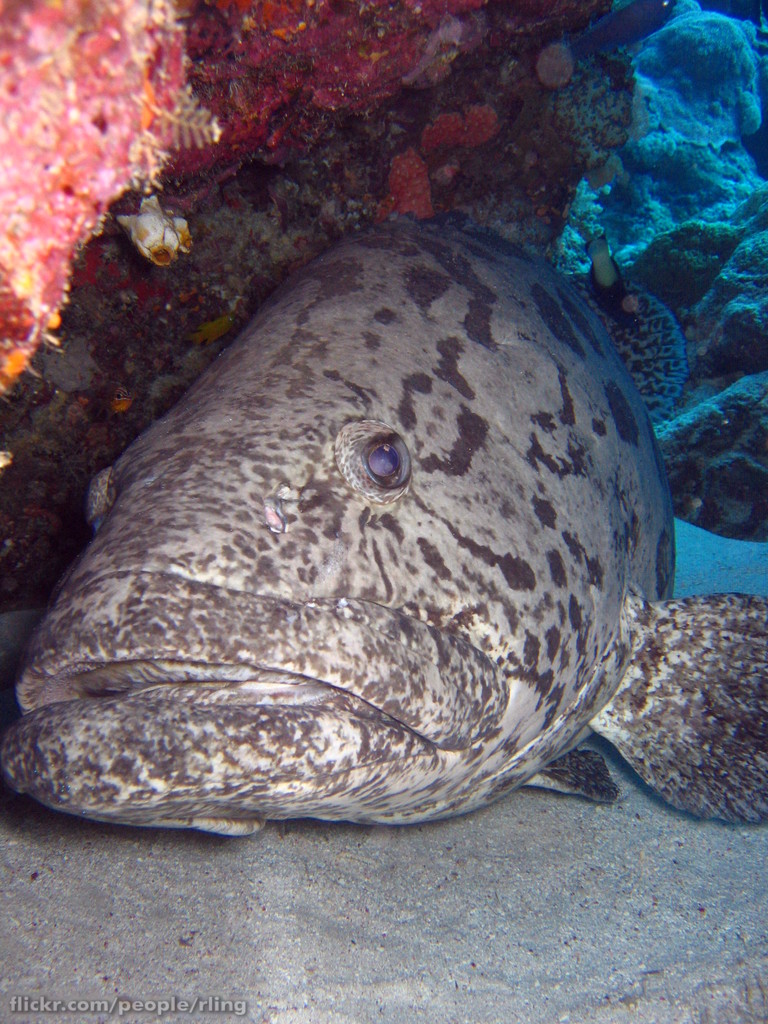 Potato GrouperEpinephelus tukula
-
 Pacific Goliath GrouperEpinephelus quinquefasciatus
-
 Orange-spotted GrouperEpinephelus coioides
-
 White GrouperEpinephelus aeneus
Compare
Questions and answers
What is the scientific name of the Red Grouper?
The scientific name of the Red Grouper is Epinephelus morio. Written with its author, the full name is Epinephelus morio (Valenciennes, 1828).
Which family does the Red Grouper belong to?
Epinephelus morio belongs to the family Epinephelidae, in the order Perciformes and the class Teleostei.
Where is the Red Grouper found?
Checklists and occurrence records place Epinephelus morio in 15 countries, including United States, Mexico, Belize, Panama, U.S. Virgin Islands and Bermuda.
What is the conservation status of the Red Grouper?
The IUCN Red List category recorded for Epinephelus morio is Vulnerable (VU).
What other names does the Red Grouper have?
Epinephelus morio is also known in English as Deer Grouper, Rock Grouper and Deer Hamlet.
Sources
Passages the profile rests on
- The red grouper has a stout, almond-shaped body with a dark reddish-brown upper surface that fades to pink underneath. Source passage: “This stout, almond-shaped fish is a dark reddish brown on top, fading to a lighter pink underneath” — floridamuseum.ufl.edu
- The body is covered with lighter spots and blotches, while the fins have darker margins. Source passage: “They are marked with lighter spots and blotches across their body and there are darker margins to the fins.” — English Wikipedia
- The red grouper has a pointed snout and large, round eyes. Source passage: “It has large, round eyes over a pointed snout” — floridamuseum.ufl.edu
- Small black dots may occur around the eyes. Source passage: “small black dots may be present around the eyes.” — floridamuseum.ufl.edu
- The caudal fin is truncate and the pectoral fins are longer than the pelvic fins. Source passage: “The pectoral fins are longer than the pelvic fins and the caudal fin is truncate.” — English Wikipedia
- The dorsal fin contains 11 spines and 16 or 17 soft rays. Source passage: “The dorsal fin contains 11 spines and 16 or 17 soft rays” — English Wikipedia
- The anal fin contains three spines and eight soft rays. Source passage: “the anal fin has three spines and eight soft rays.” — English Wikipedia
- The gill cover has three flat spines, with the central spine being the longest. Source passage: “The gill cover has three flat spines with the central spine being the longest.” — English Wikipedia
- The caudal peduncle lacks a saddle marking. Source passage: “the caudal peduncle lacks a saddle.” — floridamuseum.ufl.edu
- The species inhabits muddy and rocky bottoms in coastal waters at depths of 5–330 m. Source passage: “associated primarily with muddy and rocky bottom habitats at depths of 16-1,083 feet (5-330 m)” — floridamuseum.ufl.edu
- The species is demersal and largely sedentary. Source passage: “The red grouper is a demersal, largely sedentary species” — English Wikipedia
- Juvenile red groupers occupy seagrass beds in shallow water. Source passage: “Juvenile red groupers reside in seagrass beds in shallower waters” — floridamuseum.ufl.edu
- Adult red groupers inhabit offshore hardbottom habitats, particularly along the continental shelf edge. Source passage: “They remain in inshore waters for 4–5 years before migrating to offshore hardbottom habitat—particularly on the edge of the continental shelf—as adults.” — English Wikipedia
- Juveniles settle in shallow coastal hardbottom habitats after their pelagic larval stage. Source passage: “before it settles in shallow coastal hardbottom habitat as juveniles.” — English Wikipedia
- The red grouper primarily feeds on benthic invertebrates. Source passage: “While primarily eating benthic invertebrates” — English Wikipedia
- Its diet commonly includes xanthid and portunid crabs, juvenile spiny lobsters, and snapping shrimp. Source passage: “The diet commonly includes xanthid and portunid crabs, juvenile spiny lobster, and snapping shrimp” — English Wikipedia
- The red grouper occasionally consumes fish. Source passage: “with the occasional fish.” — English Wikipedia
- Other documented prey include octopuses, snappers, and parrotfish. Source passage: “crabs, shrimp and octopi as well as fish such as snappers and parrotfish.” — floridamuseum.ufl.edu
- The species can rapidly change its coloration when aggravated or participating in spawning activities. Source passage: “When aggravated (they are highly territorial) or involved in spawning activities, these fish can very rapidly change coloration patterns” — English Wikipedia
- Red groupers are non-migratory. Source passage: “This non-migratory fish is associated primarily with muddy and rocky bottom habitats” — floridamuseum.ufl.edu
- The red grouper is a protogynous hermaphrodite, with individuals beginning life as females. Source passage: “The red grouper is a protogynous hermaphrodite with all fish beginning life as females.” — floridamuseum.ufl.edu
- Most female red groupers transform into males between 7 and 14 years of age. Source passage: “Most of the females transform to males between 7 and 14 years of age” — floridamuseum.ufl.edu
- Sex transformation generally occurs after individuals reach at least 23 inches in length. Source passage: “sometime after reaching at least 23 inches in length.” — floridamuseum.ufl.edu
- Females reach sexual maturity at 4–6 years of age. Source passage: “Females reach sexual maturity at 4-6 years of age” — floridamuseum.ufl.edu
- Males are considered reproductively significant from 10 years of age onward. Source passage: “males are considered reproductively significant at 10 years of age and older.” — floridamuseum.ufl.edu
- Spawning in the Gulf of Mexico and Caribbean Sea occurs from January through April. Source passage: “Spawning occurs during the months of January through April in the Gulf of Mexico and the Caribbean Sea.” — floridamuseum.ufl.edu
- Red groupers spawn offshore. Source passage: “During spawning events, the fish release their sperm and eggs in offshore water.” — floridamuseum.ufl.edu
- The fertilized eggs require a salinity of 32 ppt to maintain buoyancy. Source passage: “The fertilized eggs require high salinity (32 ppt) to maintain their buoyancy.” — floridamuseum.ufl.edu
- The eggs hatch into larvae approximately 30 hours after spawning. Source passage: “The eggs hatch into larvae approximately 30 hours after spawning” — floridamuseum.ufl.edu
- Larvae settle onto the bottom substrate approximately 35–50 days after hatching. Source passage: “The larvae settle out of the zooplankton to the bottom substrate at about 35-50 days after hatching” — floridamuseum.ufl.edu
- The pelagic larval stage lasts approximately 40 days. Source passage: “has an extended (~40 day) pelagic larval stage” — English Wikipedia
- The IUCN classifies the red grouper as vulnerable. Source passage: “The International Union for Conservation of Nature has classified the red grouper as a vulnerable species.” — English Wikipedia
- The species is estimated to have declined globally by at least 30 percent over three generations or 51 years. Source passage: “It is estimated to have declined globally by at least 30 percent over three generations or 51 years.” — English Wikipedia
- Overfishing is identified as the major threat to the species. Source passage: “The major threat to the species' survival is overfishing” — English Wikipedia
- Red grouper populations are considered overfished and undergoing overfishing in the northeastern and southern Gulf of Mexico. Source passage: “Populations of red grouper are considered overfished and undergoing overfishing in the northeastern and southern portions of the Gulf of Mexico” — floridamuseum.ufl.edu
- Harvest in US waters has decreased by more than 50 percent over 55 years. Source passage: “Harvest in US waters has decreased by over 50% in the last 55 years.” — floridamuseum.ufl.edu
- Juvenile red groupers are killed as bycatch in shrimp trawling operations. Source passage: “huge numbers of juvenile red groupers that are captured as bycatch and killed by shrimp trawlers.” — floridamuseum.ufl.edu
- The red grouper is commercially important to fisheries throughout its range. Source passage: “The red grouper is a commercially important species for fisheries throughout its range” — English Wikipedia
- The species is also a valuable resource for recreational fisheries. Source passage: “and it is also a valuable resource for recreational fisheries too.” — English Wikipedia
- The red grouper can be distinguished from the Warsaw grouper, yellow-edged grouper, and misty grouper by its longer pectoral fins. Source passage: “this grouper’s pectoral fins being longer than the pelvic fins distinguishes it from the Warsaw grouper (E. nigritus), the yellow-edged grouper (E. flavolimbatus), and the misty grouper (E. mystacinus).” — floridamuseum.ufl.edu
- The resting coloration of the red grouper can resemble that of the Nassau grouper. Source passage: “When the fish is resting, the coloration becomes more banded in appearance, resembling the Nassau grouper (E. striatus).” — floridamuseum.ufl.edu
Data
- Catalogue of Life, 2026-10-16 XR cc by
- Global Biodiversity Information Facility CC BY 4.0
- Wikidata CC0
- GeoNames CC BY 4.0
- Wikimedia Commons per image; credit shown with each image
- Within the Catalogue of Life, this name comes from World Register of Marine Species cc by
References
- Cuvier and Valenciennes, 1828 where the name was published
This species in other databases
- Catalogue of Life 6G626
- Wikidata Q2414243
- iNaturalist 49637
- WoRMS urn:lsid:marinespecies.org:taxname:159354
- ITIS 167702
Page built on 28 November 2026. See how the catalog is made and all sources and licences.
Cite this page
ScientificNames.org. (2026). Epinephelus morio (Red Grouper). Retrieved November 28, 2026, from https://scientificnames.org/species/epinephelus-morio
“Epinephelus morio (Red Grouper).” ScientificNames.org, 2026, scientificnames.org/species/epinephelus-morio. Accessed 28 Nov. 2026.
ScientificNames.org. “Epinephelus morio (Red Grouper).” Accessed November 28, 2026. https://scientificnames.org/species/epinephelus-morio.
@misc{scientificnames_epinephelus_morio_red_grouper,
  author = {{ScientificNames.org}},
  title = {Epinephelus morio (Red Grouper)},
  year = {2026},
  url = {https://scientificnames.org/species/epinephelus-morio},
  note = {Accessed 2026-11-28}
}