Species · Reptiles
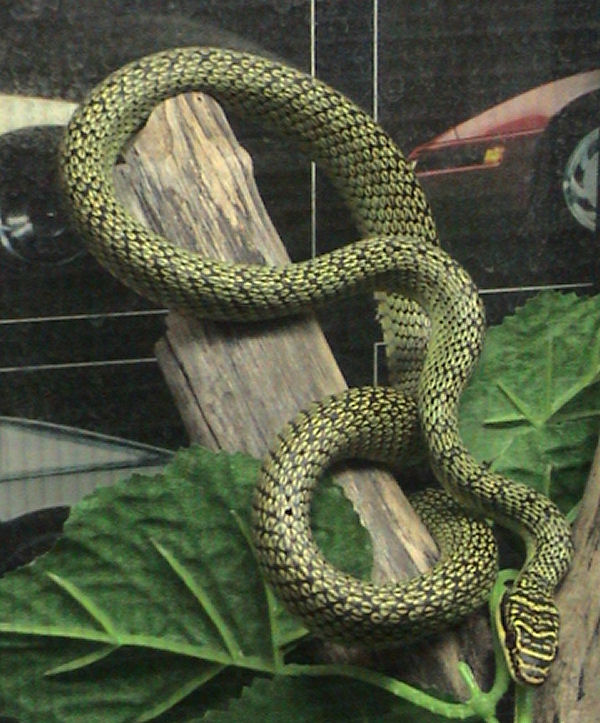
Golden Flying Snake Chrysopelea ornata
The scientific name of the Golden Flying Snake is Chrysopelea ornata. It is a species of reptile in the family Colubridae (colubrid), order Squamata. The name dates from 1802.
- Scientific name
- Chrysopelea ornata (Shaw, 1802)
- Common name
- Golden Flying Snake
- Genus
- Chrysopelea
- Family
- Colubridae (Colubrid)
- Order
- Squamata
- Class
- Reptilia
- Red List category
- LC Least Concern
- Recorded in
- 15 countries
- Name status
- accepted in the Catalogue of Life
Overview
Chrysopelea ornata occurs in India, Bangladesh, Sri Lanka, Nepal, Myanmar, Thailand, Malaysia, Laos, Cambodia, Vietnam, China and Singapore. It can glide between trees, with recorded gliding distances of up to 100 m.
Written 26 November 2026 from the sources listed below. Each statement was checked against the passage it cites; statements that could not be supported were removed.
Appearance
The Golden Flying Snake is usually green with black cross-hatching and yellow or golden accents. It has a flattened head, a constricted neck, a blunt nose and large eyes with round pupils.[1][2]
The species has sharply keeled lateral ventral scales and a vertebral scale row that is not enlarged.[3]
The Sri Lankan and southern Indian colour form is primarily greenish yellow or pale green, with black markings on its scales. Some individuals have reddish or orange flower-shaped vertebral spots.[4][5]
The Southeast Asian colour form generally lacks reddish vertebral spots and has less prominent black crossbars.[6]
Habitat
In southern Thailand, the species can inhabit human dwellings, including thatched roofing.[7]
Diet
The Golden Flying Snake feeds on small arboreal animals, including lizards, bats and small rodents. Other reported food items include bird eggs and insects.[8][9]
The species has occasionally been reported eating other snakes. Frogs have both been reported as prey and described as food that the species avoids.[10][11]
Behaviour
The Golden Flying Snake is active during the day and lives in trees. It can climb branches of very small diameter and ascend trees with few branches.[12][13]
The species can glide between trees to escape predators, pursue prey and move through forests. Gliding individuals have been recorded crossing distances of up to 100 m.[14][15][16]
During gliding, the snake forms a U-shaped concavity along its underside to increase air resistance. It undulates through the air in a swimming-like motion.[17][18]
Individuals generally flee when disturbed but may bite when handled. The species is mildly venomous and has rear-positioned fangs.[19][20]
The species captures prey by seizing its neck and crushing it with its jaws.[21]
Reproduction and life cycle
The Golden Flying Snake is oviparous. Females lay between six and twelve elongated eggs.[22][23]
Gravid females have been recorded in May and June, and hatchlings have been recorded in June. In Bangkok, mating has been reported to take place in June.[24][25][26]
Newly hatched individuals measure approximately 114–152 mm in length. The smallest recorded gravid female measured 1,093 mm in length.[27][28]
Conservation
The Golden Flying Snake is not known to be endangered.[29]
Uses
The Golden Flying Snake is sometimes cooked and eaten. It is also traded internationally as an exotic pet.[30][31]
Similar species
Chrysopelea ornata belongs to the genus Chrysopelea, which contains four other described species.[32]
Classification of the Golden Flying Snake
| Kingdom | Animalia |
|---|---|
| Phylum | Chordata |
| Subphylum | Vertebrata |
| Infraphylum | Gnathostomata |
| Parvphylum | Osteichthyes |
| Megaclass | Tetrapoda |
| Class | Reptilia (Reptile) |
| Order | Squamata (Snakes) |
| Suborder | Serpentes (Snakes) |
| Infraorder | Alethinophidia |
| Family | Colubridae (Colubrid) |
| Subfamily | Sibynophiinae |
| Genus | Chrysopelea (Flying Tree Snakes) |
| Species | Chrysopelea ornata (Shaw, 1802) |
Where the Golden Flying Snake is found
Checklists and occurrence records place Chrysopelea ornata in 15 countries across Asia. GBIF holds 2,657 georeferenced records of it.
Countries
- Bangladesh 11
- Bhutan 2
- Cambodia 134
- China 79
- India 199
- Indonesia 66
- Laos 76
- Malaysia 81
- Myanmar 102
- Nepal 3
- Philippines 59
- Singapore 50
- Sri Lanka 46
- Thailand 1,517
- Vietnam 232
Regions and cities with the most records
- Watthana, Thailand 206
- Phra Nakhon, Thailand 204
- Huai Khwang, Thailand 203
- Wang Thonglang, Thailand 203
- Din Daeng, Thailand 202
- Bangkok, Thailand 201
- Khlong Toei, Thailand 201
- Sam Sen Nai, Thailand 200
- Bang Rak, Thailand 199
- Phaya Thai, Thailand 199
- Ratchathewi, Thailand 199
- Bang Kapi, Thailand 198
- Pathum Wan, Thailand 198
- Phra Khanong, Thailand 198
- Lat Phrao, Thailand 197
- Thon Buri, Thailand 196
- Yan Nawa, Thailand 195
- Dusit, Thailand 194
- Pom Prap Sattru Phai, Thailand 193
- Samphanthawong, Thailand 192
- Sathon, Thailand 192
- Suan Luang, Thailand 192
- Bueng Kum, Thailand 190
- Khlong San, Thailand 190
- Bang Khlo, Thailand 188
- Bangkok, Thailand 188
- Chatuchak subdistrict, Thailand 188
- Chatuchak, Thailand 187
- Bang Sue, Thailand 186
- Bangkok Noi, Thailand 186
- Ban Bang Bamru, Thailand 183
- Bang Phlat, Thailand 182
- Saphan Sung, Thailand 181
- Bang Kho Laem, Thailand 180
- Bangkok Yai, Thailand 180
- Ban Khlong Prawet, Thailand 179
Range as the checklists state it
India (Assam, Sikkim, Meghalaya, Gujarat, Kerala, Bihar, West Bengal, Orissa = Odisha, Madhya Pradesh, Arunachal Pradesh [A. Captain, pers. comm.], Tamil Nadu, Tripura, Mizoram, Nagaland), Nepal, Sri Lanka, Bangladesh, Bhutan,
A number beside a place is its count of GBIF occurrence records. A place without a number comes from a checklist alone. Records show where a species has been observed or collected, which can include escapes and vagrants.
Common names
English
- Golden Flying Snake
- Flying Snake
- Indian Flying Snake
- Ornate Flying Snake
Names in 15 other languages
- Afrikaans
- Vlieënde Slang
- Bengali
- কাল নাগিনী
- Chinese
- 金花蛇
- Czech
- bojga zlatá
- Danish
- Gylden Pragttræsnog
- Dutch
- vliegende slang
- German
- Gelbgrüne Schmuckbaumnatter, Gewöhnliche Schmuckbaumnatter
- Japanese
- ゴールデントビヘビ
- Marathi
- उडता सोनसर्प
- Portuguese
- Cobra-voadora-dourada
- Russian
- Обыкновенная украшенная змея
- Sinhala
- මල්සරා
- Tamil
- பறக்கும் பாம்பு
- Thai
- งูเขียวพระอินทร์
- tcy
- ತಾರಿ ಮಾಡಲೆ, ಮರ ಕೊಡಪಲೆ
Synonyms
5 other scientific names have been used for this species and are now treated as synonyms of Chrysopelea ornata.
- Chrysopelea ornata lankavae Deraniyagala, 1945
- Chrysopelea ornata sinhaleyus Deraniyagala, 1945
- Coluber ibibiboca Daudin, 1802
- Coluber ornatus Shaw, 1802
- Chrysopelea ornata ornatissima Werner, 1925 ambiguous synonym
Subspecies and varieties
- Chrysopelea ornata ornata (Indian Ornate Flying Snake) subspecies
- Chrysopelea ornata ornatissima subspecies
Related species
-
 Paradise Flying SnakeChrysopelea paradisi
-
 Sri Lankan Flying SnakeChrysopelea taprobanica
-
 Banded Flying SnakeChrysopelea pelias
- Moluccan Flying SnakeChrysopelea rhodopleuron
-
 Corn SnakePantherophis guttatus
-
 BoomslangDispholidus typus
-
 DeKay's Brown SnakeStoreria dekayi
-
 Brown Tree SnakeBoiga irregularis
Compare
Questions and answers
What is the scientific name of the Golden Flying Snake?
The scientific name of the Golden Flying Snake is Chrysopelea ornata. Written with its author, the full name is Chrysopelea ornata (Shaw, 1802).
Which family does the Golden Flying Snake belong to?
Chrysopelea ornata belongs to the family Colubridae, in the order Squamata and the class Reptilia.
Where is the Golden Flying Snake found?
Checklists and occurrence records place Chrysopelea ornata in 15 countries, including Thailand, Vietnam, India, Cambodia, Myanmar and Malaysia.
What is the conservation status of the Golden Flying Snake?
The IUCN Red List category recorded for Chrysopelea ornata is Least Concern (LC).
What other names does the Golden Flying Snake have?
Chrysopelea ornata is also known in English as Flying Snake, Indian Flying Snake and Ornate Flying Snake.
Do flying serpents exist?
Yes. The Golden Flying Snake can glide between trees, using this ability to escape predators, pursue prey and move through forests.[14][15]
What does a flying snake eat?
The Golden Flying Snake feeds on small arboreal animals, including lizards, bats and small rodents. Its reported additional food items include bird eggs and insects, and it has occasionally been reported eating other snakes. Frogs have both been reported as prey and described as food that the species avoids.[8][9][10][11]
Sources
Passages the profile rests on
- The species is usually green with black cross-hatching and yellow or golden accents. Source passage: “Chrysopelea ornata is usually green in color, with black cross-hatching and yellow or gold colored accents.” — English Wikipedia
- The snake has a flattened head, a constricted neck, a blunt nose and large eyes with round pupils. Source passage: “It has a flattened head with constricted neck, a blunt nose and large eyes with round pupils.” — English Wikipedia
- The species has sharply keeled lateral ventral scales and a vertebral scale row that is not enlarged. Source passage: “The lateral, sharp and pronounced keeled condition of the ventrals in association with the normal, not enlarged, vertebral row of scales distinguish this snake.” — English Wikipedia
- The Sri Lankan and southern Indian colour form is primarily greenish yellow or pale green, with black markings on its scales. Source passage: “In Sri Lanka and the southern extent of its Indian range, the snake is primarily greenish yellow or pale green. Each scale has a black mesial streak or spot, and is more or less edged with black.” — English Wikipedia
- Some individuals have reddish or orange flower-shaped vertebral spots. Source passage: “A series of large, flower-shaped, reddish or orange vertebral spots may be present or absent.” — English Wikipedia
- The Southeast Asian colour form generally lacks reddish vertebral spots and has less prominent black crossbars. Source passage: “The second color variety which is more common in Southeast Asia lacks the reddish vertebral spots, and has less prominent black crossbars.” — English Wikipedia
- The species can inhabit human dwellings in southern Thailand, including thatched roofing. Source passage: “In southern parts of Thailand, they are reported to hide in the thatch of the roofing material inside bungalows to prey on geckos and mice during the night.” — English Wikipedia
- The species feeds on small arboreal animals, including lizards, bats and small rodents. Source passage: “C. ornata takes small arboreal prey, such as lizards, bats, and small rodents.” — English Wikipedia
- Its reported additional food items include bird eggs and insects. Source passage: “It might also feed on bird eggs and insects.” — English Wikipedia
- The species has occasionally been reported eating other snakes. Source passage: “Also, it is reported to take snakes occasionally” — English Wikipedia
- Frogs have both been reported as prey and described as food that the species avoids. Source passage: “and to avoid frogs, though frogs are also reported being eaten.” — English Wikipedia
- The species is active during the day and lives in trees. Source passage: “C. ornata is diurnal and arboreal.” — English Wikipedia
- The snake can climb branches of very small diameter and ascend trees with few branches. Source passage: “These snakes are excellent climbers, being able move across even the smallest of branches and even straight up trees with few branches by using the edges of rough bark.” — English Wikipedia
- The species can glide between trees. Source passage: “The snake's gliding ability, while not as impressive as that of the paradise flying snake (C. paradisi), still makes it capable of moving from tree to tree with relative ease.” — English Wikipedia
- The species uses gliding to escape predators, pursue prey and move through forests. Source passage: “This is presumably done to cover distances faster, to escape predators, to catch prey, or to move around in forests.” — English Wikipedia
- Gliding individuals have been recorded crossing distances of up to 100 m. Source passage: “They have been known to cross as much as 100 m.” — English Wikipedia
- During gliding, the snake forms a U-shaped concavity along its underside to increase air resistance. Source passage: “The snake contracts its ventral surface inwards to form a U-shaped concave depression along the entire length of their bodies, holding the outer edges of the ventral scales rigid.” — English Wikipedia
- The snake undulates through the air in a swimming-like motion. Source passage: “The snake undulates through the air, in a swimming-like motion.” — English Wikipedia
- Individuals generally flee when disturbed but may bite when handled. Source passage: “They tend to be nervous, fast-moving snakes, and attempt to flee if disturbed, but generally do not hesitate to bite if handled.” — English Wikipedia
- The species is mildly venomous and has rear-positioned fangs. Source passage: “This species is considered mildly venomous, as it is rear-fanged (opisthoglyphous).” — English Wikipedia
- The species captures prey by seizing its neck and crushing it with its jaws. Source passage: “The snake stalks or pursues the prey and seizes it by the neck, which is crushed in its strong jaws.” — English Wikipedia
- The species is oviparous. Source passage: “The snake is oviparous and six to 12 elongated eggs are laid.” — English Wikipedia
- Females lay between six and twelve elongated eggs. Source passage: “The snake is oviparous and six to 12 elongated eggs are laid.” — English Wikipedia
- Gravid females have been recorded in May and June. Source passage: “Gravid females have been in May and June and hatchlings in June.” — English Wikipedia
- Hatchlings have been recorded in June. Source passage: “Gravid females have been in May and June and hatchlings in June.” — English Wikipedia
- In Bangkok, mating has been reported to take place in June. Source passage: “In Bangkok, according to Smith, mating takes place in June.” — English Wikipedia
- Newly hatched individuals measure approximately 114–152 mm in length. Source passage: “Hatchlings measure 114–152 mm (41⁄2 to 6 in) long” — English Wikipedia
- The smallest recorded gravid female measured 1,093 mm in length. Source passage: “while the smallest gravid female recorded was 1,093 mm (3 ft 7 in) long.” — English Wikipedia
- The species is not known to be endangered. Source passage: “Not known to be endangered.” — English Wikipedia
- The species is sometimes cooked and eaten. Source passage: “C. ornata is sometimes cooked for food.” — English Wikipedia
- The species is traded internationally as an exotic pet. Source passage: “In recent years, ornate flying snakes have become increasingly available in the exotic pet trade; many are exported from Vietnam and neighboring countries.” — English Wikipedia
- Chrysopelea ornata belongs to the genus Chrysopelea, which contains four other described species. Source passage: “Chrysopelea ornata belongs to the genus Chrysopelea, which contains four other described species.” — English Wikipedia
Data
- Catalogue of Life, 2026-10-16 XR cc by
- Global Biodiversity Information Facility CC BY 4.0
- Wikidata CC0
- GeoNames CC BY 4.0
- Wikimedia Commons per image; credit shown with each image
- Within the Catalogue of Life, this name comes from The Reptile Database cc by
References
- Shaw, G. (1802). General Zoology, or Systematic Natural History. Vol.3, part 2. G. Kearsley, Thomas Davison, London: 313-615.
- Schlegel, H. (1826). Notice sur l’Erpétologie de l’île de Java; Par M. Boïé. Bulletin Des Sciences Naturelles et de Géologie, 9: 233-240.
- Duméril, A. M. C., Bibron, G. & DUMÉRIL, A. H. A.,. (1854). Erpétologie générale ou histoire naturelle complète des reptiles. Tome septième. Deuxième partie, comprenant l’histoire des serpents venimeux. Paris, Librairie Encyclopédique de Roret: I-Xii + 781-1536.
- Stoliczka, F. (1870). Observations on some Indian and Malayan Amphibia and Reptilia. J. Asiat. Soc. Bengal 39: 134-228.
- Boulenger, George A. (1890). The Fauna of British India, Including Ceylon and Burma. Reptilia and Batrachia. Taylor & Francis, London, Xviii, 541 Pp.
- Boulenger, George A. (1894). Catalogue of the snakes in the British Museum (Natural History). Volume II., Containing the Conclusion of the Colubridæ Aglyphæ. British Mus. (Nat. Hist.), London, Xi, 382 Pp.
- Wall, F. (1907). Tuctoo and snake. J. Bombay Nat. Hist. Soc. 17: 1035.
- Wall, F. (1908). A Popular Treatise on the Common Indian Snakes. Part VI. The Golden Tree-Snake (Chrysopelea ornata). J. Bombay Nat. Hist. Soc. 18: 227-243.
- Thompson, J. C. (1913). Contributions to the Anatomy of the Ophidia. Proc. Zool. Soc. London 1913: 414-426.
- Taylor, Edward H. (1918). Reptiles of Sulu Archipelago. Philippine Journal of Science 13 (5d): 233-267.
- Wall, & FRANK. (1921). Ophidia Taprobanica or the Snakes of Ceylon. Colombo Mus. (H. R. Cottle, Govt. Printer), Colombo. Xxii, 581 Pages.
- Lidth DE JEUDE, & VAN, T. W. (1922). Snakes from Sumatra. Zoologische Mededelingen 6: 239-253.
- Werner. F. (1925). Neue oder wenig bekannte Schlangen aus dem Naturhistorischen Staatsmuseum in Wien. II. Teil. Sitzungsb. Akad. Wiss., Wien, Abt. L, 134: 45 - 66.
- Smith, M. A. (1943). The Fauna of British India, Ceylon and Burma, Including the Whole of the Indo-Chinese Sub-Region. Reptilia and Amphibia. 3 (Serpentes). Taylor and Francis, London. 583 Pp.
- Constable, JOHN D. (1949). Reptiles from the Indian Peninsula in the Museum of Comparative Zoology. Bull. Mus. Comp. Zool. Harvard 103: 59-160.
- Tweedie, M. W. F. (1950). Notes on Malayan reptiles, No.2. Bull. Raffles Mus. No 23: 191-199.
- Tweedie, M. W. F. (1954). Notes on Malayan reptiles, No.3. Bull. Raffles Mus. No 25: 107-117.
- Deuve, J. (1961). Liste annotee des Serpents du Laos. Bull. Soc. Sci. Nat. Laos 1:5-32.
- Leviton, A. E. (1964). Contributions to a review of Philippine snakes. IV. The genera Chrysopelea and Dryophis. Philippine J. Sci. 93: 131-145.
- Taylor, E. H. (1965). The serpents of Thailand and adjacent waters. Univ. Kansas Sci. Bull. 45 (9): 609-1096.
- Heyer, W. R., and S. Pongsapipatana. (1970). Gliding speeds of Ptychozoon lionatum (Reptilia: Gekkonidae)and Chrysopelea ornata (Reptilia: Colubridae). Herpetologica 26(3): 317-319.
- Wilson, L. D., & HAHN, D. E. (1973). The herpetofauna of the Islas de la Bahía, Honduras. Bulletin of the Florida State Museum 17: 93-150.
- Zäpernick, P. & W. Denzer. (1982). Bissverletzungen durch eine Trugnatter - Chrysopelea ornata. Sauria 4 (4): 15-16.
- Golder, F. (1985). Eine Übersicht über die Gattung Chrysopelea (BOIE, 1826) und die Haltung und Fortpflanzung von Chrysopelea ornata ornatissima (WERNER, 1925). Sauria 7 (3): 23-28.
- Steehouder, A. M. (1985). Unsuccessful effort to incubate eggs of Chrysopelea ornata ornatissima. Litteratura Serpentium 5 (4): 166-167.
This species in other databases
Page built on 28 November 2026. See how the catalog is made and all sources and licences.
Cite this page
ScientificNames.org. (2026). Chrysopelea ornata (Golden Flying Snake). Retrieved November 28, 2026, from https://scientificnames.org/species/chrysopelea-ornata
“Chrysopelea ornata (Golden Flying Snake).” ScientificNames.org, 2026, scientificnames.org/species/chrysopelea-ornata. Accessed 28 Nov. 2026.
ScientificNames.org. “Chrysopelea ornata (Golden Flying Snake).” Accessed November 28, 2026. https://scientificnames.org/species/chrysopelea-ornata.
@misc{scientificnames_chrysopelea_ornata_golden_flying_snake,
  author = {{ScientificNames.org}},
  title = {Chrysopelea ornata (Golden Flying Snake)},
  year = {2026},
  url = {https://scientificnames.org/species/chrysopelea-ornata},
  note = {Accessed 2026-11-28}
}