Species · Reptiles
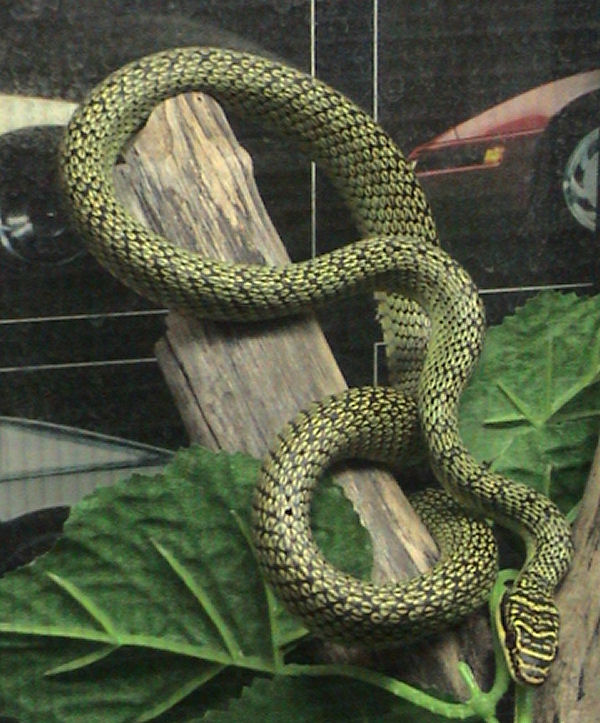
Paradise Flying Snake Chrysopelea paradisi
The scientific name of the Paradise Flying Snake is Chrysopelea paradisi. It is a species of reptile in the family Colubridae (colubrid), order Squamata. The name dates from 1827.
- Scientific name
- Chrysopelea paradisi Boie, 1827
- Common name
- Paradise Flying Snake
- Genus
- Chrysopelea
- Family
- Colubridae (Colubrid)
- Order
- Squamata
- Class
- Reptilia
- Red List category
- LC Least Concern
- Recorded in
- 8 countries
- Name status
- accepted in the Catalogue of Life

Overview
The Paradise Flying Snake is a reptile scientifically identified as Chrysopelea paradisi, belonging to the family Colubridae, order Squamata, and class Reptilia. The species lives in forests, is entirely arboreal, and is primarily found in moist forests. The species can flatten its body by extending its ribs and glide horizontally between trees.
Written 26 November 2026 from the sources listed below. Each statement was checked against the passage it cites; statements that could not be supported were removed.
Appearance
The Paradise Flying Snake can flatten its body into a strip by extending its ribs. While airborne, it adopts a triangular cross-sectional body shape.[1][2]
Habitat
The species lives in forests and is entirely arboreal. It is primarily found in moist forests.[3][4]
The species occurs in Thailand, Indonesia, Brunei, India, Malaysia, Myanmar, the Philippines, and Singapore.[5]
The species is found in southeastern Asia.[6]
Behaviour
The species glides between trees and can glide horizontally for at least 10 meters from a tree. It commonly uses an anchored J-loop takeoff when initiating a glide.[7][8][9]
During flight, the species undulates its body while keeping its head relatively stable. It uses aerial undulation to maximize its gliding distance.[10][11]
The species possesses enlarged posterior maxillary teeth and produces venom from Duvernoy's glands. It is considered mildly venomous and can constrict its prey.[12][13][14][15]
Encounters between the species and humans are rare.[16]
Reproduction and life cycle
The species reproduces by laying eggs.[17]
Similar species
The Paradise Flying Snake belongs to the genus Chrysopelea, which contains four other described species. Chrysopelea is one of five genera in the vine snake subfamily Ahaetuliinae and is most closely related to the genus Dendrelaphis within that subfamily.[18][19][20][21]
Classification of the Paradise Flying Snake
| Kingdom | Animalia |
|---|---|
| Phylum | Chordata |
| Subphylum | Vertebrata |
| Infraphylum | Gnathostomata |
| Parvphylum | Osteichthyes |
| Megaclass | Tetrapoda |
| Class | Reptilia (Reptile) |
| Order | Squamata (Snakes) |
| Suborder | Serpentes (Snakes) |
| Infraorder | Alethinophidia |
| Family | Colubridae (Colubrid) |
| Subfamily | Sibynophiinae |
| Genus | Chrysopelea (Flying Tree Snakes) |
| Species | Chrysopelea paradisi Boie, 1827 |
Where the Paradise Flying Snake is found
Checklists and occurrence records place Chrysopelea paradisi in 8 countries across Asia. GBIF holds 1,660 georeferenced records of it.
Countries
Regions and cities with the most records
- Yio Chu Kang, Singapore 668
- Ang Mo Kio New Town, Singapore 667
- Sungai Simpang, Singapore 665
- Yishun New Town, Singapore 664
- Novena, Singapore 663
- Sengkang New Town, Singapore 654
- Bukit Timah, Singapore 650
- Queenstown Estate, Singapore 646
- Woodlands, Singapore 644
- Sembawang Estate, Singapore 619
- Anak Bukit, Singapore 588
- Bukit Panjang New Town, Singapore 582
- Choa Chu Kang New Town, Singapore 579
- Teck Whye, Singapore 579
- Marsiling, Singapore 576
- Yew Tee, Singapore 576
- Keat Hong Village, Singapore 570
- Jurong East, Singapore 562
- Jurong Town, Singapore 559
- Jurong West, Singapore 559
- Kampung Pasir Gudang Baru, Malaysia 541
- Boon Lay, Singapore 536
- Matilda Estate, Singapore 501
- Johor Bahru, Malaysia 486
- Masai, Malaysia 471
- Punggol, Singapore 469
- Bandar Seri Alam, Malaysia 458
- Pasir Gudang, Malaysia 435
- Singapore, Singapore 412
- MacPherson, Singapore 410
- Eunos, Singapore 405
- Marine Parade, Singapore 399
- Kampong Pasir Ris, Singapore 397
- Taman Permas Jaya, Malaysia 395
- Ulu Bedok, Singapore 395
- Bedok New Town, Singapore 386
Range as the checklists state it
Thailand (incl. Phuket)
A number beside a place is its count of GBIF occurrence records. A place without a number comes from a checklist alone. Records show where a species has been observed or collected, which can include escapes and vagrants.
Common names
English
- Paradise Flying Snake
- (Paradise Flying Snake
- Garden Flying Snake
- Paradise Tree Snake
Names in 1 other language
- German
- Paradies-Schmuckbaumnatter
Synonyms
2 other scientific names have been used for this species and are now treated as synonyms of Chrysopelea paradisi.
- Chrysopelea paradisi celebensis Mertens, 1968 ambiguous synonym
- Chrysopelea paradisi variabilis Mertens, 1968 ambiguous synonym
Subspecies and varieties
- Chrysopelea paradisi celebensis subspecies
- Chrysopelea paradisi paradisi (Common Paradise Flying Snake) subspecies
- Chrysopelea paradisi variabilis subspecies
Related species
-
 Golden Flying SnakeChrysopelea ornata
-
 Sri Lankan Flying SnakeChrysopelea taprobanica
-
 Banded Flying SnakeChrysopelea pelias
- Moluccan Flying SnakeChrysopelea rhodopleuron
-
 Corn SnakePantherophis guttatus
-
 BoomslangDispholidus typus
-
 DeKay's Brown SnakeStoreria dekayi
-
 Brown Tree SnakeBoiga irregularis
Compare
Questions and answers
What is the scientific name of the Paradise Flying Snake?
The scientific name of the Paradise Flying Snake is Chrysopelea paradisi. Written with its author, the full name is Chrysopelea paradisi Boie, 1827.
Which family does the Paradise Flying Snake belong to?
Chrysopelea paradisi belongs to the family Colubridae, in the order Squamata and the class Reptilia.
Where is the Paradise Flying Snake found?
Checklists and occurrence records place Chrysopelea paradisi in 8 countries, including Singapore, Malaysia, Philippines, Indonesia, Thailand and Brunei.
What is the conservation status of the Paradise Flying Snake?
The IUCN Red List category recorded for Chrysopelea paradisi is Least Concern (LC).
What other names does the Paradise Flying Snake have?
Chrysopelea paradisi is also known in English as (Paradise Flying Snake, Garden Flying Snake and Paradise Tree Snake.
Is the paradise tree snake poisonous?
The Paradise Flying Snake is considered mildly venomous. It produces venom from Duvernoy's glands.[13][14]
Sources
Passages the profile rests on
- The species can flatten its body into a strip by extending its ribs. Source passage: “glide by stretching the body into a flattened strip using its ribs.” — English Wikipedia
- While airborne, the species adopts a triangular cross-sectional body shape. Source passage: “once airborne their cross sectional body is shaped into a triangle” — English Wikipedia
- The species is primarily found in moist forests. Source passage: “It is mostly found in moist forests” — English Wikipedia
- The species lives in forests and is entirely arboreal. Source passage: “It lives in forests and is fully arboreal” — English Wikipedia
- The species occurs in Thailand, Indonesia, Brunei, India, Malaysia, Myanmar, the Philippines, and Singapore. Source passage: “It is found in Thailand, Indonesia, Brunei, India, Malaysia, Myanmar, Philippines, and Singapore.” — English Wikipedia
- The species is found in southeastern Asia. Source passage: “is a species of snake found in southeastern Asia.” — inaturalist.org
- The species can glide horizontally for at least 10 meters from a tree. Source passage: “can cover a horizontal distance of 10 meters (33 feet) or more in a glide from the top of a tree.” — English Wikipedia
- The species glides between trees. Source passage: “glides between trees.” — English Wikipedia
- The species commonly uses an anchored J-loop takeoff when initiating a glide. Source passage: “Their form of takeoff which is most commonly the anchored J-loop take-off” — English Wikipedia
- During flight, the species undulates its body while keeping its head relatively stable. Source passage: “Slow motion photography shows an undulation of the snake's body in flight while the head remains relatively stable” — English Wikipedia
- The species uses aerial undulation to maximize its gliding distance. Source passage: “their bodies use an aerial undulation to maximize the distance traveled.” — English Wikipedia
- The species possesses enlarged posterior maxillary teeth. Source passage: “flying snakes possess enlarged posterior maxillary teeth” — English Wikipedia
- The species produces venom from Duvernoy's glands. Source passage: “produce venom from Duvernoy's glands” — English Wikipedia
- The species is considered mildly venomous. Source passage: “are believed to be mildly venomous.” — English Wikipedia
- The species can constrict its prey. Source passage: “also can constrict their prey” — English Wikipedia
- Encounters between this species and humans are rare. Source passage: “encounters with humans are rare.” — English Wikipedia
- The species reproduces by laying eggs. Source passage: “It has oviparous reproduction.” — English Wikipedia
- The species belongs to the genus Chrysopelea. Source passage: “Chrysopelea paradisi belongs to the genus Chrysopelea” — English Wikipedia
- The genus Chrysopelea contains four other described species besides this species. Source passage: “which contains four other described species.” — English Wikipedia
- The genus Chrysopelea is one of five genera in the vine snake subfamily Ahaetuliinae. Source passage: “Chrysopelea is one of five genera belonging to the vine snake subfamily Ahaetuliinae” — English Wikipedia
- Chrysopelea is most closely related to the genus Dendrelaphis within the stated subfamily. Source passage: “Chrysopelea is most closely related to Dendrelaphis” — English Wikipedia
- The species is identified scientifically as Chrysopelea paradisi. Source passage: “Scientific Name. Chrysopelea paradisi.” — fws.gov
Data
- Catalogue of Life, 2026-10-16 XR cc by
- Global Biodiversity Information Facility CC BY 4.0
- Wikidata CC0
- GeoNames CC BY 4.0
- Wikimedia Commons per image; credit shown with each image
- Within the Catalogue of Life, this name comes from The Reptile Database cc by
References
- F. Boie, 1827 where the name was published
- Boie, F. (1827). Bemerkungen über Merrem’s Versuch eines Systems der Amphibien, 1. Lieferung: Ophidier. Isis von Oken 20: 508-566.
- Smith, M. A. (1943). The Fauna of British India, Ceylon and Burma, Including the Whole of the Indo-Chinese Sub-Region. Reptilia and Amphibia. 3 (Serpentes). Taylor and Francis, London. 583 Pp.
- Leviton, A. E. (1964). Contributions to a review of Philippine snakes. IV. The genera Chrysopelea and Dryophis. Philippine J. Sci. 93: 131-145.
- Taylor, E. H. (1965). The serpents of Thailand and adjacent waters. Univ. Kansas Sci. Bull. 45 (9): 609-1096.
- Mertens, R. (1968). Die Arten und Unterarten der Schmuckbaumschlangen (Chrysopelea). Senckenbergiana Biologica 49 (3–4): 191–217.
- Gaulke, M. (1986). Zum Beutefangverhalten der Schmuckbaumschlange Chrysopelea paradisi Boie 1827. Salamandra 22 (2-3): 211-212.
- Bong Heang, & Kiew. (1987). An annotated checklist of the herpetofauna of Ulu Endau, Johore, Malaysia. Malayan Nature Journal 41 (2-3): 413-423.
- Dowling, H.G., & Jenner, J.V. (1988). Snakes of Burma: checklist of reported species and bibliography. Smithsonian Herp. Inf. Serv. (76): 19 Pp.
- Gaulke, M. (1994). Contribution to the snake fauna of the Sulu Archipelago, with the description of a new subspecies of Dendrelaphis caudolineatus (GRAY, 1834). The Herpetological Journal 4 (4): 136-144.
- Brown, Rafe M.; Ferner, John W.; Sison, Rogelio V.; Gonzales, Pedro C.; Kennedy, Robert S. (1996). Amphibians and reptiles of the Zambales Mountains of Luzon Island, Republic of the Philippines. Herpetological Natural History 4 (1): 1-22.
- David, P., & Vogel, G. (1996). The snakes of Sumatra. An annotated checklist and key with natural history notes. Bücher Kreth, Frankfurt/M.
- Teo, R. C. H., & Rajathurai, S. (1997). Mammals, reptiles and amphibians in the Nature Reserves of Singapore - diversity, abundance and distribution. Proc. Nature Reserves Survey Seminar. Gardens’ Bulletin Singapore 49: 353-425.
- Manthey, U., & Grossmann, W. (1997). Amphibien & Reptilien Südostasiens. Natur Und Tier Verlag (Münster), 512 Pp. (ISBN 3-931587-12-6).
- Cox, Merel J.; Van Dijk, Peter Paul; Jarujin Nabhitabhata & Thirakhupt,Kumthorn. (1998). A Photographic Guide to Snakes and Other Reptiles of Peninsular Malaysia, Singapore and Thailand. Ralph Curtis Publishing, 144 Pp.
- Chan-ard,T.; Grossmann,W.; Gumprecht,A. & Schulz,K. D. (1999). Amphibians and reptiles of peninsular Malaysia and Thailand - an illustrated checklist [bilingual English and German]. Bushmaster Publications, Würselen, Gemany, 240 Pp. [Book Review in Russ. J Herp. 7: 87].
- Stuebing, R. B., & INGER, R. F. (1999). A field guide to the snakes of Borneo. Natural History Publications (Borneo), Kota Kinabalu, 254 Pp. [Corrections in HR 31: 124].
- Pauwels,O.S.G. et al. (2000). Herpetological investigations in Phang-Nga Province, southern Peninsular Thailand, with a list of reptile species and notes on their biology. Dumerilia 4 (2): 123-154.
- Ferner, John W., Rafe M. Brown, Rogelio V. Sison and Robert S. Kennedy. (2000). The amphibians and reptiles of Panay Island, Philippines. Asiatic Herpetological Research 9: 1-37.
- Grossmann, W., & Tillack, F. (2001). Bemerkungen zur Herpetofauna des Khao Lak, Phang Nga, thailändische Halbinsel. Teil III: Ergebnisse der Jahre 1999 und 2000. Sauria 23 (3): 21-34.
- Malkmus, R.; Manthey, U.; Vogel, G. Hoffmann, P. & Kosuch, J. (2002). Amphibians and reptiles of Mount Kinabalu (North Borneo). A.R.G. Ganther Verlag, Rugell, 404 Pp.
- Sharma, R. C. (2004). Handbook Indian Snakes. AKHIL BOOKS, New Delhi, 292 Pp.
- Whitaker, & Romulus and Ashok Captain. (2004). Snakes of India. Draco Books, 500 Pp., Reprinted 2007.
- Lang, Ruud de, & Vogel, G. (2005). The snakes of Sulawesi. A field guide to the land snakes of Sulawesi with identification keys. Edition Chimaira, Frankfurter Beiträge Zur Naturkunde, 25, Frankfurt Am Main, 312 Pp.
- Iskandar, Djoko T. and Walter R. Erdelen. (2006). Conservation of amphibians and reptiles in Indonesia: issues and problems. Amphibian & Reptile Conservation 4 (1): 60-87.
This species in other databases
Page built on 28 November 2026. See how the catalog is made and all sources and licences.
Cite this page
ScientificNames.org. (2026). Chrysopelea paradisi (Paradise Flying Snake). Retrieved November 28, 2026, from https://scientificnames.org/species/chrysopelea-paradisi
“Chrysopelea paradisi (Paradise Flying Snake).” ScientificNames.org, 2026, scientificnames.org/species/chrysopelea-paradisi. Accessed 28 Nov. 2026.
ScientificNames.org. “Chrysopelea paradisi (Paradise Flying Snake).” Accessed November 28, 2026. https://scientificnames.org/species/chrysopelea-paradisi.
@misc{scientificnames_chrysopelea_paradisi_paradise_flying_snake,
  author = {{ScientificNames.org}},
  title = {Chrysopelea paradisi (Paradise Flying Snake)},
  year = {2026},
  url = {https://scientificnames.org/species/chrysopelea-paradisi},
  note = {Accessed 2026-11-28}
}