Species · Reptiles
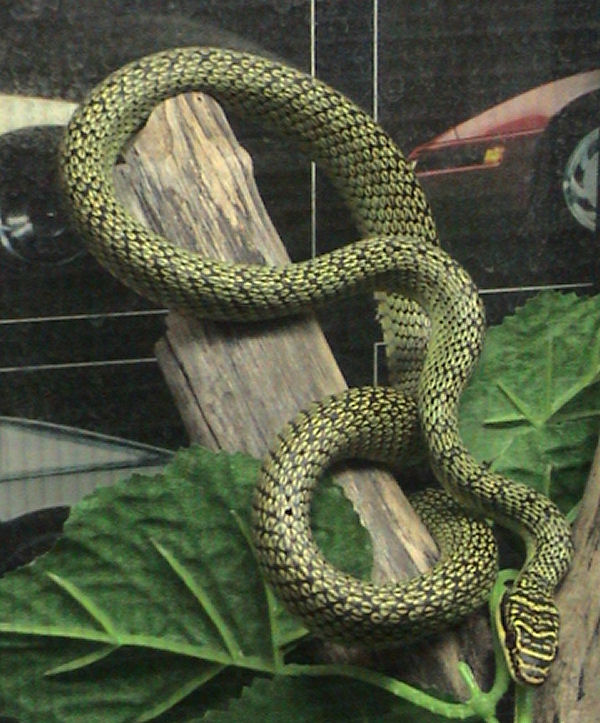
Moluccan Flying Snake Chrysopelea rhodopleuron
The scientific name of the Moluccan Flying Snake is Chrysopelea rhodopleuron. It is a species of reptile in the family Colubridae (colubrid), order Squamata. The name dates from 1827.
- Scientific name
- Chrysopelea rhodopleuron Boie, 1827
- Common name
- Moluccan Flying Snake
- Genus
- Chrysopelea
- Family
- Colubridae (Colubrid)
- Order
- Squamata
- Class
- Reptilia
- Red List category
- LC Least Concern
- Recorded in
- 2 countries
- Name status
- accepted in the Catalogue of Life
Overview
The Moluccan Flying Snake is a gliding snake in the family Colubridae. It is endemic to the Indonesian islands of Ambon and Sulawesi. It is identified as a gliding snake.
Written 26 November 2026 from the sources listed below. Each statement was checked against the passage it cites; statements that could not be supported were removed.
Appearance
The Moluccan Flying Snake is a gliding snake.[1]
Habitat
The Moluccan Flying Snake is endemic to the Indonesian islands of Ambon and Sulawesi.[2]
Similar species
Two subspecies are listed: Chrysopelea rhodopleuron rhodopleuron and Chrysopelea rhodopleuron viridis.[3]
Behaviour
The Moluccan Flying Snake is identified as a gliding snake.[4]
Classification of the Moluccan Flying Snake
| Kingdom | Animalia |
|---|---|
| Phylum | Chordata |
| Subphylum | Vertebrata |
| Infraphylum | Gnathostomata |
| Parvphylum | Osteichthyes |
| Megaclass | Tetrapoda |
| Class | Reptilia (Reptile) |
| Order | Squamata (Snakes) |
| Suborder | Serpentes (Snakes) |
| Infraorder | Alethinophidia |
| Family | Colubridae (Colubrid) |
| Subfamily | Sibynophiinae |
| Genus | Chrysopelea (Flying Tree Snakes) |
| Species | Chrysopelea rhodopleuron Boie, 1827 |
Where the Moluccan Flying Snake is found
Checklists and occurrence records place Chrysopelea rhodopleuron in 2 countries across Asia. GBIF holds 81 georeferenced records of it.
Countries
Range as the checklists state it
Indonesia (Amboina, Sulawesi)
A number beside a place is its count of GBIF occurrence records. A place without a number comes from a checklist alone. Records show where a species has been observed or collected, which can include escapes and vagrants.
Common names
English
- Moluccan Flying Snake
Names in 3 other languages
- Chinese
- 摩鹿加金花蛇
- Portuguese
- Cobra-voadora-das-molucas
- Russian
- Молуккская украшенная змея
Synonyms
3 other scientific names have been used for this species and are now treated as synonyms of Chrysopelea rhodopleuron.
- Chrysopelea viridis Fischer, 1880
- Leptophis doleschalii Jan
- Chrysopelea rhodopleuron viridis Fischer, 1880 ambiguous synonym
Subspecies and varieties
- Chrysopelea rhodopleuron rhodopleuron (Moluccan Flying Snake) subspecies
- Chrysopelea rhodopleuron viridis subspecies
Related species
-
 Golden Flying SnakeChrysopelea ornata
-
 Paradise Flying SnakeChrysopelea paradisi
-
 Sri Lankan Flying SnakeChrysopelea taprobanica
-
 Banded Flying SnakeChrysopelea pelias
-
 Corn SnakePantherophis guttatus
-
 BoomslangDispholidus typus
-
 DeKay's Brown SnakeStoreria dekayi
-
 Brown Tree SnakeBoiga irregularis
Compare
Questions and answers
What is the scientific name of the Moluccan Flying Snake?
The scientific name of the Moluccan Flying Snake is Chrysopelea rhodopleuron. Written with its author, the full name is Chrysopelea rhodopleuron Boie, 1827.
Which family does the Moluccan Flying Snake belong to?
Chrysopelea rhodopleuron belongs to the family Colubridae, in the order Squamata and the class Reptilia.
Where is the Moluccan Flying Snake found?
Checklists and occurrence records place Chrysopelea rhodopleuron in 2 countries: Indonesia and Malaysia.
What is the conservation status of the Moluccan Flying Snake?
The IUCN Red List category recorded for Chrysopelea rhodopleuron is Least Concern (LC).
Why is it called a flying snake?
It is identified as a gliding snake.[4]
What does a flying snake eat?
The group of flying snakes with which the Moluccan Flying Snake is associated captures rodents, bats, birds, and lizards.[5]
Sources
Passages the profile rests on
- Chrysopelea rhodopleuron is a gliding snake. Source passage: “is a species of gliding snake of the family Colubridae.” — English Wikipedia
- Chrysopelea rhodopleuron is endemic to the Indonesian islands of Ambon and Sulawesi. Source passage: “The snake is endemic to the Indonesian islands of Ambon and Sulawesi.” — English Wikipedia
- Two subspecies are listed for Chrysopelea rhodopleuron: Chrysopelea rhodopleuron rhodopleuron and Chrysopelea rhodopleuron viridis. Source passage: “Chrysopelea rhodopleuron rhodopleuron Boie, 1827 Chrysopelea rhodopleuron viridis Fischer, 1880” — English Wikipedia
- The Moluccan flying snake is identified as a gliding snake. Source passage: “is a species of gliding snake of the family Colubridae.” — inaturalist.org
- The Moluccan flying snake is associated with a group of flying snakes that capture rodents, bats, birds, and lizards. Source passage: “Flying snakes are active by day, capturing rodents, bats, birds, and lizards. The Moluccan flying snake (Chrysopelea rhodopleuron), which ...” — britannica.com
Data
- Catalogue of Life, 2026-10-16 XR cc by
- Global Biodiversity Information Facility CC BY 4.0
- Wikidata CC0
- GeoNames CC BY 4.0
- Within the Catalogue of Life, this name comes from The Reptile Database cc by
References
- Boie, F. (1827). Bemerkungen über Merrem’s Versuch eines Systems der Amphibien, 1. Lieferung: Ophidier. Isis von Oken 20: 508-566.
- Duméril, A. M. C., Bibron, G. & DUMÉRIL, A. H. A.,. (1854). Erpétologie générale ou histoire naturelle complète des reptiles. Tome septième. Deuxième partie, comprenant l’histoire des serpents venimeux. Paris, Librairie Encyclopédique de Roret: I-Xii + 781-1536.
- Fischer, J. G. (1880). Neue Reptilien und Amphibien. Archiv Für Naturgeschichte 46 (1): 215-227.
- Kopstein, P. F. (1926). Reptilien von den Molukken und den benachbarten Inseln. Zoologische Mededelingen 1: 71-112.
- Brongersma, L. D. (1933). Herpetological Notes I-IX. Zoologische Mededelingen 16 (1/2): 1-29.
- Lang, Ruud de, & Vogel, G. (2005). The snakes of Sulawesi. A field guide to the land snakes of Sulawesi with identification keys. Edition Chimaira, Frankfurter Beiträge Zur Naturkunde, 25, Frankfurt Am Main, 312 Pp.
- Iskandar, Djoko T. and Walter R. Erdelen. (2006). Conservation of amphibians and reptiles in Indonesia: issues and problems. Amphibian & Reptile Conservation 4 (1): 60-87.
- Koch, A. (2012). Discovery, Diversity, and Distribution of the Amphibians and Reptiles of Sulawesi and its offshore islands. Edition Chimaira, 374 Pp. [ISBN 978-3-89973-432-4].
- Lang, & Ruud de. (2013). The snakes of the Moluccas (Maluku), Indonesia. Edition Chimaira, 417 Pp.
- Wallach, Van; Kenneth L. Williams, Jeff Boundy. (2014). Snakes of the World: A Catalogue of Living and Extinct Species. [type catalogue]. Taylor and Francis, CRC Press, 1237 Pp.
- Bauer, A. M. (2016). Southeast Asian and Australasian Herpetological Collections from the Eighteenth and Nineteenth Centuries in the Zoological Museum of Berlin. In: Naturalists, Explorers and Field Scientists in South-East Asia and Australasia. [type catalogue]. Topics in Biodiversity and Conservation 15: 89-108.
- Harrington, Sean M; Jordyn M de Haan, Lindsey Shapiro, Sara Ruane. (2018). Habits and characteristics of arboreal snakes worldwide: arboreality constrains body size but does not affect lineage diversification. Biological Journal of the Linnean Society 125 (1): 61–71.
- Otani, S., & Duensser, E. (2024). ENGLISH TRANSLATION OF THE ORIGINAL DESCRIPTIONS OF SNAKES DESCRIBED BY BOIE (1826). Taprobanica 13 (02): 48–61.
This species in other databases
Page built on 27 November 2026. See how the catalog is made and all sources and licences.
Cite this page
ScientificNames.org. (2026). Chrysopelea rhodopleuron (Moluccan Flying Snake). Retrieved November 27, 2026, from https://scientificnames.org/species/chrysopelea-rhodopleuron
“Chrysopelea rhodopleuron (Moluccan Flying Snake).” ScientificNames.org, 2026, scientificnames.org/species/chrysopelea-rhodopleuron. Accessed 27 Nov. 2026.
ScientificNames.org. “Chrysopelea rhodopleuron (Moluccan Flying Snake).” Accessed November 27, 2026. https://scientificnames.org/species/chrysopelea-rhodopleuron.
@misc{scientificnames_chrysopelea_rhodopleuron_moluccan_flying_snake,
  author = {{ScientificNames.org}},
  title = {Chrysopelea rhodopleuron (Moluccan Flying Snake)},
  year = {2026},
  url = {https://scientificnames.org/species/chrysopelea-rhodopleuron},
  note = {Accessed 2026-11-27}
}