Species · Insects
Cochliotis kolbei
Cochliotis kolbei has no English name on record in the checklists used here. It is a species of insect in the family Scarabaeidae (dung beetles), order Coleoptera. The name dates from 1898.
- Scientific name
- Cochliotis kolbei Brenske, 1898
- Genus
- Cochliotis
- Family
- Scarabaeidae (Dung Beetles)
- Order
- Coleoptera
- Class
- Insecta
- Recorded in
- 1 country
- Name status
- accepted in the Catalogue of Life
Overview
Cochliotis kolbei occurs in Tanzania. The species is distinguished by its pronotal punctation and scales, lanceolate clypeal scales, and finely scaled elytra and pygidium.
Written 28 November 2026 from the sources listed below. Each statement was checked against the passage it cites; statements that could not be supported were removed.
Appearance
Adult Cochliotis kolbei beetles reach approximately 22 mm in length. The clypeus is uniformly covered with lanceolate scales.[1][2]
The pronotum is widest at the rear, and its anterior margin is slightly indented in the middle. Its sides are weakly notched, and distinct hairs occur along the front, although they are very short in the middle.[3][4][5][6]
The pronotum is finely and sparsely punctate in the middle, with substantially denser punctation toward the sides. The punctation is densest in the right-angled hind corners.[7][8]
Pronotal scales are extremely small and rounded in the middle, where they appear as white dots within the punctures. The lateral scales are more distinct, irregularly oval, and completely fill the depressions.[9][10]
The scutellum has a smooth apex. The elytral scales are somewhat stronger than those in the middle of the pronotum but remain very fine and narrow, with a few slightly more distinct scales on the weakly indicated elytral ribs.[11][12][13]
The pygidium is densely covered with fine, narrow scales approximately the same size as those on the scutellum.[14][15]
Classification of Cochliotis kolbei
| Kingdom | Animalia |
|---|---|
| Phylum | Arthropoda |
| Subphylum | Hexapoda |
| Class | Insecta (Insect) |
| Order | Coleoptera (Beetle) |
| Suborder | Polyphaga |
| Series | Staphyliniformia |
| Superfamily | Scarabaeoidea |
| Family | Scarabaeidae (Dung Beetles) |
| Subfamily | Melolonthinae |
| Tribe | Leucopholini |
| Genus | Cochliotis |
| Species | Cochliotis kolbei Brenske, 1898 |
Where Cochliotis kolbei is found
Checklists and occurrence records place Cochliotis kolbei in 1 country across Africa.
Countries
Range as the checklists state it
Afrotropical(Tanzania)
A number beside a place is its count of GBIF occurrence records. A place without a number comes from a checklist alone. Records show where a species has been observed or collected, which can include escapes and vagrants.
Related species
- Cochliotis melolonthoides
- Cochliotis somaliensis
-
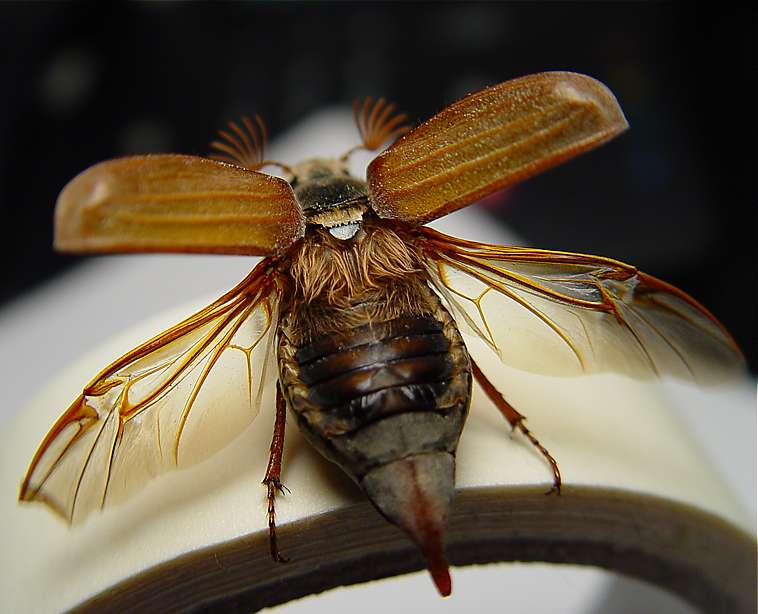 CockchaferMelolontha melolontha
-
 Hercules BeetleDynastes (Dynastes) hercules
-
 Japanese BeetlePopillia japonica
-
 Japanese Rhinoceros BeetleTrypoxylus dichotomus
-
 Sacred ScarabScarabaeus sacer
-
 Figeater BeetleCotinis (Cotinis) mutabilis
Compare
Questions and answers
Where does Cochliotis kolbei occur?
Cochliotis kolbei occurs in Tanzania.[16]
How large are adult Cochliotis kolbei beetles?
Adults reach approximately 22 mm in length.[1]
What characterizes the pronotum?
The pronotum is widest at the rear, with weakly notched sides and a slightly indented anterior margin. Its punctation is sparse in the middle and densest in the right-angled hind corners.[3][5][6][7][8]
Sources
Passages the profile rests on
- Adult Cochliotis kolbei beetles reach approximately 22 mm in length. Source passage: “Adults reach a length of about 22 mm (0.87 in).” — English Wikipedia
- The clypeus of Cochliotis kolbei is uniformly covered with lanceolate scales. Source passage: “The clypeus is evenly covered with lanceolate scales.” — English Wikipedia
- The pronotum of Cochliotis kolbei is widest at its rear. Source passage: “The pronotum is widest at the rear” — English Wikipedia
- The pronotum has distinct hairs along its front, although they are very short in the middle. Source passage: “with distinct hairs at the front, which are very short in the middle” — English Wikipedia
- The anterior margin of the pronotum is slightly indented in its middle. Source passage: “the anterior margin slightly indented in the middle” — English Wikipedia
- The pronotum has weakly notched sides. Source passage: “the sides weakly notched” — English Wikipedia
- The pronotum is finely and sparsely punctate in the middle, with substantially denser punctation toward the sides. Source passage: “finely and sparsely punctate in the middle of the surface, much more densely punctate on the sides” — English Wikipedia
- The pronotal punctation is densest in the right-angled hind corners. Source passage: “densest in the right-angled hind corners” — English Wikipedia
- The pronotal scales are extremely small and rounded in the middle, where they appear as white dots within the punctures. Source passage: “the scales are very minute and rounded in the middle, appearing as a white dot within the point” — English Wikipedia
- The lateral pronotal scales are more distinct, irregularly oval, and completely fill the depressions. Source passage: “the scales are more distinct laterally, of an irregular oval shape, completely filling the depression.” — English Wikipedia
- The scutellum of Cochliotis kolbei has a smooth apex. Source passage: “The scutellum is smooth at the apex.” — English Wikipedia
- The elytral scales are somewhat stronger than those in the middle of the pronotum but remain very fine and narrow. Source passage: “The scales of the elytra are somewhat stronger than those on the middle of the pronotum, but very fine and narrow” — English Wikipedia
- A few slightly more distinct scales occur on the weakly indicated elytral ribs. Source passage: “with a few slightly more distinct scales on the weakly indicated ribs.” — English Wikipedia
- The pygidium of Cochliotis kolbei is densely covered with fine, narrow scales. Source passage: “The pygidium is densely covered. These scales are fine, narrow” — English Wikipedia
- The pygidial scales are approximately the same size as those on the scutellum. Source passage: “as large as those of the scutellum.” — English Wikipedia
- Cochliotis kolbei occurs in Tanzania. Source passage: “It is found in Tanzania.” — English Wikipedia
Data
- Catalogue of Life, 2026-10-16 XR cc by
- Wikidata CC0
- GeoNames CC BY 4.0
- Within the Catalogue of Life, this name comes from World Scarabaeidae Database cc by
References
- Brenske, E. (1898). Melolonthiden aus Afrika. Stettiner Entomologische Zeitung, Stettin 59(4):333-394. https://www.zobodat.at/pdf/Entomologische-Zeitung-Stettin_59_0333-0394.pdf Link where the name was published
This species in other databases
Page built on 29 November 2026. See how the catalog is made and all sources and licences.
Cite this page
ScientificNames.org. (2026). Cochliotis kolbei. Retrieved November 29, 2026, from https://scientificnames.org/species/cochliotis-kolbei
“Cochliotis kolbei.” ScientificNames.org, 2026, scientificnames.org/species/cochliotis-kolbei. Accessed 29 Nov. 2026.
ScientificNames.org. “Cochliotis kolbei.” Accessed November 29, 2026. https://scientificnames.org/species/cochliotis-kolbei.
@misc{scientificnames_cochliotis_kolbei,
  author = {{ScientificNames.org}},
  title = {Cochliotis kolbei},
  year = {2026},
  url = {https://scientificnames.org/species/cochliotis-kolbei},
  note = {Accessed 2026-11-29}
}