Species · Birds
Black-faced Cotinga Conioptilon mcilhennyi
The scientific name of the Black-faced Cotinga is Conioptilon mcilhennyi. It is a species of bird in the family Cotingidae (contingas), order Passeriformes. The name dates from 1966.
- Scientific name
- Conioptilon mcilhennyi Lowery & O'Neill, 1966
- Common name
- Black-faced Cotinga
- Genus
- Conioptilon
- Family
- Cotingidae (Contingas)
- Order
- Passeriformes
- Class
- Aves
- Red List category
- LC Least Concern
- Recorded in
- 3 countries
- Name status
- accepted in the Catalogue of Life

Overview
Conioptilon mcilhennyi occurs in Bolivia, Brazil, and Peru. It is the only species in the genus Conioptilon and has no recognized subspecies.
Written 27 November 2026 from the sources listed below. Each statement was checked against the passage it cites; statements that could not be supported were removed.
Similar species
The Black-faced Cotinga is the sister species of the Bare-necked Fruitcrow.[1]
Appearance
Adult males have predominantly black heads and throats, with a white crescent behind the ear coverts. Their upperparts are dark gray, while the wings and tail are darker gray.[2][3]
The breast is light gray, transitioning to white on the lower belly and undertail coverts. The species is also described as light gray with darker gray wings and a black face.[4][5]
Males and females look similar, although females are slightly smaller and have somewhat paler underparts. Both sexes have dark reddish-brown irises.[6][7]
The bill is dark grayish brown with a slightly hooked tip. The legs and feet are dark olive-gray.[8][9]
The species has powder down on its unfeathered parts and on the upper surfaces of its wings and tail.[10]
The Black-faced Cotinga measures 23–25 cm in length. Three measured individuals weighed between 81 and 89 g.[11][12]
Habitat
The Black-faced Cotinga inhabits humid forests, particularly swampy or seasonally flooded areas around lakes and rivers. It occurs in the subcanopy of seasonally flooded swamp or floodplain forests and terra firme forests.[13][14]
In Brazil, the species favors várzea forest but also occurs in terra firme and burned forest.[15]
The species is usually found below 300 m elevation and rarely occurs as high as 450 m. It has been recorded at elevations up to 700 m on one occasion.[16][17]
Diet
Fruit makes up most of the Black-faced Cotinga's diet, with insects and possibly flowers also consumed.[18]
Behaviour
The Black-faced Cotinga is believed to remain in the same region throughout the year. It generally forages alone or in pairs and does not participate in mixed-species feeding flocks.[19][20][21]
The species obtains fruit by briefly hovering after flying out from a perch. It frequently feeds alongside other birds in fruiting trees, particularly larger Ficus figs.[22][23]
One vocalization is a quiet, descending 'coww' sound, and another is a squeaky, rising 'huuEEE' sound. The species also has a vibrato call resembling the call of a Smooth-billed Ani.[24][25][26]
Reproduction and life cycle
The breeding season has not been established, although breeding activity includes August and September.[27]
The two known nests were bowl-shaped structures made from thin plant fibers and positioned in forks of branches. They were approximately 15 m and 35 m above the ground.[28][29][30]
Both parents provisioned a nestling in one of the two documented nests.[31]
Conservation
The IUCN classifies the Black-faced Cotinga as Least Concern. Its population size is unknown and is believed to be declining.[32][33]
Its lowland forest habitat faces degradation associated with selective logging, development, oil and gas extraction, mining, road construction, and human colonization. The species is considered uncommon in Peru.[34][35]
The species was most recently assessed for the IUCN Red List in 2024.[36]
Classification of the Black-faced Cotinga
| Kingdom | Animalia |
|---|---|
| Phylum | Chordata |
| Subphylum | Vertebrata |
| Infraphylum | Gnathostomata |
| Parvphylum | Osteichthyes |
| Megaclass | Tetrapoda |
| Class | Aves (Bird) |
| Order | Passeriformes (Passerine) |
| Family | Cotingidae (Contingas) |
| Genus | Conioptilon |
| Species | Conioptilon mcilhennyi Lowery & O'Neill, 1966 |
Where the Black-faced Cotinga is found
Checklists and occurrence records place Conioptilon mcilhennyi in 3 countries across South America. GBIF holds 1,781 georeferenced records of it.
Countries
Regions and cities with the most records
- Madre de Dios, Peru 1,288
- Puerto Maldonado, Peru 472
- Acre, Brazil 392
- Pando, Bolivia 42
- Ucayali, Peru 38
- Senador Guiomard, Brazil 35
- Rio Branco, Brazil 30
- Tambopata, Peru 5
Range as the checklists state it
South America
A number beside a place is its count of GBIF occurrence records. A place without a number comes from a checklist alone. Records show where a species has been observed or collected, which can include escapes and vagrants.
Common names
English
- Black-faced Cotinga
Names in 24 other languages
- Arabic
- قطنجة سوداء الوجه
- Catalan
- cotinga caranegre
- Chinese
- 黑脸伞鸟, 黑臉傘鳥
- Croatian
- crnolica kotinga
- Czech
- kotinga černolící
- Danish
- Sortmasket Kotinga
- Dutch
- Zwartmaskercotinga
- Esperanto
- nigramaska kotingo
- Finnish
- mustapääkotinga
- French
- Cotinga à face noire
- German
- Schwarzgesichtkotinga, Schwarzgesichtschmuckvogel, Schwarzkopf-Schmuckvogel, Schwarzkopfschmuckvogel
- Italian
- Cotinga faccianera
- Japanese
- カオグロカザリドリ
- Lithuanian
- juodaveidė kotinga
- Norwegian
- svartmaskekotinga
- Polish
- czarnogłów
- Portuguese
- anambé-de-cara-preta, cotinga-de-faces-pretas
- Russian
- Чернолицая котинга
- Slovak
- kotinga čiernolíca
- Spanish
- Cotinga carinegro
- Swedish
- svartmaskad kotinga
- Turkish
- Kara Yüzlü Kotinga
- Ukrainian
- котинга чорнощока
- Welsh
- cotinga wynebddu
Related species
-
 CapuchinbirdPerissocephalus tricolor
-
 Andean Cock-of-the-rockRupicola peruvianus
-
 White BellbirdProcnias albus
-
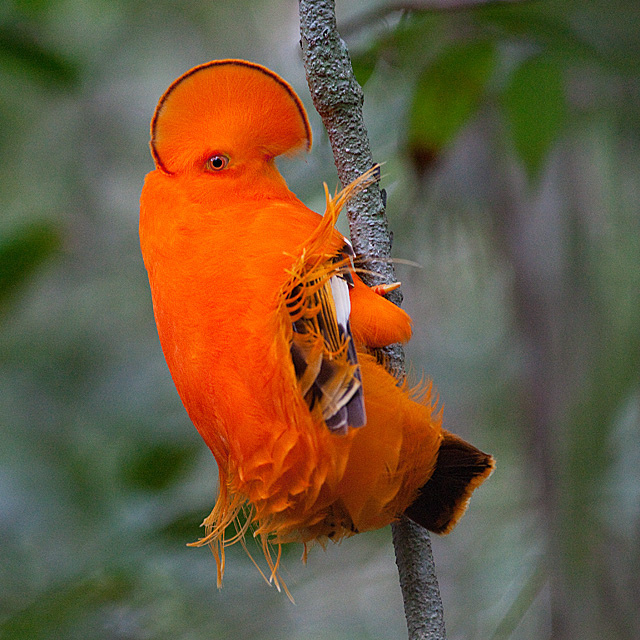 Guianan Cock-of-the-rockRupicola rupicola
-
 Screaming PihaLipaugus vociferans
-
 Bare-throated BellbirdProcnias nudicollis
-
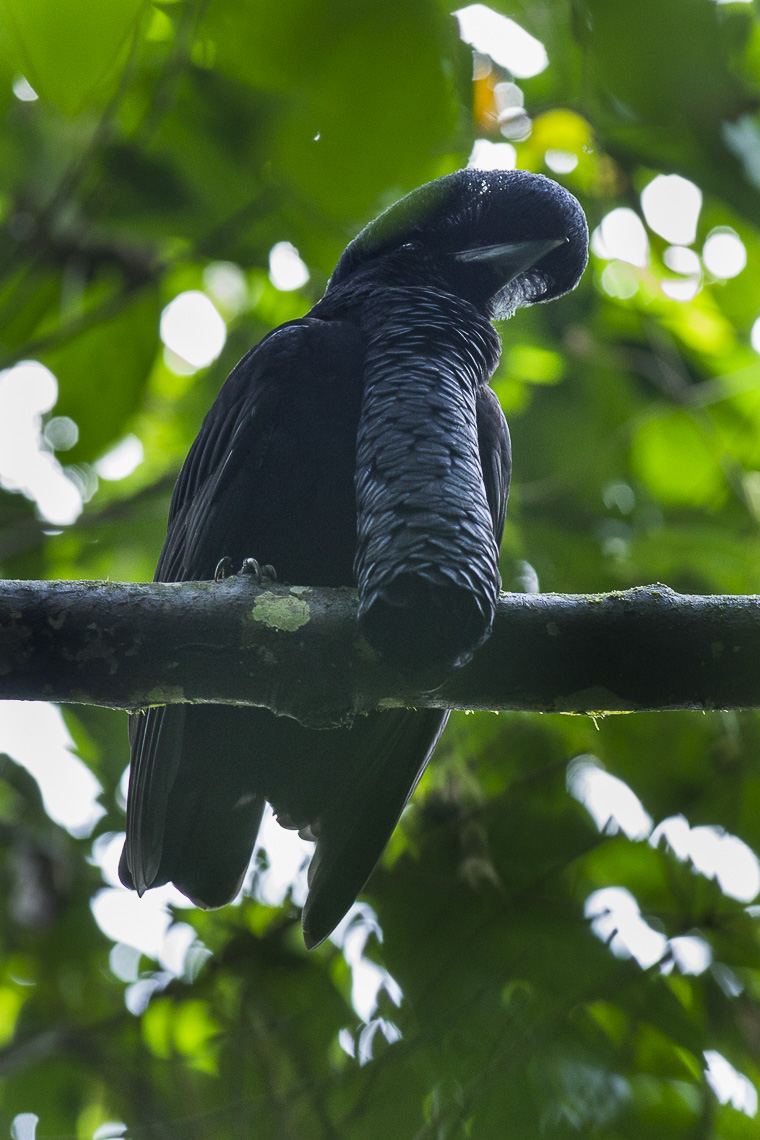 Long-wattled UmbrellabirdCephalopterus penduliger
-
 Three-wattled BellbirdProcnias tricarunculatus
Compare
Questions and answers
What is the scientific name of the Black-faced Cotinga?
The scientific name of the Black-faced Cotinga is Conioptilon mcilhennyi. Written with its author, the full name is Conioptilon mcilhennyi Lowery & O'Neill, 1966.
Which family does the Black-faced Cotinga belong to?
Conioptilon mcilhennyi belongs to the family Cotingidae, in the order Passeriformes and the class Aves.
Where is the Black-faced Cotinga found?
Checklists and occurrence records place Conioptilon mcilhennyi in 3 countries: Peru, Brazil and Bolivia.
What is the conservation status of the Black-faced Cotinga?
The IUCN Red List category recorded for Conioptilon mcilhennyi is Least Concern (LC).
Where does the Black-faced Cotinga occur?
It occurs in Bolivia, Brazil, and Peru. The largest portion of its range lies in the eastern Peruvian departments of Ucayali, Madre de Dios, and Cuzco.[37][38]
Where does the Black-faced Cotinga occur in Peru?
It occurs primarily north of the Madre de Dios River and is found in Manu National Park.[39][40]
Where does the Black-faced Cotinga occur in Brazil and Bolivia?
In Brazil, its range extends into Acre state in far western Brazil, where it occurs along the upper Jurua River. In Bolivia, it occurs in Pando Department in far northern Bolivia.[41][42]
Sources
Passages the profile rests on
- The Black-faced Cotinga is the sister species of the Bare-necked Fruitcrow. Source passage: “found that the black-faced cotinga was sister to the bare-necked fruitcrow (Gymnoderus foetidusi).” — English Wikipedia
- Adult males have predominantly black heads and throats with a white crescent behind the ear coverts. Source passage: “Adult males have a mostly black head and throat with a white crescent behind the ear coverts.” — English Wikipedia
- The upperparts are dark gray, while the wings and tail are darker gray. Source passage: “Their upperparts are dark gray and their wings and tail an even darker gray.” — English Wikipedia
- The breast is light gray and transitions to white on the lower belly and undertail coverts. Source passage: “Their breast is a lighter gray that becomes white on the lower belly and undertail coverts.” — English Wikipedia
- The Black-faced Cotinga is described as light gray with darker gray wings and a black face. Source passage: “Light gray, with darker gray wings and a black face.” — ebird.org
- Males and females look similar, although females are slightly smaller and have somewhat paler underparts. Source passage: “The sexes are almost alike; females are slightly smaller than males and appear to have slightly paler underparts.” — English Wikipedia
- Both sexes have dark reddish-brown irises. Source passage: “Both sexes have a dark reddish-brown iris” — English Wikipedia
- The bill is dark grayish brown and has a slightly hooked tip. Source passage: “a dark grayish brown bill with a slight hook on the tip” — English Wikipedia
- The legs and feet are dark olive-gray. Source passage: “dark olive-gray legs and feet.” — English Wikipedia
- The species has powder down on its unfeathered parts and on the upper surfaces of its wings and tail. Source passage: “their unfeathered parts havehite powder down and the upper surfaces of their wings and tail were also powdery.” — English Wikipedia
- The Black-faced Cotinga measures 23–25 cm in length. Source passage: “The black-faced cotinga is 23 to 25 cm (9.1 to 9.8 in) long” — English Wikipedia
- Three measured individuals weighed between 81 and 89 g. Source passage: “three individuals weighed 81 to 89 g (2.9 to 3.1 oz).” — English Wikipedia
- The Black-faced Cotinga inhabits humid forests, particularly swampy or seasonally flooded areas around lakes and rivers. Source passage: “The species inhabits humid forest, especially areas that are swampy or seasonally flooded around lakes and along rivers.” — English Wikipedia
- The species occurs in the subcanopy of seasonally flooded swamp or floodplain forests and terra firme forests. Source passage: “The species is found in the subcanopy of seasonally flooded swamp or floodplain forest, and terra firme forest” — datazone.birdlife.org
- In Brazil, the species favors várzea forest but also occurs in terra firme and burned forest. Source passage: “Though it favors várzea in Brazil, it also occurs in terra firme and burned forest there.” — English Wikipedia
- The species is usually found below 300 m elevation and rarely occurs as high as 450 m. Source passage: “In elevation it mostly occurs below 300 m (1,000 ft) and only rarely reaches 450 m (1,500 ft).” — English Wikipedia
- The species has been recorded at elevations up to 700 m on one occasion. Source passage: “up to 300 m, rarely to 450 m and once to 700 m” — datazone.birdlife.org
- Fruit makes up most of the Black-faced Cotinga's diet, with insects and possibly flowers also consumed. Source passage: “The black-faced cotinga feeds mostly on fruit and also includes insects and possibly flowers in its diet.” — English Wikipedia
- The Black-faced Cotinga is believed to remain in the same region throughout the year. Source passage: “The black-faced cotinga is believed to be a year-round resident.” — English Wikipedia
- The Black-faced Cotinga generally forages alone or in pairs. Source passage: “It typically forages singly or in pairs.” — English Wikipedia
- The species does not participate in mixed-species feeding flocks. Source passage: “It does not join mixed-species feeding flocks” — English Wikipedia
- The species obtains fruit by briefly hovering after flying out from a perch. Source passage: “It plucks fruit while briefly hovering after a sally from a perch.” — English Wikipedia
- The species frequently feeds alongside other birds in fruiting trees, particularly larger Ficus figs. Source passage: “but often feeds with other species in fruiting trees, especially larger Ficus figs.” — English Wikipedia
- One vocalization of the species is a quiet, descending 'coww' sound. Source passage: “a quiet, descending coww” — English Wikipedia
- Another vocalization is a squeaky, rising 'huuEEE' sound. Source passage: “a squeaky, rising huuEEE?” — English Wikipedia
- The species has a vibrato call resembling the call of a Smooth-billed Ani. Source passage: “Smooth-billed Ani-like “corree” call with vibrato.” — ebird.org
- The breeding season has not been established, although breeding activity includes August and September. Source passage: “The black-faced cotinga's breeding season has not been defined but includes August and September.” — English Wikipedia
- The two known nests were bowl-shaped structures made from thin plant fibers. Source passage: “The only two known nests were bowls made from thin plant fibers.” — English Wikipedia
- Both documented nests were positioned in forks of branches. Source passage: “Both were in branch forks” — English Wikipedia
- The two documented nests were approximately 15 m and 35 m above the ground. Source passage: “one of them about 15 m (50 ft) and the other about 35 m (115 ft) above the ground.” — English Wikipedia
- Both parents provisioned a nestling in one of the two documented nests. Source passage: “One of them had a nestling that was being provisioned by both parents.” — English Wikipedia
- The IUCN classifies the Black-faced Cotinga as Least Concern. Source passage: “The IUCN has assessed the black-faced cotinga as being of Least Concern.” — English Wikipedia
- The population size of the Black-faced Cotinga is unknown and is believed to be declining. Source passage: “Its population size is not known and is believed to be decreasing.” — English Wikipedia
- The species' lowland forest habitat faces degradation associated with selective logging, development, oil and gas extraction, mining, road construction, and human colonization. Source passage: “the region has been subject to selective logging and is being opened up for development, with oil/gas extraction and mining, and associated road building and human colonisation, resulting in further degradation.” — English Wikipedia
- The species is considered uncommon in Peru. Source passage: “It is considered uncommon in Peru” — English Wikipedia
- The species was most recently assessed for the IUCN Red List in 2024. Source passage: “Black-faced Cotinga Conioptilon mcilhennyi has most recently been assessed for The IUCN Red List of Threatened Species in 2024.” — iucnredlist.org
- The Black-faced Cotinga occurs in Bolivia, Brazil, and Peru. Source passage: “It is found in Bolivia, Brazil, and Peru.” — English Wikipedia
- The largest portion of the species' range lies in the eastern Peruvian departments of Ucayali, Madre de Dios, and Cuzco. Source passage: “The largest part of its range is in the eastern Peruvian departments of Ucayali, Madre de Dios, and Cuzco.” — English Wikipedia
- In Peru, the species occurs primarily north of the Madre de Dios River. Source passage: “There it is found primarily north of the Madre de Dios River.” — English Wikipedia
- The Black-faced Cotinga occurs in Manu National Park in Peru. Source passage: “It is considered uncommon in Peru and occurs in Manu National Park in that country.” — English Wikipedia
- The species' range extends into Acre state in far western Brazil, where it occurs along the upper Jurua River. Source passage: “Its range extends east into far western Brazil's Acre state, where it occurs along the upper Jurua River” — English Wikipedia
- The species also occurs in Pando Department in far northern Bolivia. Source passage: “and into far northern Bolivia's Pando Department.” — English Wikipedia
- The species was first described by George Lowery and John O'Neill in 1966. Source passage: “The black-faced cotinga was first described by George Lowery and John O'Neill in 1966” — English Wikipedia
- The specific epithet mcilhennyi commemorates John S. McIlhenny, who sponsored the expedition that collected the first specimens. Source passage: “They assigned the specific epithet mcilhennyi to recognize John. S. McIlhenny, "who sponsored the Louisiana State University 1964-65 Peruvian Expedition" during which the first specimens were obtained.” — English Wikipedia
Data
- Catalogue of Life, 2026-10-16 XR cc by
- Global Biodiversity Information Facility CC BY 4.0
- Wikidata CC0
- GeoNames CC BY 4.0
- Wikimedia Commons per image; credit shown with each image
- Within the Catalogue of Life, this name comes from The Integrated Taxonomic Information System cc0
References
- Lowery, George H., and John P. O’Neill. (1966). A New Genus and Species of Contiga from Eastern Peru. The Auk, Vol. 83, No. 1. where the name was published
- Gill, Frank, & and Minturn Wright. (2006). Birds of the World: Recommended English Names.
This species in other databases
Page built on 27 November 2026. See how the catalog is made and all sources and licences.
Cite this page
ScientificNames.org. (2026). Conioptilon mcilhennyi (Black-faced Cotinga). Retrieved November 27, 2026, from https://scientificnames.org/species/conioptilon-mcilhennyi
“Conioptilon mcilhennyi (Black-faced Cotinga).” ScientificNames.org, 2026, scientificnames.org/species/conioptilon-mcilhennyi. Accessed 27 Nov. 2026.
ScientificNames.org. “Conioptilon mcilhennyi (Black-faced Cotinga).” Accessed November 27, 2026. https://scientificnames.org/species/conioptilon-mcilhennyi.
@misc{scientificnames_conioptilon_mcilhennyi_black_faced_cotinga,
  author = {{ScientificNames.org}},
  title = {Conioptilon mcilhennyi (Black-faced Cotinga)},
  year = {2026},
  url = {https://scientificnames.org/species/conioptilon-mcilhennyi},
  note = {Accessed 2026-11-27}
}