Species · Fishes
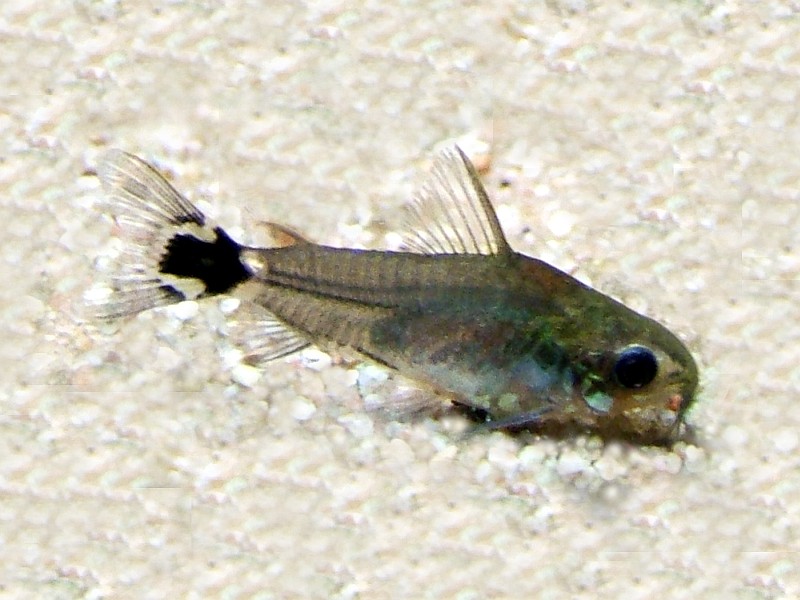
Blacktop Corydoras Corydoras acutus
The scientific name of the Blacktop Corydoras is Corydoras acutus. It is a species of fish in the family Callichthyidae (mailed catfishes), order Siluriformes. The name dates from 1872.
- Scientific name
- Corydoras acutus Cope, 1872
- Common name
- Blacktop Corydoras
- Genus
- Corydoras
- Family
- Callichthyidae (Mailed Catfishes)
- Order
- Siluriformes
- Class
- Teleostei
- Red List category
- LC Least Concern
- Environment
- freshwater
- Recorded in
- 4 countries
- Name status
- accepted in the Catalogue of Life

Overview
Blacktop Corydoras is a tropical freshwater ray-finned fish in the family Callichthyidae and subfamily Corydoradinae. It occurs in the Amazon River basin in Ecuador and northern Peru. It reaches a maximum recorded length of 4.3 centimetres.
Written 27 November 2026 from the sources listed below. Each statement was checked against the passage it cites; statements that could not be supported were removed.
Appearance
Blacktop Corydoras is a tropical freshwater ray-finned fish belonging to the subfamily Corydoradinae and family Callichthyidae.[1]
It reaches a maximum recorded length of 4.3 centimetres.[2]
Habitat
Blacktop Corydoras inhabits freshwater environments in a tropical climate. It occurs in water with a pH range of 6.0–8.0 and a hardness of 2–25 dGH.[3][4][5]
Its habitat has water temperatures between 25 and 28 °C.[6]
Diet
Blacktop Corydoras feeds on worms, benthic crustaceans and insects. It also consumes plant matter.[7][8][9][10]
Behaviour
Adults do not guard the eggs after laying them.[11]
Reproduction and life cycle
Blacktop Corydoras deposits its eggs among dense vegetation. The female carries between two and four eggs between her pelvic fins while the male fertilizes them, a process that takes approximately 30 seconds.[12][13][14]
After fertilization, the female attaches the eggs to a suitable surface. She repeats this process until approximately 100 eggs have been fertilized and deposited.[15][16]
Uses
Blacktop Corydoras has commercial importance in the aquarium trade.[17]
Classification of the Blacktop Corydoras
| Kingdom | Animalia |
|---|---|
| Phylum | Chordata |
| Subphylum | Vertebrata |
| Infraphylum | Gnathostomata |
| Parvphylum | Osteichthyes |
| Gigaclass | Actinopterygii |
| Superclass | Actinopteri |
| Class | Teleostei (Teleost) |
| Order | Siluriformes (Catfish) |
| Family | Callichthyidae (Mailed Catfishes) |
| Subfamily | Corydoradinae |
| Genus | Corydoras (Cory) |
| Species | Corydoras acutus Cope, 1872 |
Where the Blacktop Corydoras is found
Checklists and occurrence records place Corydoras acutus in 4 countries. GBIF holds 117 georeferenced records of it.
Countries
Regions and cities with the most records
- Loreto, Peru 20
- Pando, Bolivia 20
- Pará, Brazil 16
- Rondônia, Brazil 14
- Beni Department, Bolivia 7
- Nova Timboteua, Brazil 5
- Bonito, Brazil 4
- Santa Maria do Pará, Brazil 4
- Igarapé-Açu, Brazil 3
- Ourém, Brazil 3
A number beside a place is its count of GBIF occurrence records. A place without a number comes from a checklist alone. Records show where a species has been observed or collected, which can include escapes and vagrants.
Common names
English
- Blacktop Corydoras
- Blacktop Corydora
- Cortesi
- Blacktop Catfish
Names in 4 other languages
- Czech
- pancéřníček ostrý
- Polish
- Kirysek czarnogrzbiety
- Portuguese
- Coridora
- Spanish
- Coridoras, Shirudi
Related species
-
 Pygmy CorydorasCorydoras pygmaeus
-
 Bronze CorydorasCorydoras aeneus
-
 Panda CorydorasCorydoras panda
-
 Sterba's CorydorasCorydoras sterbai
-
 Dwarf CorydorasCorydoras hastatus
-
 Threestripe CorydorasCorydoras trilineatus
-
 Leopard CorydorasCorydoras julii
-
 Salt and Pepper CatfishCorydoras habrosus
Compare
Questions and answers
What is the scientific name of the Blacktop Corydoras?
The scientific name of the Blacktop Corydoras is Corydoras acutus. Written with its author, the full name is Corydoras acutus Cope, 1872.
Which family does the Blacktop Corydoras belong to?
Corydoras acutus belongs to the family Callichthyidae, in the order Siluriformes and the class Teleostei.
Where is the Blacktop Corydoras found?
Checklists and occurrence records place Corydoras acutus in 4 countries: Brazil, Peru, Bolivia and Ecuador.
What is the conservation status of the Blacktop Corydoras?
The IUCN Red List category recorded for Corydoras acutus is Least Concern (LC).
What other names does the Blacktop Corydoras have?
Corydoras acutus is also known in English as Blacktop Corydora, Cortesi and Blacktop Catfish.
What is the scientific name for Corydoras?
The scientific name of Blacktop Corydoras is Corydoras acutus.[18]
Sources
Passages the profile rests on
- The species is a tropical freshwater ray-finned fish belonging to the subfamily Corydoradinae and family Callichthyidae. Source passage: “The blacktop corydoras (Corydoras acutus) is a tropical freshwater ray-finned fish belonging to the subfamily Corydoradinae, the corys, of the family Callichthyidae, the armoured catfishes.” — English Wikipedia
- The species reaches a maximum recorded length of 4.3 centimetres. Source passage: “The fish will grow in length up to 1.7 inches (4.3 centimeters).” — English Wikipedia
- The species inhabits freshwater environments in a tropical climate. Source passage: “It lives in a tropical climate in water with a 6.0–8.0 pH, a water hardness of 2–25 dGH, and a temperature range of 77–83 °F (25–28 °C).” — English Wikipedia
- The species occurs in water with a pH range of 6.0–8.0. Source passage: “It lives in a tropical climate in water with a 6.0–8.0 pH” — English Wikipedia
- The species inhabits water with a hardness of 2–25 dGH. Source passage: “a water hardness of 2–25 dGH” — English Wikipedia
- The species inhabits water with temperatures between 25 and 28 °C. Source passage: “a temperature range of 77–83 °F (25–28 °C).” — English Wikipedia
- The species feeds on worms. Source passage: “It feeds on worms, benthic crustaceans, insects, and plant matter.” — English Wikipedia
- The species consumes benthic crustaceans. Source passage: “It feeds on worms, benthic crustaceans, insects, and plant matter.” — English Wikipedia
- The species consumes insects. Source passage: “It feeds on worms, benthic crustaceans, insects, and plant matter.” — English Wikipedia
- The species consumes plant matter. Source passage: “It feeds on worms, benthic crustaceans, insects, and plant matter.” — English Wikipedia
- Adults do not guard the eggs after laying them. Source passage: “It lays eggs in dense vegetation and adults do not guard the eggs.” — English Wikipedia
- The species deposits its eggs among dense vegetation. Source passage: “It lays eggs in dense vegetation” — English Wikipedia
- The female carries between two and four eggs between her pelvic fins while the male fertilizes them. Source passage: “The female holds 2–4 eggs between her pelvic fins, where the male fertilizes them for about 30 seconds.” — English Wikipedia
- Egg fertilization by the male takes approximately 30 seconds. Source passage: “where the male fertilizes them for about 30 seconds.” — English Wikipedia
- After fertilization, the female attaches the eggs to a suitable surface. Source passage: “Only then does the female swim to a suitable spot, where she attaches the very sticky eggs.” — English Wikipedia
- The female repeats the egg-carrying and attachment process until approximately 100 eggs have been fertilized and deposited. Source passage: “The pair repeats this process until about 100 eggs have been fertilized and attached.” — English Wikipedia
- The species has commercial importance in the aquarium trade. Source passage: “The blacktop corydoras is of commercial importance in the aquarium trade industry.” — English Wikipedia
- The species was described by Edward Drinker Cope in 1872. Source passage: “It was described by Edward Drinker Cope in 1872.” — English Wikipedia
Data
- Catalogue of Life, 2026-10-16 XR cc by
- Global Biodiversity Information Facility CC BY 4.0
- Wikidata CC0
- GeoNames CC BY 4.0
- Wikimedia Commons per image; credit shown with each image
- Within the Catalogue of Life, this name comes from World Register of Marine Species cc by
References
- Cope, E. D. (1872). On the fishes of the Ambyiacu River. Proceedings of the Academy of Natural Sciences of Philadelphia, v. 23: 250–294, Pls. 3–16. where the name was published
This species in other databases
- Catalogue of Life 6B6VG
- Wikidata Q542258
- iNaturalist 609595
- WoRMS urn:lsid:marinespecies.org:taxname:1020484
- ITIS 164283
Page built on 27 November 2026. See how the catalog is made and all sources and licences.
Cite this page
ScientificNames.org. (2026). Corydoras acutus (Blacktop Corydoras). Retrieved November 27, 2026, from https://scientificnames.org/species/corydoras-acutus
“Corydoras acutus (Blacktop Corydoras).” ScientificNames.org, 2026, scientificnames.org/species/corydoras-acutus. Accessed 27 Nov. 2026.
ScientificNames.org. “Corydoras acutus (Blacktop Corydoras).” Accessed November 27, 2026. https://scientificnames.org/species/corydoras-acutus.
@misc{scientificnames_corydoras_acutus_blacktop_corydoras,
  author = {{ScientificNames.org}},
  title = {Corydoras acutus (Blacktop Corydoras)},
  year = {2026},
  url = {https://scientificnames.org/species/corydoras-acutus},
  note = {Accessed 2026-11-27}
}