Species · Fishes
Rust Corydoras Corydoras rabauti
The scientific name of the Rust Corydoras is Corydoras rabauti. It is a species of fish in the family Callichthyidae (mailed catfishes), order Siluriformes. The name dates from 1941.
- Scientific name
- Corydoras rabauti La Monte, 1941
- Common name
- Rust Corydoras
- Genus
- Corydoras
- Family
- Callichthyidae (Mailed Catfishes)
- Order
- Siluriformes
- Class
- Teleostei
- Environment
- freshwater
- Recorded in
- 4 countries
- Name status
- accepted in the Catalogue of Life

Overview
The Rust Corydoras is a fish first described in 1941 by American ichthyologist Francesca Raimonde La Monte. It is native to the Upper Amazon, Solimões, and Rio Negro basins in South America, with known distribution in Brazil and Peru and possible occurrence in Colombia. Its body is rusty orange and has a large black stripe extending from the dorsal body region to the ventral portion of the caudal peduncle.
Written 26 November 2026 from the sources listed below. Each statement was checked against the passage it cites; statements that could not be supported were removed.
Appearance
The Rust Corydoras has a rusty orange body and a large black stripe extending from the dorsal body region to the ventral portion of the caudal peduncle. It lacks scales and is covered with bony plates called scutes.[1][2][3]
Adults typically measure between 55 and 65 millimetres in length. Sexually mature females tend to be larger, broader, and deeper-bodied than males.[4][5]
Habitat
The species primarily inhabits floodplain lakes, oxbow lakes, and riverine environments. It occurs at water depths between 2 and 25 metres.[6][7]
Its habitat waters have a pH between 6.0 and 8.0. Documented tropical habitat temperatures range from 25 to 27 °C.[8][9]
Diet
The Rust Corydoras is omnivorous. Its natural diet includes small worms, crustaceans, insects, freshwater detritus, and plant matter.[10][11]
In aquariums, it readily accepts sinking dry foods, brine shrimp, bloodworms, and Tubifex worms.[12]
Behaviour
The species is peaceful and gregarious. It occasionally rises to the water surface to gulp air before submerging and can breathe atmospheric oxygen using a heavily modified intestine.[13][14][15]
The species secretes mild venom from axillary glands located at the bases of its pectoral-fin spines. Its stiffened pectoral-fin spines can penetrate human skin and cause significant pain.[16][17]
Reproduction and life cycle
During spawning, females hold two to four eggs between their pelvic fins while males fertilize them. This fertilization and egg-holding process can take up to 30 seconds.[18][19]
Females repeatedly attach fertilized eggs to suitable hiding locations until approximately 100 eggs have been deposited. The species hides its eggs but does not guard or care for them afterward.[20][21]
Egg incubation lasts approximately three to four days before hatching. After absorbing their yolk sacs, newly hatched fry are recommended to receive small live foods such as brine shrimp and microworms.[22][23]
Conservation
The species has not been evaluated for the IUCN Red List. It is not of interest to commercial fisheries.[24][25]
Similar species
Osteogaster rabauti can be distinguished from Osteogaster zygatus by its black stripe extending into the ventral portion of the caudal peduncle.[26]
Classification of the Rust Corydoras
| Kingdom | Animalia |
|---|---|
| Phylum | Chordata |
| Subphylum | Vertebrata |
| Infraphylum | Gnathostomata |
| Parvphylum | Osteichthyes |
| Gigaclass | Actinopterygii |
| Superclass | Actinopteri |
| Class | Teleostei (Teleost) |
| Order | Siluriformes (Catfish) |
| Family | Callichthyidae (Mailed Catfishes) |
| Subfamily | Corydoradinae |
| Genus | Corydoras (Cory) |
| Species | Corydoras rabauti La Monte, 1941 |
Where the Rust Corydoras is found
Checklists and occurrence records place Corydoras rabauti in 4 countries across South America. GBIF holds 67 georeferenced records of it.
Countries
Regions and cities with the most records
- Amazonas Department, Colombia 15
- Tabatinga, Brazil 11
- Leticia, Colombia 10
- Loreto, Peru 9
- Benjamin Constant, Brazil 5
- Ucayali, Peru 5
- Amazonas, Brazil 3
- Aripuanã, Brazil 3
- Mato Grosso, Brazil 3
A number beside a place is its count of GBIF occurrence records. A place without a number comes from a checklist alone. Records show where a species has been observed or collected, which can include escapes and vagrants.
Common names
English
- Rust Corydoras
- Rabaut's Corydoras
- Dwarf Corydoras
- Iridescent Corydoras
- Myer's Corydoras
- Orange-red Corydoras
- Rabaut's Catfish
- Rust Cory Catfish
- Rusty Corydoras
Names in 10 other languages
- Chinese
- 邁氏兵鯰
- Czech
- pancéřníček tmavý
- Danish
- Myers pansermalle
- Finnish
- Ruostemonninen
- German
- Rostpanzerwels
- Mandarin Chinese
- 迈氏兵鲶, 黑躯兵鲶, 黑軀兵鯰
- Polish
- kirysek rdzawy
- Portuguese
- Coridora, Corídora
- Russian
- Панцирник Рабо
- Swedish
- Rostpansarmal
Synonyms
3 other scientific names have been used for this species and are now treated as synonyms of Corydoras rabauti.
- Corydoras meyersi Miranda Ribeiro, 1942
- Corydoras myersi Miranda Ribeiro, 1942
- Osteogaster rabauti (La Monte, 1941)
Related species
-
 Pygmy CorydorasCorydoras pygmaeus
-
 Bronze CorydorasCorydoras aeneus
-
 Panda CorydorasCorydoras panda
-
 Sterba's CorydorasCorydoras sterbai
-
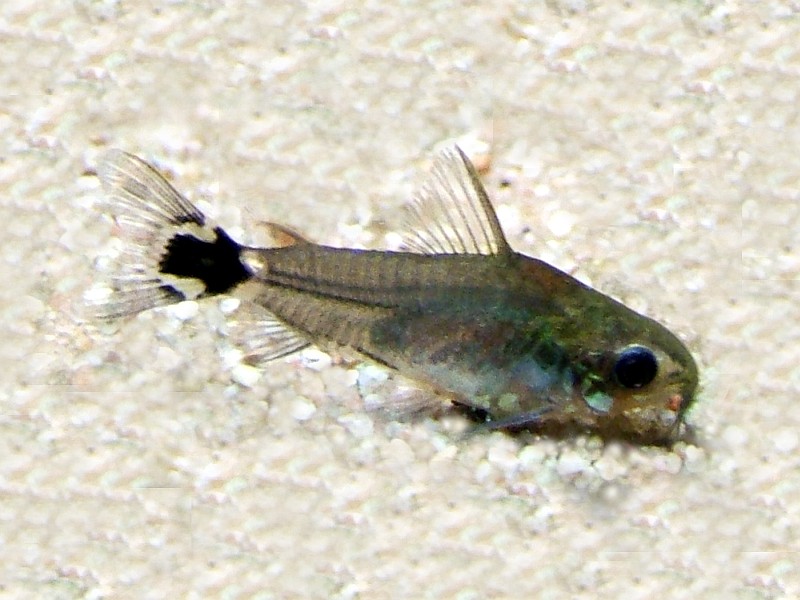 Dwarf CorydorasCorydoras hastatus
-
 Threestripe CorydorasCorydoras trilineatus
-
 Leopard CorydorasCorydoras julii
-
 Salt and Pepper CatfishCorydoras habrosus
Compare
Questions and answers
What is the scientific name of the Rust Corydoras?
The scientific name of the Rust Corydoras is Corydoras rabauti. Written with its author, the full name is Corydoras rabauti La Monte, 1941.
Which family does the Rust Corydoras belong to?
Corydoras rabauti belongs to the family Callichthyidae, in the order Siluriformes and the class Teleostei.
Where is the Rust Corydoras found?
Checklists and occurrence records place Corydoras rabauti in 4 countries: Brazil, Peru, Colombia and Ecuador.
What other names does the Rust Corydoras have?
Corydoras rabauti is also known in English as Rabaut's Corydoras, Dwarf Corydoras, Iridescent Corydoras, Myer's Corydoras, Orange-red Corydoras and Rabaut's Catfish.
What is the scientific name for Corydoras?
The scientific name of the Rust Corydoras is Corydoras rabauti La Monte, 1941.[27]
What foods do Corydoras eat?
The Rust Corydoras is omnivorous. Its natural diet includes small worms, crustaceans, insects, freshwater detritus, and plant matter. In aquariums, it readily accepts sinking dry foods, brine shrimp, bloodworms, and Tubifex worms.[10][11][12]
Sources
Passages the profile rests on
- The body is rusty orange in coloration. Source passage: “The body of Osteogaster rabauti is a rusty orange hue” — English Wikipedia
- A large black stripe extends from the dorsal body region to the ventral portion of the caudal peduncle. Source passage: “It has a large black stripe in the dorsal portion of its body, which extends to the ventral portion of the caudal peduncle.” — English Wikipedia
- The species lacks scales and is covered with bony plates called scutes. Source passage: “O. rabauti is completely scaleless, and is instead covered with bony plates known as scutes.” — English Wikipedia
- Adults typically measure between 55 and 65 millimetres in length. Source passage: “adults typically growing to a length of 55 millimetres (2.2 in) to 65 millimetres (2.6 in).” — English Wikipedia
- Sexually mature females tend to be larger, broader, and deeper-bodied than males. Source passage: “sexually mature females tending to grow larger, broader, and deeper-bodied than males.” — English Wikipedia
- The species primarily inhabits floodplain lakes, oxbow lakes, and riverine environments. Source passage: “It primarily inhabits floodplain lakes, oxbow lakes, and riverine habitats.” — English Wikipedia
- It occurs at water depths between 2 and 25 metres. Source passage: “in depths between 2 metres (6.6 ft) and 25 metres (82 ft)” — English Wikipedia
- It occurs in waters with a pH between 6.0 and 8.0. Source passage: “It is found in a pH range of 6.0 to 8.0” — English Wikipedia
- Its documented tropical habitat temperatures range from 25 to 27 °C. Source passage: “in tropical temperatures of 25 °C (77 °F) to 27 °C (81 °F).” — English Wikipedia
- The species is omnivorous. Source passage: “Osteogaster rabauti is an omnivore” — English Wikipedia
- Its natural diet includes small worms, crustaceans, insects, freshwater detritus, and plant matter. Source passage: “small worms, crustaceans, and insects; as well as freshwater detritus and plant matter.” — English Wikipedia
- In aquariums, it readily accepts sinking dry foods, brine shrimp, bloodworms, and Tubifex worms. Source passage: “it will readily accept most sinking dry foods, as well as live or frozen brine shrimp, bloodworms, and Tubifex worms.” — English Wikipedia
- The species is peaceful and gregarious. Source passage: “Osteogaster rabauti is a peaceful and gregarious fish” — English Wikipedia
- It occasionally rises to the water surface to gulp air before submerging. Source passage: “occasionally rising to surface of the water and taking in gulps of air before submerging.” — English Wikipedia
- It can breathe atmospheric oxygen using a heavily modified intestine. Source passage: “They possess a heavily modified intestine, which allows them to take in atmospheric oxygen and survive in low-oxygen environments.” — English Wikipedia
- The species secretes mild venom from axillary glands located at the bases of its pectoral-fin spines. Source passage: “Osteogaster rabauti secretes a mild venom from the axillary glands at the base of each pectoral-fin spine” — English Wikipedia
- Its stiffened pectoral-fin spines can penetrate human skin and cause significant pain. Source passage: “these spines are capable of penetrating human skin and causing significant pain in conjunction with the venom.” — English Wikipedia
- During spawning, females hold two to four eggs between their pelvic fins while males fertilize them. Source passage: “the female fish will hold two to four eggs between her pelvic fins, while the male fertilizes them.” — English Wikipedia
- The fertilization and egg-holding process can take up to 30 seconds. Source passage: “This can take up to 30 seconds” — English Wikipedia
- The species hides its eggs but does not guard or care for them afterward. Source passage: “it hides its eggs, but does not guard or care for them after.” — English Wikipedia
- Females repeatedly attach fertilized eggs to suitable hiding locations until approximately 100 eggs have been deposited. Source passage: “This process will be repeated until about 100 eggs are fertilized and attached to the hiding place.” — English Wikipedia
- Egg incubation lasts approximately three to four days before hatching. Source passage: “Incubation takes place for 3–4 days, after which the eggs will hatch.” — English Wikipedia
- Newly hatched fry are recommended to receive small live foods such as brine shrimp and microworms after absorbing their yolk sacs. Source passage: “When the fry fully absorb their yolk sacs, it is recommended to feed them small live food such as brine shrimp and microworms.” — English Wikipedia
- The species has not been evaluated for the IUCN Red List. Source passage: “It has not been evaluated by the IUCN Red List” — English Wikipedia
- The species is not of interest to commercial fisheries. Source passage: “and is of no interest to commercial fisheries.” — English Wikipedia
- Osteogaster rabauti can be distinguished from Osteogaster zygatus by its black stripe extending into the ventral portion of the caudal peduncle. Source passage: “This allows it to be distinguished from the visually similar species Osteogaster zygatus, as O. zygatus's stripe is only present on the dorsal portion of its body.” — English Wikipedia
- The species was first described in 1941 by American ichthyologist Francesca Raimonde La Monte. Source passage: “It was first described by the American ichthyologist Francesca Raimonde La Monte in 1941” — English Wikipedia
- The species is native to the Upper Amazon, Solimões, and Rio Negro basins in South America. Source passage: “Osteogaster rabauti is native to the Upper Amazon, Solimões, and Rio Negro basins in South America.” — English Wikipedia
- Its known geographic distribution includes Brazil and Peru, with a possible occurrence in Colombia. Source passage: “it is known to inhabit Brazil and Peru, and possibly Colombia as well.” — English Wikipedia
Data
- Catalogue of Life, 2026-10-16 XR cc by
- Global Biodiversity Information Facility CC BY 4.0
- Wikidata CC0
- GeoNames CC BY 4.0
- Wikimedia Commons per image; credit shown with each image
- Within the Catalogue of Life, this name comes from World Register of Marine Species cc by
References
- LaMonte, F. R. (1941). A new Corydoras from Brazil. Zoologica, Scientific Contributions of the New York Zoological Society, 26 (pt 1, no. 2): 5–6. where the name was published
This species in other databases
Page built on 28 November 2026. See how the catalog is made and all sources and licences.
Cite this page
ScientificNames.org. (2026). Corydoras rabauti (Rust Corydoras). Retrieved November 28, 2026, from https://scientificnames.org/species/corydoras-rabauti
“Corydoras rabauti (Rust Corydoras).” ScientificNames.org, 2026, scientificnames.org/species/corydoras-rabauti. Accessed 28 Nov. 2026.
ScientificNames.org. “Corydoras rabauti (Rust Corydoras).” Accessed November 28, 2026. https://scientificnames.org/species/corydoras-rabauti.
@misc{scientificnames_corydoras_rabauti_rust_corydoras,
  author = {{ScientificNames.org}},
  title = {Corydoras rabauti (Rust Corydoras)},
  year = {2026},
  url = {https://scientificnames.org/species/corydoras-rabauti},
  note = {Accessed 2026-11-28}
}