Species · Birds
Great Blue Turaco Corythaeola cristata
The scientific name of the Great Blue Turaco is Corythaeola cristata. It is a species of bird in the family Musophagidae (turaco), order Musophagiformes. The name dates from 1816.
- Scientific name
- Corythaeola cristata (Vieillot, 1816)
- Common name
- Great Blue Turaco
- Genus
- Corythaeola
- Family
- Musophagidae (Turaco)
- Order
- Musophagiformes
- Class
- Aves
- Red List category
- LC Least Concern
- Recorded in
- 22 countries
- Name status
- accepted in the Catalogue of Life

Overview
Corythaeola cristata inhabits rainforests and gallery forests and occurs from Guinea eastward across sub-Saharan nations to the Imatong Mountains in South Sudan. It has predominantly grey-blue upperparts and an upright blue-black crest approximately 10 cm high.
Written 26 November 2026 from the sources listed below. Each statement was checked against the passage it cites; statements that could not be supported were removed.
Appearance
Its undertail coverts are chestnut, while its undertail is black and yellowish. Its yellow bill has an orange-red tip, and its brown eyes are surrounded by black bare skin.[1][2]
Its legs and feet are black with yellow soles. Males and females have similar plumage.[3][4]
The Great Blue Turaco measures 70–76 cm in length and has a body mass ranging from 800 to 1,231 g.[5][6]
Habitat
The Great Blue Turaco inhabits rainforests and gallery forests. It can thrive in areas cleared by humans.[7][8]
Its range extends from Guinea eastward across sub-Saharan nations to the Imatong Mountains in South Sudan. Its documented range includes Uganda, Rwanda, Tanzania, western Kenya, the Democratic Republic of Congo, and Angola.[9][10][11]
Diet
The Great Blue Turaco feeds on leaves, flowers, and fruits from numerous plant species. Documented food plants include species of the genera Musanga, Cissus, Ficus, Polyalthia, and Heisteria.[12][13]
In Kenya, it has been recorded eating mitzeeri in April, loquat in July, guava in September, and Cordia africana during November and December.[14][15][16][17]
In observations from Rwanda, leaves constitute approximately 25% of its diet. It consumes leaves more frequently when fruit is less abundant.[18][19]
Behaviour
The Great Blue Turaco is gregarious and forms small groups of approximately six or seven individuals. It contributes to seed dispersal by passing seeds in its faeces away from parent trees.[20][21]
Reproduction and life cycle
The Great Blue Turaco nests in trees at heights of 8–25 metres above the ground. Its nest is constructed as a platform of sticks.[22][23]
Both sexes incubate the eggs. The usual clutch contains two eggs, although clutches of one or three eggs are occasionally recorded.[24][25]
The eggs are white or greenish-white and almost round. They measure 46–50 mm by 41–43 mm.[26][27]
Uses
The Great Blue Turaco is highly regarded as food in West Africa and is hunted and eaten by local people. Its meat is popular in smaller villages.[28][29]
Its long tail feathers are valued for decorative purposes.[30]
Similar species
The closest relatives of the Great Blue Turaco are the go-away birds and plantain eaters of the genus Crinifer.[31]
Classification of the Great Blue Turaco
| Kingdom | Animalia |
|---|---|
| Phylum | Chordata |
| Subphylum | Vertebrata |
| Infraphylum | Gnathostomata |
| Parvphylum | Osteichthyes |
| Megaclass | Tetrapoda |
| Class | Aves (Bird) |
| Order | Musophagiformes (Turaco) |
| Family | Musophagidae (Turaco) |
| Genus | Corythaeola |
| Species | Corythaeola cristata (Vieillot, 1816) |
Where the Great Blue Turaco is found
Checklists and occurrence records place Corythaeola cristata in 22 countries across Africa. GBIF holds 20,187 georeferenced records of it.
Countries
- Angola 144
- Burundi 25
- Cameroon 542
- Central African Republic 175
- Democratic Republic of the Congo 690
- Equatorial Guinea 404
- Gabon 529
- Ghana 786
- Guinea 24
- Guinea-Bissau 108
- Ivory Coast 468
- Kenya 1,573
- Liberia 164
- Niger 4
- Nigeria 391
- Republic of the Congo 326
- Rwanda 1,143
- Sierra Leone 330
- South Sudan 4
- Tanzania 47
- Togo 9
- Uganda 12,301
Regions and cities with the most records
- Kasanje, Uganda 3,369
- Katabi, Uganda 3,231
- Entebbe, Uganda 3,192
- Kajansi, Uganda 2,884
- Rwiimi, Uganda 2,367
- Kanungu, Uganda 1,760
- Kakamega County, Kenya 1,438
- Kakamega, Kenya 1,331
- Ntungamo, Uganda 1,119
- Western Province, Rwanda 1,100
- Cyato, Rwanda 1,072
- Rangiro, Rwanda 1,065
- Bushekeri, Rwanda 1,056
- Rubanda, Uganda 1,015
- Kirambo, Rwanda 859
- Mpigi, Uganda 839
- Karengera, Rwanda 832
- Kagano, Rwanda 830
- Western, Ghana 704
- Karambi, Rwanda 664
- Bunamwaya, Uganda 618
- Elubo, Ghana 605
- Lugazi, Uganda 602
- Buhesi, Uganda 592
- Kyengera, Uganda 549
- Kampala, Uganda 517
- Buikwe, Uganda 504
- Njeru, Uganda 491
- Shangi, Rwanda 423
- Bushenge, Rwanda 412
- Nyabitekeli, Rwanda 398
- Bundibugyo, Uganda 388
- Fort Portal, Uganda 384
- Masindi, Uganda 351
- Kasangati, Uganda 342
- Mai-Ndombe, Democratic Republic of the Congo 321
1 more country has a few records outside this range
These countries hold a few records of Corythaeola cristata but lie outside the range the checklists give for it. Such records are often zoo or garden specimens, museum material or vagrants, so the species is not counted as occurring there.
Range as the checklists state it
Africa
A number beside a place is its count of GBIF occurrence records. A place without a number comes from a checklist alone. Records show where a species has been observed or collected, which can include escapes and vagrants.
Common names
English
- Great Blue Turaco
- GBTU
Names in 28 other languages
- Arabic
- توراكو أزرق كبير
- Catalan
- turac gegant
- Chinese
- 蓝蕉鹃, 藍蕉鵑
- Croatian
- veliki turako
- Czech
- turako velký
- Danish
- Kæmpeturako
- Dutch
- Reuzentoerako
- Esperanto
- giganta turako
- Estonian
- hiidturako
- Finnish
- keisariturako
- French
- Touraco géant
- German
- Riesenturako
- Greek
- Μπλε Τουράκο
- Hungarian
- óriásturákó
- Italian
- Turaco azzurro gigante, Turaco blu maggiore
- Japanese
- カンムリエボシドリ
- Lithuanian
- mėlynasis turakas
- Norwegian
- kjempeturako
- Polish
- szyszak, turako olbrzymi
- Portuguese
- turaco-gigante, turaco-grande
- Russian
- Большой голубой турако, Большой турако
- Serbian
- Veliki plavi turako
- Slovak
- koko veľký
- Spanish
- Turaco gigante
- Swedish
- jätteturako
- Turkish
- Büyük Mavi Turakogil, Büyük Turako, Büyük mavi muzcul
- Ukrainian
- турако блакитний
- Welsh
- twraco mawr
Synonyms
3 other scientific names have been used for this species and are now treated as synonyms of Corythaeola cristata.
- Corythaeola cristata cristata Vieillot, LJP, 1816
- Corythaeola cristata yalensis Mearns, EA, 1915
- Musophaga cristata Vieillot, 1816
Related species
-
 Red-crested TuracoTauraco erythrolophus
-
 Knysna TuracoTauraco corythaix
-
 Guinea TuracoTauraco persa
-
 Western Plantain-eaterCrinifer piscator
-
 Livingstone's TuracoTauraco livingstonii
-
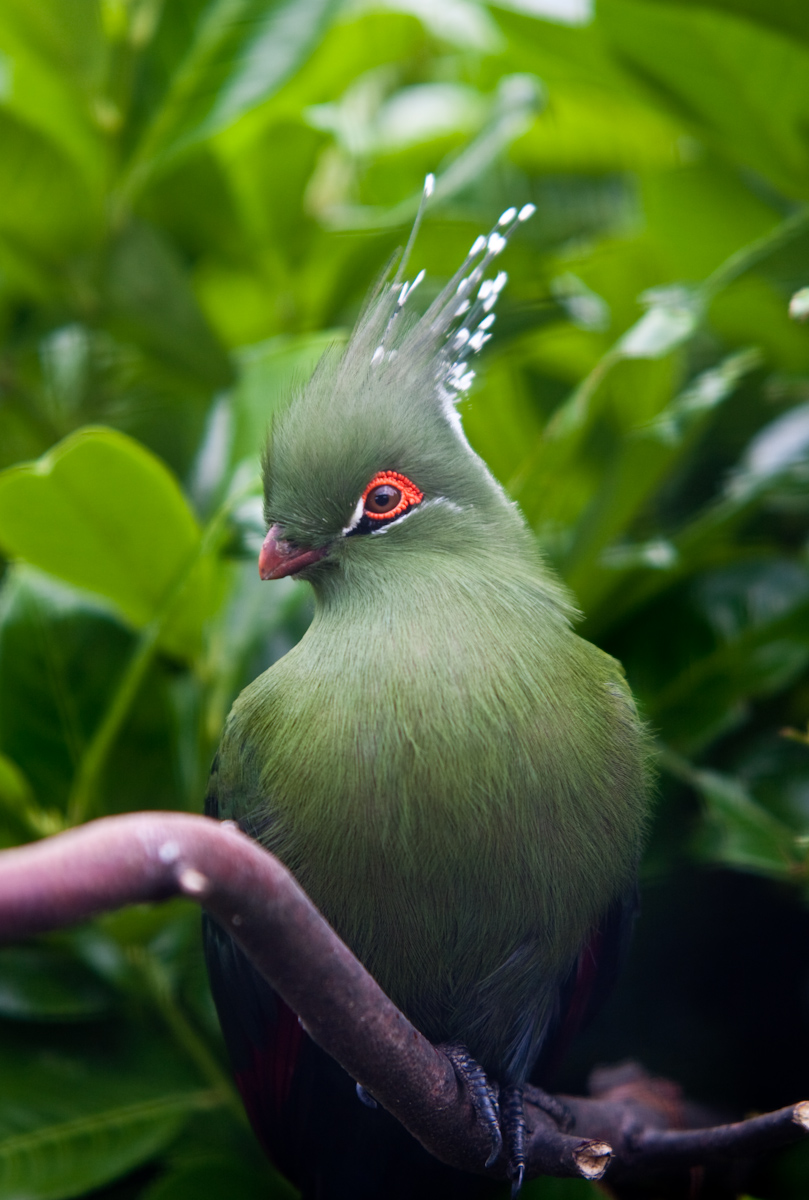 Schalow's TuracoTauraco schalowi
-
 Fischer's TuracoTauraco fischeri
-
 Hartlaub's TuracoTauraco hartlaubi
Compare
Questions and answers
What is the scientific name of the Great Blue Turaco?
The scientific name of the Great Blue Turaco is Corythaeola cristata. Written with its author, the full name is Corythaeola cristata (Vieillot, 1816).
Which family does the Great Blue Turaco belong to?
Corythaeola cristata belongs to the family Musophagidae, in the order Musophagiformes and the class Aves.
Where is the Great Blue Turaco found?
Checklists and occurrence records place Corythaeola cristata in 22 countries, including Uganda, Kenya, Rwanda, Ghana, Democratic Republic of the Congo and Cameroon.
What is the conservation status of the Great Blue Turaco?
The IUCN Red List category recorded for Corythaeola cristata is Least Concern (LC).
What other names does the Great Blue Turaco have?
Corythaeola cristata is also known in English as GBTU.
Where does the great blue turaco live?
The Great Blue Turaco inhabits rainforests and gallery forests. Its range extends from Guinea eastward across sub-Saharan nations to the Imatong Mountains in South Sudan, and south to the Democratic Republic of Congo and Angola.[7][9][11]
Sources
Passages the profile rests on
- Its undertail coverts are chestnut, while its undertail is black and yellowish. Source passage: “The undertail coverts are chestnut, and the undertail is black and yellowish.” — English Wikipedia
- Its yellow bill has an orange-red tip, and its brown eyes are surrounded by black bare skin. Source passage: “The yellow bill has an orange-red tip, the eyes are brown, and surrounded by a ring of black bare skin.” — English Wikipedia
- Its legs and feet are black with yellow soles. Source passage: “The legs and feet are black with yellow soles.” — English Wikipedia
- Male and female Great Blue Turacos have similar plumage. Source passage: “The sexes have similar plumage.” — English Wikipedia
- The Great Blue Turaco measures 70–76 cm in length. Source passage: “At 70–76 cm (28–30 in) in length, it is the largest species of turaco.” — English Wikipedia
- The Great Blue Turaco has a body mass ranging from 800 to 1,231 g. Source passage: “Generally, the great blue turaco is 70–76 cm (28–30 in) in length with a mass of 800–1,231 g (1.764–2.714 lb).” — English Wikipedia
- The Great Blue Turaco inhabits rainforests and gallery forests. Source passage: “It inhabits rainforests and gallery forests.” — English Wikipedia
- The species can thrive in areas cleared by humans. Source passage: “It has also adapted to areas cleared by humans and can thrive in these areas.” — English Wikipedia
- The Great Blue Turaco occurs from Guinea eastward across sub-Saharan nations to the Imatong Mountains in South Sudan. Source passage: “The species ranges from Guinea in the west, and east across the sub-Saharan nations to the Imatong Mountains in South Sudan;” — English Wikipedia
- Its documented range includes Uganda, Rwanda, Tanzania, and western Kenya. Source passage: “it also occurs in Uganda, Rwanda, Tanzania and western Kenya,” — English Wikipedia
- The species' range extends south to the Democratic Republic of Congo and Angola. Source passage: “south to the Democratic Republic of Congo and Angola.” — English Wikipedia
- The Great Blue Turaco feeds on leaves, flowers, and fruits from numerous plant species. Source passage: “The great blue turaco eats leaves, flowers, as well as fruit of many plant species,” — English Wikipedia
- Its documented food plants include species of the genera Musanga, Cissus, Ficus, Polyalthia, and Heisteria. Source passage: “including those of the genera Musanga, Cissus, Ficus (such as Ficus capensis) Polyalthia, Heisteria,” — English Wikipedia
- In Kenya, the species has been recorded eating mitzeeri in April. Source passage: “In Kenya, it has been recorded eating mitzeeri (Bridelia micrantha) in April,” — English Wikipedia
- In Kenya, the species has been recorded eating loquat in July. Source passage: “loquat (Eriobotrya japonica) in July,” — English Wikipedia
- In Kenya, the species has been recorded eating guava in September. Source passage: “guava (Psidium guajava) in September” — English Wikipedia
- In Kenya, the species has been recorded eating Cordia africana during November and December. Source passage: “and Cordia africana over November and December.” — English Wikipedia
- Leaves constitute approximately 25% of the Great Blue Turaco's diet in observations from Rwanda. Source passage: “Fieldwork in Rwanda revealed leaves constituted around 25% of its diet,” — English Wikipedia
- The species consumes leaves more frequently when fruit is less abundant. Source passage: “being eaten more often when fruit is less abundant.” — English Wikipedia
- The Great Blue Turaco is gregarious and forms small groups of approximately six or seven individuals. Source passage: “The great blue turaco is gregarious, with birds forming small troops of some six or seven individuals.” — English Wikipedia
- The Great Blue Turaco contributes to seed dispersal by passing seeds in its faeces away from parent trees. Source passage: “The species also play a role in seed dispersal as it generally passes seed in its faeces some distance from parent trees.” — English Wikipedia
- The Great Blue Turaco nests in trees at heights of 8–25 metres above the ground. Source passage: “The species nests in trees between 8 and 25 metres (26 and 82 ft) above the ground,” — English Wikipedia
- Its nest is constructed as a platform of sticks. Source passage: “the nest is a platform of sticks.” — English Wikipedia
- Both sexes incubate the eggs. Source passage: “Both sexes incubate the clutch of two (rarely one or three) eggs” — English Wikipedia
- The usual clutch contains two eggs, although clutches of one or three eggs are occasionally recorded. Source passage: “the clutch of two (rarely one or three) eggs” — English Wikipedia
- The eggs are white or greenish-white and almost round. Source passage: “The eggs are white or greenish-white and almost round,” — English Wikipedia
- The eggs measure 46–50 mm by 41–43 mm. Source passage: “measuring 46–50 mm by 41–43 mm (1.8–2.0 in by 1.6–1.7 in).” — English Wikipedia
- The Great Blue Turaco is highly regarded as food in West Africa and is hunted and eaten by local people. Source passage: “Highly regarded as food in West Africa, it is often hunted and eaten by local people.” — English Wikipedia
- The meat of the Great Blue Turaco is popular in smaller villages. Source passage: “The meat is popular in smaller villages,” — English Wikipedia
- Its long tail feathers are valued for decorative purposes. Source passage: “and the long tail feathers are prized for decorations.” — English Wikipedia
- The closest relatives of the Great Blue Turaco are the go-away birds and plantain eaters of the genus Crinifer. Source passage: “Its closest relatives are the go-away birds and plantain eaters of the genus Crinifer.” — English Wikipedia
Data
- Catalogue of Life, 2026-10-16 XR cc by
- Global Biodiversity Information Facility CC BY 4.0
- Wikidata CC0
- GeoNames CC BY 4.0
- Wikimedia Commons per image; credit shown with each image
- Within the Catalogue of Life, this name comes from The Integrated Taxonomic Information System cc0
References
- Dickinson, Edward C., ed. (2003). The Howard and Moore Complete Checklist of the Birds of the World, 3rd Edition.
- Gill, Frank, & and Minturn Wright. (2006). Birds of the World: Recommended English Names.
- Dickinson, E. C., and J. V. Remsen Jr., eds. (2013). The Howard and Moore Complete Checklist of the Birds of the World, 4th Edition, Vol. 1 Non-Passerines.
This species in other databases
Page built on 29 November 2026. See how the catalog is made and all sources and licences.
Cite this page
ScientificNames.org. (2026). Corythaeola cristata (Great Blue Turaco). Retrieved November 29, 2026, from https://scientificnames.org/species/corythaeola-cristata
“Corythaeola cristata (Great Blue Turaco).” ScientificNames.org, 2026, scientificnames.org/species/corythaeola-cristata. Accessed 29 Nov. 2026.
ScientificNames.org. “Corythaeola cristata (Great Blue Turaco).” Accessed November 29, 2026. https://scientificnames.org/species/corythaeola-cristata.
@misc{scientificnames_corythaeola_cristata_great_blue_turaco,
  author = {{ScientificNames.org}},
  title = {Corythaeola cristata (Great Blue Turaco)},
  year = {2026},
  url = {https://scientificnames.org/species/corythaeola-cristata},
  note = {Accessed 2026-11-29}
}