Species · Birds
Fischer's Turaco Tauraco fischeri
The scientific name of the Fischer's Turaco is Tauraco fischeri. It is a species of bird in the family Musophagidae (turaco), order Musophagiformes. The name dates from 1878.
- Scientific name
- Tauraco fischeri (Reichenow, 1878)
- Common name
- Fischer's Turaco
- Genus
- Tauraco
- Family
- Musophagidae (Turaco)
- Order
- Musophagiformes
- Class
- Aves
- Red List category
- NT Near Threatened
- Recorded in
- 3 countries
- Name status
- accepted in the Catalogue of Life

Overview
Tauraco fischeri occurs in coastal East Africa, including Kenya, Somalia, and Tanzania.
Written 26 November 2026 from the sources listed below. Each statement was checked against the passage it cites; statements that could not be supported were removed.
Similar species
White eye stripes and red orbital skin distinguish Fischer's Turaco from the red-crested turaco.[1]
Appearance
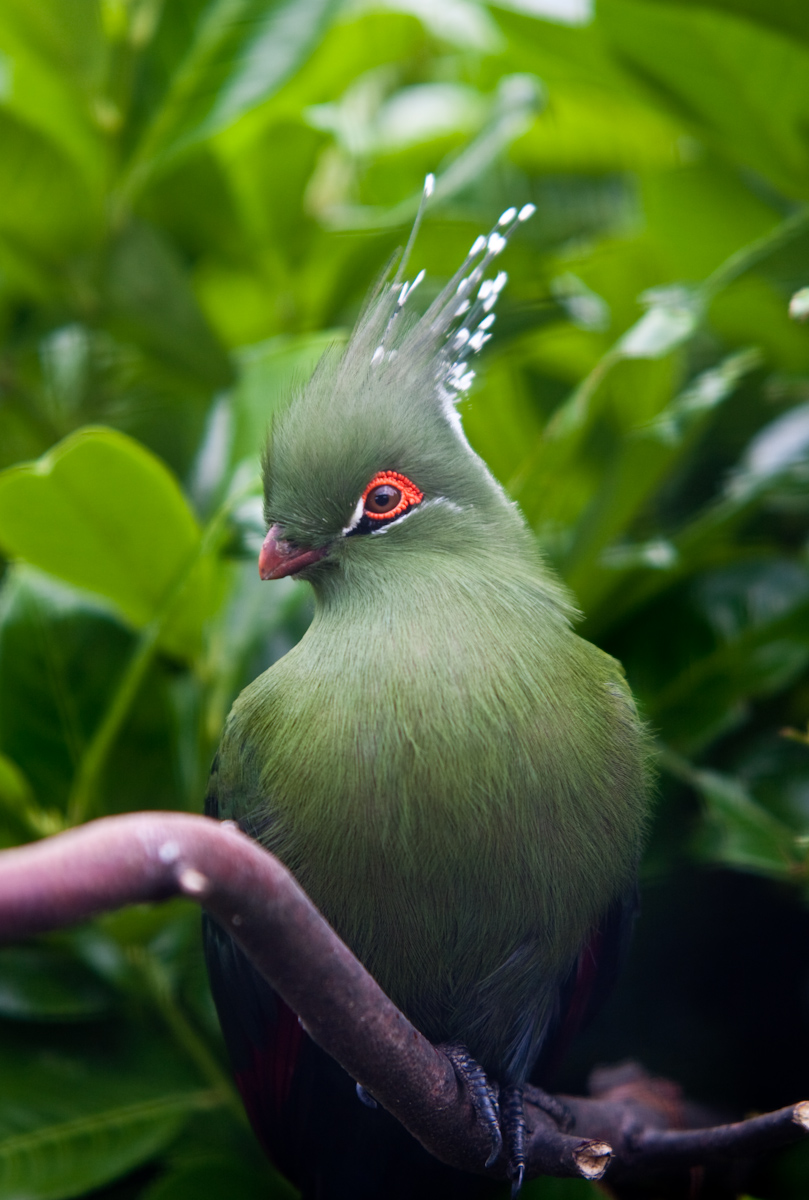
Fischer's Turaco has a green body, a reddish crest with white tips, a black belly, and red primary feathers. Its wings are green-blue and its tail is dark blue-green.[2][3]
The skin surrounding its eyes is red and bordered by a white line extending toward the red bill. A small black patch below the eye is bordered by a white line extending beneath the ear-coverts.[4][5]
The species has iridescent dark blue wings and tail, together with a green head and breast. Its head bears a moderate crest.[6][7]
Habitat
Fischer's Turaco occurs in coastal East Africa, including Kenya, Somalia, and Tanzania. It inhabits coastal and riverine forests and woodlands in its East African range.[8][9]
Its natural habitats include subtropical or tropical moist lowland forest, subtropical or tropical moist montane forest, and arable land. It occupies forest thickets and favors the canopy and sub-canopy of mature fruiting trees.[10][11]
Diet
Fischer's Turaco feeds mainly on fruits, particularly figs and berries. Its diet also includes flower buds, young leaf shoots, and insects.[12][13]
Behaviour
Individuals commonly travel alone or in pairs.[14]
Its song consists of loud growls with slowly rising notes that develop into sequences of up to 12 identical notes.[15]
Reproduction and life cycle
After forming a pair bond, Fischer's Turaco constructs a loose platform nest made of sticks in the tree canopy. Both sexes participate in nest construction and egg incubation.[16][17]
A typical clutch contains two white eggs. Egg incubation lasts approximately 22–23 days.[18][19]
Chicks leave the nest at approximately four to five weeks of age. Young birds are not capable of flying until approximately six weeks of age.[20][21]
Conservation
The population of Fischer's Turaco is decreasing, with an estimated 1,500 to 7,000 mature individuals. The species is threatened by habitat loss and trapping for the wildlife trade.[22][23][24]
The species is protected under Appendix II of the Convention on International Trade in Endangered Species of Wild Fauna and Flora. Commercial trade of the species was suspended in Somalia in 2019 under Notification to the Parties No. 2004/055.[25][26]
A shipment containing 38 trafficked individuals was intercepted in Zambia in 2025.[27]
Classification of the Fischer's Turaco
| Kingdom | Animalia |
|---|---|
| Phylum | Chordata |
| Subphylum | Vertebrata |
| Infraphylum | Gnathostomata |
| Parvphylum | Osteichthyes |
| Megaclass | Tetrapoda |
| Class | Aves (Bird) |
| Order | Musophagiformes (Turaco) |
| Family | Musophagidae (Turaco) |
| Genus | Tauraco (Turacos) |
| Species | Tauraco fischeri (Reichenow, 1878) |
Where the Fischer's Turaco is found
Checklists and occurrence records place Tauraco fischeri in 3 countries across Africa. GBIF holds 2,264 georeferenced records of it.
Countries
Regions and cities with the most records
- Kilifi County, Kenya 1,088
- Watamu, Kenya 714
- Tanga, Tanzania 559
- Maramba, Tanzania 525
- Kwale County, Kenya 449
- Malindi, Kenya 447
- Korogwe, Tanzania 446
- Muheza, Tanzania 428
- Ukunda, Kenya 340
- Matuga, Kenya 189
- Tana River County, Kenya 33
- Jomvu, Kenya 16
- Mazeras, Kenya 16
- Kilifi, Kenya 12
- Mariakani, Kenya 12
- Mtwapa, Kenya 12
- Lushoto, Tanzania 11
- Matui, Tanzania 11
- Mazinde, Tanzania 11
- Mombasa, Kenya 10
- Lamu, Kenya 7
- Mlalo, Tanzania 7
- Masalani, Kenya 4
2 more countries have a few records outside this range
These countries hold a few records of Tauraco fischeri but lie outside the range the checklists give for it. Such records are often zoo or garden specimens, museum material or vagrants, so the species is not counted as occurring there.
Range as the checklists state it
Africa
A number beside a place is its count of GBIF occurrence records. A place without a number comes from a checklist alone. Records show where a species has been observed or collected, which can include escapes and vagrants.
Common names
English
- Fischer's Turaco
- FITU
Names in 33 other languages
- Arabic
- توراكو فيشر, توراكو فيشري
- Breton
- Tourako Fischer
- Catalan
- turac de Fischer
- Chinese
- 費氏冠蕉鵑, 费氏蕉鹃
- Croatian
- crvenokresti turako
- Czech
- turako Fischerův, turako pobřežní
- Danish
- Fischers Turako, Fischer´ Turako
- Dutch
- Fischers Toerako
- Esperanto
- fiŝera turako
- Estonian
- rannikuturako
- Finnish
- punatöyhtöturako
- French
- Touraco de Fischer
- German
- Fischerturako, Rotkronturako
- Hungarian
- Fischer-turákó
- Italian
- Turaco di Fischer
- Japanese
- フィッシャーエボシドリ
- Lithuanian
- Fišerio turakas
- Malayalam
- ഫിഷേഴ്സ് ടുറാക്കോ
- Norwegian
- rødnakketurako
- Persian
- موزخوار فیشر
- Polish
- turak koroniasty
- Portuguese
- turaco-de-fischer, turaco-oriental
- Russian
- Береговой турако, Турако Фишера
- Serbian
- Fišerov turako
- Slovak
- turako korunkový
- Slovenian
- Fischerjev turako
- Spanish
- Tauraco de Fischeri, Turaco de Fischer
- Swedish
- kustturako
- Turkish
- Finsch Turakosu
- Ukrainian
- турако кенійський
- Welsh
- twraco Fischer
- mrj
- Фишер турако
- nav
- Hashkʼaan yildeełí bitsiiyah łichíʼígíí
Synonyms
One other scientific name has been used for this species and is now treated as a synonym of Tauraco fischeri.
- Corythaix fischeri Reichenow, 1878
Subspecies and varieties
- Tauraco fischeri fischeri subspecies
- Tauraco fischeri zanzibaricus subspecies
Related species
-
 Red-crested TuracoTauraco erythrolophus
-
 Knysna TuracoTauraco corythaix
-
 Guinea TuracoTauraco persa
-
 Livingstone's TuracoTauraco livingstonii
-
 Schalow's TuracoTauraco schalowi
-
 Hartlaub's TuracoTauraco hartlaubi
-
 White-crested TuracoTauraco leucolophus
-
 Bannerman's TuracoTauraco bannermani
Compare
Questions and answers
What is the scientific name of the Fischer's Turaco?
The scientific name of the Fischer's Turaco is Tauraco fischeri. Written with its author, the full name is Tauraco fischeri (Reichenow, 1878).
Which family does the Fischer's Turaco belong to?
Tauraco fischeri belongs to the family Musophagidae, in the order Musophagiformes and the class Aves.
Where is the Fischer's Turaco found?
Checklists and occurrence records place Tauraco fischeri in 3 countries: Kenya, Tanzania and Somalia.
What is the conservation status of the Fischer's Turaco?
The IUCN Red List category recorded for Tauraco fischeri is Near Threatened (NT).
What other names does the Fischer's Turaco have?
Tauraco fischeri is also known in English as FITU.
What are some interesting facts about turacos?
Fischer's Turaco has red primary feathers, red skin surrounding its eyes, and a reddish crest with white tips. Its song consists of loud growls that develop into sequences of up to 12 identical notes.[2][4][15]
Sources
Passages the profile rests on
- White eye stripes and red orbital skin distinguish this species from the red-crested turaco. Source passage: “Their white eye stripes and red orbital skin help to distinguish them from the more common red-crested turaco.” — English Wikipedia
- The species has a green body, a reddish crest with white tips, a black belly, and red primary feathers. Source passage: “These green-bodied turacos have a white-tipped reddish crest, a black belly, and red primaries.” — English Wikipedia
- Its wings are green-blue and its tail is dark blue-green. Source passage: “They also feature green-blue wings and a dark blue-green tail.” — English Wikipedia
- The skin surrounding its eyes is red and bordered by a white line extending toward the red bill. Source passage: “The red skin around their eyes is margined in front by a white line that extends to its bright red bill” — English Wikipedia
- A small black patch below the eye is bordered by a white line extending beneath the ear-coverts. Source passage: “below by a small black patch also bordered by a white line that extends to below its ear-coverts.” — English Wikipedia
- The species has iridescent dark blue wings and tail, together with a green head and breast. Source passage: “A spectacular turaco with iridescent dark blue wings and tail and a green head and breast.” — ebird.org
- Its head bears a moderate crest. Source passage: “Note the ornate markings on the head: a moderate crest that is” — ebird.org
- The species occurs in coastal East Africa, including Kenya, Somalia, and Tanzania. Source passage: “It is found in Coastal East Africa, including Kenya, Somalia, and Tanzania.” — English Wikipedia
- The species inhabits coastal and riverine forests and woodlands in its East African range. Source passage: “The Fischer's turaco inhabits coastal and riverine forest and woodland in Coastal East Africa” — English Wikipedia
- Its natural habitats include subtropical or tropical moist lowland forest, subtropical or tropical moist montane forest, and arable land. Source passage: “Its natural habitats are subtropical or tropical moist lowland forest, subtropical or tropical moist montane forest, and arable land.” — English Wikipedia
- The species occupies forest thickets and favors the canopy and sub-canopy of mature fruiting trees. Source passage: “This species lives in forest thickets, but does favor the canopy and sub-canopy of mature fruiting trees.” — English Wikipedia
- The species feeds mainly on fruits, particularly figs and berries. Source passage: “This bird eats mainly fruits (especially figs and berries)” — English Wikipedia
- Its diet also includes flower buds, young leaf shoots, and insects. Source passage: “but also eats flower buds, young leaf shoots, and insects.” — English Wikipedia
- Individuals commonly travel alone or in pairs. Source passage: “they travel alone or in pairs” — English Wikipedia
- Its song consists of loud growls with slowly rising notes that develop into sequences of up to 12 identical notes. Source passage: “The song of the Fischer's turaco is described as a series of loud growls where the rising notes commence slowly and progress as a series of up to 12 identical notes.” — English Wikipedia
- After forming a pair bond, the species constructs a loose platform nest made of sticks in the tree canopy. Source passage: “Once bonded, the Fischer's turaco makes a loose, platform stick nest in the tree canopy.” — English Wikipedia
- Both sexes participate in nest construction and egg incubation. Source passage: “Both males and females help build the nest and incubate the eggs.” — English Wikipedia
- A typical clutch contains two white eggs. Source passage: “A typical clutch consists of 2 white eggs” — English Wikipedia
- Egg incubation lasts approximately 22–23 days. Source passage: “an incubation period of 22–23 days.” — English Wikipedia
- Chicks leave the nest at approximately four to five weeks of age. Source passage: “Chicks fledge from the nest between 4–5 weeks” — English Wikipedia
- Young birds are not capable of flying until approximately six weeks of age. Source passage: “but are not able to fly until about 6 weeks of age.” — English Wikipedia
- The population of the species is decreasing. Source passage: “The population of Fischer's turacos is decreasing” — English Wikipedia
- The estimated number of mature individuals is between 1,500 and 7,000. Source passage: “the current number of mature individuals estimated to be 1,500 - 7,000.” — English Wikipedia
- The species is threatened by habitat loss and trapping for the wildlife trade. Source passage: “It is threatened by habitat loss and trapping for the wildlife trade.” — English Wikipedia
- The species is protected under Appendix II of the Convention on International Trade in Endangered Species of Wild Fauna and Flora. Source passage: “This species is currently protected by the United Nations' Convention on International Trade in Endangered Species of Wild Fauna and Flora (CITIES) Appendix II.” — English Wikipedia
- Commercial trade of the species was suspended in Somalia in 2019 under Notification to the Parties No. 2004/055. Source passage: “In Somalia, Notification to the Parties No. 2004/055 was enacted in 2019, which suspended all commercial trade of the species.” — English Wikipedia
- A shipment containing 38 trafficked individuals was intercepted in Zambia in 2025. Source passage: “In 2025 a consignment of 38 trafficked birds was intercepted in Zambia.” — English Wikipedia
Data
- Catalogue of Life, 2026-10-16 XR cc by
- Global Biodiversity Information Facility CC BY 4.0
- Wikidata CC0
- GeoNames CC BY 4.0
- Wikimedia Commons per image; credit shown with each image
- Within the Catalogue of Life, this name comes from The Integrated Taxonomic Information System cc0
References
- Dickinson, Edward C., ed. (2003). The Howard and Moore Complete Checklist of the Birds of the World, 3rd Edition.
- Gill, Frank, & and Minturn Wright. (2006). Birds of the World: Recommended English Names.
- Dickinson, E. C., and J. V. Remsen Jr., eds. (2013). The Howard and Moore Complete Checklist of the Birds of the World, 4th Edition, Vol. 1 Non-Passerines.
This species in other databases
Page built on 29 November 2026. See how the catalog is made and all sources and licences.
Cite this page
ScientificNames.org. (2026). Tauraco fischeri (Fischer's Turaco). Retrieved November 29, 2026, from https://scientificnames.org/species/tauraco-fischeri
“Tauraco fischeri (Fischer's Turaco).” ScientificNames.org, 2026, scientificnames.org/species/tauraco-fischeri. Accessed 29 Nov. 2026.
ScientificNames.org. “Tauraco fischeri (Fischer's Turaco).” Accessed November 29, 2026. https://scientificnames.org/species/tauraco-fischeri.
@misc{scientificnames_tauraco_fischeri_fischers_turaco,
  author = {{ScientificNames.org}},
  title = {Tauraco fischeri (Fischer's Turaco)},
  year = {2026},
  url = {https://scientificnames.org/species/tauraco-fischeri},
  note = {Accessed 2026-11-29}
}