Species · Birds
Knysna Turaco Tauraco corythaix
The scientific name of the Knysna Turaco is Tauraco corythaix. It is a species of bird in the family Musophagidae (turaco), order Musophagiformes. The name dates from 1827.
- Scientific name
- Tauraco corythaix (Wagler, 1827)
- Common name
- Knysna Turaco
- Genus
- Tauraco
- Family
- Musophagidae (Turaco)
- Order
- Musophagiformes
- Class
- Aves
- Red List category
- LC Least Concern
- Recorded in
- 15 countries
- Name status
- accepted in the Catalogue of Life

Overview
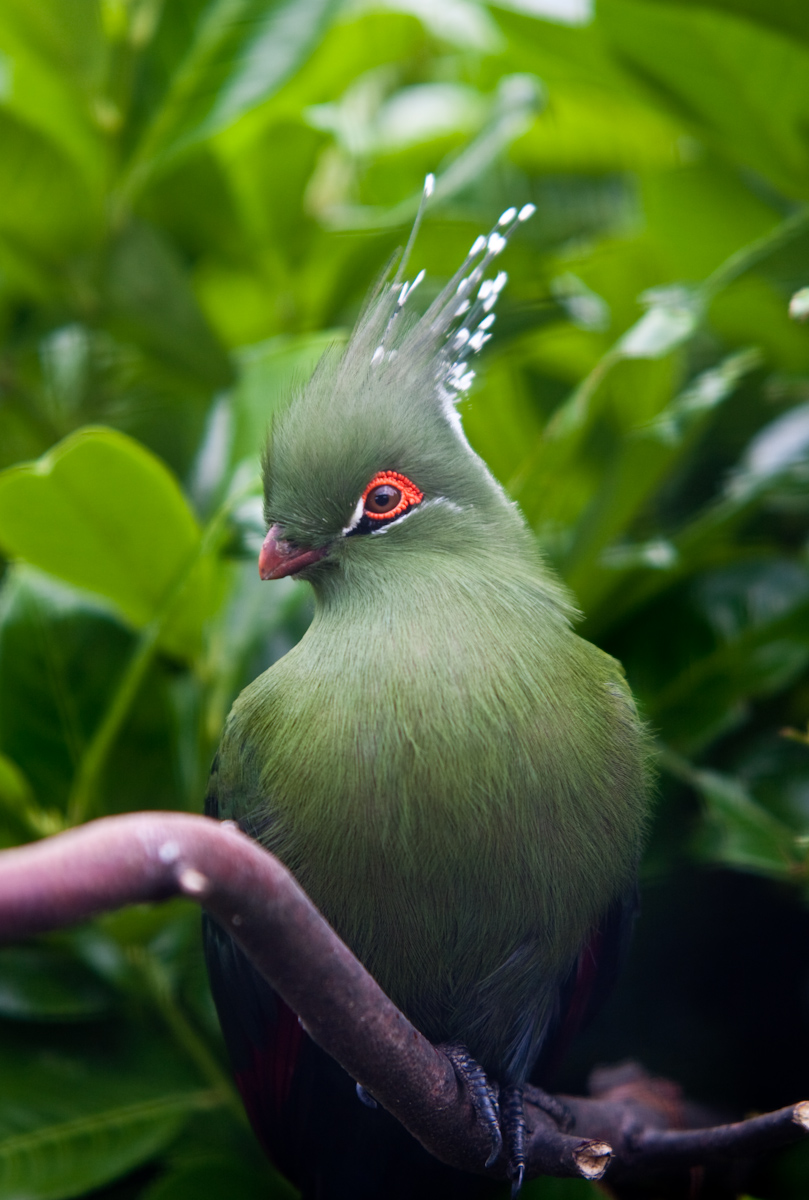
Tauraco corythaix occurs in southern and eastern South Africa. It has predominantly green plumage, a tall green crest with white tips and conspicuously crimson primary flight feathers.
Written 26 November 2026 from the sources listed below. Each statement was checked against the passage it cites; statements that could not be supported were removed.
Appearance
The Knysna Turaco has predominantly green plumage and a small, thick, orange-red bill. It has a white line immediately below its eye, brown eyes and deep-red eye-rings.[1][2][3][4]
Its tall green crest has white tips, and its primary flight feathers are conspicuously crimson. Juveniles have shorter crests without white tips.[5][6][7]
The species measures 40–42 cm in length, including its tail.[8]
Habitat
The Knysna Turaco breeds in mature evergreen forests.[9]
It occurs in southern and eastern South Africa.[10]
Diet
The Knysna Turaco feeds on fruit, insects and earthworms.[11][12][13]
Behaviour
The Knysna Turaco commonly flies between forest trees and moves by hopping along branches. It produces a loud kow-kow-kow-kow call.[14][15][16]
The species maintains its plumage colours throughout the year. Its red wing feathers are thought to help it escape predators and become invisible when it lands and folds its wings.[17][18][19]
Reproduction and life cycle
The Knysna Turaco builds a shallow platform nest from sticks. The nest is placed in a tree or a clump of creepers.[20][21]
The species lays two eggs per clutch.[22]
Similar species
The Knysna Turaco was formerly sometimes classified as a subspecies of the West African green turaco. Livingstone's turaco and Schalow's turaco were formerly considered subspecies.[23][24]
Classification of the Knysna Turaco
| Kingdom | Animalia |
|---|---|
| Phylum | Chordata |
| Subphylum | Vertebrata |
| Infraphylum | Gnathostomata |
| Parvphylum | Osteichthyes |
| Megaclass | Tetrapoda |
| Class | Aves (Bird) |
| Order | Musophagiformes (Turaco) |
| Family | Musophagidae (Turaco) |
| Genus | Tauraco (Turacos) |
| Species | Tauraco corythaix (Wagler, 1827) |
Where the Knysna Turaco is found
Checklists and occurrence records place Tauraco corythaix in 15 countries across Africa. GBIF holds 34,792 georeferenced records of it.
Countries
- Angola 30
- Cameroon 45
- Democratic Republic of the Congo 6
- Eswatini 13
- Gabon 13
- Kenya 43
- Liberia 11
- Malawi 33
- Mozambique 3
- Republic of the Congo 6
- South Africa 34,485
- Tanzania 36
- Uganda 37
- Zambia 14
- Zimbabwe 17
Regions and cities with the most records
- Eastern Cape, South Africa 12,311
- Western Cape, South Africa 9,342
- KwaZulu-Natal, South Africa 5,602
- George, South Africa 4,250
- Plettenberg Bay, South Africa 2,851
- Gonubie, South Africa 2,184
- Gqeberha, South Africa 2,030
- Mpumalanga, South Africa 2,022
- Limpopo, South Africa 2,001
- Knysna, South Africa 1,993
- East London, South Africa 1,932
- Motherwell, South Africa 1,786
- Mdantsane, South Africa 1,649
- Pinetown, South Africa 1,251
- Ntuzuma, South Africa 1,238
- Port Alfred, South Africa 1,197
- Mpumalanga, South Africa 1,107
- Despatch, South Africa 1,101
- eMuziwezinto, South Africa 1,015
- Scottburgh, South Africa 981
- Ga-Malakhe, South Africa 901
- Tzaneen, South Africa 893
- Margate, South Africa 840
- Grahamstown, South Africa 793
- Port Shepstone, South Africa 761
- Groot-Brakrivier, South Africa 726
- Sabie, South Africa 572
- Howick, South Africa 547
- Mpophomeni, South Africa 500
- eMkhomazi, South Africa 447
- Pietermaritzburg, South Africa 346
- Duiwelskloof, South Africa 240
- Richmond, South Africa 226
- Mossel Bay, South Africa 209
- Barberton, South Africa 204
- Stutterheim, South Africa 197
1 more country has a few records outside this range
These countries hold a few records of Tauraco corythaix but lie outside the range the checklists give for it. Such records are often zoo or garden specimens, museum material or vagrants, so the species is not counted as occurring there.
Range as the checklists state it
Africa
A number beside a place is its count of GBIF occurrence records. A place without a number comes from a checklist alone. Records show where a species has been observed or collected, which can include escapes and vagrants.
Common names
English
- Knysna Turaco
- KNTU
- Knysna Lourie
- Painted Lori
Names in 27 other languages
- Afrikaans
- Knysnaloerie
- Arabic
- توراكو كنيسنا
- Catalan
- turac de Knysna
- Chinese
- 尼斯那蕉鹃, 白梢冠蕉鵑
- Croatian
- južnoafrički turako
- Czech
- turako přílbový
- Danish
- Kapturako
- Dutch
- Knysnatoerako
- Esperanto
- najsna turako
- Estonian
- lõunaturako
- Finnish
- etelänturako
- French
- Touraco louri
- German
- Federhelmturako, Helmturako
- Hungarian
- sisakos turákó
- Italian
- Turaco di Knysna
- Japanese
- エボシドリ
- Lithuanian
- šalminis turakas
- Norwegian
- natalturako
- Polish
- turak niebieskozielony
- Portuguese
- turaco-de-knysna, turaco-meridional
- Russian
- Шлемоносный турако
- Serbian
- Knisna turako
- Slovak
- turako kapucňový
- Spanish
- Turaco de Knysna
- Swedish
- knysnaturako
- Turkish
- Nayzna Turakosu
- Ukrainian
- турако-книсна
Synonyms
3 other scientific names have been used for this species and are now treated as synonyms of Tauraco corythaix.
- Spelectos corythaix Wagler, 1827
- Tauraco persa corythaix Wagler, JG, 1827
- Tauraco persa corythraix Wagler, JG, 1827
Subspecies and varieties
- Tauraco corythaix corythaix (Southern Knysna Loerie) subspecies
- Tauraco corythaix phoebus (Drakensberg Loerie) subspecies
Related species
-
 Red-crested TuracoTauraco erythrolophus
-
 Guinea TuracoTauraco persa
-
 Livingstone's TuracoTauraco livingstonii
-
 Schalow's TuracoTauraco schalowi
-
 Fischer's TuracoTauraco fischeri
-
 Hartlaub's TuracoTauraco hartlaubi
-
 White-crested TuracoTauraco leucolophus
-
 Bannerman's TuracoTauraco bannermani
Compare
Questions and answers
What is the scientific name of the Knysna Turaco?
The scientific name of the Knysna Turaco is Tauraco corythaix. Written with its author, the full name is Tauraco corythaix (Wagler, 1827).
Which family does the Knysna Turaco belong to?
Tauraco corythaix belongs to the family Musophagidae, in the order Musophagiformes and the class Aves.
Where is the Knysna Turaco found?
Checklists and occurrence records place Tauraco corythaix in 15 countries, including South Africa, Cameroon, Kenya, Uganda, Tanzania and Malawi.
What is the conservation status of the Knysna Turaco?
The IUCN Red List category recorded for Tauraco corythaix is Least Concern (LC).
What other names does the Knysna Turaco have?
Tauraco corythaix is also known in English as KNTU, Knysna Lourie and Painted Lori.
What is a knysna turaco?
The Knysna Turaco is a large bird in the family Musophagidae. It has predominantly green plumage, a tall green crest with white tips and crimson primary flight feathers.[1][5][6][25]
Sources
Passages the profile rests on
- The species has predominantly green plumage. Source passage: “contrast with the mainly green plumage.” — English Wikipedia
- The species has a small, thick, orange-red bill. Source passage: “The small but thick orange-red bill” — English Wikipedia
- The species has a white line immediately below its eye. Source passage: “a white line just under the eye” — English Wikipedia
- The species has brown eyes and deep-red eye-rings. Source passage: “The eye is brown and the eye-ring deep red.” — English Wikipedia
- The species has a tall green crest with white tips. Source passage: “It has a tall green crest, which is tipped with white.” — English Wikipedia
- Its primary flight feathers are conspicuously crimson. Source passage: “In flight, Knysna turaco shows conspicuous crimson primary flight feathers.” — English Wikipedia
- Juveniles have shorter crests without white tips. Source passage: “juvenile birds have a shorter crest without the white tips.” — English Wikipedia
- The species measures 40–42 cm in length, including its tail. Source passage: “It is 40–42 cm long, including a long tail.” — English Wikipedia
- The species breeds in mature evergreen forests. Source passage: “resident breeder in the mature evergreen forests” — English Wikipedia
- The species occurs in southern and eastern South Africa. Source passage: “of southern and eastern South Africa” — English Wikipedia
- The species feeds on fruit. Source passage: “It feeds on fruit, insects and earthworms.” — English Wikipedia
- The species eats insects. Source passage: “It feeds on fruit, insects and earthworms.” — English Wikipedia
- The species eats earthworms. Source passage: “It feeds on fruit, insects and earthworms.” — English Wikipedia
- The species commonly flies between forest trees. Source passage: “usually seen flying between forest trees” — English Wikipedia
- The species moves by hopping along branches. Source passage: “or hopping along branches.” — English Wikipedia
- The species produces a loud kow-kow-kow-kow call. Source passage: “It has a loud kow-kow-kow-kow call.” — English Wikipedia
- The species maintains its plumage colours throughout the year. Source passage: “These birds maintain their colours throughout the year.” — English Wikipedia
- The species is thought to use its red wing feathers as a means of escaping predators. Source passage: “The Knysna Loerie is thought to use its red wing feathers to escape predators.” — English Wikipedia
- Its red wing feathers become invisible when it lands and folds its wings. Source passage: “As the Loerie lands and folds its wings, the red feathers of the wings become invisible” — English Wikipedia
- The species builds a shallow platform nest from sticks. Source passage: “in a shallow platform nest made from sticks” — English Wikipedia
- The nest is placed in a tree or a clump of creepers. Source passage: “placed in a tree or clump of creepers.” — English Wikipedia
- The species lays two eggs per clutch. Source passage: “This species lays two eggs” — English Wikipedia
- The species was formerly sometimes classified as a subspecies of the West African green turaco. Source passage: “It was formerly sometimes considered to be a subspecies of the green turaco of West Africa.” — English Wikipedia
- Livingstone's turaco and Schalow's turaco were formerly considered subspecies. Source passage: “The Livingstone's and Schalow's turacos were once considered subspecies.” — English Wikipedia
- The species is described as a large turaco. Source passage: “is a large turaco, one of a group of African near-passerine birds.” — inaturalist.org
Data
- Catalogue of Life, 2026-10-16 XR cc by
- Global Biodiversity Information Facility CC BY 4.0
- Wikidata CC0
- GeoNames CC BY 4.0
- Wikimedia Commons per image; credit shown with each image
- Within the Catalogue of Life, this name comes from The Integrated Taxonomic Information System cc0
References
- Dickinson, Edward C., ed. (2003). The Howard and Moore Complete Checklist of the Birds of the World, 3rd Edition.
- Gill, Frank, & and Minturn Wright. (2006). Birds of the World: Recommended English Names.
- Dickinson, E. C., and J. V. Remsen Jr., eds. (2013). The Howard and Moore Complete Checklist of the Birds of the World, 4th Edition, Vol. 1 Non-Passerines.
This species in other databases
Page built on 26 November 2026. See how the catalog is made and all sources and licences.
Cite this page
ScientificNames.org. (2026). Tauraco corythaix (Knysna Turaco). Retrieved November 26, 2026, from https://scientificnames.org/species/tauraco-corythaix
“Tauraco corythaix (Knysna Turaco).” ScientificNames.org, 2026, scientificnames.org/species/tauraco-corythaix. Accessed 26 Nov. 2026.
ScientificNames.org. “Tauraco corythaix (Knysna Turaco).” Accessed November 26, 2026. https://scientificnames.org/species/tauraco-corythaix.
@misc{scientificnames_tauraco_corythaix_knysna_turaco,
  author = {{ScientificNames.org}},
  title = {Tauraco corythaix (Knysna Turaco)},
  year = {2026},
  url = {https://scientificnames.org/species/tauraco-corythaix},
  note = {Accessed 2026-11-26}
}