Species · Flowering plants
English Hawthorn Crataegus laevigata
The scientific name of the English Hawthorn is Crataegus laevigata. It is a species of flowering plant in the family Rosaceae (rose family), order Rosales.
- Scientific name
- Crataegus laevigata (Poir.) DC.
- Common name
- English Hawthorn
- Genus
- Crataegus
- Family
- Rosaceae (Rose Family)
- Order
- Rosales
- Class
- Magnoliopsida
- Red List category
- LC Least Concern
- Recorded in
- 40 countries
- Name status
- accepted in the Catalogue of Life

Overview
Crataegus laevigata is native to western and central Europe, with a range extending from Great Britain and Spain eastward to Romania and Ukraine.
Written 26 November 2026 from the sources listed below. Each statement was checked against the passage it cites; statements that could not be supported were removed.
Appearance
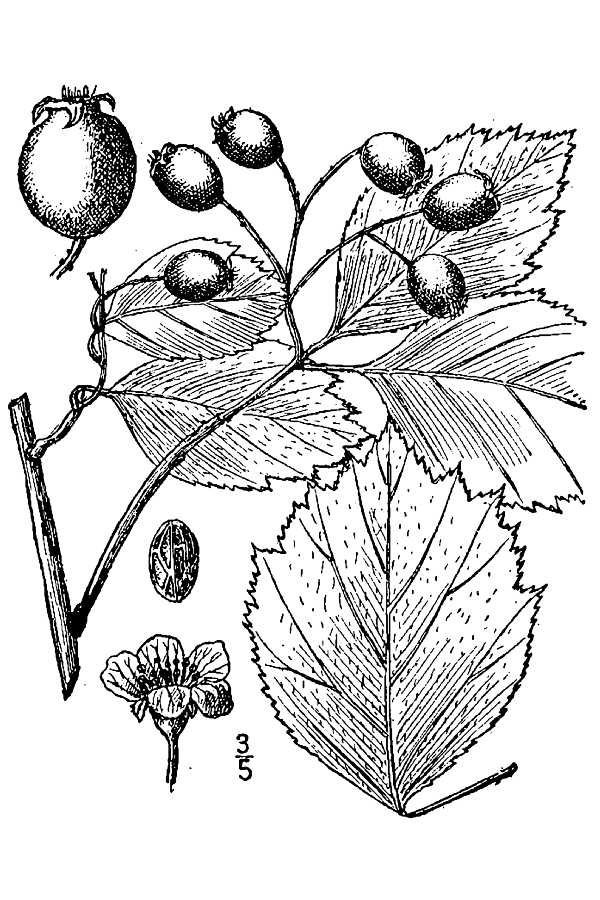
English hawthorn is a large shrub or small tree with a dense crown. It typically grows to 8 metres tall and can rarely reach 12 metres.[1][2]
Its glossy, mid-green leaves measure 2–6 cm long and 2–5 cm wide. Each leaf has two or three shallow, forward-pointing lobes on each side.[3][4]
Its white or pale pink flowers grow in clusters containing six to twelve flowers and can reach 2.4 cm in diameter. They have two or sometimes three styles, more than twenty stamens and five obtuse, triangular sepals. The inner surfaces of the petals can be slightly velvety.[5][6][7][8][9][10][11]
Its fruit is a slightly oval, dark red pome measuring 6–10 mm in diameter and containing two or three nutlets. The fruit appears in early autumn.[12][13][14]
Habitat
In Great Britain, English hawthorn is typically found in ancient woodland and old hedgerows.[15]
It can grow in any soil that is not waterlogged, including moist but well-drained soil. It grows in full sun or partial shade.[16][17][18]
Uses
English hawthorn is usually grown as an ornamental shrub and is useful for wildlife hedging. It is suitable as a specimen tree in town, coastal and exposed gardens.[19][20][21]
It can be pruned according to pruning group 1 or trimmed as a hedge after flowering or in autumn.[22]
Similar species
English hawthorn differs from Crataegus monogyna in having shallowly lobed leaves with forward-pointing lobes. Its leaves also lack the hair tufts in the vein axils found in the comparison with Crataegus monogyna.[23][24]
English hawthorn flowers have more than one style, unlike those of Crataegus monogyna. Its fruits are slightly oval, whereas those of Crataegus monogyna are round.[25][14]
English hawthorn and Crataegus monogyna hybridise to produce Crataegus × media.[26]
Reproduction and life cycle
English hawthorn has hermaphrodite flowers, which are pollinated by insects. In the United Kingdom, it flowers in May and June.[27][28][29]
Each style produces a seed, resulting in fruits with more than one seed. The fruits contain an average of 2.8 seeds each.[30][31]
Its fruits persist for an average of 64.4 days.[32]
Conservation
English hawthorn may be susceptible to fireblight, honey fungus, crown gall, silver leaf, powdery mildews and leaf spots.[33]
Classification of the English Hawthorn
| Kingdom | Plantae |
|---|---|
| Subkingdom | Pteridobiotina |
| Phylum | Tracheophyta |
| Class | Magnoliopsida |
| Order | Rosales |
| Family | Rosaceae (Rose Family) |
| Subfamily | Amygdaloideae |
| Tribe | Maleae |
| Subtribe | Malinae |
| Genus | Crataegus (Hawthorn) |
| Species | Crataegus laevigata (Poir.) DC. |
Where the English Hawthorn is found
Checklists and occurrence records place Crataegus laevigata in 40 countries across Africa, Europe and North America. GBIF holds 208,518 georeferenced records of it.
Countries where it is native or its origin is not stated
- Austria 3,336
- Belarus 17
- Belgium 4,891
- Bosnia and Herzegovina 7
- Croatia 85
- Czechia 2,048
- Denmark 15,930
- Estonia 39
- Finland 24
- France 73,287
- Germany 43,093
- Hungary 198
- Isle of Man 8
- Italy 950
- Latvia 131
- Liechtenstein 12
- Lithuania 13
- Luxembourg 1,758
- Moldova 6
- Poland 2,921
- Romania 36
- Russia 121
- San Marino
- Serbia 13
- Slovakia 5,263
- Slovenia 91
- Spain 668
- Sweden 8,570
- Switzerland 9,724
- The Netherlands 6,665
- Ukraine 155
Countries where it has been introduced
- Algeria
- Canada 20
- Guernsey 1
- Ireland 72
- Jersey
- Libya
- Norway 282
- United Kingdom 27,923
- United States 160
Regions and cities with the most records
- Bavaria, Germany 29,374
- England, United Kingdom 27,076
- Grand Est, France 17,780
- Bourgogne-Franche-Comté, France 17,400
- Auvergne-Rhône-Alpes, France 10,775
- Centre-Val de Loire, France 7,468
- Hauts-de-France, France 6,488
- South Denmark, Denmark 5,422
- Île-de-France, France 5,350
- Central Jutland, Denmark 4,258
- Bad Neustadt an der Saale, Germany 3,252
- Bad Kissingen, Germany 3,183
- Vaud, Switzerland 2,821
- Zealand, Denmark 2,702
- Skåne, Sweden 2,493
- Upper Austria, Austria 2,367
- Schweinfurt, Germany 2,150
- North Rhine-Westphalia, Germany 2,096
- Baden-Wurttemberg, Germany 1,958
- Gelderland, The Netherlands 1,938
- Capital Region, Denmark 1,931
- Lichtenfels, Germany 1,717
- Mecklenburg-Vorpommern, Germany 1,685
- Coburg, Germany 1,558
- Lower Saxony, Germany 1,522
- Stamford, United Kingdom 1,517
- Melton Mowbray, United Kingdom 1,515
- Overijssel, The Netherlands 1,494
- Kulmbach, Germany 1,493
- Droitwich, United Kingdom 1,466
- Borehamwood, United Kingdom 1,455
- Barnet, United Kingdom 1,423
- Würzburg, Germany 1,415
- Hengelo, The Netherlands 1,410
- St Albans, United Kingdom 1,409
- Totteridge, United Kingdom 1,406
7 more countries have a few records outside this range
These countries hold a few records of Crataegus laevigata but lie outside the range the checklists give for it. Such records are often zoo or garden specimens, museum material or vagrants, so the species is not counted as occurring there.
A number beside a place is its count of GBIF occurrence records. A place without a number comes from a checklist alone. Records show where a species has been observed or collected, which can include escapes and vagrants.
Common names
English
- English Hawthorn
- Midland Hawthorn
- Smooth Hawthorn
- Whitethorn
- Woodland Hawthorn
Names in 37 other languages
- Afrikaans
- engelse haagdoring, meidoring, witdoring
- Armenian
- Սզնի
- Basque
- Hegoaldeko elorri zuri
- Bulgarian
- Черен глог
- Catalan
- espinalb centreeuropeu
- Chinese
- 亮葉山楂
- Croatian
- Crveni glog
- Czech
- hloh obecný
- Danish
- Almindelig hvidtjørn
- Dutch
- Tweestijlige meidoorn
- Esperanto
- Dustilusa kratago
- Estonian
- tömbilehine viirpuu
- Finnish
- pyöröorapihlaja
- French
- aubépine lisse, aubépine à deux styles, aubépine épineuse
- German
- Zweigriffeliger Weißdorn, Zweigriffliger Weißdorn
- Hungarian
- Cseregalagonya, Kétbibés galagonya
- Icelandic
- Hvítþyrnir
- Italian
- Biancospino selvatico
- Japanese
- セイヨウサンザシ
- Kazakh
- Тікенді долана
- Lithuanian
- Glotnioji gudobelė, Grauželinė gudobelė
- Norwegian Bokmål
- parkhagtorn
- Polish
- Głóg dwuszyjkowy
- Portuguese
- Pilriteiro
- Russian
- Боярышник обыкновенный, Боярышник сглаженный
- Serbian
- Црвени глог
- Slovak
- Hloh krivokališný, hloh obyčajný
- Slovenian
- navadni glog
- Spanish
- espino navarro, majuelo de dos huesos
- Swedish
- hagtorn, rundhagtorn
- Turkish
- Bahçe Alıcı
- Ukrainian
- Глід двостовпчиковий (Глід згладжений)
- Welsh
- Draenen Wen, Draenen Wen Dwy Golofn, Draenen Wen Lefn, Draenen Ysbyddaden, Egfaenwydd, Merys, Ysbyddaden
- csb
- Dwaseminnô mąkùszka
- frr
- Haageduurn
- hsb
- Dwupěstkaty hłohonc
- myv
- Бояронь умарина
Synonyms
14 other scientific names have been used for this species and are now treated as synonyms of Crataegus laevigata.
- Crataegus helvetica W.Koch
- Crataegus laevigata
- Crataegus oxyacantha Gruppe
- Crataegus oxyacantha f. gireoudii Späth
- Crataegus oxyacantha f. glabrata Sanio
- Crataegus oxyacantha f. laevigata (Poir.) Beck
- Crataegus oxyacantha subvar. eriocarpa Rouy & E.G.Camus
- Crataegus oxyacantha var. flore-alba-plena Rodigas
- Crataegus oxyacantha var. flore-punicea Rodigas
- Crataegus oxyacantha var. flore-rubra-plena Rodigas
- Crataegus oxyacantha var. laevigata (Poir.) H.Lév.
- Crataegus oxyacantha var. obtusata Ser.
- Crataegus oxyacantha var. vulgaris Willd.
- Mespilus oxyacantha subvar. glabrata (Sanio) Asch. & Graebn.
Subspecies and varieties
- Crataegus laevigata subsp. laevigata subspecies
- Crataegus laevigata var. palmstruchii variety
Related species
-
 Common HawthornCrataegus monogyna
-
 Chinese HawthornCrataegus pinnatifida
-
 Mexican HawthornCrataegus mexicana
-
 AzaroleCrataegus azarolus
-
 Cockspur HawthornCrataegus crus-galli
-
 Oriental HawthornCrataegus orientalis
-
 Black HawthornCrataegus douglasii
-
 Washington HawthornCrataegus phaenopyrum
Compare
Questions and answers
What is the scientific name of the English Hawthorn?
The scientific name of the English Hawthorn is Crataegus laevigata. Written with its author, the full name is Crataegus laevigata (Poir.) DC..
Which family does the English Hawthorn belong to?
Crataegus laevigata belongs to the family Rosaceae, in the order Rosales and the class Magnoliopsida.
Where is the English Hawthorn found?
Checklists and occurrence records place Crataegus laevigata in 40 countries, including France, Germany, Denmark, Switzerland, Sweden and The Netherlands.
What is the conservation status of the English Hawthorn?
The IUCN Red List category recorded for Crataegus laevigata is Least Concern (LC).
What other names does the English Hawthorn have?
Crataegus laevigata is also known in English as Midland Hawthorn, Smooth Hawthorn, Whitethorn and Woodland Hawthorn.
What is the fruit of the whitethorn?
The fruit of English hawthorn is a dark red pome measuring 6–10 mm in diameter and containing two or three nutlets. It appears in early autumn.[12][13]
What is the habitat of hawthorn?
In Great Britain, English hawthorn is typically found in ancient woodland and old hedgerows. It can grow in any soil that is not waterlogged and in full sun or partial shade.[15][17][18]
What is Crataegus good for?
English hawthorn is usually grown as an ornamental shrub and is useful for wildlife hedging. It is also suitable as a specimen tree in town, coastal and exposed gardens.[19][20][21]
What are the disadvantages of hawthorn trees?
English hawthorn may be susceptible to fireblight, honey fungus, crown gall, silver leaf, powdery mildews, leaf spots, caterpillars, aphids and gall mites. Its seeds contain toxins and should be removed if the fruit is being considered for consumption.[33][34][35]
Sources
Passages the profile rests on
- Crataegus laevigata is a large shrub or small tree with a dense crown. Source passage: “It is a large shrub or small tree growing to 8 m (26 ft) or rarely to 12 m (39 ft) tall, with a dense crown.” — English Wikipedia
- The species typically grows to 8 metres tall and can rarely reach 12 metres. Source passage: “growing to 8 m (26 ft) or rarely to 12 m (39 ft) tall” — English Wikipedia
- Its leaves measure 2–6 cm long and 2–5 cm wide, with two or three shallow, forward-pointing lobes on each side. Source passage: “The leaves are 2–6 cm (0.79–2.4 in) long and 2–5 cm (0.79–2.0 in) broad, with two or three shallow, forward-pointing lobes on each side of the leaf.” — English Wikipedia
- Its leaves are glossy, mid-green and shallowly lobed. Source passage: “with glossy, shallowly-lobed mid-green leaves” — rhs.org.uk
- Its flowers are white or pale pink and grow in clusters containing six to twelve flowers. Source passage: “The hermaphrodite flowers are produced in corymbs of 6 to 12, each flower with five white or pale pink petals” — English Wikipedia
- Its flowers have two or sometimes three styles. Source passage: “each flower with five white or pale pink petals and two or sometimes three styles.” — English Wikipedia
- Its flowers can reach 2.4 cm in diameter. Source passage: “Flowers are up to 2.4 cm in diameter” — English Wikipedia
- Its flowers have more than twenty stamens. Source passage: “more than 20 stamens.” — English Wikipedia
- Its flowers have five obtuse, triangular sepals. Source passage: “They have 5 triangular sepals, which are obtuse.” — English Wikipedia
- The inner surfaces of its petals can be slightly velvety. Source passage: “The petals can be slightly velvety on the inside.” — English Wikipedia
- Its flowers can measure up to 2.4 cm across. Source passage: “Flowers are up to 2.4 cm in diameter” — English Wikipedia
- Its fruit is a dark red pome measuring 6–10 mm in diameter and containing two or three nutlets. Source passage: “The fruit is a dark red pome 6–10 mm (0.2–0.4 in) diameter, slightly broader than long, containing two or three nutlets.” — English Wikipedia
- Its fruit is red and appears in early autumn. Source passage: “followed by red fruit in early autumn” — rhs.org.uk
- The fruits of Crataegus laevigata are slightly oval, whereas those of Crataegus monogyna are round. Source passage: “these make them slightly oval, in contrast with the single-seeded and therefore round fruits of common hawthorn.” — English Wikipedia
- In Great Britain, the species is typically found in ancient woodland and old hedgerows. Source passage: “where it is typically found in ancient woodland and old hedgerows” — English Wikipedia
- The species can be grown in moist but well-drained or well-drained soil. Source passage: “Moist but well–drained or Well–drained” — rhs.org.uk
- The species can grow in any soil that is not waterlogged. Source passage: “Grow in any (not waterlogged) soil in full sun or part shade.” — rhs.org.uk
- The species grows in full sun or partial shade. Source passage: “in full sun or part shade.” — rhs.org.uk
- The species is usually grown as an ornamental shrub. Source passage: “usually grown as an ornamental shrub” — rhs.org.uk
- The species is useful for wildlife hedging. Source passage: “Use for wildlife hedging.” — rhs.org.uk
- The species is suitable as a specimen tree in town, coastal and exposed gardens. Source passage: “Useful specimen trees for town, coastal or exposed gardens.” — rhs.org.uk
- The species can be pruned according to pruning group 1 or trimmed as a hedge after flowering or in autumn. Source passage: “pruning group 1; or trim hedges after flowering or in autumn” — rhs.org.uk
- Crataegus laevigata is distinguished from Crataegus monogyna by its shallowly lobed leaves with forward-pointing lobes. Source passage: “in the leaves being only shallowly lobed, with forward-pointing lobes” — English Wikipedia
- Crataegus laevigata leaves lack the hair tufts in the vein axils found in the comparison with Crataegus monogyna. Source passage: “without hair tufts in the vein axils” — English Wikipedia
- Crataegus laevigata flowers have more than one style, unlike those of Crataegus monogyna. Source passage: “in the flowers having more than one style.” — English Wikipedia
- Crataegus laevigata and Crataegus monogyna hybridise to produce Crataegus × media. Source passage: “The two species hybridise, giving rise to C. × media.” — English Wikipedia
- The species has hermaphrodite flowers. Source passage: “The hermaphrodite flowers are produced in corymbs of 6 to 12” — English Wikipedia
- Insects pollinate the flowers of this species. Source passage: “They are pollinated by insects.” — English Wikipedia
- The species flowers in May and June in the United Kingdom. Source passage: “It flowers in May to June (UK)” — English Wikipedia
- Each style produces a seed, resulting in fruits with more than one seed. Source passage: “Each style produces a seed, so its fruits also have more than one seed” — English Wikipedia
- The fruits contain an average of 2.8 seeds each. Source passage: “bears an average of 2.8 seeds per fruit.” — English Wikipedia
- Its fruits persist for an average of 64.4 days. Source passage: “Its fruit persists for an average of 64.4 days” — English Wikipedia
- The species may be susceptible to fireblight, honey fungus, crown gall, silver leaf, powdery mildews and leaf spots. Source passage: “May be susceptible to fireblight, honey fungus, crown gall, silver leaf, Powdery mildews and leaf spots” — rhs.org.uk
- The species may be susceptible to caterpillars, aphids and gall mites. Source passage: “May be susceptible to caterpillars, aphids and gall mites” — rhs.org.uk
- The seeds contain toxins and should be removed if the fruit is being considered for consumption. Source passage: “Seeds contain toxins so these should be removed if you are considering eating the fruit” — rhs.org.uk
Data
- Catalogue of Life, 2026-10-16 XR cc by
- Global Biodiversity Information Facility CC BY 4.0
- Wikidata CC0
- GeoNames CC BY 4.0
- Wikimedia Commons per image; credit shown with each image
- Within the Catalogue of Life, this name comes from Synonymic Checklists of the Vascular Plants of the World cc by
References
- (Poir.) DC. where the name was published
This species in other databases
Page built on 29 November 2026. See how the catalog is made and all sources and licences.
Cite this page
ScientificNames.org. (2026). Crataegus laevigata (English Hawthorn). Retrieved November 29, 2026, from https://scientificnames.org/species/crataegus-laevigata
“Crataegus laevigata (English Hawthorn).” ScientificNames.org, 2026, scientificnames.org/species/crataegus-laevigata. Accessed 29 Nov. 2026.
ScientificNames.org. “Crataegus laevigata (English Hawthorn).” Accessed November 29, 2026. https://scientificnames.org/species/crataegus-laevigata.
@misc{scientificnames_crataegus_laevigata_english_hawthorn,
  author = {{ScientificNames.org}},
  title = {Crataegus laevigata (English Hawthorn)},
  year = {2026},
  url = {https://scientificnames.org/species/crataegus-laevigata},
  note = {Accessed 2026-11-29}
}