Species · Flowering plants
Common Hawthorn Crataegus monogyna
The scientific name of the Common Hawthorn is Crataegus monogyna. It is a species of flowering plant in the family Rosaceae (rose family), order Rosales.
- Scientific name
- Crataegus monogyna Jacq.
- Common name
- Common Hawthorn
- Genus
- Crataegus
- Family
- Rosaceae (Rose Family)
- Order
- Rosales
- Class
- Magnoliopsida
- Red List category
- LC Least Concern
- Recorded in
- 71 countries
- Name status
- accepted in the Catalogue of Life

Overview
Common hawthorn is a shrub or small tree in the family Rosaceae and order Rosales. It is native to Europe, including Ireland and Britain, northwestern Africa and Western Asia, and has become naturalised in the Pacific Northwest of North America.
Written 26 November 2026 from the sources listed below. Each statement was checked against the passage it cites; statements that could not be supported were removed.
Appearance
Common hawthorn is a shrub or small tree with a dense crown. Its bark is dull brown with vertical orange cracks, and its younger stems have sharp thorns approximately 12.5 millimetres long.[1][2][3]
Its leaves measure 20–40 millimetres long and are obovate with deeply divided lobes. The upper surface is dark green and the underside is paler.[4][5]
Its flowers are white and frequently pink, with numerous red stamens and a single style. They are moderately fragrant.[6][7][8]
Its fruit is a small, oval, dark red pome approximately 10 millimetres long. Each fruit contains a seed enclosed within a hard stone-like structure called a pyrene.[9][10]
The species can reach approximately 10 metres in height.[11]
Habitat
Common hawthorn grows in disturbed and semi-cleared areas.[12]
Reproduction and life cycle
Common hawthorn produces hermaphroditic flowers in late spring. In its native range, flowering generally occurs between May and early June.[13][14]
Its flowers are arranged in clusters containing 5–25 flowers. Midges, bees and other insects pollinate them.[15][16]
Its fruits develop in groups of two or three along smaller branches and contain an average of 2.8 seeds per fruit. They persist for an average of 107.3 days.[17][18][19]
Behaviour
Birds that consume common hawthorn fruits disperse its seeds through their droppings.[20]
Excessive grazing can cause young shoots to be eaten and prevent their normal growth.[21]
Diet
Thrushes and waxwings consume common hawthorn fruits during winter.[22]
Conservation
A study in Wales indicated that sheep overgrazing could eliminate common hawthorn locally within 60–70 years.[23]
Uses
Common hawthorn fruits are used to prepare jellies, jams, syrups and wine. Its young leaves can be eaten in salads, and its flower petals are edible.[24][25][26]
The species is extensively planted as a hedge, particularly in agricultural settings. Its wood is used as firewood because it burns with substantial heat and little smoke.[27][28]
Its leaves, flowers and fruits contain phytochemicals with antioxidant properties. Its leaf extract has demonstrated antimicrobial activity against Staphylococcus aureus.[29][30]
Similar species
Common hawthorn differs from Crataegus laevigata by having more deeply lobed leaves with widely spreading lobes and one flower style rather than two or three.[31][32]
Common hawthorn can hybridise with Crataegus laevigata. Crataegus rhipidophylla is another species that hybridises with it.[33][34]
Classification of the Common Hawthorn
| Kingdom | Plantae |
|---|---|
| Subkingdom | Pteridobiotina |
| Phylum | Tracheophyta |
| Class | Magnoliopsida |
| Order | Rosales |
| Family | Rosaceae (Rose Family) |
| Subfamily | Amygdaloideae |
| Tribe | Maleae |
| Subtribe | Malinae |
| Genus | Crataegus (Hawthorn) |
| Species | Crataegus monogyna Jacq. |
Where the Common Hawthorn is found
Checklists and occurrence records place Crataegus monogyna in 71 countries across Africa, Asia, Europe, North America, Oceania and South America. GBIF holds 1,438,061 georeferenced records of it.
Countries where it is native or its origin is not stated
- Aland Islands 144
- Albania 27
- Algeria 75
- Andorra 19
- Armenia 17
- Austria 13,285
- Azerbaijan 12
- Belarus 72
- Belgium 40,692
- Bosnia and Herzegovina 55
- Bulgaria 80
- China 12
- Croatia 187
- Cyprus 19
- Czechia 2,711
- Denmark 50,294
- Estonia 157
- Finland 284
- France 472,401
- Georgia 33
- Germany 69,152
- Gibraltar 13
- Greece 407
- Guernsey 20
- Hungary 486
- India 7
- Iran 7
- Iraq 20
- Ireland 6,229
- Isle of Man 4,230
- Israel 61
- Italy 4,712
- Jersey 18
- Kosovo 5
- Kyrgyzstan 3
- Latvia 130
- Lebanon 34
- Libya
- Liechtenstein 23
- Lithuania 77
- Luxembourg 2,716
- Malta 7
- Moldova 40
- Montenegro 14
- Morocco 144
- North Macedonia 5
- Norway 2,464
- Poland 15,643
- Romania 190
- Russia 1,894
- San Marino 1
- Serbia 31
- Slovakia 9,094
- Slovenia 314
- Spain 33,710
- Sweden 13,177
- Switzerland 25,721
- Syria 20
- The Netherlands 117,762
- Tunisia 25
- Turkey 328
- Turkmenistan 4
- Ukraine 1,369
Countries where it has been introduced
- Argentina 21
- Australia 8,136
- Canada 2,565
- New Zealand 2,211
- Portugal 6,355
- South Africa 14
- United Kingdom 523,171
- United States 4,705
Regions and cities with the most records
- England, United Kingdom 425,513
- Auvergne-Rhône-Alpes, France 88,904
- Bourgogne-Franche-Comté, France 57,215
- Île-de-France, France 55,431
- Centre-Val de Loire, France 50,503
- Scotland, United Kingdom 49,183
- Bavaria, Germany 47,804
- Grand Est, France 46,426
- Hauts-de-France, France 35,709
- Wales, United Kingdom 29,638
- Provence-Alpes-Côte d'Azur, France 28,166
- Occitanie, France 25,032
- Gelderland, The Netherlands 20,776
- Kingswood, United Kingdom 19,311
- Keynsham, United Kingdom 18,922
- Bristol, United Kingdom 17,995
- Mangotsfield, United Kingdom 16,708
- Central Jutland, Denmark 16,615
- Bath, United Kingdom 15,174
- Burngreave, United Kingdom 14,764
- Pays de la Loire, France 14,483
- Sheffield, United Kingdom 14,189
- Rotherham, United Kingdom 14,027
- Yate, United Kingdom 13,863
- Halewood, United Kingdom 13,767
- Allerton, United Kingdom 13,723
- Dronfield, United Kingdom 13,709
- Runcorn, United Kingdom 13,480
- Speke, United Kingdom 13,475
- Huyton, United Kingdom 13,439
- Old Swan, United Kingdom 13,424
- Prescot, United Kingdom 13,375
- Widnes, United Kingdom 13,276
- Rawmarsh, United Kingdom 13,163
- Maltby, United Kingdom 13,108
- Fulwood, United Kingdom 13,105
1 more country has a few records outside this range
These countries hold a few records of Crataegus monogyna but lie outside the range the checklists give for it. Such records are often zoo or garden specimens, museum material or vagrants, so the species is not counted as occurring there.
Range as the checklists state it
England (England, Wales, Isle of Man, Scotland, Outer Hebrides, Orkney Isl. [I], Shetland Isl. [I], Isles of Scilly); Ireland (Ireland, Northern Ireland); Denmark; Norway; Sweden; Finland; Netherlands; Belgium; Luxembourg; Germany (Brandenburg, Berlin, Baden-Württemberg, Bayern, Hessen, Hamburg, Mecklenburg-Vorpommern, Niedersachsen, Nordrhein-Westfalen, Rheinland-Pfalz, Schleswig-Holstein, Saarland, Sachsen, Sachsen-Anhalt, Thüringen); Switzerland; Liechtenstein; Austria; Poland; Czech Republic; Slovakia; Hungary; Portugal; Spain; Andorra; Gibraltar; Baleares; France; Channel Isl. (Alderney, Guernsey, Jersey, Sark); Corsica; Sardinia; Italy; Sicily; Malta; San Marino; Slovenia; Croatia; Bosnia & Hercegovina; Montenegro; Serbia; Kosovo; North Macedonia; Albania; Romania; Bulgaria; European Turkey; Greece (widespread, incl. many islands); Crete; Estonia; Latvia; Lithuania; Belarus; European Russia; Moldova; Ukraine; Crimea; Morocco; Algeria; Tunisia; Libya; Madeira [I] (Madeira Isl. [I]); Canary Isl. [I] (Gran Canaria [I]); South Africa [I]; Northern Caucasus; Georgia [Caucasus]; East Aegaean Isl. (Lesvos, Chios, Ikaria, Samos, Karpathos, Rhodos); Turkey (Inner Anatolia, N-Anatolia, NE-Anatolia, NW-Anatolia: Bithynia, S-Anatolia, SE-Anatolia, SE-Anatolia: Mesopotamian Anatolia, SSW-Anatolia, SW-Anatolia, W-Anatolia, WN-Anatolia); Iraq (NE-Iraq); Iran (N-Iran); Cyprus (C-Mountains, S-Cyprus); Lebanon (Antilebanon, C-Lebanon, coastal W-Lebanon); Syria (coastal W-Syria, NW-Syria); Israel (N-Israel); Sinai peninsula; Australia [I] (South Australia [I], Queensland [I], New South Wales [I], Victoria [I], Tasmania [I]); New Zealand [I]; Alaska [I]; Canada [I] (British Columbia [I], New Brunswick [I], Nova Scotia [I], Ontario [I], Prince Edward Isl. [I], Québec [I]); USA [I] (Arkansas [I], California [I], Connecticut [I], District of Columbia [I], Delaware [I], Illinois [I], Kentucky [I], Massachusetts [I], Maine [I], Michigan [I], Montana [I], New Hampshire [I], New Jersey [I], New York [I], Ohio [I], Oregon [I], Pennsylvania [I], Rhode Island [I], Tennessee [I], Utah [I], Virginia [I], Vermont [I], Washington State [I], Wisconsin [I], West Virginia [I]); Argentina [I]
Global
A number beside a place is its count of GBIF occurrence records. A place without a number comes from a checklist alone. Records show where a species has been observed or collected, which can include escapes and vagrants.
Common names
English
- Common Hawthorn
- English Hawthorn
- Hawthorn
- Neapolitan Medlar
- May
- One-seeded Hawthorn
- Red Hawthorn
- Single-seed Hawthorn
Names in 49 other languages
- Afrikaans
- Meidoring
- Arabic
- زعرور أحادي المدقة, زعرور بري شائع
- Asturian
- espinera
- Azerbaijani
- Birdişicikli yemişan
- Basque
- Elorri zuri, Elorri zuria
- Belarusian
- Глог аднапесцікавы
- Bulgarian
- Обикновен глог
- Catalan
- Cirerer de Bon Pastor, arç blanc, espinalb
- Chinese
- 單籽山楂
- Croatian
- Bijeli glog, Glog
- Danish
- Engriflet hvidtjørn, Éngriflet hvidtjørn
- Dutch
- Eenstijlige meidoorn
- Estonian
- üheemakane viirpuu
- Finnish
- tylppöorapihlaja
- French
- aubépine monogyne, aubépine à un style
- Galician
- Estripeiro, Estripo
- German
- Eingriffeliger Weißdorn, Eingriffliger Weißdorn, Hagedorn
- Hebrew
- עוזרר חד-גלעיני
- Hungarian
- Egybibés galagonya
- Irish
- Sceach gheal
- Italian
- Biancospino, Biancospino comune
- Japanese
- アカバナサンザシ
- Lithuanian
- Vienapiestė gudobelė
- Macedonian
- Обичен глог
- Maltese
- Żagħrun
- Norwegian Bokmål
- hagtorn
- Persian
- خفچه, زالزالک قرمز، زالزالک تک هسته، سرخ ولیک، سرخه ولیک
- Polish
- głóg jednoszyjkowy
- Portuguese
- Estrepoeiro, Pilriteiro
- Romanian
- Păducel
- Russian
- Боярышник однопестичный
- Scottish Gaelic
- Sgìtheach, craobhan-sgithich, droigheann-geal, sgitheach
- Serbian
- Бели глог
- Slovak
- hloh jednosemenný
- Slovenian
- enovrati glog
- Spanish
- Espinillo Albar, Espino Albar, majuelo
- Swedish
- trubbhagtorn
- Turkish
- Adi Geyikdikeni, Adi alıç, Yemişen
- Ukrainian
- Глід одноматочковий
- Welsh
- Crawel y Moch, Crawol y Moch, Criafol y Moch, Draenen Wen, Draenen Wen Un Golofn, Drain Gwyn, Drain Ysbyddaid, Egfaenwydd
- arg
- Arto blanco
- csb
- Jednoseminnô mąkùszka
- diq
- Sêvze
- frr
- Haageduurn
- hsb
- Jednopěstkaty hłohonc
- kur
- Givîj
- oji
- Miinensagaawanzh
- sco
- Scrog
- srd
- Caràlighe
Synonyms
366 other scientific names have been used for this species and are now treated as synonyms of Crataegus monogyna.
- Crataegus aegeica Pojark.
- Crataegus aguilaris Sennen
- Crataegus alemanniensis Cinovskis
- Crataegus alemanniensis f. microalemanniensis Cinovskis
- Crataegus alemanniensis var. orientobaltica (Cinovskis) Cinovskis
- Crataegus alemanniensis var. subborealis (Cinovskis) Cinovskis
- Crataegus azarella Griseb.
- Crataegus azarolus var. glabra Coss.
- Crataegus bracteolaris Gand.
- Crataegus brevispina f. subinermis Vicioso
- Crataegus brevispina var. contracta (Hrabétová) Ker.-Nagy
- Crataegus brevispina var. javorkae (Pénzes) Ker.-Nagy
- Crataegus brevispina var. microphylla (Csató) Ker.-Nagy
- Crataegus bruantii Carrière
- Crataegus calycina var. cuneata Diap.
- Crataegus curvisepala subsp. colorata Hrabétová
- Crataegus debeauxii Gand. & Debeaux
- Crataegus debeauxii Cand.
- Crataegus destefani Lojac.
- Crataegus dissecta Borkh.
- Crataegus diversifolia (Pers.) Steud.
- Crataegus diversifolia (Pers.) M.Roem.
- Crataegus elegans (Poir.) Mutel
- Crataegus fissa (Poir.) Bosc ex DC.
- Crataegus hirsuta Schur
- Crataegus inermis Sennen
- Crataegus insegnae (Tineo ex Guss.) Bertol.
- Crataegus jaquinii A.Kern.
- Crataegus jaquinii var. cylindrocarpa Murr
- Crataegus javorkae (Pénzes) Ker.-Nagy
- Crataegus krumbholzii R.Doll
- Crataegus laciniata Willk.
- Crataegus laciniata var. decussata (Wallr.) Diap.
- Crataegus laciniata var. lasiocarpa (Lange) Lange
- Crataegus lamprophylla Gand.
- Crataegus lasiocarpa Lange
- Crataegus leiomonogyna Klokov
- Crataegus lipskyi Klokov
- Crataegus maura L.
- Crataegus maura L.fil.
Showing 40 of 366.
Subspecies and varieties
Related species
-
 Chinese HawthornCrataegus pinnatifida
-
 Mexican HawthornCrataegus mexicana
-
 AzaroleCrataegus azarolus
-
 English HawthornCrataegus laevigata
-
 Cockspur HawthornCrataegus crus-galli
-
 Oriental HawthornCrataegus orientalis
-
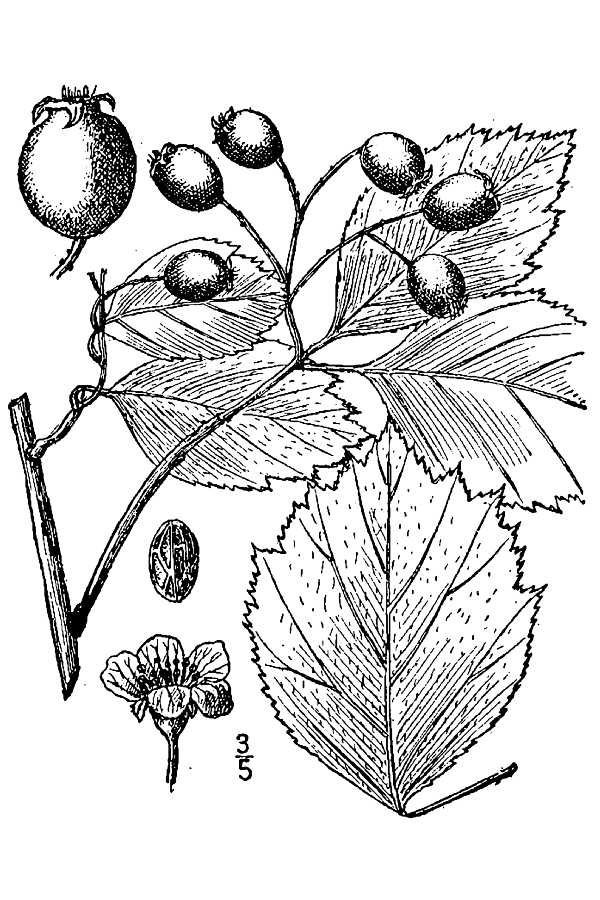 Black HawthornCrataegus douglasii
-
 Washington HawthornCrataegus phaenopyrum
Compare
Questions and answers
What is the scientific name of the Common Hawthorn?
The scientific name of the Common Hawthorn is Crataegus monogyna. Written with its author, the full name is Crataegus monogyna Jacq..
Which family does the Common Hawthorn belong to?
Crataegus monogyna belongs to the family Rosaceae, in the order Rosales and the class Magnoliopsida.
Where is the Common Hawthorn found?
Checklists and occurrence records place Crataegus monogyna in 71 countries, including France, The Netherlands, Germany, Denmark, Belgium and Spain.
What is the conservation status of the Common Hawthorn?
The IUCN Red List category recorded for Crataegus monogyna is Least Concern (LC).
What other names does the Common Hawthorn have?
Crataegus monogyna is also known in English as English Hawthorn, Hawthorn, Neapolitan Medlar, May, One-seeded Hawthorn and Red Hawthorn.
What does hawthorn do to your body?
Its leaves, flowers and fruits contain phytochemicals with antioxidant properties. Its leaf extract has demonstrated antimicrobial activity against Staphylococcus aureus.[29][30]
Can humans eat hawthorn berries?
Common hawthorn fruits are used to prepare jellies, jams, syrups and wine.[24]
What is the habitat of hawthorn?
Common hawthorn grows in disturbed and semi-cleared areas.[12]
Can humans eat common hawthorn berries?
Common hawthorn fruits are used to prepare jellies, jams, syrups and wine.[24]
Are hawthorn fruits edible?
Common hawthorn fruits are used to prepare jellies, jams, syrups and wine.[24]
Sources
Passages the profile rests on
- Crataegus monogyna is a shrub or small tree with a dense crown. Source passage: “The common hawthorn is a shrub or small tree up to about 10 metres (33 feet) tall, with a dense crown.” — English Wikipedia
- Its bark is dull brown and has vertical orange cracks. Source passage: “The bark is dull brown with vertical orange cracks.” — English Wikipedia
- Its younger stems have sharp thorns approximately 12.5 millimetres long. Source passage: “The younger stems bear sharp thorns, about 12.5 millimetres (1⁄2 inch) long.” — English Wikipedia
- Its leaves measure 20–40 millimetres long and are obovate with deeply divided lobes. Source passage: “The leaves are 20 to 40 mm (3⁄4 to 1+1⁄2 in) long, obovate, and deeply lobed” — English Wikipedia
- The upper leaf surface is dark green, while the underside is paler. Source passage: “The upper surface is dark green above and paler underneath.” — English Wikipedia
- Its flowers are white and frequently pink, with numerous red stamens and a single style. Source passage: “The flowers are white, frequently pink.” — English Wikipedia
- Its flowers have numerous red stamens and one style. Source passage: “they have numerous red stamens and a single style” — English Wikipedia
- Its flowers are moderately fragrant. Source passage: “and are moderately fragrant.” — English Wikipedia
- Its fruit is a small, oval, dark red pome approximately 10 millimetres long. Source passage: “The haw is a small, oval, dark red fruit about 10 mm (0.39 in) long, berry-like, but structurally a pome” — English Wikipedia
- Each fruit contains one seed enclosed within a hard stone-like structure called a pyrene. Source passage: “containing a single seed within a stone, the pyrene.” — English Wikipedia
- The species can reach approximately 10 metres in height. Source passage: “It grows to about 10 metres (33 feet) tall” — English Wikipedia
- The species grows in disturbed and semi-cleared areas. Source passage: “It grows in disturbed, semi-cleared areas.” — English Wikipedia
- The species produces hermaphroditic flowers in late spring. Source passage: “producing hermaphrodite flowers in late spring.” — English Wikipedia
- In its native range, flowering generally occurs between May and early June. Source passage: “May to early June in its native area” — English Wikipedia
- Its flowers are arranged in clusters containing 5–25 flowers. Source passage: “in corymbs of 5–25 together” — English Wikipedia
- Midges, bees and other insects pollinate its flowers. Source passage: “They are pollinated by midges, bees, and other insects” — English Wikipedia
- Its fruits develop in groups of two or three along smaller branches. Source passage: “The haws develop in groups of two or three along smaller branches.” — English Wikipedia
- Its fruits contain an average of 2.8 seeds per fruit. Source passage: “bears an average of 2.8 seeds per fruit.” — English Wikipedia
- Its fruits persist for an average of 107.3 days. Source passage: “Its fruit persists for an average of 107.3 days” — English Wikipedia
- Birds that consume its fruits disperse its seeds through their droppings. Source passage: “these birds eat the haws and disperse the seeds in their droppings.” — English Wikipedia
- Excessive grazing can cause its young shoots to be eaten and prevent their normal growth. Source passage: “new shoots of vulnerable C. monogyna trees in the open field are eaten by animals. This does not allow them to grow” — English Wikipedia
- Thrushes and waxwings consume its fruits during winter. Source passage: “Haws are important for wildlife in winter, particularly thrushes and waxwings; these birds eat the haws” — English Wikipedia
- A study in Wales indicated that sheep overgrazing could eliminate the species locally within 60–70 years. Source passage: “A study in Wales indicated that current levels of overgrazing by sheep might extirpate the species in 60–70 years.” — English Wikipedia
- Its fruits are used to prepare jellies, jams, syrups and wine. Source passage: “They are commonly made into jellies, jams, syrups, or wine” — English Wikipedia
- Its young leaves can be eaten in salads. Source passage: “The young leaves are tender enough to be used in salads.” — English Wikipedia
- Its flower petals are edible. Source passage: “The petals are also edible.” — English Wikipedia
- The species is extensively planted as a hedge, particularly in agricultural settings. Source passage: “Common hawthorn is extensively planted as a hedge plant, especially for agricultural use.” — English Wikipedia
- Its wood is used as firewood because it burns with substantial heat and little smoke. Source passage: “It is a good firewood, which burns with a good heat and little smoke.” — English Wikipedia
- Its leaves, flowers and fruits contain phytochemicals with antioxidant properties. Source passage: “The fruit, leaves, and flowers contain significant amounts of polyphenols, flavonoids, flavonols, phenolic acids and dye compounds with antioxidant properties” — pmc.ncbi.nlm.nih.gov
- Its leaf extract has demonstrated antimicrobial activity against Staphylococcus aureus. Source passage: “C. monogyna leaf extract exhibits high polyphenol content and significant antioxidant activity as well as antimicrobial activity, including against Staphylococcus aureus” — pmc.ncbi.nlm.nih.gov
- Crataegus monogyna differs from Crataegus laevigata by having more deeply lobed leaves with widely spreading lobes. Source passage: “the leaves being deeply lobed, with spreading lobes” — English Wikipedia
- Crataegus monogyna differs from Crataegus laevigata by having one flower style rather than two or three. Source passage: “the flowers having just one style, not two or three.” — English Wikipedia
- Crataegus monogyna can hybridise with Crataegus laevigata. Source passage: “They are interfertile, however, so hybrids occur frequently” — English Wikipedia
- Crataegus rhipidophylla is another species that hybridises with Crataegus monogyna. Source passage: “Another species that also hybridises with the common hawthorn is Crataegus rhipidophylla” — English Wikipedia
Data
- Catalogue of Life, 2026-10-16 XR cc by
- Global Biodiversity Information Facility CC BY 4.0
- Wikidata CC0
- GeoNames CC BY 4.0
- Wikimedia Commons per image; credit shown with each image
- Within the Catalogue of Life, this name comes from Synonymic Checklists of the Vascular Plants of the World cc by
References
- Jacq. (1775). Fl. Austriac. [Jacquin] 3: 50 (1775). where the name was published
This species in other databases
Page built on 27 November 2026. See how the catalog is made and all sources and licences.
Cite this page
ScientificNames.org. (2026). Crataegus monogyna (Common Hawthorn). Retrieved November 27, 2026, from https://scientificnames.org/species/crataegus-monogyna
“Crataegus monogyna (Common Hawthorn).” ScientificNames.org, 2026, scientificnames.org/species/crataegus-monogyna. Accessed 27 Nov. 2026.
ScientificNames.org. “Crataegus monogyna (Common Hawthorn).” Accessed November 27, 2026. https://scientificnames.org/species/crataegus-monogyna.
@misc{scientificnames_crataegus_monogyna_common_hawthorn,
  author = {{ScientificNames.org}},
  title = {Crataegus monogyna (Common Hawthorn)},
  year = {2026},
  url = {https://scientificnames.org/species/crataegus-monogyna},
  note = {Accessed 2026-11-27}
}