Species · Flowering plants
Oriental Hawthorn Crataegus orientalis
The scientific name of the Oriental Hawthorn is Crataegus orientalis. It is a species of flowering plant in the family Rosaceae (rose family), order Rosales.
- Scientific name
- Crataegus orientalis Pall. ex M.Bieb.
- Common name
- Oriental Hawthorn
- Genus
- Crataegus
- Family
- Rosaceae (Rose Family)
- Order
- Rosales
- Class
- Magnoliopsida
- Recorded in
- 19 countries
- Name status
- accepted in the Catalogue of Life

Overview
Crataegus orientalis is native to the Mediterranean region, Turkey, Caucasia, Crimea, and western Iran. It has deeply cut, dark green leaves with five to nine lobes and grey undersides, and produces white, fragrant flowers and red or yellowish-red fruits.
Written 26 November 2026 from the sources listed below. Each statement was checked against the passage it cites; statements that could not be supported were removed.
Appearance
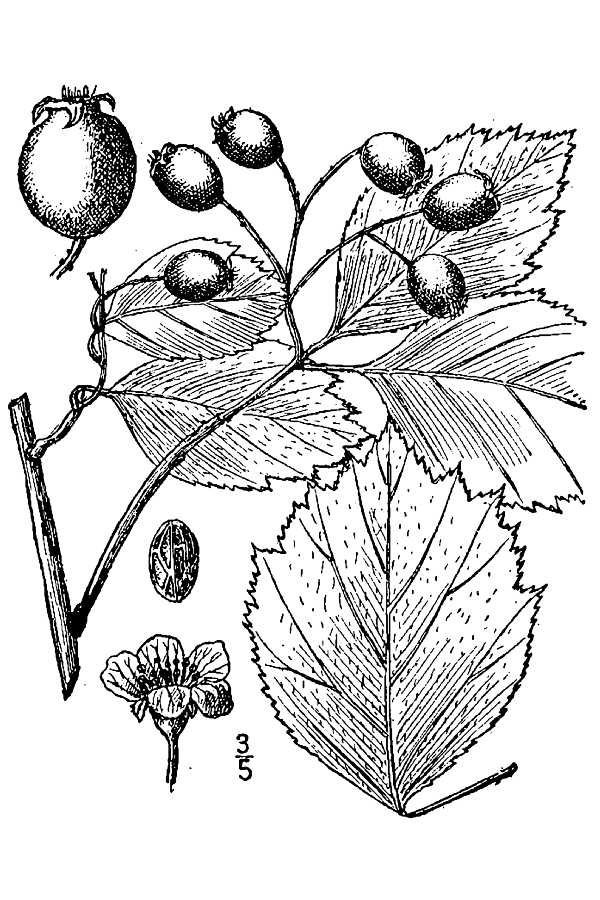
Oriental Hawthorn has deeply cut, dark green leaves with five to nine lobes and grey undersides. The leaves turn yellow in autumn.[1][2]
Habitat
Oriental Hawthorn is native to the Mediterranean region, Turkey, Caucasia, Crimea, and western Iran. Its natural distribution also includes Iraq.[3][4]
The species prefers moist but well-drained or well-drained growing conditions.[5]
Diet
The fruits of Oriental Hawthorn are eaten raw in Caucasia.[6]
Uses
Oriental Hawthorn is cultivated as an ornamental shrub. Its fruits are used as food and for medicinal purposes, and are consumed fresh or as dietary supplements.[7][8][9]
In Caucasia, the fruits are used to make a type of sweet bread. The leaves, flowers, and fruits of hawthorn species including Oriental Hawthorn are processed into jams, teas, food additives, functional drinks, and snack foods.[10][11]
The fruits contain polyphenols, and the species contains flavonoids, phenolic acids, terpenes, and pectin. Its chemical composition has been investigated for antioxidant and cardioprotective properties.[12][13][14]
Oriental Hawthorn has reported anti-inflammatory, hypolipidemic, and antihypertensive properties. It has also been investigated for anticoagulant, anti-ischemic, diuretic, and cardiotonic properties.[15][16][17]
The species has traditionally been used as a therapeutic agent for heart disease. Hawthorn has also traditionally been used to regulate lipid metabolism, promote appetite, and reduce blood glucose levels.[18][19]
Classification of the Oriental Hawthorn
| Kingdom | Plantae |
|---|---|
| Subkingdom | Pteridobiotina |
| Phylum | Tracheophyta |
| Class | Magnoliopsida |
| Order | Rosales |
| Family | Rosaceae (Rose Family) |
| Subfamily | Amygdaloideae |
| Tribe | Maleae |
| Subtribe | Malinae |
| Genus | Crataegus (Hawthorn) |
| Species | Crataegus orientalis Pall. ex M.Bieb. |
Where the Oriental Hawthorn is found
Checklists and occurrence records place Crataegus orientalis in 19 countries across Asia and Europe. GBIF holds 860 georeferenced records of it.
Countries where it is native or its origin is not stated
- Albania 4
- Armenia 102
- Austria 3
- Azerbaijan 8
- Bulgaria 3
- Denmark 3
- Georgia 11
- Greece 63
- Iran 2
- Italy 5
- Kazakhstan 3
- North Macedonia 10
- Russia 20
- Sweden 13
- The Netherlands 5
- Turkey 151
- Ukraine 336
- United Kingdom 116
Countries where it has been introduced
Regions and cities with the most records
- Crimea, Ukraine 283
- Feodosiya, Ukraine 92
- England, United Kingdom 89
- Alushta, Ukraine 71
- Sudak, Ukraine 61
- Yalta, Ukraine 40
- Ankara, Turkey 36
- Ankara, Turkey 30
- Çankaya, Turkey 30
- Balaklava, Ukraine 29
- Gölbaşı, Turkey 29
- Sevastopol, Ukraine 26
- Syunik, Armenia 22
- Alfreton, United Kingdom 17
- Ararat, Armenia 17
- Vayots Dzor, Armenia 13
- Belper, United Kingdom 11
- Skåne, Sweden 11
- Simferopol, Ukraine 10
- Abovyan, Armenia 9
- Bury, United Kingdom 9
- Darwen, United Kingdom 9
- Haslingden, United Kingdom 9
- Kotayk, Armenia 9
- Ramsbottom, United Kingdom 9
- Rawtenstall, United Kingdom 9
- Rossendale, United Kingdom 9
- Aragatsotn, Armenia 8
- Ashtarak, Armenia 8
- Northern Ireland, United Kingdom 8
- Charentsavan, Armenia 7
- Rochdale, United Kingdom 7
- Tunceli, Turkey 7
- Bakhchysaray, Ukraine 6
- Chadderton, United Kingdom 6
- Oldham, United Kingdom 6
1 more country has a few records outside this range
These countries hold a few records of Crataegus orientalis but lie outside the range the checklists give for it. Such records are often zoo or garden specimens, museum material or vagrants, so the species is not counted as occurring there.
A number beside a place is its count of GBIF occurrence records. A place without a number comes from a checklist alone. Records show where a species has been observed or collected, which can include escapes and vagrants.
Common names
English
- Oriental Hawthorn
- Oriental Thorn
Names in 3 other languages
- Greek
- Κράταιγος ο Ανατολικός
- Swedish
- luddhagtorn
- Welsh
- Draenen Wen y Dwyrain
Synonyms
2 other scientific names have been used for this species and are now treated as synonyms of Crataegus orientalis.
- Crataegus orientalis var. orientalis
- Mespilus tanacetifolia prol. orientalis (Pall. ex M.Bieb.) Asch. & Graebn.
Subspecies and varieties
- Crataegus orientalis subsp. orientalis subspecies
- Crataegus orientalis subsp. pojarkovae subspecies
- Crataegus orientalis subsp. szovitsii subspecies
Related species
-
 Common HawthornCrataegus monogyna
-
 Chinese HawthornCrataegus pinnatifida
-
 Mexican HawthornCrataegus mexicana
-
 AzaroleCrataegus azarolus
-
 English HawthornCrataegus laevigata
-
 Cockspur HawthornCrataegus crus-galli
-
 Black HawthornCrataegus douglasii
-
 Washington HawthornCrataegus phaenopyrum
Compare
Questions and answers
What is the scientific name of the Oriental Hawthorn?
The scientific name of the Oriental Hawthorn is Crataegus orientalis. Written with its author, the full name is Crataegus orientalis Pall. ex M.Bieb..
Which family does the Oriental Hawthorn belong to?
Crataegus orientalis belongs to the family Rosaceae, in the order Rosales and the class Magnoliopsida.
Where is the Oriental Hawthorn found?
Checklists and occurrence records place Crataegus orientalis in 19 countries, including Ukraine, Turkey, United Kingdom, Armenia, Greece and Russia.
What other names does the Oriental Hawthorn have?
Crataegus orientalis is also known in English as Oriental Thorn.
What is the habitat of hawthorn?
Oriental Hawthorn is native to the Mediterranean region, Turkey, Caucasia, Crimea, western Iran, and Iraq. It prefers moist but well-drained or well-drained growing conditions.[3][4][5]
What are the disadvantages of hawthorn trees?
Oriental Hawthorn may be susceptible to caterpillars, gall mites, and aphids. It may also be affected by leaf spot, fireblight, powdery mildews, and honey fungus. Its seeds contain toxins and should be removed if the fruits are intended for consumption.[20][21][22]
What is Crataegus good for?
The fruits of Oriental Hawthorn are used as food and for medicinal purposes. The species has traditionally been used for heart disease and has been investigated for antioxidant, cardioprotective, anti-inflammatory, hypolipidemic, antihypertensive, anticoagulant, anti-ischemic, diuretic, and cardiotonic properties.[8][12][15][16][17][18]
Sources
Passages the profile rests on
- The species has deeply cut, dark green leaves with five to nine lobes and grey undersides. Source passage: “Deeply-cut, dark green downy leaves with 5-9 lobes are grey beneath” — rhs.org.uk
- Its leaves turn yellow in autumn. Source passage: “turn yellow in the autumn.” — rhs.org.uk
- The species is native to the Mediterranean region, Turkey, Caucasia, Crimea, and western Iran. Source passage: “native to the Mediterranean region, Turkey, Caucasia, Crimea, and western Iran” — English Wikipedia
- The species is native to the Mediterranean region, Iraq, Iran, and other areas mentioned in the review. Source passage: “C. orientalis is a highly variable ornamental tree in gardens native to the Mediterranean region (Iraq, Ira” — pmc.ncbi.nlm.nih.gov
- The species prefers moist but well-drained or well-drained growing conditions. Source passage: “Moist but well–drained or Well–drained” — rhs.org.uk
- The fruits are eaten raw in Caucasia. Source passage: “In Caucasia the fruits are either eaten raw” — English Wikipedia
- The species is cultivated as an ornamental shrub. Source passage: “usually grown as an ornamental shrub” — rhs.org.uk
- The fruits of the species are used as food and for medicinal purposes. Source passage: “widely utilized as a fruit for food and medicinal purposes in herbal shops.” — pmc.ncbi.nlm.nih.gov
- The fruits are consumed fresh or as dietary supplements. Source passage: “widely consumed as natural, fresh fruits or safe dietary supplements” — pmc.ncbi.nlm.nih.gov
- The fruits are used to make a type of sweet bread in Caucasia. Source passage: “or used to make a type of sweet bread.” — English Wikipedia
- The leaves, flowers, and fruits of hawthorn species including this species are processed into jams, teas, food additives, functional drinks, and snack foods. Source passage: “most fresh hawthorn leaves, flowers, and fruits are commonly processed into jams, teas, food additives, functional drinks, and snack foods” — pmc.ncbi.nlm.nih.gov
- The species has been investigated for antioxidant and cardioprotective properties. Source passage: “The current review provides a comprehensive overview of the phytochemical constituents and heart‐protective therapeutic properties of Crataegus orientalis.” — pmc.ncbi.nlm.nih.gov
- The fruits contain polyphenols. Source passage: “as they are rich sources of polyphenols” — pmc.ncbi.nlm.nih.gov
- The species contains flavonoids, phenolic acids, terpenes, and pectin. Source passage: “owing to its numerous bioactive compounds (flavonoids, phenolic acids, terpenes, and pectin)” — pmc.ncbi.nlm.nih.gov
- The species has reported anti-inflammatory and hypolipidemic properties. Source passage: “including antioxidant, anti‐inflammatory, hypolipidemic, antihyperglycemic” — pmc.ncbi.nlm.nih.gov
- The species has reported antihypertensive properties. Source passage: “anti‐inflammatory, hypolipidemic, antihyperglycemic, antihypertensive” — pmc.ncbi.nlm.nih.gov
- The species has been investigated for anticoagulant, anti-ischemic, diuretic, and cardiotonic properties. Source passage: “anticoagulant, anti‐ischemic, diuretic, and cardiotonic properties” — pmc.ncbi.nlm.nih.gov
- The species has traditionally been used as a therapeutic agent for heart disease. Source passage: “hawthorn has been used in traditional medicine for centuries as a therapeutic agent for heart disease” — pmc.ncbi.nlm.nih.gov
- Hawthorn has traditionally been used to regulate lipid metabolism, promote appetite, and reduce blood glucose levels. Source passage: “to regulate lipid metabolism, promote appetite, and reduce blood glucose levels” — pmc.ncbi.nlm.nih.gov
- The seeds contain toxins and should be removed if the fruits are intended for consumption. Source passage: “Seeds contain toxins so these should be removed if you are considering eating the fruit” — rhs.org.uk
- The species may be susceptible to caterpillars, gall mites, and aphids. Source passage: “May be susceptible to caterpillars, gall mites and aphids” — rhs.org.uk
- The species may be susceptible to leaf spot, fireblight, powdery mildews, and honey fungus. Source passage: “may be susceptible to a leaf spot, fireblight, Powdery mildews and honey fungus” — rhs.org.uk
Data
- Catalogue of Life, 2026-10-16 XR cc by
- Global Biodiversity Information Facility CC BY 4.0
- Wikidata CC0
- GeoNames CC BY 4.0
- Wikimedia Commons per image; credit shown with each image
- Within the Catalogue of Life, this name comes from Synonymic Checklists of the Vascular Plants of the World cc by
References
- Pall. ex M.Bieb. where the name was published
This species in other databases
Page built on 27 November 2026. See how the catalog is made and all sources and licences.
Cite this page
ScientificNames.org. (2026). Crataegus orientalis (Oriental Hawthorn). Retrieved November 27, 2026, from https://scientificnames.org/species/crataegus-orientalis
“Crataegus orientalis (Oriental Hawthorn).” ScientificNames.org, 2026, scientificnames.org/species/crataegus-orientalis. Accessed 27 Nov. 2026.
ScientificNames.org. “Crataegus orientalis (Oriental Hawthorn).” Accessed November 27, 2026. https://scientificnames.org/species/crataegus-orientalis.
@misc{scientificnames_crataegus_orientalis_oriental_hawthorn,
  author = {{ScientificNames.org}},
  title = {Crataegus orientalis (Oriental Hawthorn)},
  year = {2026},
  url = {https://scientificnames.org/species/crataegus-orientalis},
  note = {Accessed 2026-11-27}
}