Species · Birds
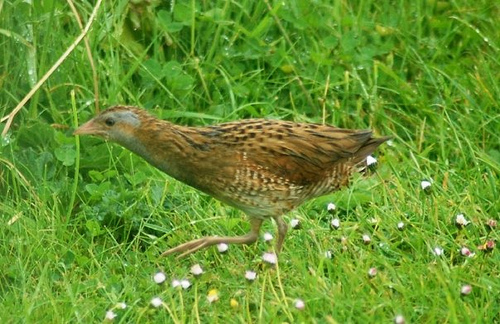
Corn Crake Crex crex
The scientific name of the Corn Crake is Crex crex. It is a species of bird in the family Rallidae (rail), order Gruiformes. The name dates from 1758.
- Scientific name
- Crex crex (Linnaeus, 1758)
- Common name
- Corn Crake
- Genus
- Crex
- Family
- Rallidae (Rail)
- Order
- Gruiformes
- Class
- Aves
- Red List category
- LC Least Concern
- Environment
- terrestrial
- Recorded in
- 65 countries
- Name status
- accepted in the Catalogue of Life
Overview
The breeding range extends from Ireland eastwards through Europe to central Siberia, with a substantial breeding population in western China, and it winters mainly in Africa. The male produces a loud, repetitive krek krek call that can be heard from distances of up to 1.5 km.
Written 26 November 2026 from the sources listed below. Each statement was checked against the passage it cites; statements that could not be supported were removed.
Appearance
The wings have distinctive chestnut coverts with some white bars. Females have warmer-toned upperparts and a narrower, duller eye streak than males.[1][2]
Habitat
The species breeds mainly in cool, moist grassland managed for hay production. Traditional farmland with limited mowing and fertiliser application provides breeding habitat.[3][4]
Other breeding habitats include mountain and taiga grasslands, coastal grasslands, and grasslands created by fire. The species generally avoids very wet habitats and vegetation taller than 50 cm.[5][6]
Diet
The Corn Crake is omnivorous but feeds mainly on invertebrates. Its animal prey also includes small frogs and mammals.[7][8]
Plant foods include grass seeds and cereal grains.[9]
Behaviour
When flushed by a dog, it generally flies less than 50 m before landing behind cover.[10]
The male produces a loud, repetitive call described as krek krek, which can be heard from distances of up to 1.5 km. Calling helps establish breeding territories, attract females, and challenge intruding males.[11][12][13]
Reproduction and life cycle
Males may mate with two or more females during a breeding season. The average male breeding territory covers 15.7 hectares, while females have an average home range of 5.5 hectares.[14][15][16]
Nests are constructed in ground-level scrapes or hollows and concealed within grass. They are made from woven dry grass and other plants and lined with finer grasses.[17][18]
A typical clutch contains 6–14 cream-coloured eggs with rufous blotches. Eggs hatch after an incubation period of 19–20 days, and young birds fledge at approximately five weeks of age.[19][20][21]
Conservation
The species has declined steeply across much of its former breeding range. Modern agricultural practices threaten breeding success by destroying nests before breeding is completed.[22][23]
The Corn Crake is classified as Least Concern on the IUCN Red List. Large populations in Russia and Kazakhstan contribute to its overall conservation status.[24][25]
Classification of the Corn Crake
| Kingdom | Animalia |
|---|---|
| Phylum | Chordata |
| Subphylum | Vertebrata |
| Infraphylum | Gnathostomata |
| Parvphylum | Osteichthyes |
| Megaclass | Tetrapoda |
| Class | Aves (Bird) |
| Order | Gruiformes (Rails) |
| Family | Rallidae (Rail) |
| Genus | Crex (Corn Crake) |
| Species | Crex crex (Linnaeus, 1758) |
Where the Corn Crake is found
Checklists and occurrence records place Crex crex in 65 countries across Asia and North America. GBIF holds 293,820 georeferenced records of it.
Countries
- Aland Islands 90
- Armenia 106
- Austria 1,672
- Azerbaijan 37
- Belarus 795
- Belgium 5,379
- Bosnia and Herzegovina 40
- Bulgaria 915
- Canada 8
- China 45
- Croatia 181
- Cyprus 26
- Czechia 1,157
- Denmark 10,488
- Estonia 16,542
- Faroe Islands 3
- Finland 11,522
- France 6,627
- Georgia 232
- Germany 3,088
- Greece 35
- Greenland 18
- Guadeloupe 5
- Hungary 235
- Iceland 16
- India 11
- Iran 27
- Ireland 1,412
- Isle of Man 98
- Israel 1,226
- Italy 152
- Jordan 26
- Kazakhstan 114
- Kuwait 111
- Kyrgyzstan 87
- Latvia 491
- Lebanon 23
- Liechtenstein 16
- Lithuania 874
- Luxembourg 23
- Moldova 41
- Montenegro 7
- Norway 11,372
- Oman 8
- Palestinian Territory 64
- Poland 6,670
- Portugal 34
- Qatar 6
- Romania 256
- Russia 10,998
- Saint Pierre and Miquelon 5
- Saudi Arabia 83
- Serbia 117
- Slovakia 357
- Slovenia 332
- South Africa 414
- Spain 214
- Sweden 89,572
- Switzerland 2,952
- The Netherlands 8,724
- Turkey 273
- Ukraine 3,748
- United Arab Emirates 148
- United Kingdom 93,284
- United States 188
Regions and cities with the most records
- Scotland, United Kingdom 53,976
- Uppsala, Sweden 13,563
- Kalmar, Sweden 11,737
- Gotland, Sweden 8,836
- Västmanland, Sweden 8,291
- Västra Götaland, Sweden 7,661
- Stockholm, Sweden 5,301
- Örebro, Sweden 4,447
- Moscow Oblast, Russia 4,439
- Uppsala, Sweden 4,359
- Östergötland, Sweden 4,173
- Dalarna, Sweden 3,786
- Gävleborg, Sweden 3,783
- Gelderland, The Netherlands 3,195
- Skåne, Sweden 2,925
- Pärnumaa, Estonia 2,693
- Zealand, Denmark 2,634
- Isle of Lewis, United Kingdom 2,569
- Diest, Belgium 2,562
- Tessenderlo, Belgium 2,558
- Hasselt, Belgium 2,485
- Sint-Truiden, Belgium 2,484
- Beringen, Belgium 2,474
- Koersel, Belgium 2,472
- Zonhoven, Belgium 2,472
- Heusden, Belgium 2,471
- Zolder, Belgium 2,471
- Enköping, Sweden 2,461
- Houthalen, Belgium 2,460
- England, United Kingdom 2,446
- Södermanland, Sweden 2,348
- Tartu, Estonia 2,329
- Rogaland, Norway 2,311
- Värmland, Sweden 2,295
- Vallentuna, Sweden 2,188
- Täby, Sweden 2,182
16 more countries have a few records outside this range
These countries hold a few records of Crex crex but lie outside the range the checklists give for it. Such records are often zoo or garden specimens, museum material or vagrants, so the species is not counted as occurring there.
Range as the checklists state it
Europe & Northern Asia (excluding China)
North America
Southern Asia
A number beside a place is its count of GBIF occurrence records. A place without a number comes from a checklist alone. Records show where a species has been observed or collected, which can include escapes and vagrants.
Common names
English
- Corn Crake
- COCR
- Corncrake
- Land Rail
Names in 70 other languages
- Arabic
- سلوى, مرعة الذرة, مرعة الغيط
- Armenian
- Մարգահավ
- Asturian
- guión
- Azerbaijani
- Adi çivdimdik
- Basque
- Giloi
- Belarusian
- Драч, Драч (або дзяргач)
- Bengali
- ক্রেক্স ক্রেক্স
- Breton
- Rakig-melchon
- Bulgarian
- Ливаден дърдавец
- Catalan
- Guatlla maresa, guatlla maresa eurasiàtica
- Chinese
- 長腳秧雞, 长脚秧鸡
- Croatian
- kosac
- Czech
- chřástal polní
- Danish
- Engsnarre
- Dutch
- kwartelkoning
- Esperanto
- krekso
- Estonian
- rukkirääk
- Faroese
- Akurskritt
- Finnish
- ruisrääkkä
- French
- Roi des cailles, Râle des genêts, Râle des prés, Râle rouge, râle de genêts
- Galician
- Rascón de terra
- Georgian
- ღალღა
- German
- Wachtelkönig, Wiesenknarrer, Wiesenralle, Wiesenschnarrer
- Greek
- Ορτυκομάνα
- Hebrew
- מלכישליו חלודי
- Hungarian
- haris
- Icelandic
- Engirella
- Irish
- Traonach
- Italian
- Re di quaglie
- Japanese
- ウズラクイナ
- Kazakh
- Шәукілдек
- Latvian
- grieze
- Lithuanian
- Griežlė, paprastoji griežlė
- Luxembourgish
- Wuechtelkinnek
- Macedonian
- Прдавец, крекс
- Mongolian
- Явган түнжин
- Northern Sami
- Bealdovuonccis
- Norwegian
- åkerrikse
- Persian
- یلوه حنایی
- Polish
- derkacz, derkacz (zwyczajny)
- Portuguese
- codornizão, codornizão-eurasiático, codornizão-euroasiático, codornizão-europeu
- Romanian
- Cristel de câmp
- Russian
- Дергач, Коростель
- Scottish Gaelic
- ràc an arbhair, ràc an t-sìl, ràcain an arbhair, ràcain an t-sìl, traoin, traon
- Serbian
- Prdavac, Прдавац
- Slovak
- chrapkáč poľný
- Slovenian
- kosec
- Spanish
- Guion de codornices, Guión de codornices, Rey de Codornices
- Swedish
- kornknarr
- Turkish
- Bıldırcınkılavuzu
- Ukrainian
- Деркач, деркач лучний
- Welsh
- Rhegen yr Yd, Rhegennod yr Yd, rhegen yr ŷd
- bak
- Тартай
- chm
- Кӓрш
- chv
- Карӑш
- cor
- Crekyar
- csb
- Kasper
- frr
- Knalangefal
- fry
- Teapert
- glv
- Eean raip
- kbd
- МэкъупӀэджэд
- kir
- Кадимки тартар тоок
- kom
- Герчкан
- mhr
- карш
- myv
- Дерьгун
- olo
- Ruislindu
- oss
- Цъæх мæга
- pnb
- کارن کریک
- sah
- Лахаатта
- vep
- Tähklind
Synonyms
7 other scientific names have been used for this species and are now treated as synonyms of Crex crex.
- Crex crepitans Palmer, S, 1836
- Crex pratensis Bechstein, JM, 1803
- Crex pratensis similis Zarudny, NA, 1918
- Crex strepera Palmer, S, 1836
- Gallinula crex
- Rallus crex Linnaeus, 1758
- Rallus featherstonii Buller, WL, 1865
Related species
-
 TakahēPorphyrio hochstetteri
-
 Australasian SwamphenPorphyrio melanotus
-
 American CootFulica americana
-
 Eurasian CootFulica atra
-
 Common MoorhenGallinula chloropus
-
 WekaGallirallus australis
-
 Tasmanian NativehenTribonyx mortierii
-
 White-breasted WaterhenAmaurornis phoenicurus
Compare
Questions and answers
What is the scientific name of the Corn Crake?
The scientific name of the Corn Crake is Crex crex. Written with its author, the full name is Crex crex (Linnaeus, 1758).
Which family does the Corn Crake belong to?
Crex crex belongs to the family Rallidae, in the order Gruiformes and the class Aves.
Where is the Corn Crake found?
Checklists and occurrence records place Crex crex in 65 countries, including United Kingdom, Sweden, Estonia, Finland, Norway and Russia.
What is the conservation status of the Corn Crake?
The IUCN Red List category recorded for Crex crex is Least Concern (LC).
What other names does the Corn Crake have?
Crex crex is also known in English as COCR, Corncrake and Land Rail.
Sources
Passages the profile rests on
- The wings have distinctive chestnut coverts with some white bars. Source passage: “The wing coverts are a distinctive chestnut colour with some white bars.” — English Wikipedia
- Females have warmer-toned upperparts and a narrower, duller eye streak than males. Source passage: “Compared to the male, the female has warmer-toned upperparts and a narrower duller eye streak.” — English Wikipedia
- The species breeds mainly in cool, moist grassland managed for hay production. Source passage: “It is now mainly found in cool moist grassland used for the production of hay” — English Wikipedia
- Breeding habitats include traditional farmland with limited mowing and fertiliser application. Source passage: “particularly moist traditional farmland with limited cutting or fertiliser use.” — English Wikipedia
- Breeding habitats can include mountain and taiga grasslands, coastal grasslands, and grasslands created by fire. Source passage: “It also utilises other treeless grasslands in mountains or taiga, on coasts, or where created by fire.” — English Wikipedia
- The species generally avoids very wet habitats and vegetation taller than 50 cm. Source passage: “very wet habitats are avoided, as are open areas and those with vegetation more than 50 cm (20 in) tall” — English Wikipedia
- The species is omnivorous but feeds mainly on invertebrates. Source passage: “The corn crake is omnivorous but mainly feeds on invertebrates” — English Wikipedia
- Its animal prey includes small frogs and mammals. Source passage: “the occasional small frog or mammal” — English Wikipedia
- Its plant foods include grass seeds and cereal grains. Source passage: “plant material including grass seed and cereal grain.” — English Wikipedia
- When flushed by a dog, it generally flies less than 50 m before landing behind cover. Source passage: “When flushed by a dog, it will fly less than 50 m (160 ft), frequently landing behind a bush or thicket” — English Wikipedia
- The male produces a loud, repetitive call described as krek krek. Source passage: “a loud, repetitive, grating krek krek” — English Wikipedia
- The male's call can be heard from distances of up to 1.5 km. Source passage: “The call can be heard from 1.5 km (0.93 mi) away” — English Wikipedia
- Male calling helps establish breeding territories, attract females, and challenge intruding males. Source passage: “serves to establish the breeding territory, attract females, and challenge intruding males.” — English Wikipedia
- Males may mate with two or more females during a breeding season. Source passage: “a male may have a shifting home range, and mate with two or more females” — English Wikipedia
- The average male breeding territory covers 15.7 hectares. Source passage: “The male's territory can vary from 3 to 51 ha (7.4 to 126.0 acres), but averages 15.7 ha (39 acres).” — English Wikipedia
- Females have an average home range of 5.5 hectares. Source passage: “The female has a much smaller range, averaging only 5.5 ha (14 acres).” — English Wikipedia
- Nests are constructed in ground-level scrapes or hollows and concealed within grass. Source passage: “The nest, well hidden in the grass, is built in a scrape or hollow in the ground.” — English Wikipedia
- The nest is constructed from woven dry grass and other plants and lined with finer grasses. Source passage: “It is made of woven coarse dry grass and other plants, and lined with finer grasses.” — English Wikipedia
- A typical clutch contains 6–14 cream-coloured eggs with rufous blotches. Source passage: “lays 6–14 cream-coloured eggs which are covered with rufous blotches.” — English Wikipedia
- Eggs hatch after an incubation period of 19–20 days. Source passage: “These hatch in 19–20 days” — English Wikipedia
- Young birds fledge at approximately five weeks of age. Source passage: “the black precocial chicks fledge after about five weeks.” — English Wikipedia
- The species has declined steeply across much of its former breeding range. Source passage: “This crake is in steep decline across much of its former breeding range” — English Wikipedia
- Modern agricultural practices threaten breeding success by destroying nests before breeding is completed. Source passage: “modern farming practices often destroy nests before breeding is completed.” — English Wikipedia
- The species is classified as Least Concern on the IUCN Red List. Source passage: “this bird is classed as least concern on the IUCN Red List” — English Wikipedia
- Large populations in Russia and Kazakhstan contribute to the species' overall conservation status. Source passage: “large, apparently stable, populations in Russia and Kazakhstan.” — English Wikipedia
Data
- Catalogue of Life, 2026-10-16 XR cc by
- Global Biodiversity Information Facility CC BY 4.0
- Wikidata CC0
- GeoNames CC BY 4.0
- Wikimedia Commons per image; credit shown with each image
- Within the Catalogue of Life, this name comes from The Integrated Taxonomic Information System cc0
References
- Syst. Nat. ed. 10 p. 153 where the name was published
- Banks, R. C., R. W. McDiarmid, and A. L. Gardner. (1987). Checklist of Vertebrates of the United States, the U.S. Territories, and Canada. Resource Publication, No. 166.
- Gill, Frank, & and Minturn Wright. (2006). Birds of the World: Recommended English Names.
- Dickinson, E. C., and J. V. Remsen Jr., eds. (2013). The Howard and Moore Complete Checklist of the Birds of the World, 4th Edition, Vol. 1 Non-Passerines.
- Howell, Steve N. G., Ian Lewington, and Will Russell. (2014). Rare Birds of North America.
This species in other databases
- Catalogue of Life ZFFP
- Wikidata Q26017
- iNaturalist 443
- WoRMS urn:lsid:marinespecies.org:taxname:416690
- Avibase corcra
Page built on 28 November 2026. See how the catalog is made and all sources and licences.
Cite this page
ScientificNames.org. (2026). Crex crex (Corn Crake). Retrieved November 28, 2026, from https://scientificnames.org/species/crex-crex
“Crex crex (Corn Crake).” ScientificNames.org, 2026, scientificnames.org/species/crex-crex. Accessed 28 Nov. 2026.
ScientificNames.org. “Crex crex (Corn Crake).” Accessed November 28, 2026. https://scientificnames.org/species/crex-crex.
@misc{scientificnames_crex_crex_corn_crake,
  author = {{ScientificNames.org}},
  title = {Crex crex (Corn Crake)},
  year = {2026},
  url = {https://scientificnames.org/species/crex-crex},
  note = {Accessed 2026-11-28}
}