Species · Birds
Shelley's Crimsonwing Cryptospiza shelleyi
The scientific name of the Shelley's Crimsonwing is Cryptospiza shelleyi. It is a species of bird in the family Estrildidae (munias), order Passeriformes. The name dates from 1902.
- Scientific name
- Cryptospiza shelleyi Sharpe, 1902
- Common name
- Shelley's Crimsonwing
- Genus
- Cryptospiza
- Family
- Estrildidae (Munias)
- Order
- Passeriformes
- Class
- Aves
- Red List category
- EN Endangered
- Recorded in
- 5 countries
- Name status
- accepted in the Catalogue of Life

Overview
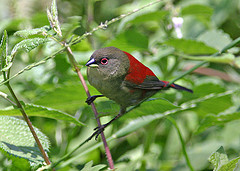
Cryptospiza shelleyi is distributed throughout the Albertine Rift montane forests. It has a red bill and upperparts, an olive throat, orange flanks and black wings.
Written 27 November 2026 from the sources listed below. Each statement was checked against the passage it cites; statements that could not be supported were removed.
Appearance
The male has a bright red crown, face and back, contrasting black wings and tail, and olive-yellow underparts. The female has an olive-coloured head and red markings on her mantle and rump.[1][2]
Both sexes have bright red bills. The species measures approximately 13 centimetres in length.[3][4]
Habitat
Shelley's Crimsonwing inhabits closed-canopy moist forests, particularly lush valley bottoms near water. It also occupies low secondary growth along forest edges.[5][6]
The species occurs in forest clearings and glades dominated by large herbs. It also inhabits the upper forest and moorland ecotone.[7][8]
Behaviour
The species is generally found at low levels. It produces a sharp, high-pitched call consisting of repeated tit notes.[9][10]
It has been observed feeding on the ground for more than three minutes before flying away.[11]
Conservation
Shelley's Crimsonwing is classified as vulnerable, and its population trend is decreasing. The estimated population and number of mature individuals are between 1,000 and 2,499.[12][13][14][15]
The species has experienced population declines over recent decades. Uncontrolled deforestation is identified as a possible factor associated with these declines.[16][17]
The species is generally rare, although it is common in a few threatened forests. It also exhibits unexplained fluctuations in abundance.[18][19]
Researchers have been advised to investigate population declines and fluctuations to assess extinction threats. Surveying the extent of the species' habitat has been proposed as a conservation measure.[20][21]
The species was assessed for the IUCN Red List in 2017.[22]
Classification of the Shelley's Crimsonwing
| Kingdom | Animalia |
|---|---|
| Phylum | Chordata |
| Subphylum | Vertebrata |
| Infraphylum | Gnathostomata |
| Parvphylum | Osteichthyes |
| Megaclass | Tetrapoda |
| Class | Aves (Bird) |
| Order | Passeriformes (Passerine) |
| Family | Estrildidae (Munias) |
| Genus | Cryptospiza (Crimsonwing) |
| Species | Cryptospiza shelleyi Sharpe, 1902 |
Where the Shelley's Crimsonwing is found
Checklists and occurrence records place Cryptospiza shelleyi in 5 countries. GBIF holds 113 georeferenced records of it.
Countries
Regions and cities with the most records
A number beside a place is its count of GBIF occurrence records. A place without a number comes from a checklist alone. Records show where a species has been observed or collected, which can include escapes and vagrants.
Common names
English
- Shelley's Crimsonwing
- SHCR
- Shelley's Crimson-wing
Names in 26 other languages
- Arabic
- قرمزي الجناح شيلي
- Chinese
- 謝利氏紅嘴朱翅雀, 谢氏朱翅雀
- Croatian
- crvenoleđa estrilda
- Czech
- astrild bambusový
- Danish
- Stor Bjergastrild
- Dutch
- Shelleys Bergastrild
- Esperanto
- ruĝmantela estrildo
- Estonian
- suur-mägiamadiin
- Finnish
- isopunapeippo
- French
- Astrild de Shelley, Bengali de Shelley, Mandingo de Shelley, Sénégali de Shelley
- German
- Rotmantel-Astrild, Rotmantelastrild
- Hungarian
- Shelley hegyi asztrildja
- Italian
- Alarossa di Shelley
- Japanese
- ズアカハゴロモキンパラ
- Lithuanian
- bambukinė kalninė astrilda
- Norwegian
- edelastrild
- Polish
- krasnorzytka czerwonodzioba
- Portuguese
- asa-carmim-de-bico-vermelho, asa-vermelha-de-bico-vermelho, asa-vermelha-de-shelley
- Russian
- Красноспинный горный астрильд, Рувензорский астрильд
- Serbian
- Šelijeva brdska astrilda
- Slovak
- karmínka bambusová
- Spanish
- Estrilda de Shelley
- Swedish
- rödnäbbad bergastrild
- Turkish
- Shelley Astrildi
- Ukrainian
- червоногуз заїрський
- Welsh
- aderyn adeingoch Shelley
Related species
-
 Abyssinian CrimsonwingCryptospiza salvadorii
-
 Red-faced CrimsonwingCryptospiza reichenovii
-
 Dusky CrimsonwingCryptospiza jacksoni
-
 Scaly-breasted MuniaLonchura punctulata
-
 Red AvadavatAmandava amandava
-
 Common WaxbillEstrilda astrild
-
 Indian SilverbillEuodice malabarica
-
 Red-browed FinchNeochmia temporalis
Compare
Questions and answers
What is the scientific name of the Shelley's Crimsonwing?
The scientific name of the Shelley's Crimsonwing is Cryptospiza shelleyi. Written with its author, the full name is Cryptospiza shelleyi Sharpe, 1902.
Which family does the Shelley's Crimsonwing belong to?
Cryptospiza shelleyi belongs to the family Estrildidae, in the order Passeriformes and the class Aves.
Where is the Shelley's Crimsonwing found?
Checklists and occurrence records place Cryptospiza shelleyi in 5 countries: Uganda, Democratic Republic of the Congo, Rwanda, Burundi and Republic of the Congo.
What is the conservation status of the Shelley's Crimsonwing?
The IUCN Red List category recorded for Cryptospiza shelleyi is Endangered (EN).
What other names does the Shelley's Crimsonwing have?
Cryptospiza shelleyi is also known in English as SHCR and Shelley's Crimson-wing.
Where does Shelley's Crimsonwing occur?
Its recorded range includes the Itombwe Mountain and Kahuzi-Biéga National Park in the Democratic Republic of Congo, as well as forests west of Lake Kivu. In Rwanda, it has been recorded in Nyungwe Forest, Gishwati, Makwa and Mukura Forest; in Burundi, it occurs in Bururi Forest and other locations. Its Ugandan range includes the Rwenzori Mountains and Bwindi Impenetrable Forest, and the Virunga Mountain is also included in its recorded range.[23][24][25][26][27][28]
Sources
Passages the profile rests on
- The male has a bright red crown, face and back, contrasting black wings and tail, and olive-yellow underparts. Source passage: “The male Shelley's crimson-wing has bright red crown, face and back, with contrasting black wings and tail, as well as olive-yellow underparts” — English Wikipedia
- The female has an olive-coloured head and red markings on her mantle and rump. Source passage: “The female is drabber with an olive head and some red on the mantle and rump.” — English Wikipedia
- Both sexes have bright red bills. Source passage: “Both sexes have bright red bills.” — English Wikipedia
- The species measures approximately 13 centimetres in length. Source passage: “It is approximately 13 centimetres (5.1 in) long.” — English Wikipedia
- The species inhabits closed-canopy moist forests, particularly lush valley bottoms near water. Source passage: “Shelley's crimsonwing inhabits the closed-canopy moist forest, often in lush valley bottoms near water” — English Wikipedia
- The species also occupies low secondary growth along forest edges. Source passage: “as well as low secondary growth at forest edges” — English Wikipedia
- The species occurs in forest clearings and glades dominated by large herbs. Source passage: “forest clearings and glades dominated by large herbs” — English Wikipedia
- The species also inhabits the upper forest and moorland ecotone. Source passage: “the upper forest/moorland ecotone.” — English Wikipedia
- The species produces a sharp, high-pitched call consisting of repeated tit notes. Source passage: “Its voice is sharp and high-pitched with tit tit tit call.” — English Wikipedia
- The species is generally found at low levels. Source passage: “It is a brightly coloured finch found at low levels.” — English Wikipedia
- The species has been observed feeding on the ground for more than three minutes before flying away. Source passage: “it was seen feeding from the ground for more than 3 minutes before it flew off” — English Wikipedia
- The species is classified as vulnerable. Source passage: “is a vulnerable species of estrildid finch” — English Wikipedia
- The estimated population is between 1,000 and 2,499 individuals. Source passage: “with a current population estimate of 1,000–2,499.” — English Wikipedia
- The population trend is decreasing. Source passage: “Population trend Decreasing” — datazone.birdlife.org
- The number of mature individuals is estimated at 1,000–2,499. Source passage: “Number of mature individuals 1,000 - 2,499” — datazone.birdlife.org
- The species has experienced population declines over recent decades. Source passage: “It has shown population decline over the past few decades” — English Wikipedia
- Uncontrolled deforestation is identified as a possible factor associated with population decline. Source passage: “This is possibly related to uncontrolled deforestation.” — English Wikipedia
- The species is generally rare, although it is common in a few threatened forests. Source passage: “It is generally rare, only being common in a few threatened forests” — English Wikipedia
- The species exhibits unexplained fluctuations in abundance. Source passage: “which shows unexplained fluctuations in abundance.” — English Wikipedia
- Researchers have been advised to investigate population declines and fluctuations to assess extinction threats. Source passage: “researchers investigate declines and fluctuations in Shelley's crimsonwing population, in order to assess threats of extinction.” — English Wikipedia
- Surveying the extent of the species' habitat has been proposed as a conservation measure. Source passage: “This includes surveying the extent of its habitat.” — English Wikipedia
- The species was assessed for the IUCN Red List in 2017. Source passage: “Shelley's Crimsonwing Cryptospiza shelleyi has most recently been assessed for The IUCN Red List of Threatened Species in 2017.” — iucnredlist.org
- Its recorded range includes the Itombwe Mountain and Kahuzi-Biéga National Park in the Democratic Republic of Congo. Source passage: “including the Itombwe Mountain, Kahuzi-Biéga National Park” — English Wikipedia
- The species occurs in forests west of Lake Kivu in the Democratic Republic of Congo. Source passage: “mountains at the west of Lake Kivu in Democratic Republic of Congo” — English Wikipedia
- In Rwanda, the species has been recorded in Nyungwe Forest, Gishwati, Makwa and Mukura Forest. Source passage: “Nyungwe Forest, Gishwati, Makwa and Mukura Forest in Rwanda” — English Wikipedia
- The species occurs in Bururi Forest and other locations in Burundi. Source passage: “Bururi Forest and elsewhere in Burundi” — English Wikipedia
- Its Ugandan range includes the Rwenzori Mountains and Bwindi Impenetrable Forest. Source passage: “the Rwenzori Mountains and Bwindi Impenetrable Forest in Uganda” — English Wikipedia
- The Virunga Mountain is included in the species' recorded range. Source passage: “as well as the Virunga Mountain.” — English Wikipedia
Data
- Catalogue of Life, 2026-10-16 XR cc by
- Global Biodiversity Information Facility CC BY 4.0
- Wikidata CC0
- GeoNames CC BY 4.0
- Wikimedia Commons per image; credit shown with each image
- Within the Catalogue of Life, this name comes from The Integrated Taxonomic Information System cc0
References
- Gill, Frank, & and Minturn Wright. (2006). Birds of the World: Recommended English Names.
This species in other databases
Page built on 29 November 2026. See how the catalog is made and all sources and licences.
Cite this page
ScientificNames.org. (2026). Cryptospiza shelleyi (Shelley's Crimsonwing). Retrieved November 29, 2026, from https://scientificnames.org/species/cryptospiza-shelleyi
“Cryptospiza shelleyi (Shelley's Crimsonwing).” ScientificNames.org, 2026, scientificnames.org/species/cryptospiza-shelleyi. Accessed 29 Nov. 2026.
ScientificNames.org. “Cryptospiza shelleyi (Shelley's Crimsonwing).” Accessed November 29, 2026. https://scientificnames.org/species/cryptospiza-shelleyi.
@misc{scientificnames_cryptospiza_shelleyi_shelleys_crimsonwing,
  author = {{ScientificNames.org}},
  title = {Cryptospiza shelleyi (Shelley's Crimsonwing)},
  year = {2026},
  url = {https://scientificnames.org/species/cryptospiza-shelleyi},
  note = {Accessed 2026-11-29}
}