Species · Flowering plants
Giant Sumpweed Cyclachaena xanthiifolia
The scientific name of the Giant Sumpweed is Cyclachaena xanthiifolia. It is a species of flowering plant in the family Asteraceae (composite), order Asterales.
- Scientific name
- Cyclachaena xanthiifolia (Nutt.) Fresen.
- Common name
- Giant Sumpweed
- Genus
- Cyclachaena
- Family
- Asteraceae (Composite)
- Order
- Asterales
- Class
- Magnoliopsida
- Recorded in
- 29 countries
- Name status
- accepted in the Catalogue of Life
Overview
Giant sumpweed is an annual herbaceous flowering plant in the family Asteraceae that grows from a distinct taproot. It is native to South Dakota, where it occurs widely in floodplains, bottomlands, riverbanks, roadsides, and fertile agricultural fields. It produces numerous drooping flower heads and large quantities of lightweight, wind-borne pollen that can cause severe allergic reactions.
Written 28 November 2026 from the sources listed below. Each statement was checked against the passage it cites; statements that could not be supported were removed.
Appearance
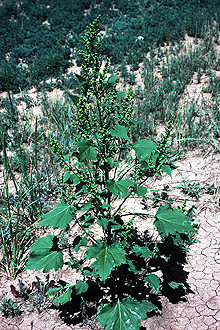
Giant sumpweed typically reaches heights of 30 to 200 cm. Its erect, angular, robust stem is unbranched near the base and extensively branched in the upper flowering region.[1][2]
The lower stem is hairless, while the upper portions have fine, sticky glandular hairs. Leaves are opposite on the lower stem and may become alternate near the upper flower clusters.[3][4]
The simple leaves are broadly ovate to triangular and may have shallowly three-lobed blades with coarsely or doubly toothed margins. The blades measure 6 to 12 cm in length and 5 to 12 cm in width, with petioles measuring 1 to 7 cm.[5][6][7][8]
The upper leaf surface is slightly rough and sparsely covered with straight, stiff, appressed hairs. The lower surface is paler and covered with dense, long, soft, appressed hairs.[9][10]
The flowering structures consist of numerous small, drooping, disk-shaped heads grouped into dense, elongated, branching panicles. Each involucre measures 1.5 to 3 mm in height and has five outer herbaceous phyllaries and five inner scarious to membranous, hairless phyllaries.[11][12][13]
Male central florets have white to pale yellow tubular corollas approximately 2 to 2.5 mm long. Outer female florets have extremely reduced whitish corollas measuring 0.1 to 0.5 mm in length.[14][15]
The fruits are smooth, egg-shaped to triangular cypselae measuring 2 to 3 mm long. Mature fruits become dark brown to nearly black, and the species does not possess a pappus.[16][17][18]
Habitat
Giant sumpweed commonly grows in floodplains, bottomlands, riverbanks, roadsides, and fertile agricultural fields. It grows best in loose, highly fertile, friable, nutrient-rich alluvial or sandy soils.[19][20]
The plant can grow in full sun or partial shade and prefers consistently moist soil with a moisture content of approximately 70% to 80%.[21][22]
Uses
Giant sumpweed provides shelter for local wildlife by forming dense colonies. Its flowers attract beetles, flies, and native bees during an extended blooming period.[23][24]
Its seeds provide an important autumn food source for finches and other seed-eating birds. Prehistoric Native American populations historically cultivated and consumed its small seeds as a grain crop.[25][26]
Its seeds were historically displaced as a grain crop by maize.[27]
Reproduction and life cycle
Flowering takes place from July through October. Each male floret contains five stamens whose filaments are fused into a tube, while each female floret has a single inferior ovary and a style divided into two short, thread-like stigmas.[28][29][30]
The fruits mature between August and October. Seeds can remain viable in the soil seed bank for as long as six years.[31][32]
Seed germination requires moist cold stratification to overcome dormancy.[33]
Conservation
Giant sumpweed is widely managed as an aggressive weed.[34]
Classification of the Giant Sumpweed
| Kingdom | Plantae |
|---|---|
| Subkingdom | Pteridobiotina |
| Phylum | Tracheophyta |
| Class | Magnoliopsida |
| Order | Asterales |
| Family | Asteraceae (Composite) |
| Subfamily | Asteroideae |
| Tribe | Heliantheae |
| Subtribe | Ambrosiinae |
| Genus | Cyclachaena (Giant Sumpweed) |
| Species | Cyclachaena xanthiifolia (Nutt.) Fresen. |
Where the Giant Sumpweed is found
Checklists and occurrence records place Cyclachaena xanthiifolia in 29 countries across Asia, Europe and North America. GBIF holds 11,235 georeferenced records of it.
Countries where it is native or its origin is not stated
Countries where it has been introduced
- Armenia 1
- Austria 103
- Azerbaijan
- Belarus 34
- Belgium 143
- Bulgaria
- Croatia
- Czechia 83
- Estonia 46
- France 128
- Germany 586
- Hungary 19
- Kosovo
- Kyrgyzstan 3
- Latvia
- Lithuania
- Luxembourg 4
- Moldova 9
- Poland 412
- Romania 1,563
- Serbia 8
- Slovakia 367
- Slovenia
- Spain 29
- Switzerland 24
- Ukraine 1,116
Regions and cities with the most records
- Voronezh Oblast, Russia 554
- Belgorod Oblast, Russia 461
- Vaslui County, Romania 430
- Samara Oblast, Russia 393
- Iași County, Romania 367
- Saratov Oblast, Russia 362
- Colorado, United States 270
- Saratov, Russia 256
- Kursk Oblast, Russia 251
- Engels, Russia 247
- Penza Oblast, Russia 245
- Voronezh, Russia 240
- Pridonskoy, Russia 233
- Privolzhskiy, Russia 233
- Semiluki, Russia 226
- Belgorod, Russia 209
- Cherkasy, Ukraine 193
- Mokotów, Poland 171
- Praga Południe, Poland 171
- Novaya Usman’, Russia 170
- Ochota, Poland 170
- Praga Północ, Poland 170
- Warsaw, Poland 170
- Wola, Poland 170
- Śródmieście, Poland 170
- Żoliborz, Poland 170
- Galați County, Romania 169
- Rembertów, Poland 169
- Targówek, Poland 169
- Ząbki, Poland 167
- Włochy, Poland 166
- Bemowo, Poland 165
- Marki, Poland 165
- Bielany, Poland 162
- Białołeka, Poland 161
- Zielonka, Poland 161
9 more countries have a few records outside this range
These countries hold a few records of Cyclachaena xanthiifolia but lie outside the range the checklists give for it. Such records are often zoo or garden specimens, museum material or vagrants, so the species is not counted as occurring there.
Range as the checklists state it
Netherlands [I]; Belgium [I]; Luxembourg [I]; Germany [I]; Switzerland [I]; Austria [I]; Poland [I]; Czech Republic [I]; Slovakia [I]; Hungary [I]; Spain [I]; France [I]; Slovenia [I]; Croatia [I]; Serbia [I]; Kosovo [I]; Romania [I]; Bulgaria [I]; Estonia [I]; Latvia [I]; Lithuania [I]; Belarus [I]; European Russia [I]; Moldova [I]; Ukraine [I]; Crimea [I]; Russian Far East [I] (Khabarovsk [I], Primorye [I]); Kyrgyzstan [I]; Northern Caucasus [I]; Armenia [I]; Azerbaijan [I]; Canada (Alberta, British Columbia, Manitoba, Nova Scotia, Ontario, Prince Edward Isl., Québec, Saskatchewan); USA (Arizona, Colorado, Connecticut, District of Columbia, Iowa, Idaho, Illinois, Indiana, Kansas, Kentucky, Massachusetts, Maine, Michigan, Minnesota, Missouri, Montana, North Dakota, Nebraska, New Hampshire, New Jersey, New Mexico, Nevada, New York, Ohio, Oklahoma, Oregon, Pennsylvania, Rhode Island, South Carolina, South Dakota, Texas, Utah, Virginia, Vermont, Washington State, Wisconsin, Wyoming)
A number beside a place is its count of GBIF occurrence records. A place without a number comes from a checklist alone. Records show where a species has been observed or collected, which can include escapes and vagrants.
Common names
English
- Giant Sumpweed
- Burrweed Marsh-elder
- Carelessweed
- Coarse Sumpweed
- False Ragweed
- Marsh-elder
- Rag Sumpweed
- Tall Marsh-elder
Names in 6 other languages
- Finnish
- sahaiiva
- French
- fausse herbe à poux, iva xanthifoliée, iva à feuilles de lampourde, ive à feuilles de lampourde
- German
- Schlagkraut
- Norwegian Bokmål
- gullblad
- Portuguese
- malmequer-do-brejo
- Swedish
- iva
Synonyms
9 other scientific names have been used for this species and are now treated as synonyms of Cyclachaena xanthiifolia.
- Cyclachaena pedicellata Rydb.
- Cyclachaena xanthiifolia var. minor Wawra
- Cyclachaena xanthiifolia var. xanthiifolia
- Euphrosyne xanthiifolia (Nutt.) A.Gray
- Iva paniculata Nutt.
- Iva pedicellata (Rydb.) Cory
- Iva xanthiifolia Nutt.
- Iva xanthiifolia f. incisa C.Dobrescu & G.Vitalariu
- Iva xanthiifolia var. pedicellata (Rydb.) Kittell
Related species
-
 Jerusalem ArtichokeHelianthus tuberosus
-
 ChicoryCichorium intybus
-
 Absinthe WormwoodArtemisia absinthium
-
 Common SunflowerHelianthus annuus
-
 Common YarrowAchillea millefolium
-
 LettuceLactuca sativa
-
 TarragonArtemisia dracunculus
-
 African MarigoldTagetes erecta
Compare
Questions and answers
What is the scientific name of the Giant Sumpweed?
The scientific name of the Giant Sumpweed is Cyclachaena xanthiifolia. Written with its author, the full name is Cyclachaena xanthiifolia (Nutt.) Fresen..
Which family does the Giant Sumpweed belong to?
Cyclachaena xanthiifolia belongs to the family Asteraceae, in the order Asterales and the class Magnoliopsida.
Where is the Giant Sumpweed found?
Checklists and occurrence records place Cyclachaena xanthiifolia in 29 countries, including Russia, United States and Canada.
What other names does the Giant Sumpweed have?
Cyclachaena xanthiifolia is also known in English as Burrweed Marsh-elder, Carelessweed, Coarse Sumpweed, False Ragweed, Marsh-elder and Rag Sumpweed.
What is marsh elder used for?
Giant sumpweed provides shelter for local wildlife through its dense colonies. Its flowers attract beetles, flies, and native bees, and its seeds provide autumn food for finches and other seed-eating birds. Prehistoric Native American populations historically cultivated and consumed its seeds as a grain crop.[23][24][25][26]
Can you eat marsh elder?
Prehistoric Native American populations historically cultivated and consumed the small seeds of giant sumpweed as a grain crop. Its seeds were later displaced as a grain crop by maize.[26][27]
What is marsh elder allergy?
Giant sumpweed produces large quantities of lightweight, wind-borne pollen that can cause severe allergic reactions.[35]
Sources
Passages the profile rests on
- The plant typically reaches heights of 30 to 200 cm. Source passage: “Giant sumpweed typically grows to a height of 30 to 200 cm” — openprairie.sdstate.edu
- Its stem is erect, angular, and robust, remaining unbranched near the base but becoming extensively branched in the upper flowering region. Source passage: “a stout, erect, angular stem that is unbranched below but heavily branched within the upper inflorescence.” — openprairie.sdstate.edu
- The lower stem is hairless, whereas its upper portions have fine, sticky glandular hairs. Source passage: “The lower portion of the stem is completely hairless, while the upper sections bear fine, sticky, glandular hairs.” — openprairie.sdstate.edu
- Leaves are arranged oppositely on the lower stem but may become alternately arranged near the upper flower clusters. Source passage: “Leaf insertion is primarily opposite along the lower stem but can shift to an alternate arrangement near the upper flower clusters.” — openprairie.sdstate.edu
- Its simple leaves are broadly ovate to triangular and may have shallowly three-lobed blades. Source passage: “The leaves are simple, broadly ovate to triangular, and sometimes shallowly three-lobed.” — openprairie.sdstate.edu
- Leaf blades measure 6 to 12 cm in length and 5 to 12 cm in width. Source passage: “blades measuring 6 to 12 cm long and 5 to 12 cm wide” — openprairie.sdstate.edu
- The leaf margins are coarsely or doubly toothed. Source passage: “with coarsely or doubly toothed margins.” — openprairie.sdstate.edu
- Its leaf petioles range from 1 to 7 cm in length. Source passage: “Petioles are present and well-developed, 1 to 7 cm in length.” — openprairie.sdstate.edu
- The upper leaf surface is slightly rough and sparsely covered with straight, stiff, appressed hairs. Source passage: “The upper leaf surface is slightly rough-textured with a sparse covering of straight, stiff, appressed hairs” — openprairie.sdstate.edu
- The lower leaf surface is paler than the upper surface and covered with dense, long, soft, appressed hairs. Source passage: “the lower surface is distinctly paler and silky-soft due to a dense layer of long, soft, appressed hairs.” — openprairie.sdstate.edu
- The flowering structures consist of numerous small, drooping, disk-shaped heads grouped into dense, elongated, branching panicles. Source passage: “The inflorescence consists of numerous small, drooping, disk-shaped heads arranged in dense, elongated, branching panicles” — openprairie.sdstate.edu
- The involucre surrounding each flower head measures 1.5 to 3 mm in height. Source passage: “The cup-like involucre at the base of each head measures 1.5 to 3 mm high.” — openprairie.sdstate.edu
- Each flower head has five outer herbaceous phyllaries and five inner scarious to membranous, hairless phyllaries. Source passage: “It features 5 outer herbaceous phyllaries (bracts) that are broad and covered in fine hairs, and 5 inner scarious to membranous, glabrous phyllaries.” — openprairie.sdstate.edu
- Male central florets have white to pale yellow tubular corollas approximately 2 to 2.5 mm long. Source passage: “Staminate (male) central florets feature fused petals forming a white to pale yellow tubular corolla roughly 2 to 2.5 mm long” — openprairie.sdstate.edu
- The outer female florets have extremely reduced whitish corollas measuring 0.1 to 0.5 mm in length. Source passage: “the outer pistillate (female) florets have an obsolete or heavily reduced, tiny whitish corolla tube measuring only 0.1 to 0.5 mm long.” — openprairie.sdstate.edu
- The species does not possess a pappus. Source passage: “A pappus is entirely absent.” — openprairie.sdstate.edu
- The fruits are smooth, egg-shaped to triangular cypselae measuring 2 to 3 mm long. Source passage: “The fruit is a smooth, egg-shaped to triangular cypsela (achene) measuring 2 to 3 mm long” — openprairie.sdstate.edu
- Mature fruits become dark brown to nearly black. Source passage: “turning dark brown to nearly black as it reaches maturity” — openprairie.sdstate.edu
- It commonly grows in floodplains, bottomlands, riverbanks, roadsides, and fertile agricultural fields. Source passage: “commonly occupying high-moisture or disturbed habitats such as floodplains, bottomlands, riverbanks, roadsides, and fertile agricultural fields.” — openprairie.sdstate.edu
- The species grows best in loose, highly fertile, friable, nutrient-rich alluvial or sandy soils. Source passage: “Best in loose, highly fertile, friable, and nutrient-rich alluvial or sandy soils.” — openprairie.sdstate.edu
- It can grow in full sun or partial shade. Source passage: “Full sun to partial shade.” — openprairie.sdstate.edu
- The plant prefers consistently moist soil with a moisture content of approximately 70% to 80%. Source passage: “Consistently moist conditions where the soil moisture content remains around 70% to 80.” — openprairie.sdstate.edu
- The plant provides shelter for local wildlife by forming dense colonies. Source passage: “forming dense colonies that offer cover for local wildlife” — openprairie.sdstate.edu
- Its flowers attract beetles, flies, and native bees during an extended blooming period. Source passage: “attracting various beetles, flies, and native bees during its long blooming window.” — openprairie.sdstate.edu
- Its seeds provide an important autumn food source for finches and other birds that eat seeds. Source passage: “The high volume of smooth, nutrient-dense seeds serves as an essential autumn food resource for finches and other seed-eating bird species.” — openprairie.sdstate.edu
- Prehistoric Native American populations historically cultivated and consumed its small seeds as a grain crop. Source passage: “The small seeds were historically harvested and consumed as a cultivated grain crop by prehistoric Native American populations” — openprairie.sdstate.edu
- Its seeds have historically been displaced as a grain crop by maize. Source passage: “before being largely supplanted by maize.” — openprairie.sdstate.edu
- Flowering takes place from July through October. Source passage: “Flowering occurs from July through October.” — openprairie.sdstate.edu
- Each male floret contains five stamens whose filaments are fused into a tube. Source passage: “Each staminate floret contains 5 stamens with filaments fused into a tube” — openprairie.sdstate.edu
- Each female floret has a single inferior ovary and a style divided into two short, thread-like stigmas. Source passage: “The pistil structure consists of a single inferior ovary per pistillate floret, terminating in a style that branches into 2 short, thread-like stigmas” — openprairie.sdstate.edu
- The fruits mature between August and October. Source passage: “reaches maturity between August and October.” — openprairie.sdstate.edu
- Its seeds can remain viable in the soil seed bank for as long as six years. Source passage: “Seeds remain highly viable in the soil seed bank for up to six years.” — openprairie.sdstate.edu
- Seed germination requires moist cold stratification to overcome dormancy. Source passage: “Seeds require moist cold stratification to break dormancy.” — openprairie.sdstate.edu
- The species is widely managed as an aggressive weed. Source passage: “is widely managed as an aggressive weed” — openprairie.sdstate.edu
- The plant produces large quantities of lightweight, wind-borne pollen that can cause severe allergic reactions. Source passage: “high production of lightweight, wind-borne pollen that acts as a severe allergen.” — openprairie.sdstate.edu
Data
- Catalogue of Life, 2026-10-16 XR cc by
- Global Biodiversity Information Facility CC BY 4.0
- Wikidata CC0
- GeoNames CC BY 4.0
- Wikimedia Commons per image; credit shown with each image
- Within the Catalogue of Life, this name comes from Synonymic Checklists of the Vascular Plants of the World cc by
References
- Fresen. (1836). Index Sem. (Frankfurt) 1836: [4] (1836), ex Prodr. [A.P. de Candolle] 7: 288. where the name was published
This species in other databases
Page built on 29 November 2026. See how the catalog is made and all sources and licences.
Cite this page
ScientificNames.org. (2026). Cyclachaena xanthiifolia (Giant Sumpweed). Retrieved November 29, 2026, from https://scientificnames.org/species/cyclachaena-xanthiifolia
“Cyclachaena xanthiifolia (Giant Sumpweed).” ScientificNames.org, 2026, scientificnames.org/species/cyclachaena-xanthiifolia. Accessed 29 Nov. 2026.
ScientificNames.org. “Cyclachaena xanthiifolia (Giant Sumpweed).” Accessed November 29, 2026. https://scientificnames.org/species/cyclachaena-xanthiifolia.
@misc{scientificnames_cyclachaena_xanthiifolia_giant_sumpweed,
  author = {{ScientificNames.org}},
  title = {Cyclachaena xanthiifolia (Giant Sumpweed)},
  year = {2026},
  url = {https://scientificnames.org/species/cyclachaena-xanthiifolia},
  note = {Accessed 2026-11-29}
}